Big Five and CQ Research: What Studies Show
Personality shapes cultural adaptation: openness boosts CQ, while skills and context determine workplace performance.
Nick Blasi

Big Five and CQ Research: What Studies Show
The short answer: personality matters at work, but it does not work alone. What the studies show is simple: Openness has the strongest link to CQ, Extraversion helps with contact, Agreeableness helps with day-to-day behavior, Conscientiousness helps with planning, and high Neuroticism is the clearest stress risk. For helping roles, that means you can use trait patterns to spot likely strengths, stress points, and support needs without turning people into fixed types.
If I had to sum up the research in a few lines, I’d put it this way:
- Traits shape default behavior
- CQ shapes how well a person works across group differences
- Context, supervision, and skills still matter a lot
- Most findings are links, not proof of cause
- No single trait score decides whether someone will do well
A few takeaways stand out fast:
- Openness is the most consistent predictor across all four CQ parts
- Agreeableness can make openness work better in person-to-person settings
- Extraversion helps people start contact and respond in the moment
- Conscientiousness is tied most to planning and checking assumptions
- Higher Neuroticism tends to make stress-heavy adjustment harder
- In teams and client work, relationship quality often sits in the middle between traits and results
Here’s the plain-English view: if you work in social work, counseling, coaching, or nonprofit leadership, these studies suggest that good performance comes from the mix of personality, learned skills, and the setting you’re in. So I’d read trait scores as clues, not verdicts.
| Trait | Main link in the research | What it often means at work |
|---|---|---|
| Openness | All CQ parts | More comfort with new people, norms, and ideas |
| Extraversion | Drive and action | Easier time starting contact |
| Agreeableness | Action | More warmth, cooperation, and behavior shifts |
| Conscientiousness | Planning | More structure and follow-through |
| Neuroticism | Negative link, mostly action | More stress reactivity under pressure |
So before getting into the details, the big point is this: the research does not say “hire one personality type.” It says to look at trait patterns, pair them with training and support, and pay close attention to how people relate to clients, coworkers, and pressure on the job.
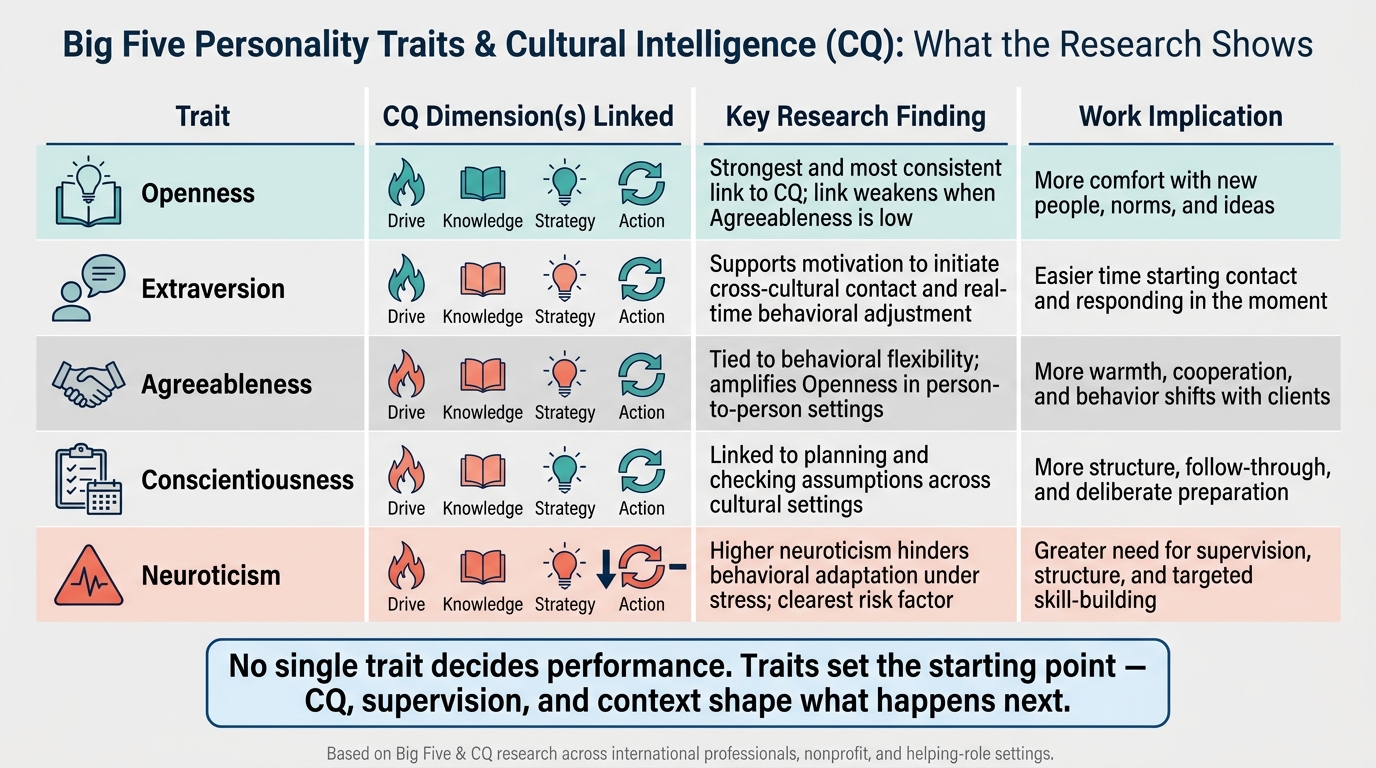
Big Five Personality Traits & Cultural Intelligence (CQ): Research Summary
Big Five and CQ in plain language
The Big Five: five personality dimensions, not labels
The Big Five describes five personality traits on a spectrum. For helping professionals, that means using personality data for better outcomes depends on how traits help or get in the way of client work in different settings. Scores sit on a range. No score is right or wrong, and no one fits neatly into a box[2]. Trait scores show patterns in how a person tends to think, feel, and act. They do not lock anyone into fixed behavior.
| Big Five Trait | Higher scores tend toward... | Lower scores tend toward... |
|---|---|---|
| Openness | Curiosity, creative thinking | Preference for familiar routines |
| Conscientiousness | Dependability, structure | Less structure, more spontaneity |
| Extraversion | Social engagement, morale-lifting | Deep focus, independent work |
| Agreeableness | Cooperation, empathy | Directness, skepticism, or pushback |
| Neuroticism | Emotional reactivity, stress sensitivity | Emotional stability, resilience |
So what does this mean in day-to-day work? Traits show a person's default leanings. CQ helps explain how those leanings show up when the people, norms, and expectations around them change from one group to another.
CQ: drive, knowledge, strategy, and action
Cultural intelligence (CQ) is the ability to work well across cultural differences. The good news is that CQ can be learned. Researchers break it into four parts: drive is the motivation to engage; knowledge is understanding cultural differences; strategy is thinking before acting; action is adjusting behavior in real time[1].
In practice, CQ shapes trust, coordination, and how people respond to clients from different backgrounds. It is the difference between having good intentions and knowing how to act on them when the moment gets tricky.
Why personality and CQ should be considered together
Personality shapes default tendencies. CQ shapes adaptation.
Research explains this with a model that treats performance as a mix of traits, skills, and context. In plain English, performance does not come from traits alone. It comes from how traits interact with abilities like CQ and with the setting a person is working in. A helping professional high in Openness may adjust more easily, but someone lower in Openness can still build strong CQ through deliberate effort[1].
Research suggests traits alone do not explain cross-cultural effectiveness. CQ helps turn personality into action that works. Personality sets the starting point, while CQ affects how well someone adjusts.
Big 5 Personality Traits (Easiest Explanation)
What research shows about each Big Five trait and CQ
The pattern isn’t flat. Some traits line up with CQ much more than others.
Openness and Extraversion: curiosity and social initiative often support CQ
Openness has the strongest and most consistent link to CQ. It is the only Big Five trait with a positive relationship to all four CQ dimensions: drive, knowledge, strategy, and action [3]. People who are curious, open to new ideas, and at ease with unfamiliar situations tend to learn across cultural differences, think through those differences, and adjust how they act.
That said, openness doesn’t do all the heavy lifting on its own. It works best when agreeableness is also high. In a study of 244 international professionals, the openness-CQ link became negligible when agreeableness was low [3]. Put simply, curiosity matters, but so does warmth. If someone wants to learn yet struggles in day-to-day interactions, that curiosity may not turn into effective cross-cultural work.
Extraversion also helps, especially with the drive to start cross-cultural contact and the action needed to adjust in live situations [3]. Social confidence can make it easier to start the conversation. But starting the conversation and adapting well are not the same thing. Extraversion can open the door, though careful adjustment still matters.
Agreeableness and Conscientiousness: cooperation and follow-through can strengthen CQ
Agreeableness is tied most closely to the action side of CQ [3]. That makes sense. In real interactions, people who are more cooperative and easy to work with may be better able to shift their behavior when the situation calls for it.
Conscientiousness plays a narrower role. Research links it to the strategy dimension of CQ, which includes planning responses and checking assumptions across cultural settings [3]. In messy or unclear situations, conscientious people often bring order. They’re more likely to pause, think ahead, and avoid running on autopilot.
Neuroticism: stress reactivity is usually a risk factor for CQ
Higher neuroticism is usually linked to lower CQ, especially the action dimension [3]. Under stress, high neuroticism can make behavioral adjustment harder [3][1].
By contrast, low neuroticism is linked to better stress management, workplace adaptability, and decision-making under pressure [1].
Still, high neuroticism should not be treated as disqualifying. That kind of all-or-nothing thinking misses the point. In high-pressure helping roles, it simply means support and supervision matter more. Supervision, structure, and targeted skill-building can reduce the effect of emotional reactivity on day-to-day performance [1].
| Big Five Trait | CQ Dimension(s) Linked | Key Takeaway |
|---|---|---|
| Openness | Drive, Knowledge, Strategy, Action | Strongest overall link; works best when agreeableness is high |
| Extraversion | Drive, Knowledge, Action | Supports contact and action |
| Conscientiousness | Strategy | Supports planning |
| Agreeableness | Action | Supports behavioral flexibility |
| Neuroticism (high) | Action (negative link) | Can hinder adaptation under stress |
These trait-CQ differences matter most in work that depends on trust, coordination, and client contact. That’s where the patterns tend to show up most clearly, especially in trust, team cohesion, and service quality.
How Big Five and CQ affect relationships, teams, and service delivery
Relationships: trust, conflict, and willingness to open up
In early one-on-one interactions, extraversion and agreeableness shape most of the warmth and ease people feel. Of the two, agreeableness has the stronger effect [5]. That matters in helping relationships. When clients feel warmth and ease early on, they may be more willing to open up and stay engaged.
Similar styles can make early interactions feel smoother. But there’s a catch. When both people are low on warmth and cooperation, the relationship often needs more structure and support to stay productive [5]. CQ helps that warmth and flexibility come across well across differences in background and social norms.
The same traits also shape how teams deal with coordination, inclusion, and conflict.
Teams: coordination, inclusion, and multicultural performance
CQ matters here because it helps stop personality differences from turning into cross-cultural friction.
In nonprofit and community-service settings, trait patterns shape how well teams stick together. Agreeableness is a key buffer against interpersonal conflict in group settings [1]. Conscientiousness supports coordination and follow-through, but in roles that depend on close coordination, it works best when paired with agreeableness [1]. In more group-centered settings, cooperation and follow-through tend to matter more than assertiveness alone [1]. CQ helps teams read different communication styles without mistaking them for resistance or poor fit.
Service delivery: client engagement and outcomes
In direct service, these same traits matter even more because they shape whether clients feel understood, respected, and willing to stay engaged.
A 2024 study of cooperative facilitators found that interpersonal relationship quality significantly mediated the effect of extraversion, agreeableness, and conscientiousness on satisfaction outcomes [4]. Put simply, facilitators who used these traits to build stronger relationships got better results. CQ helps staff adjust tone, pacing, and expectations to the client’s cultural context.
Emotional stability also matters in high-pressure service work. It is consistently linked to better stress management and decision-making under pressure in healthcare and other high-stakes environments [1].
Practice applications and tools
How social workers, counselors, coaches, and nonprofit leaders can apply these findings
The next step is to turn these patterns into day-to-day choices. Personality sets the baseline. CQ, supervision, and context shape what happens next. Traits matter, but performance also depends on capabilities like learning agility and the ability to adjust in changing situations [1].
A good place to start is honest self-reflection on your own trait pattern. A counselor who scores lower on extraversion may need to be more deliberate about building rapport at the start of a session. A team leader with higher conscientiousness can lean on structure and follow-through, while also paying attention to how that style comes across in more relationship-centered settings [1].
Staffing choices matter too. When two people who both score low on agreeableness are paired on a case or project, how agreeableness shapes workplace conflict can cause interactions to go badly in a hurry [5]. Supervisors can use that kind of pattern to make better pairing decisions without turning people into labels.
When staff have a hard time in high-change, cross-cultural situations, the answer is skill-building. Supervision can help them build faster learning and more flexible work habits over time [1].
Using Personos to apply Big Five insights in real time
Tools can help move these ideas from theory into the moment. Personos turns these findings into live guidance for hard client and team situations through personality profiles, relationship reports, prompts, and action tracking.
A social worker getting ready for a hard home visit can describe the situation in the chat and get advice shaped to both their own personality profile and the client's. That can include tone, pacing, and how to respond to resistance. This is the TCC model [1] at work: traits, capabilities, and context all taken into account.
Its Dynamic Reports go past single-person profiles. Relationship reports show how two specific people are likely to interact, where friction may show up, and what communication shifts may help. That lines up with the dyadic interaction research: the mix of two people's traits matters just as much as either profile on its own [5]. For teams, group reports surface shared strengths and blind spots that supervisors can use right away.
Prompts give short, useful nudges between sessions, and the ActionBoard turns insight into tasks that can be tracked.
Conclusion: what the studies show overall
Openness, extraversion, agreeableness, and conscientiousness each support different parts of strong communication and performance, while higher neuroticism stands out as the clearest risk factor for coping and decision-making under pressure [1][5]. Traits set the starting point, CQ affects how those traits show up across settings, and supervision and context shape how much they matter in practice.
FAQs
Can CQ be improved with training?
Yes. Cultural intelligence (CQ) can improve over time.
Research shows that CQ can grow through multicultural experiences, education, travel, and focused training or self-awareness programs. Personos helps professionals put those ideas into practice with real-time, personality-aware guidance for work with clients and teams from different backgrounds.
Which trait matters most for client-facing work?
Conscientiousness is the strongest overall predictor of job performance across many kinds of work. It shows up as dependability, persistence, and steady focus on goals, which matter a lot in client-facing roles.
Other traits can matter too, depending on the situation. But conscientiousness often helps people turn interpersonal knowledge into action that works. Tools like Personos can help professionals use these traits more effectively in client interactions.
How should managers use trait scores fairly?
Managers should use trait scores as one input, not as a stand-alone way to judge performance.
A better way to think about traits is this: they’re behavioral resources. Whether they help or hurt depends on two things: what a person can do and what the job asks them to do.
That’s why scores need to be read alongside factors like job design, leadership climate, and role demands. Trait effects can shift based on the setting, especially across innovation, social, and competitive work.
Personos can help here by pairing personality profiles with context-specific guidance, so managers get a read that fits the role instead of a one-size-fits-all view.