Behavioral Data For Team Design: 6 Key Uses
Use behavioral data, kept private, to pair staff, shape roles, tailor supervision, reduce conflict, and streamline onboarding in care teams.
Christian Thomas

Behavioral Data For Team Design: 6 Key Uses
Most team problems are not about workload alone. They are often about fit, stress, and communication. I’d sum this up in one line: behavioral data can help me build teams with fewer clashes, better role fit, and smoother support, if I use it with clear privacy limits.
Here’s the short version:
- I can use behavioral data to pair staff who work well together
- I can use it to shape roles around work style and pressure points
- I can plan supervision based on how someone responds to stress and feedback
- I can spot conflict risks early before they spread
- I can support new hires in the first 30 to 90 days
- I can help cross-program teams work better around the same client
This kind of data usually goes beyond simple type tests. In the article, it points to the Five Factor Model, with 30 traits on an 80-point scale. That means I’m not looking at a label. I’m looking at patterns that may help with team setup and day-to-day support.
But there’s a hard line here: behavioral data should support judgment, not replace it. It should not be used to rank people, punish staff, or make hiring and firing calls. And raw scores should stay private.
| Use | What I’d use it for | What I would not do |
|---|---|---|
| Pairing | Match work styles and stress patterns | Share scores with coworkers |
| Roles | Assign tasks with better fit | Box people into fixed labels |
| Supervision | Adjust check-ins and feedback | Use scores in reviews |
| Conflict | See likely friction points early | Stereotype staff |
| Onboarding | Set training pace and mentor match | Judge long-term fit too fast |
| Cross-program work | Improve coordination | Expose full profiles |
If I’m leading a nonprofit or care team, the article’s main point is simple: use behavioral data as a guide, keep access tight, and turn it into clear actions instead of labels.
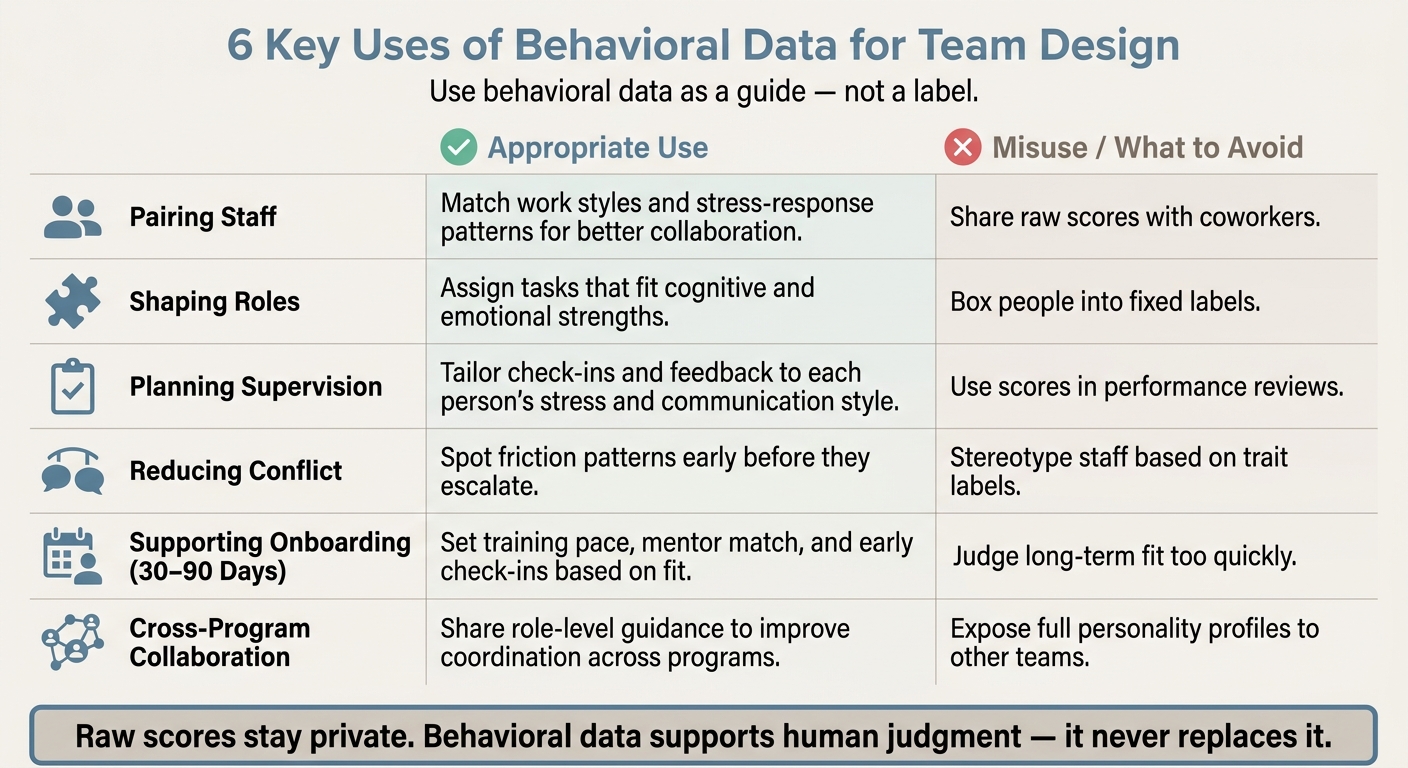
6 Key Uses of Behavioral Data for Team Design: Do's and Don'ts
PI Design Walkthrough: Build Better Teams with Behavioral Data
What Behavioral Data Can and Cannot Tell You
Behavioral data works best when it helps people make better decisions, not when it gets used to box people in.
It brings together validated personality scores with context like job history, goals, values, and working relationships. That extra detail gives teams a better view of how someone tends to work day to day, not just what “type” they are. When you add situational context, the data becomes helpful for role design, supervision, and staff pairings. That matters a lot when you're matching staff who bring different strengths to the same case or program.
What it cannot do matters just as much. Behavioral data should never be used to punish people. Raw trait scores should not be shared with managers or peers, because people without training can read too much into them. The goal is to support human judgment, not substitute for it.
Use the table below to separate sound practice from misuse:
| Appropriate Use | Misuse |
|---|---|
| Identifying communication differences | Ranking staff by scores |
| Planning supervision approach | Justifying disciplinary action |
| Pairing for complementary strengths | Sharing scores with team members |
| Supporting onboarding conversations | Making hiring or firing decisions |
| Reducing conflict before it escalates | Stereotyping based on trait labels |
Staff should also know exactly how their data will be used: for development, not discipline. Ethical platforms hide identity before processing and show only limited insights to authorized users. That helps protect staff trust and makes team-design work much easier.
With those guardrails in place, behavioral data can help pair staff with complementary strengths.
1. Pairing Staff for Complementary Strengths
Once data use stays limited to development, managers can use it to make better staff pairings. In nonprofit and care settings, poor pairings can affect clients directly. Behavioral data gives managers a clearer view of how two people communicate, deal with stress, and work through problems together.
The main point is how two people function as a team, not just what their separate profiles show. Personos treats pairing as a relationship issue, not just a profile-matching exercise.
Pairing choices get better when managers look at personality data alongside program goals, staff history, and client needs. For example, a case manager and an outreach worker may work well together when one brings structure and the other is strong at building rapport with clients. That can make day-to-day service delivery steadier and cut avoidable friction.
Managers should not share raw scores with staff. Instead, they should get shared-fit insights, such as a note that two team members have different communication and stress-response patterns and may need a shared plan before taking on a high-stress case together. The same data can also help clarify who should handle what next.
2. Shaping Roles and Responsibilities
Behavioral data can also help managers shape roles and assign work with more care. After a team is in place, the next step is simple in theory but tricky in practice: deciding who should handle which tasks.
Here, the goal is to match the work to the person best suited for it.
Take a reentry program as an example. If a case manager shows high creativity scores and also handles stress well, a manager could pull that person into designing new client intake processes. Another team member might take on work that better fits a different mix of cognitive and emotional demands. That kind of deliberate assignment helps managers divide work based on what the role actually calls for [1][2].
Managers should get only high-level guidance, not raw scores. That lets them assign work without exposing private data.
Behavioral data works best when paired with job history, program goals, and task demands. Used together, those inputs help managers assign work with more precision. They also make it easier to tailor supervision to each person.
3. Planning Supervision and Support
Once roles are in place, supervision should follow that same fit. Behavioral data can help supervisors tailor check-ins, feedback, and day-to-day guidance to what each person needs. That cuts down on missed check-ins, off-target feedback, and extra escalation.
Signals like stress response, communication style, motivation, and temperament give supervisors a better sense of when to step in and how often to do it. In a shelter or reentry setting, that can look very different from one staff member to the next. One person may do best with scheduled check-ins and clear, specific expectations. Another may respond better to more collaborative feedback.
When supervisors spot a mismatch early, they can ease tension before it starts affecting the rest of the team. That same kind of pattern-matching can also help managers notice conflict before it turns into a bigger issue.
Tools should show only practical guidance and keep personal data protected through masking and HIPAA-compliant handling [2]. Supervisors should not see raw scores directly, and those scores should never be used in performance reviews [2].
4. Reducing Interpersonal Conflict
Team friction often starts with differences people don’t see. One person shuts down under stress. Another gets blunt. Someone else needs time to think before responding. Under pressure, those gaps can turn into conflict fast.
Trait-level behavioral data helps bring the source of that tension into view. Instead of leaning on broad labels, it gives teams a closer look at why two case managers keep missing each other. The issue might come from stress response, communication style, or the way each person deals with pressure.
Once that pattern is visible, managers have something they can use. Context still matters. Values, history, and past friction help explain why certain pairs keep running into the same wall. That matters in reentry programs and social work teams, where even small tensions can affect the people they serve.
With that in mind, managers can adjust how those working relationships are set up. Sometimes that means changing the tone of a hard conversation. Sometimes it’s about timing, message, or who should deliver it. Small shifts like that can keep friction from spreading across the team.
Raw scores should never be shared between colleagues or used to label anyone [2]. The point is to surface only what a manager can act on: clear, practical guidance that helps supervisors step in early. That same awareness can also help new hires sidestep friction before it starts.
5. Supporting New Hires and Onboarding
Once you've cut friction among current staff, the next step is to stop it from showing up during a new hire's first few weeks. The first 30 to 90 days tend to show fit the fastest. A case manager joining a reentry program, for example, brings their own stress response, communication style, and motivation. Those things shape how they step into the team.
If managers look at how a new hire's traits may line up with a supervisor and nearby teammates in the first week, they can make smarter calls about that person's entry into the team. That includes training pace, expectation-setting, and early check-ins. Some people settle in faster with a structured onboarding plan. Others do better with a start that leans more on relationships and trust.
It's also smart to pair new hires with mentors whose communication style is compatible, not identical. That kind of match can cut early friction and help the new hire get steady in a high-pressure setting. It also makes later supervision easier.
Keep raw scores private. Share only high-level guidance that helps with growth and day-to-day support. Those early habits can also help teams work more smoothly across programs.
6. Improving Cross-Program Collaboration
The same fit logic applies when work moves across program lines. This is where behavioral data tends to matter most. If a housing navigator, a mental health case manager, and a peer support specialist are all helping the same client, even small communication gaps can throw service delivery off track. Different programs often work in different ways, and people under stress don't always respond the same way. That friction can make coordination harder.
Cross-program teams need shared, role-level guidance, not full personality profiles.
The fix isn't giving everyone more data. It's sharing less, but sharing the right parts. For example, noting that a staff member shows strong creativity can help a team decide who should lead joint planning, without exposing a full profile. These cross-team fit insights can show where coordination may start to slip before it actually does [2].
Behavioral data also helps teams stay aligned around the same client, not just manage handoffs. When several programs support one client, this kind of data helps staff line up around that client's stress patterns and motivations [1]. That kind of consistency matters most during high-stakes transitions, like discharge planning or crisis response.
One clear guardrail matters here: raw scores stay private [2]. What gets shared across programs should stay limited to actionable guidance, just enough to improve coordination, and not enough to profile another team. That line keeps handoffs practical and helps avoid privacy concerns that can slow collaboration.
Where Tools Like Personos Fit
These team-design uses need a tool that turns trait data into action. A lot of tools squash people into a type, color, or letter. In nonprofits and care settings, that can be a costly mistake because relationship work is part of the job every day. Personos takes a different path. So the tool you pick matters just as much as the data itself.
Personos uses granular trait data instead of type labels. That helps leaders pair staff, shape roles, and plan support in a more grounded way. The point isn't just to describe people. It's to help teams make better day-to-day calls.
Each feature ties back to a team-design job:
- Dynamic Reports show how two people are likely to work together, which helps with pairing and role fit.
- Personos Chat gives real-time guidance for supervision, conflict, and coordination.
- ActionBoard turns those insights into assigned next steps, so progress doesn't slip through the cracks between check-ins.
- Prompts send short, scheduled nudges tied to specific relationships, which helps teams use behavioral data between formal meetings.
Only approved users can see high-level guidance, not raw scores. Personos supports HIPAA-compliant handling of sensitive organizational and client data [2]. Once access is this limited, governance and consent become the next question.
Ethical Considerations for U.S. Nonprofit and Care Teams
Once you've picked a tool, governance is what keeps behavioral data useful and trusted. Ethical use starts before anything gets collected. Staff need to know what’s being gathered, why it’s being gathered, and who can see it. Without that kind of openness, even a helpful tool can chip away at trust.
People should understand how the information will be used before it starts shaping team design decisions. That point matters. In nonprofit and care settings, tools should support working relationships, not take the place of human judgment.
Raw personality scores should stay out of view for managers and peers. Instead, only role-related guidance should appear for people who are allowed to access it. That kind of access control helps teams use the data without sliding into surveillance.
Ethical use also shapes retention in nonprofit and care settings. When handled the right way, behavioral data can cut avoidable friction that adds to burnout and turnover.
Treat behavioral data as a snapshot, not a final label. A low score in one setting doesn’t define someone’s later performance. Revisit the data as roles, stressors, and relationships shift.
Conclusion
Reactive staffing gets expensive fast. Patching coverage gaps, moving people around after conflict starts, and waiting for new hires to find their footing all take time and energy. In nonprofit and care teams, even small staffing issues can spill into client care. A proactive approach to team design helps stop that cycle before it starts.
These six uses show how behavioral data can support team design, not just team labeling. For nonprofit and care leaders, that means practical ways to build steadier teams with less friction.
That said, the upside depends on how the data is used. Behavioral data works best when it's paired with human judgment and clear privacy guardrails. When equity, privacy, and human connection stay at the center, AI can support mission impact instead of pulling attention away from it. And teams don't stand still. As caseloads, stress, and team relationships change, the guidance should change too. Keep coming back to the data as those conditions shift.
FAQs
How is behavioral data collected?
Behavioral data is gathered during onboarding with a short Five Factor Model (FFM) personality assessment that takes about 5 minutes. Users can also share extra context if they want, such as goals, job descriptions, past experiences, and notes.
Personos can change over time by learning from encrypted conversations and searchable chat history. It also keeps memory across personal, relationship, and group levels. Users can add more context by typing "@" for specific relationships or groups, with consent.
Who should have access to team insights?
Team insights should be in the hands of the people doing the work every day in nonprofit and care settings. That includes social workers, nonprofit staff, counselors, coaches, managers, and other leaders who help teams work well together.
Personos can also give clients access to their own custom reports, separate from team-level insights. And when it makes sense, organizations can sponsor seats for those clients.
How often should behavioral data be updated?
Behavioral data should be treated as dynamic, not fixed, if you want it to stay useful.
People change. Teams change too. Working styles shift, relationships evolve, and what was true a few months ago may not hold up today. That’s why behavioral data needs to be tracked on a continuous basis so the guidance stays current.
Tools like Personos can help by providing real-time analysis as team dynamics change.