Balancing Opposing Traits in Team Settings
Turn personality differences into collaboration wins by mapping traits, setting team norms, and using real-time AI support.
Rachel Johnson

Balancing Opposing Traits in Team Settings
Teams are made up of people with very different working styles and personalities. These differences, like introversion vs. extraversion or structured planning vs. flexibility, can either strengthen collaboration or cause conflict if not managed well. Misunderstandings often happen when these traits are misread, leading to poor communication, slower decisions, and frustration.
To address this, tools like the Five Factor Model (FFM) help teams understand personality-driven behaviors and turn potential friction into teamwork and collaboration. Platforms like Personos ($9 per seat/month) use AI to provide real-time advice and personalized strategies for managing these dynamics. Key steps include mapping team traits, creating collaboration agreements, and ensuring psychological safety. When done well, this approach improves productivity and reduces tension, allowing teams to work better together.
| Trait Conflict | Common Misread | Impact |
|---|---|---|
| Extravert vs. Introvert | Introvert seems disengaged | Missed ideas in discussions |
| Planner vs. Spontaneous | Spontaneous seems unreliable | Workflow and deadline tension |
| Risk-Averse vs. Risk-Tolerant | Cautious seems obstructive | Decision-making delays |
Understanding and addressing these dynamics early can turn differences into strengths for any team.
Masterclass: Strategies for Handling Personality Differences at Work
This masterclass builds on our core framework for solving team conflicts with personality insights to create a more cohesive work environment.
Key Trait Conflicts That Disrupt Team Dynamics
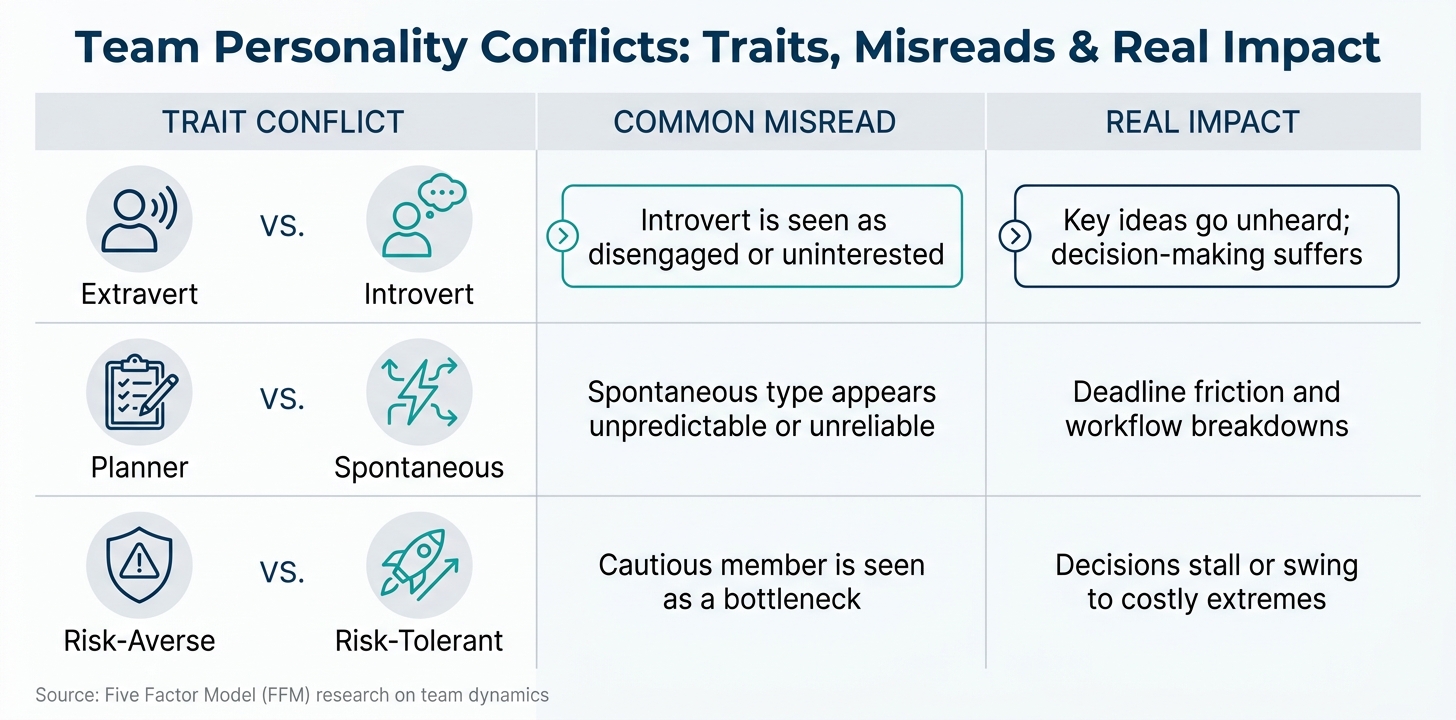
Team Personality Conflicts: Traits, Misreads & Real Impact
While not every personality difference causes problems, certain combinations of traits tend to create tension in team environments. Recognizing common conflict triggers can help leaders address issues before they grow. Below, we explore three common personality pairings that often lead to challenges in collaboration.
Extraverts vs. Introverts
Extraverts often dominate group discussions. They think out loud, jump into conversations quickly, and tend to steer the pace of meetings. Introverts, by contrast, prefer to process their thoughts internally before speaking. As a result, fast-moving discussions can make it harder for introverts to share their ideas.
The real issue lies in how each side interprets the other. Extraverts might see an introvert's silence as disengagement or lack of interest, while introverts may view an extravert's enthusiasm as overpowering or dismissive.
This disconnect can hurt decision-making. When extraverts dominate, teams risk overlooking valuable perspectives. Research highlights the importance of psychological safety - creating an environment where everyone feels comfortable speaking up. Without it, introverts may hold back, and the team loses access to a wealth of insights.
Planners vs. Spontaneous Types
Planners, often high in conscientiousness, thrive on structure. They prefer clear deadlines, defined roles, and predictable workflows. Spontaneous team members, on the other hand, value flexibility and adapt as situations evolve. While both approaches have their strengths, they can clash when working on shared projects.
For example, a planner might create a detailed timeline only to feel frustrated when a spontaneous colleague treats those deadlines as flexible. Meanwhile, the spontaneous team member may feel stifled or micromanaged by rigid processes. These tensions tend to peak at critical moments, like project kickoffs or looming deadlines, when teamwork is essential.
Risk-Averse vs. Risk-Tolerant Team Members
Some team members naturally focus on potential pitfalls, while others are more inclined to chase opportunities. This difference often results in a tug-of-war between caution and ambition. Risk-averse individuals may delay decisions to thoroughly evaluate potential problems, while risk-tolerant teammates push for quick action.
These opposing viewpoints frequently surface during strategic planning or major decisions. A risk-tolerant member might see their cautious counterpart as a roadblock, while the risk-averse individual might perceive their bold colleague as reckless. If left unchecked, this dynamic can either stall progress or lead to hasty, costly mistakes.
Summary Table of Conflicts
| Trait Conflict | Common Misread | Real Impact |
|---|---|---|
| Extravert vs. Introvert | Introvert seems disengaged | Key ideas go unheard |
| Planner vs. Spontaneous | Spontaneous type appears unpredictable | Deadline and workflow friction |
| Risk-Averse vs. Risk-Tolerant | Cautious member seems like a bottleneck | Decision-making stalls or swings to extremes |
Understanding these dynamics is the first step toward managing them effectively. This sets the stage for exploring personality-based strategies to improve collaboration.
Why Opposing Traits Escalate Into Team Problems
personality differences don’t automatically lead to conflict. What often turns minor differences into major issues are misinterpretations, unclear roles, and a lack of psychological safety within the team.
Misreading Trait-Driven Behaviors
Sometimes, even well-meaning actions can be misunderstood. For example, someone who pushes for quick decisions might be labeled as reckless, while another who insists on following processes could be seen as inflexible. These misinterpretations often lead to unnecessary tension. As Marc H. Anderson points out:
"Conflict is a ubiquitous feature of groups in organizations that clearly affects group performance." [1]
When teams lack a shared understanding of each other’s intentions, they tend to assume the worst. This highlights the importance of fostering an environment where team members can better understand each other’s behaviors and intentions.
The Role of Psychological Safety
Even when people recognize that conflicts stem from personality differences, they often stay silent. Why? Because they don’t feel safe bringing up their concerns. When team members feel judged for being "too cautious" or "too impulsive", they may disengage, avoid collaboration, or hold back their ideas. This not only stifles creativity but also prevents the team from benefiting from diverse perspectives.
Leaders play a critical role here. By validating different working styles and encouraging open discussions about team dynamics, they can create an atmosphere where concerns are addressed before they escalate. Psychological safety, in this context, is key to ensuring that small misunderstandings don’t grow into larger, unresolved conflicts.
Poor Role Fit and Unclear Task Design
Unclear roles and poorly designed tasks can make things worse. When responsibilities are vague, or tasks don’t align with individual strengths, personality clashes are more likely to occur. For instance, assigning a spontaneous thinker to handle detailed compliance tasks can lead to frustration for both them and their more detail-oriented colleagues.
On the flip side, aligning roles with individual strengths helps reduce misunderstandings. When tasks are clearly defined and tailored to fit different working styles, team members are less likely to see each other’s differences as problems. Not only does this improve team harmony, but it also boosts productivity by leveraging everyone’s unique strengths.
How to Manage Opposing Traits in Your Team
Handling conflicts within a team requires practical strategies that address the root causes of tension.
Using the Five Factor Model to Map Team Dynamics
To better understand personality conflicts, the Five Factor Model (FFM) can help pinpoint the traits driving specific behaviors. This approach shifts the focus from labeling someone as "difficult" to understanding the underlying characteristics influencing their actions. By identifying these traits, you can turn potential friction into opportunities for collaboration.
For instance, pairing individuals with complementary traits can boost teamwork. Someone who scores high in Openness (imaginative and idea-driven) often pairs well with someone strong in Conscientiousness (methodical and detail-oriented). A real-world example comes from ButterflyMX, a company specializing in access control technology. They aligned roles based on traits - placing extroverts in client-facing positions and assigning detail-oriented employees to quality assurance. The result? Noticeable improvements in productivity.
Tools like Personos simplify this process. Personos generates Dynamic Reports that provide insights at individual, relationship, and group levels. These reports not only highlight personal traits but also reveal how team members interact and where conflicts might emerge.
Setting Up Team Collaboration Agreements
Once you've mapped out your team's personality traits, the next step is creating collaboration agreements. These agreements go beyond generic mission statements - they directly address points of friction with practical solutions.
"The goal is not to eliminate personality friction. The goal is to make it visible, understand where it lives, and build structures that convert destructive friction into productive tension." [2]
For example, in teams with both assertive and reserved members, a turn-taking system during meetings ensures everyone has a chance to contribute, not just the most vocal participants. Collecting written input or using anonymous feedback tools can also help quieter team members share their ideas.
These agreements should be tailored to the specific dynamics within your team. Generic rules often miss the mark, but targeted strategies can address the real issues at play. And when conflicts arise despite these agreements, real-time AI tools can provide immediate, actionable support.
Using AI Tools for Real-Time Support
Even with clear norms in place, real-time AI tools can help reinforce collaboration. Studies show that teams with diverse personality traits are 66% more likely to exceed their goals when those differences are actively managed.
While traditional tools like DISC or Hogan provide static personality assessments, Personos offers AI-driven, adaptive solutions. Its conversational AI chat allows managers to address conflicts quickly with personalized, trait-based advice. The platform also includes an ActionBoard, which helps teams turn insights into actionable steps, ensuring problems are resolved effectively.
At just $9 per seat per month, Personos is far more affordable than traditional personality assessments, which can cost $250 or more per person. One success story involved a community outreach coordinator who saw a 45% reduction in team turnover within six months by using Personos to address underlying team dynamics. This demonstrates how understanding personality traits can lead to measurable improvements in team performance.
Conclusion: Building Better Teams Through Trait Awareness
Understanding personality traits can turn team differences into an advantage. Instead of allowing opposing traits to create friction, leaders can use these differences to strengthen collaboration. Research shows that effectively managing diverse personality traits can significantly enhance a team's overall success.
The focus should be on preventing conflicts before they arise. By regularly evaluating their team's personality dynamics - using tools like the Five Factor Model - leaders can identify and address potential tension points early. For example, studies highlight that teams with higher averages in Conscientiousness and Agreeableness tend to perform more consistently and harmoniously over time, provided there aren't major disparities in those traits among team members [3]. This kind of proactive strategy helps create an environment where team members feel psychologically safe and motivated to improve together.
"Personality is cited as the most accurate predictor of job performance." - Ozer and Benet [3]
Psychological safety is a game-changer for team performance, boosting results by up to 10 times. Achieving this requires intentional efforts, such as establishing clear structures, fostering open communication, and using tools that go beyond guesswork to provide actionable insights.
Platforms like Personos make this process scalable and practical. Unlike traditional assessments, Personos offers real-time, adaptable insights that evolve with your team’s needs - at an accessible cost. For teams aiming to turn personality understanding into tangible results, it’s a straightforward step toward meaningful progress.
FAQs
How can I identify trait conflicts early?
Keeping an eye on how teams communicate and interact can reveal a lot about workplace harmony. Tools like Personos take this a step further by analyzing workplace data - think email tone or how often someone speaks up in meetings. This helps identify shifts in sentiment or potential mismatches before they turn into bigger problems.
Sure, manual methods like regular feedback sessions are helpful, but they can miss the finer details. That’s where Personos shines. It generates dynamic reports and sends real-time alerts, offering tailored recommendations to tackle personality clashes and enhance team collaboration proactively.
What meeting rules help introverts speak up?
Providing introverts with a platform to contribute starts with preparation. Share meeting agendas and materials 24–48 hours in advance so they have time to gather their thoughts. During the meeting, create space by pausing for about 10 seconds after asking questions - this allows everyone, especially introverts, to process and respond.
To ensure balanced participation, try structured approaches like round-robin sharing, where everyone gets a turn to speak, or 1-2-4-All, a method that gradually expands group discussions. Additionally, offering shared documents for asynchronous input can ease the pressure of speaking on the spot and create a more inclusive environment. These small adjustments can make a big difference in encouraging quieter voices to be heard.
When should we use an AI tool like Personos?
When dealing with tricky interpersonal dynamics, managing personality-driven conflicts, or improving teamwork, an AI tool like Personos can be a game-changer. It's especially useful for leaders, managers, and professionals who value insights backed by data. You can use it for real-time coaching during critical conversations, identifying sources of tension within a team, or brainstorming potential solutions for tough interactions. Just remember to pair the AI’s suggestions with your own judgment and maintain open, honest communication.