Applications of Multimodal Emotion Analysis in Counseling
Multimodal emotion analysis reveals hidden client distress, improves therapeutic alignment, and reshapes crisis care.
Rachel Johnson

Applications of Multimodal Emotion Analysis in Counseling
Multimodal emotion analysis combines data from speech, facial expressions, and physiological signals to better understand emotions. In counseling, this approach bridges gaps between what clients say and how they feel, offering insights that improve crisis detection, communication, and long-term outcomes. Tools like Personos integrate personality data and real-time feedback to support both clients and therapists while addressing ethical considerations like privacy and bias.
Key takeaways:
- Crisis Detection: AI identifies risks like suicidal ideation through text, audio, and behavioral signals.
- Therapeutic Communication: Real-time feedback helps counselors align with client emotions.
- Long-Term Monitoring: Tracks emotional trends and reduces practitioner burnout.
- Ethical Practices: Ensures privacy and addresses biases in emotion recognition.
Platforms like Personos make these tools accessible, offering features like client personality dynamics and between-session support for $9/month per seat. These advancements help therapists focus on meaningful client interactions while improving care quality.
He Built an AI Model That Can Decode Your Emotions - Ep 19. with Alan Cowen
Applications for Crisis Detection and Risk Assessment
In crisis situations, counselors often need quick and accurate insights to intervene effectively. Multimodal emotion analysis is stepping in to meet this need by analyzing text, speech, and behavioral signals simultaneously. This approach helps identify risks early, supporting three key applications in crisis intervention.
Suicide and Self-Harm Risk Monitoring
Clients in distress don’t always openly communicate their suicidal thoughts. By combining text and audio analysis, hidden risks can be uncovered more effectively. Text-based models, in particular, excel at detecting high-risk ideation due to their ability to pick up on explicit details such as suicidal plans, which are often embedded in written or spoken words.
A study conducted by the Hangzhou Psychological Support Hotline at Hangzhou Seventh People's Hospital highlights this advantage. Researchers analyzed 1,057 calls made between January 2022 and December 2023, with 526 identified as high-risk. Using a deep learning framework with GPT embeddings, they achieved an impressive 80.48% F1 score in identifying high-risk calls. The model had a recall rate of 88.69% for suicidal ideation, meaning it missed fewer than 12% of high-risk cases. In comparison, audio-based models like Wav2Vec 2.0 and Whisper performed less effectively, with only a 63.7% F1 score for emotional state classification and weaker detection of specific markers like suicide plans [5]. While text models excel, acoustic cues - such as slower speech or lower pitch - can still provide valuable context for identifying withdrawal.
Real-Time Escalation and Client Routing
In crisis scenarios, speed is critical. Large Language Models (LLMs) like GPT-4o and DeepSeek-R1 are now being used as real-time assistants, analyzing calls, labeling risks, and providing clinically informed explanations [5].
"LLMs could act as a vital 'co-pilot' for hotline operators, helping to prioritize urgent calls, though further research is needed to address clinical safety and reliability prior to real-world deployment." - Rao et al., PLOS Digital Health [5]
For telehealth and crisis hotlines, this means AI can assist in routing the most urgent calls to senior clinicians or emergency responders. These systems also generate natural language explanations, allowing human operators to validate the AI’s reasoning before taking action. This combination of rapid detection and personalized insights ensures that high-risk cases are handled with precision and care.
Adding Personality Insights to Crisis Signals
Detecting crisis signals is just the beginning - understanding a client’s personality adds valuable context for tailoring interventions. By integrating emotion data with personality profiles, counselors can move beyond generic responses to provide more personalized support. For example, a client high in neuroticism and low in agreeableness may require a completely different approach than someone who is conscientious but emotionally reserved. Emotion analysis identifies the issue, while personality context helps explain the underlying dynamics.
Platforms like Personos bring this capability to life. Built on the Five Factor Model, Personos Chat offers real-time, personality-specific guidance to counselors during high-pressure moments. It suggests communication strategies tailored to how each client processes stress and support.
"When you're navigating a client in crisis, de-escalating conflict, or making placement decisions that change lives, Personos Chat is always there with real-time guidance tailored to each individual and situation." - Personos for Nonprofits [4]
Priced at $9/month per seat, Personos Pro makes these advanced tools accessible to nonprofits and under-resourced agencies. These organizations often handle the most challenging cases but lack the infrastructure to provide consistent support [6].
Building Trust and Strengthening Therapeutic Alliances
Trust is at the heart of effective counseling. Beyond recognizing immediate crises, understanding how clients engage over time is essential for building strong therapeutic relationships. Multimodal emotion analysis is reshaping how counselors identify and address engagement gaps, especially when working with clients who are hesitant, guarded, or from underserved communities.
Real-Time Feedback on Client Engagement
Modern emotion analysis systems go beyond tracking client emotions - they assess the quality of the interaction itself. These systems identify "misalignment moments", which occur when a client displays significant distress, but the counselor's response doesn't align with the emotional intensity of the situation [1].
For example, a phrase like "That sounds difficult" can have vastly different effects depending on tone. Delivered with warmth and genuine empathy, it can foster connection. But with a flat or indifferent tone, the same words might feel dismissive. Automated prosody analysis can detect these subtle differences in real time, providing counselors with feedback they might otherwise miss [1].
This technology is especially important for marginalized populations. A 2026 pilot study involving primary care patients - 83% of whom were Black - revealed a striking disconnect: 75% of participants who reported positive communication experiences actually displayed nonverbal cues of distress, disappointment, or confusion during audiovisual analysis [3]. Researchers noted:
"Nonverbal expressions aligned with self-reports for negative experiences but contradicted self-reports for positive experiences, highlighting the need for providers to be mindful of social desirability bias and patient-provider power imbalances." - Yaara Zisman-Ilani, MA, PhD, Temple University [3]
This shows how clients, particularly those from underserved communities, may verbally say they are fine while their nonverbal cues tell a different story. Emotion analysis tools help counselors see beyond surface-level responses, offering insights that pave the way for more meaningful interactions.
Improving Counselor Communication Strategies
Recognizing that a client is disengaged is just the first step - what matters next is how a counselor responds. This is where sentiment and prosody analysis tools move from observation to action, offering practical guidance.
Advanced tools like Whisper-large-v3 analyze counselor audio, tracking behaviors such as reflective listening, empathic validation, and vocal warmth. These systems are remarkably accurate, achieving a macro-F1 score of 0.91 in identifying provider behaviors - on par with trained human evaluators [1].
"Recognition of client emotional states represents only one component of therapeutic interaction. The subsequent phase involves assessing whether provider responses effectively address identified emotional states through coordinated verbal and nonverbal communication." - Saahithi Mallarapu et al., Northeastern University [1]
By offering clear, actionable feedback rather than vague suggestions, these tools empower counselors to refine their communication techniques over time.
Personality-Based Trust-Building Strategies
Taking it a step further, integrating personality data adds another layer to building trust. While emotion analysis reveals how a client feels, personality insights help counselors understand why they might react in certain ways and what communication strategies are most effective. Together, these tools provide a clearer path forward, especially with clients who are resistant or guarded.
Platforms like Personos address this challenge head-on. Using the Five Factor Model and 30 personality traits, Personos generates Relationship Reports that highlight potential friction points and tailored communication strategies. For instance, a client who scores low in openness and high in neuroticism requires a vastly different approach than someone who is highly agreeable but emotionally avoidant. Personos Chat provides real-time, situation-specific guidance during or between sessions, drawing on these personality profiles and any case notes the counselor has added.
"Learn exactly how to establish trust and communicate effectively with resistant or guarded individuals." - Personos.ai [4]
Additionally, the platform's ActionBoard allows counselors to assign small, trackable tasks to clients between sessions. This keeps clients engaged outside of therapy and creates a visible record of progress. At just $9/month per seat, it's a cost-effective solution for nonprofits and community agencies serving high-need populations with limited budgets.
Long-Term Monitoring and Outcome Tracking
After addressing immediate crises and fostering trust, long-term monitoring provides a clearer picture of a client’s progress over time.
Tracking Client Emotional Trends Over Time
One-off assessments can’t capture the full story of a client’s journey. A study from April 2026 by Sentio University analyzed 751 telehealth psychotherapy sessions using an open-source BERT-based model to track client distress over time. The AI-generated sentiment scores showed a moderate correlation with the Outcome Questionnaire 45 (OQ-45): r = -0.31 for overall scores and r = -0.34 for the Symptom Distress subscale [7]. The system also flags "Red alert" cases - clients whose emotional trends suggest a high risk of dropping out [7].
"The verbal sentiment measured from session transcripts is more objective than the self-reported questionnaire instruments that are widely used in clinical practice." - Sentio University [7]
This approach not only helps tailor treatment plans but also reduces the mental strain on practitioners.
Reducing Burnout for Practitioners
Burnout is a serious issue for behavioral health professionals. A staggering 80% of workers in this field report burnout, making it the top obstacle to hiring and retaining staff in nonprofit organizations [6]. Managing heavy caseloads, documenting sessions, and staying emotionally engaged with clients can feel overwhelming without proper support.
Personos steps in to ease this burden by automating documentation and providing real-time, personality-specific guidance. Instead of replaying sessions in their minds, counselors receive immediate, actionable advice. This streamlining of routine tasks not only lightens the load but also enhances the overall effectiveness of therapy.
"With Personos, I no longer feel the burden of solving my client's problems. Instead, I walk beside them as they discover their own solutions. It significantly transforms practitioner support." - Steve Huff, PhD, 30-year social work veteran [6]
Personos also includes resources specifically designed for practitioners, addressing challenges like empathy fatigue, boundary management, and decision-making under pressure. By prioritizing counselor well-being, these tools ensure that practitioners can continue to provide high-quality care.
Between-Session Support Tools for Clients
The work of personal growth doesn’t stop when a session ends, but support often does. AI tools can bridge this gap, keeping clients engaged and motivated between sessions.
Personos offers features like the ActionBoard and Personos Prompts, which combine task tracking with personalized nudges to help clients stay on track with their goals outside of therapy [4]. Priced at $9/month per seat, this tool is an affordable option for nonprofits and community organizations, ensuring even resource-limited groups can provide continuous support to their clients.
Choosing the Right Tools for Counseling Applications
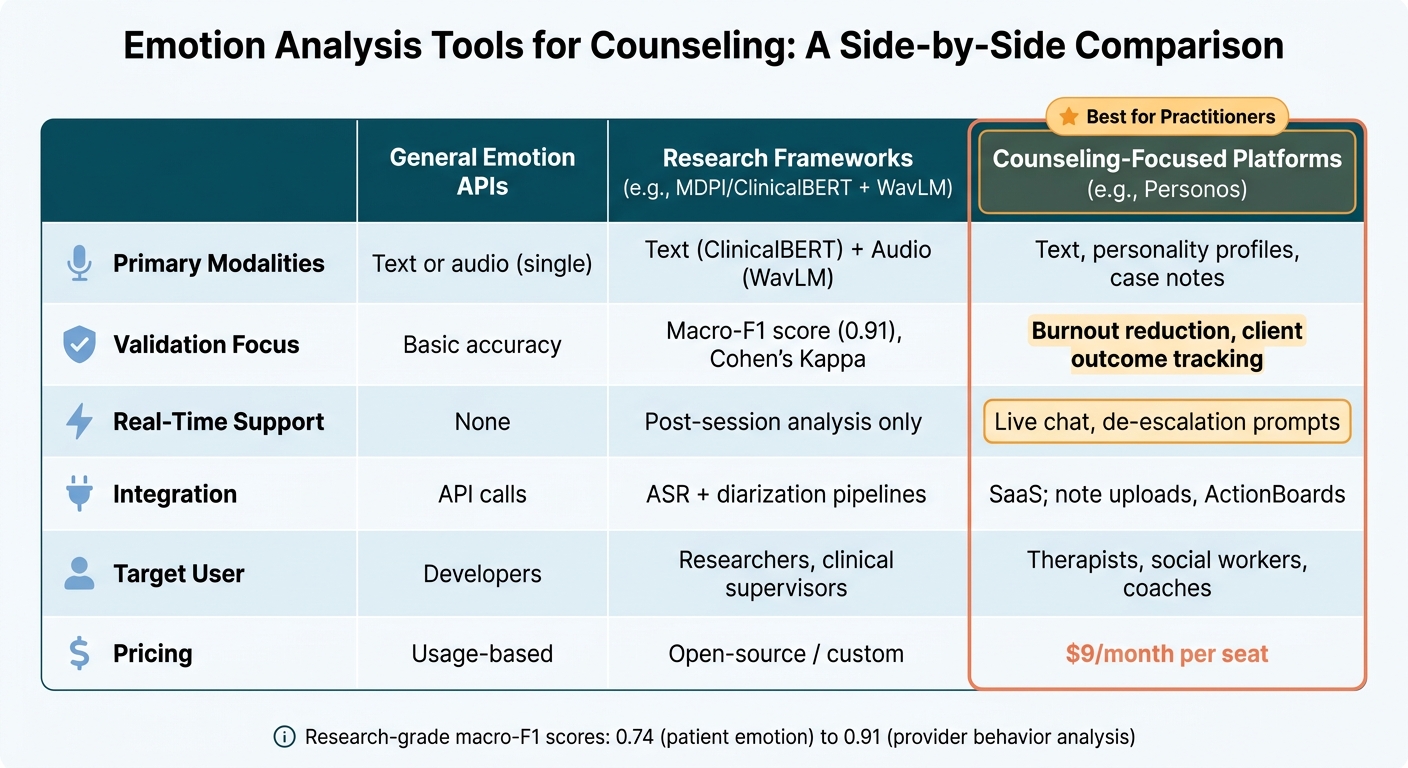
Emotion Analysis Tools for Counseling: Feature Comparison
When it comes to counseling, having the right tools is essential - especially when real-time emotion analysis is involved. The tools you choose can make a big difference in how effectively you support clients.
Key Criteria for Evaluating Tools
Not every emotion analysis tool is suitable for clinical use. Before selecting a platform, there are a few critical factors to keep in mind.
Clinical validation should be your first priority. Tools that rely on macro-F1 scores and Cohen's kappa - rather than simple accuracy rates - are better equipped to identify rare but vital signals, such as crisis markers or therapeutic ruptures. These situations often involve severe class imbalances in counseling data, and even tools boasting 90% accuracy may fail to catch them.
Domain specificity is another key consideration. Tools trained on general datasets often fall short in clinical settings. Ensure the platform has been fine-tuned with counseling-specific datasets, like CounselChat or HOPE, to ensure it delivers relevant and reliable insights.
Lastly, think about privacy compliance and configurability. Look for features like data masking, encrypted conversations, and a "no training" policy to protect client data from being used to improve the vendor’s global models. Additionally, tools that allow you to upload your own case notes and clinical approaches ensure the platform aligns with your therapeutic framework.
Comparison of Available Tools
Emotion analysis tools can be grouped into three main categories: general emotion APIs, research-grade frameworks, and counseling-focused platforms. Each serves a different purpose and caters to unique needs.
- General emotion APIs: These are quick to integrate and work well for basic tasks, like customer sentiment analysis. However, they’re limited to single modalities (text or audio) and lack the depth needed for nuanced therapeutic work. They’re best for basic screening but not much else.
- Research-grade frameworks: Systems like those detailed in the MDPI Computers Journal are technically advanced. They combine tools like ClinicalBERT for text and WavLM for audio, achieving a macro-F1 of 0.74 for patient emotion recognition and up to 0.91 in controlled settings for analyzing provider behavior. However, they require complex setups, including speaker diarization, automatic speech recognition (ASR), and Python environments. These are more suited to researchers and supervisors, not everyday practitioners.
- Counseling-focused platforms: Platforms like Personos are tailored specifically for therapists and social workers. Instead of just providing raw data, they offer personality-driven insights based on the Five Factor Model. Features like real-time chat, Dynamic Reports, and ActionBoard are designed for managing active caseloads, making them highly practical for day-to-day use.
| Feature | General Emotion APIs | Research Frameworks (e.g., MDPI) | Personos |
|---|---|---|---|
| Primary Modalities | Text or audio (single) | Text (ClinicalBERT) + Audio (WavLM) [1] | Text, personality profiles, case notes [8] |
| Validation Focus | Basic accuracy | Macro-F1, Cohen's Kappa [1] | Burnout reduction, client outcome tracking [4] |
| Real-Time Support | None | Post-session analysis only [1] | Live chat, de-escalation prompts [8] |
| Integration | API calls | ASR + diarization pipelines [1] | SaaS; note uploads, ActionBoards [6] |
| Target User | Developers | Researchers, clinical supervisors [1] | Therapists, social workers, coaches [9] |
| Pricing | Usage-based | Open-source / custom | $9/month per seat [6] |
"Recognition of client emotional states represents only one component of therapeutic interaction. The subsequent phase involves assessing whether provider responses effectively address identified emotional states through coordinated verbal and nonverbal communication." - Saahithi Mallarapu et al., MDPI Computers Journal [1]
Integration and Training Considerations
Even the most advanced tool won’t work if it doesn’t fit into your workflow. Research-grade frameworks often demand significant technical resources, such as ASR pipelines, speaker diarization systems, and staff capable of managing per-class threshold optimization for rare signals. While this may be feasible for large health systems or universities, it’s impractical for smaller organizations.
For most counseling teams, SaaS-based platforms are the better choice. Training should focus on workflow alignment - helping staff understand how to upload case notes and therapeutic frameworks so the AI’s recommendations reflect their approach.
"Your session notes, approaches, and goals can be uploaded and woven into every chat response, report, and recommendation so guidance reflects your style." - Personos [8]
Additionally, training should emphasize using reports for reflective practice. Beyond client insights, these tools can help practitioners recognize early signs of empathy fatigue, ensuring they remain effective and supported in their work. Tools that prioritize the well-being of both clients and practitioners tend to have the greatest long-term impact.
The Future of Emotion Analysis in Counseling
Emotion analysis is moving forward at an incredible pace. It’s no longer just about detecting feelings - it’s about using that understanding to drive meaningful interventions. Closed-loop systems are making this possible by continuously sensing a client’s mood, updating personalized models, and providing tailored responses in real time [10]. This shift is setting the stage for a new level of therapeutic responsiveness.
One of the standout advancements is bidirectional modeling, which evaluates both the client’s emotions and the counselor’s reactions. These models have achieved a 72% alignment rate, a major leap compared to earlier methods [1]. They also identify moments of emotional misalignment, offering real-time feedback that was unimaginable just a few years ago.
"Effective counseling requires emotion attunement, namely emotional expressions that are compatible with the client's current emotional state without rigid mirroring." - Jiangnan Yang et al., DELTA Framework [11]
New frameworks like DELTA are pushing the boundaries even further. Tested in February 2026 on the MESC multimodal benchmark, DELTA uses an Emotion Attunement Score (EAS) - a reinforcement learning metric designed to guide responses toward genuine emotional compatibility. When GPT-5.2 integrated DELTA, its counseling quality score rose from 80.07 to 83.41 across areas like Comprehensiveness, Professionalism, and Authenticity [11]. Privacy-conscious tools are also advancing: wearable PPG sensors can now track heart rate variability to identify anxiety in clients who might be hesitant to speak openly. These sensors don’t require audio recordings, which helps maintain trust while improving accuracy [2].
For practitioners, these innovations are more than just technical achievements - they’re practical game changers. Tools like automated session reports and real-time de-escalation prompts reduce the administrative workload that often leads to burnout. Platforms such as Personos tackle this head-on, offering features like personality-aware guidance, an ActionBoard, and Dynamic Reports. At just $9 per seat per month, these tools are affordable even for nonprofits and smaller organizations, providing structured support without increasing workloads.
With these advancements, emotion analysis is poised to transform counseling. By combining real-time insights with personalized tools, these technologies empower counselors to focus on what truly matters - their clients. However, it’s important to view these tools as support systems, not replacements, to enhance the human touch in therapy.
FAQs
How reliable is emotion AI for spotting suicide risk?
Emotion AI holds promise in identifying suicide risks but should serve as a supplement to professional clinical judgment. While AI models can sometimes achieve performance close to that of clinicians in specific tasks, challenges such as ensuring reliability and recognizing nuanced suicidal thoughts remain. Human oversight is indispensable. Tools like Personos provide AI-driven personality insights, aiding in crisis management and fostering trust in critical situations.
Will emotion analysis record or store my therapy sessions?
Whether sessions are recorded varies based on the platform being used. Some tools offer features like transcription and session summaries for progress notes. Others, such as PsyCounAssist, focus on monitoring emotions without recording sessions to maintain confidentiality. Similarly, Personos emphasizes privacy by using encrypted interactions and adhering to responsible data management practices. Make sure to discuss with your counselor how your data is handled, what is collected, and the specific storage policies in place.
How do personality insights change counseling decisions?
Personality insights empower counselors to align their methods with a client’s natural tendencies, making their approach more engaging and effective. Instead of relying on one-size-fits-all techniques, analyzing behavior and communication styles allows for personalized strategies that resonate better with each individual.
Tools like Personos offer real-time, personality-focused guidance to support critical decisions. Whether it’s de-escalating a crisis or fostering trust, these tools help counselors fine-tune their tone, timing, and techniques, paving the way for meaningful and lasting progress.