Anxious-Avoidant Conflict: Repair After Hard Talks
Counselor-led steps to pause safely, own actions, acknowledge hurt, make one clear request, and track repair between sessions.
Rachel Johnson

Anxious-Avoidant Conflict: Repair After Hard Talks
You don’t have to agree to begin repairing the hurt after an argument. My starting point: pause with a clear return time, own your actions, and acknowledge your partner’s hurt before explaining what you meant.
With a counselor, you can:
- Spot the pursue-withdraw cycle without blaming either partner.
- Make one clear request and schedule a time to revisit the unresolved issue.
- Track 1–2 agreed actions between sessions, without turning follow-up into monitoring.
I’d measure repair by what happens next, not just the apology. <u>Safety comes first:</u> if there are threats, fear, or coercion, seek individual support and safety planning rather than joint repair.
How to Interrupt the Negative Cycle in Anxious-Avoidant Relationships
How the Pursue-Withdraw Cycle Keeps Conflict Unresolved
When repair stalls, the argument can shift from the original issue to when and how to talk about it. Anxious and avoidant responses are patterns, not fixed identities. Someone may pursue in one disagreement and withdraw in another.[15][16] Naming the pattern helps the counselor guide the couple from analysis toward repair.
Map the Cycle Without Blame
With your counselor, trace a recent disagreement: trigger → pursuit → withdrawal → increased alarm → further withdrawal. Describe what each person did and what they intended. Check those intentions rather than assuming questions mean care or silence means rejection.[17][18] This map helps both partners stop reacting only to the other person’s last move.
Separate what each person was trying to protect from how their behavior affected their partner.
| Behavior | Possible protective intention | Harmful impact |
|---|---|---|
| Repeated questions after feeling disconnected | Seeks reassurance or clarity | Can create pressure and make calm discussion harder |
| Silence or leaving without a return time | Seeks relief from overload | Can increase uncertainty and alarm |
| More messages after receiving no response | Tries to restore contact | Can intensify overwhelm |
| Not responding after agreeing to a return time | May seek more time to settle; intent needs checking | Undermines trust in the agreement and delays repair |
Intent matters, but impact still counts. Each person is responsible for their actions, and not all actions are equally safe. A clearly communicated, time-limited pause is different from punitive silence. Seeking reassurance is different from repeated questioning that becomes pressuring or controlling.
Check Safety Before Joint Repair
A counselor should assess safety privately, including whether each partner can disagree without fear. Red flags include blocking exits, controlling money or transportation, sexual coercion, stalking, property destruction, and retaliation after disclosure. This screening helps determine whether joint repair can proceed or needs to pause for individual support. If someone cannot speak freely, working on repair together may increase danger. The person experiencing abuse is not responsible for the abuse.[7][9][10][11]
Work with a domestic-violence advocate on an individual safety plan. Identify safe contacts, transportation, needed medications, and a separate device if communications are monitored. Begin joint repair only when both partners can take part freely and safely. In the United States, contact the National Domestic Violence Hotline at 800-799-SAFE (7233) or call 911 for immediate danger.[6][8][12][13][14]
If both partners can participate safely, move next to specific repair steps.
Steps for Counselor-Guided Repair
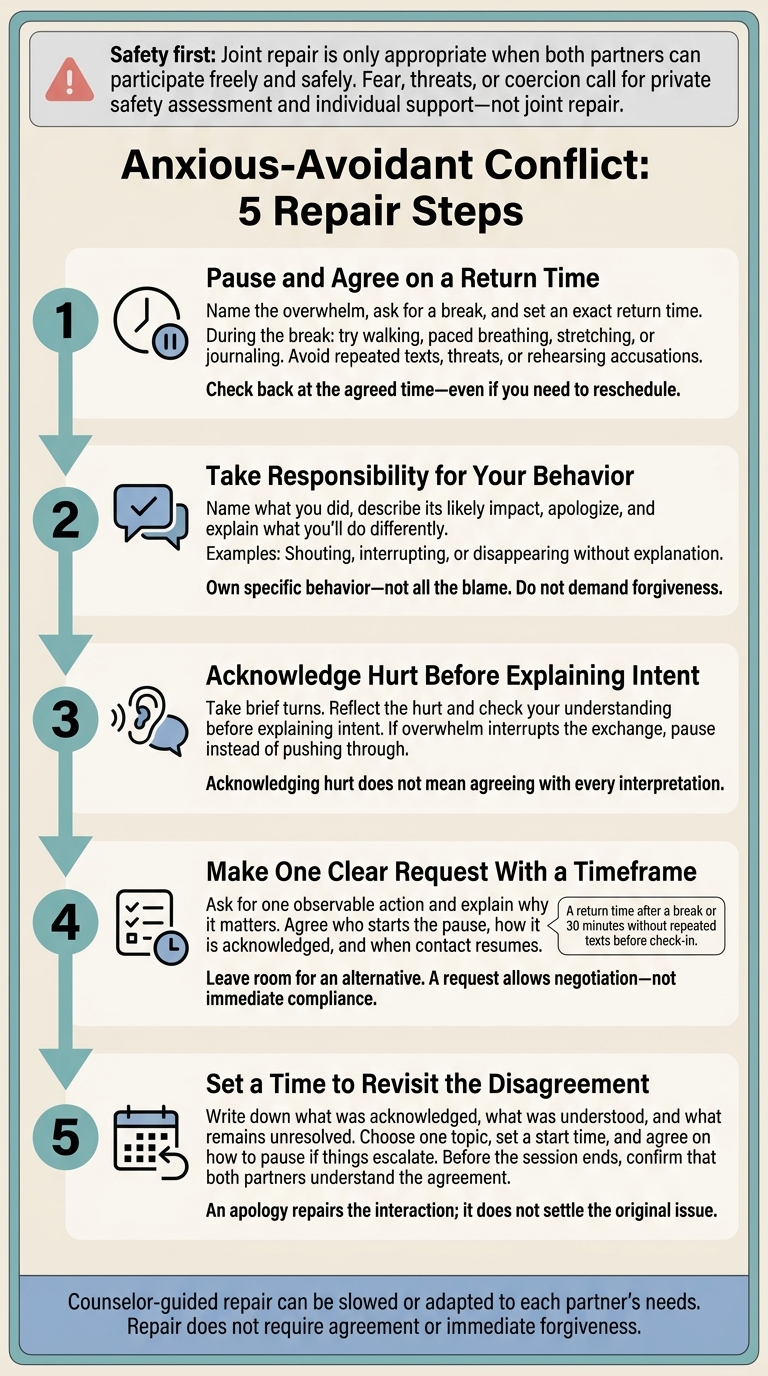
Anxious-Avoidant Conflict: 5 Repair Steps
These steps turn the cycle into a clear repair plan. Each one helps reduce pressure, restore predictability, or lower alarm.
Pause and Agree on a Return Time
Agree ahead of time on how to pause: name the overwhelm, ask for a break, and set an exact return time. During the break, try walking, paced breathing, stretching, or journaling. Avoid repeated texts, threats, or rehearsing accusations.
Check back at the agreed time, even if you need to reschedule. The counselor can model neutral wording and slow the pace to account for trauma history, language access, sensory needs, or language-processing differences.
Take Responsibility for Your Behavior
Name what you did plainly, whether it was shouting, interrupting, or disappearing without explanation. Describe its likely impact, apologize, and explain what you’ll do differently next time.
Accountability means owning specific behavior, not taking all the blame. Each partner may have different responsibilities. Neither has to accept an accusation they believe is inaccurate. The counselor should interrupt counterattacks and keep excuses out of the apology. The partner apologizing cannot demand forgiveness.
Acknowledge Hurt Before Explaining Intent
Give each partner a brief turn to speak. The listener reflects the hurt and checks their understanding before explaining their intent. This can help the pursuing partner feel less alarmed and the withdrawing partner feel less need to defend themselves.
When listening gets difficult, the counselor can model reflection, shorten turns, summarize, or offer written prompts. If trauma activation or overwhelm interrupts the exchange, pause instead of pushing through. Acknowledging hurt does not mean agreeing with every interpretation.
Make One Clear Request With a Timeframe
After taking responsibility and acknowledging hurt, ask for one action the other person can observe:
A return time after a break or 30 minutes without repeated texts before check-in.
Explain why it matters, and leave room for an alternative if the request won’t work. The counselor should confirm who will start the pause, how the other partner will acknowledge it, and when contact will resume. A request allows negotiation. It does not demand immediate compliance.
Set a Time to Revisit the Disagreement
Write down what was acknowledged, what was understood, and what remains unresolved. Then schedule the next check-in so the same unresolved cycle is less likely to restart. Choose one topic, set a start time, and agree on how to pause if the exchange escalates again.
Before the session ends, the counselor should check that both partners understand the agreement. An apology repairs the interaction; it does not settle the original issue. Use the next session to check whether the agreement held between talks.
Follow Through Between Counseling Sessions
A repair plan needs to work outside the session, too. Between sessions, check whether it held up. Give each partner just one or two observable actions, matched to their schedules, living arrangements, culture, technology access, and safety. Agree on one reporting method and one response window. Follow-up should not become monitoring.
Track Agreements and Repair Attempts
With both partners’ consent, record only observable behavior and reported body cues: the trigger, whether a pause was used, whether a return time was set and kept, whether a request was answered, and what changed afterward. Use this record to spot patterns, not assign blame. If written tracking could increase risk, use a private verbal review or clinician-held notes instead.
Set Limits When Conflict Escalates
Agree on clear rules for ending a conversation when conflict escalates. These include threats of leaving used to control the other person, retaliation, intimidation, repeated pursuit during a pause, or disappearing without a return plan.
Decide what each person will do next, such as moving to a safer space or contacting someone they trust. Fear or coercive control calls for a private safety assessment, not more communication homework.
Review What Worked and What Did Not
At the next session, review one successful repair and one missed agreement without blame. Name the barrier, change one part of the plan, and rehearse the step that failed. Persistent boundary violations, fear, or retaliation should prompt a reassessment of joint counseling.
Consider Personos for Practitioner Support
For practitioners handling these follow-up tasks, Personos can help organize reminders and track agreed actions. Its chat, Dynamic Reports, Prompts, and ActionBoard can support communication plans and pattern review. It is not therapy and does not replace counseling, safety assessment, crisis care, or clinical judgment.
Conclusion: Repair Takes Repeated Follow-Through
Repair gets tested after the session ends. Ending a conversation doesn’t mean you’ve repaired an unresolved argument. Name the cycle without blame. If you pause, set a time to return. Then come back, take responsibility for your behavior, acknowledge the hurt, and make one clear request with a timeframe.
Measure repair by what happens between sessions, not by how smoothly the conversation went. If fear or coercion is present, put individual support and safety planning ahead of joint repair.
Repair doesn’t require agreement or immediate forgiveness. It requires a more dependable way to reconnect.
FAQs
What if my partner won’t revisit an unresolved argument?
If your partner won’t return to an unresolved argument, Personos can help you understand the personality dynamics behind their withdrawal [1][2]. Its private, context-aware relationship profile offers tailored ways to communicate with a guarded partner and rebuild trust [1][3].
Unlike tools that offer fixed advice, Personos uses the scientifically validated Five Factor Model and your relationship history to guide you toward working together in your specific situation [1][4][5].
How can we rebuild trust after repeated failed repairs?
Rebuilding trust after failed repairs starts with adjusting how you communicate to fit each person’s personality, including how they process emotions and respond to feedback.
Personos, an AI-powered platform for helping professionals, uses the Five Factor Model to provide real-time, research-based guidance. It helps professionals tailor communication, work through resistance, and build rapport to support repair between difficult sessions.
How do I distinguish overwhelm from punitive silence?
The key difference is why someone shuts down: Is it a response to stress, or a deliberate choice to withdraw and exert control? How they process conflict can help you tell the difference.
Personos, an AI-powered personality psychology platform based on the Five Factor Model, uses personality data and context to give practitioners tailored guidance. It helps them examine what’s behind the silence and how to respond effectively.