AI Tools for Trust-Building in Team Dynamics
AI personality tools analyze behavior and communication to reduce conflict, boost trust, and improve team collaboration and productivity.
Christian Thomas

AI Tools for Trust-Building in Team Dynamics
AI is reshaping how teams build trust and collaborate. From reducing workplace conflicts by 50% to improving communication effectiveness by 40%, AI-driven personality tools are helping teams work smarter, not harder. These tools analyze personality traits, communication styles, and behavioral patterns to provide real-time insights, allowing team members to better understand and connect with each other.
Key takeaways:
- AI tools like Personos use personality profiling to guide communication and prevent misunderstandings.
- Human-AI teams are 60% more productive and generate 70% more outputs compared to human-only teams.
- AI excels at supporting "low potential" teams, improving coordination and outcomes significantly.
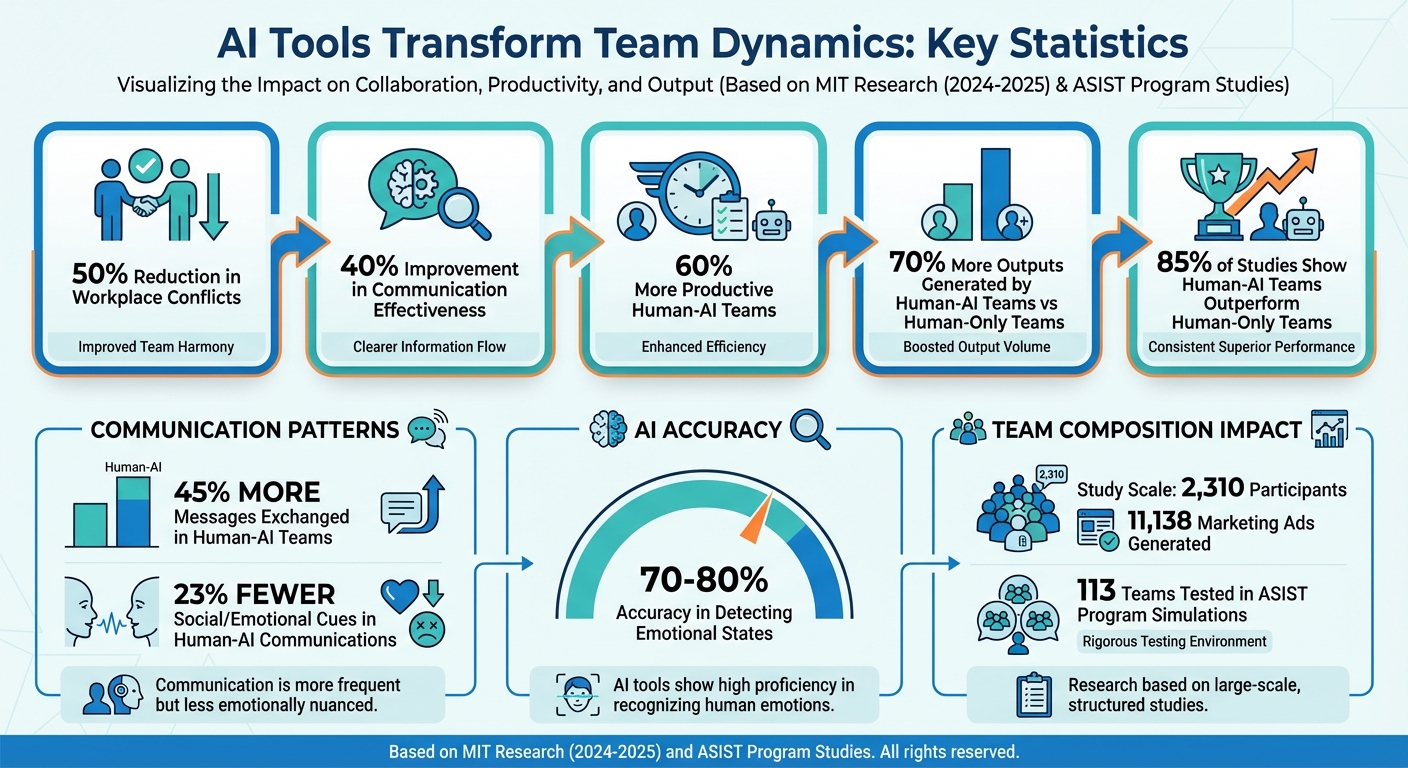
AI Impact on Team Performance: Key Statistics and Benefits
How AI-Powered Personality Tools Work
AI Personality Profiling Explained
AI-driven personality tools analyze communication and behavior by processing various data sources. These systems rely on advanced models like BERT to interpret text from messages, emails, and chats. They focus on identifying patterns that correspond to the Big Five personality traits: Openness, Conscientiousness, Extraversion, Agreeableness, and Neuroticism [1][3].
Beyond text, these tools also monitor behavioral cues such as keystroke dynamics, edit history, and even physiological signals like heart rate or facial expressions. These methods are designed to decode emotional signals [4]. The most advanced systems incorporate Artificial Theory of Mind (AToM), enabling them to infer human mental states based on observable actions [2]. In simpler terms, these AI systems don't just analyze what you say - they aim to understand the reasoning behind your words.
"For AI to be capable of teamwork, it needs to understand the attitudes, behaviors, and cognition humans rely on during collaboration." – Nature, Scientific Reports [2]
A notable example of this technology in action comes from an October 2024 study by MIT researchers Harang Ju and Sinan Aral. Using the MindMeld platform, they conducted a large-scale experiment with 2,310 participants, generating 11,138 marketing ads by randomizing AI personality traits through GPT-4o. The study showed that speech affect detection systems could identify emotional states with an impressive 70% to 80% accuracy, allowing for real-time adjustments during collaborative tasks [1][4].
These detailed personality profiles enable AI tools to align their insights with team goals effectively.
Aligning Personality Insights with Team Goals
Once personality profiles are established, AI tools use this information to enhance team dynamics by aligning traits with specific objectives. This process often involves complementarity matching, where traits are paired to balance strengths and weaknesses. For example, the MIT study found that combining conscientious humans with "Open" AI agents significantly improved the quality of creative outputs. However, some pairings, like extroverted humans working with highly conscientious AI, occasionally led to reduced performance [1].
These systems employ reinforcement learning algorithms to refine their strategies. By tracking "Policy Prediction Errors", they adapt cooperation approaches based on a teammate's reputation and past interactions [5]. Tools like Personos use this method to provide real-time, context-sensitive prompts. These prompts help teams manage conversations more effectively by detecting early signs of tension in communication patterns and suggesting adjustments to tone or timing to prevent conflicts.
A clear distinction is made between taskwork and teamwork. Between 2021 and 2024, the Artificial Social Intelligence for Successful Teams (ASIST) program tested AI agents in simulated urban search and rescue missions with 113 teams. The results were striking: AI advisors provided socially-aware guidance that significantly improved the performance of "low potential" teams, boosting mission outcomes across the board [2].
Research on AI for Team Trust-Building
Human-AI Team Trust Studies
Research shows that human-AI teams function quite differently from traditional human-only groups. For instance, in March 2025, MIT researchers Harang Ju and Sinan Aral conducted a large-scale experiment involving 2,310 participants on the MindMeld platform. Their findings revealed that human-AI teams exchanged 45% more messages than human-only teams. However, these messages included 23% fewer social or emotional cues[1]. This shift allowed team members to concentrate more on creating content rather than spending time on relationship-building.
Interestingly, 85% of studies found that human-AI teams outperformed human-only teams. Specifically, in the MIT experiment, human-AI teams generated 70% more outputs per individual compared to their human-only counterparts[1]. This productivity boost is linked to a reduction in what’s often called the "social coordination tax" - the time and energy spent on maintaining rapport and emotional connections.
Trust within human-AI teams operates under unique dynamics. A 2025 study by Na Chen and Xinyue Zhang from Beijing University of Chemical Technology found that when AI agents omitted critical details, it significantly undermined team trust more than when they used vague language[6]. Teams struggled to identify and address these gaps when key details were missing. However, teams with higher baseline trust were better equipped to handle unclear communication from AI, treating it as a solvable issue rather than a major setback. These findings suggest that tailoring AI communication styles to team dynamics could improve overall performance.
Personality Matching and Team Performance
Building on trust dynamics, matching personality traits between humans and AI provides further insights into team performance. In the MIT MindMeld study, researchers randomized AI personality traits using the Big Five framework. The results were intriguing: conscientious humans paired with "Open" AI agents produced higher-quality visual content. On the other hand, extroverted humans working with conscientious AI agents saw a decline in the quality of both text and images[1].
At an organizational level, these insights were tested in a field experiment conducted at Procter & Gamble in April 2025. Led by Fabrizio Dell'Acqua and colleagues from Harvard and NBER, the study involved 776 professionals and demonstrated how AI could break down organizational silos. AI-enabled individuals matched the performance of entire human-only teams. More importantly, while R&D and commercial professionals typically proposed solutions biased toward their own departments, those collaborating with AI developed balanced, cross-functional recommendations[7].
"AI adoption at scale in knowledge work reshapes not only performance but also how expertise and social connectivity manifest within teams, compelling organizations to rethink the very structure of collaborative work." – Fabrizio Dell'Acqua[7]
Another key finding came from the ASIST program's urban search and rescue simulations conducted between 2021 and 2024. These simulations revealed that AI advisors had the most significant positive impact on "low potential" teams - those with weaker baseline skills. AI disproportionately improved their coordination compared to high-performing teams, highlighting its potential to elevate underperforming groups[2].
How Organizations Use AI for Team Collaboration
AI in Executive Coaching and Conflict Resolution
Organizations are increasingly turning to AI to enhance executive coaching and streamline conflict resolution. Using AI-powered personality tools, leaders and coaches can now craft strategies on the fly, thanks to real-time personality profiles. These tools dive into behavioral patterns, offering insights into how individuals naturally communicate, deal with conflict, and make decisions. This allows for more targeted coaching and faster progress in resolving challenges.
However, even in high-trust teams, missing critical details from AI can disrupt progress. Research highlights the importance of immediate feedback loops to address gaps in data effectively [6]. To counter this, organizations have implemented systems that quickly flag and correct missing information, ensuring smoother collaboration.
AI also plays an active role in monitoring leadership dynamics and managing conflicts. By leveraging advanced cognitive models, AI tools provide tailored advice to address misunderstandings and foster better communication within teams [2]. These situational insights not only help resolve conflicts faster but also reinforce trust, complementing earlier studies on how AI can enhance team interactions.
Case Study: Personos for Team Optimization
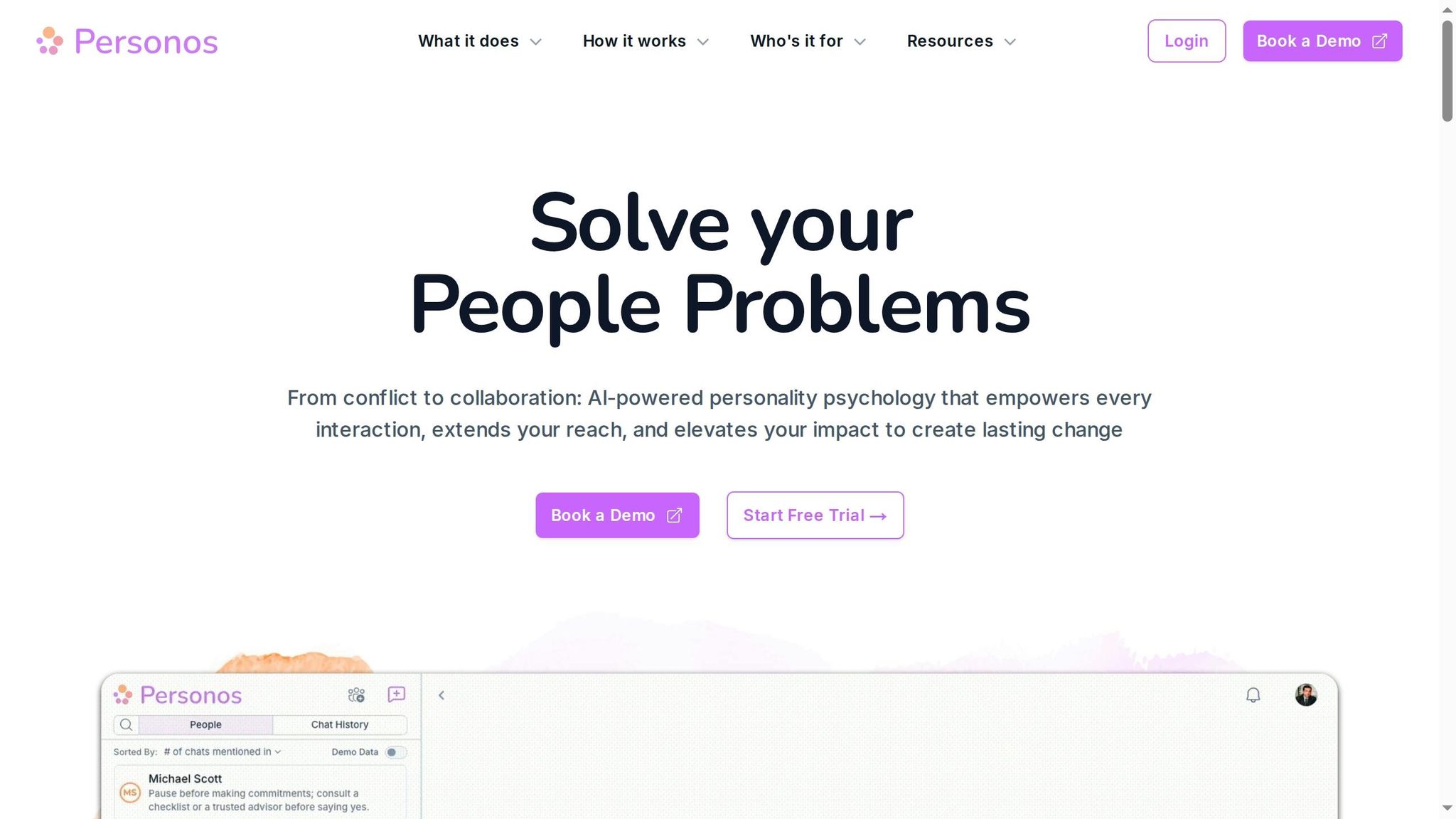
Personos offers a clear example of how AI can transform team collaboration. This platform uses AI-driven personality insights and dynamic reports to optimize team roles and boost teamwork across various industries [8]. Leaders use Personos to match individual strengths with specific roles, improving team chemistry by focusing on traits like social intelligence, communication style, and a collaborative mindset [2][8].
The platform's applications extend beyond traditional business settings. In sports, it helps refine team dynamics; in education, it supports guidance counselors by improving student interactions; and in non-profits, it tackles staff burnout by enhancing community engagement. Personos’ conversational AI provides personalized advice tailored to both individual personalities and the unique challenges teams face. This aligns with research emphasizing the need for AI to have structured, machine-readable data about human collaborators before engaging [2].
sbb-itb-f8fc6bf
The Future of AI in Trust-Building
Key Takeaways for Teams and Leaders
AI is evolving beyond mere efficiency and moving toward fostering deeper interpersonal understanding. The next wave of tools, often referred to as "Relationship AI", leverages personality science - such as the Five-Factor Model - to help individuals better understand one another and rebuild trust through meaningful connections. Rather than replacing human judgment, these systems aim to enhance communication and collaboration.
"AI has made us more efficient in how we work and communicate, but not smarter about how we connect with people. We built Personos to change that, turning personality science into everyday guidance that helps people see and understand one another." - Christian Thomas, CEO and Co-Founder, Personos [9]
This approach paves the way for trust built on clear, actionable insights.
Studies show that transparent AI tools, which explain their recommendations, foster appropriate levels of trust. Teams that understand the reasoning behind AI-driven insights are more likely to embrace them effectively. Leaders should prioritize platforms that offer context-aware coaching, tailoring feedback in real time based on individual personality dynamics instead of relying on one-size-fits-all advice. This aligns with earlier research highlighting the importance of proactive communication and conflict resolution.
What was once reserved for top executives is now accessible to entire teams. Personos, for example, democratizes coaching by making personality-based guidance available across organizations. In November 2025, Steve Huff, PhD, Founder of THRiVE Coaching, incorporated Personos into programs for individuals dealing with terminal illness and trauma. The AI functioned as a "teaching partner", improving communication and addressing challenges more effectively [9].
What's Next: AI's Growing Role in Team Success
Building on current achievements, AI is entering a new phase of innovation. The rise of Artificial Theory of Mind (AToM) represents a significant step forward. These advanced systems are designed to predict human mental states, enabling them to adjust communication styles based on a teammate's personality and knowledge level while understanding the unique dynamics of each interaction.
In a review of over 5,000 studies, researchers found that human-AI teams outperformed human-only groups in 85% of cases [1]. The benefits are especially pronounced for struggling teams. In an analysis of 113 teams, Artificial Social Intelligence advisors improved the performance of "low potential" groups across various mission outcomes [2]. This suggests that AI's greatest strength may lie in helping underperforming teams unlock their potential, regardless of their starting point.
"Personos isn't just technology, it's a teaching partner. A constant criticism of AI is that it makes us dumber. To the contrary, Personos helps make our members smarter about how they communicate." - Steve Huff, PhD, Founder, THRiVE Coaching [9]
The shift from task-based assistance to nuanced, personality-driven teamwork is a game-changer. Organizations should act now to integrate personality-based feedback systems, using AI to tailor how messages are delivered to fit each recipient’s profile. This approach minimizes misunderstandings, resolves conflicts faster, and strengthens team dynamics before issues escalate. The future of AI isn’t about replacing human connection - it’s about enhancing the skills that make us better communicators and collaborators.
Managing Teams to Thrive When Humans + AI Interact: Building Emotional Agility and Trust
FAQs
How can AI personality tools help teams build trust and improve communication?
AI personality tools use advanced machine learning to analyze individual personality traits and offer real-time, tailored communication suggestions. These tools help team members adapt their language and approach to align with their colleagues' preferences, minimizing misunderstandings and encouraging smoother collaboration. For instance, they might recommend rewording a request to suit a teammate’s need for detailed information or focusing on shared goals during a conversation.
Studies indicate that AI-driven communication can boost trust and improve team efficiency. By providing context-aware prompts and actionable insights, these tools make interactions more seamless, strengthen relationships, and keep teams aligned on common objectives. Tools like Personos go even further, combining personality assessments with dynamic coaching, conflict-resolution strategies, and practical advice to ensure every interaction fosters trust and enhances team dynamics.
What challenges might arise when using AI to improve team dynamics?
Integrating AI into team workflows isn’t without its hurdles. One big challenge is the lack of trust in AI systems, especially when employees don’t fully understand how these tools operate. This uncertainty can lead to hesitation or even outright resistance when adopting AI-driven solutions. On top of that, juggling AI-generated suggestions alongside day-to-day responsibilities can add to the mental strain for team members.
Another issue arises when AI tools provide unclear or incomplete information, which can create confusion and disrupt effective communication. This not only undermines trust but can also strain collaboration within teams. Add to this the concerns over data privacy, biases in AI algorithms, and the difficulty of clearly defining AI’s role in workflows, and it’s easy to see why adoption can be a complex process.
To tackle these obstacles, organizations need to prioritize transparency and clear communication about what AI can and cannot do. Building trust is key, and tools that help employees understand AI’s capabilities can make a big difference. For example, platforms like Personos are designed to bridge these gaps by offering real-time personality insights, proactive communication prompts, and dynamic reports. These features not only improve collaboration but also reduce misunderstandings, helping AI become a true partner in team dynamics.
How can teams use AI-driven personality insights to achieve their goals?
AI-powered personality insights can help teams align individual behaviors with shared goals by focusing on three main strategies:
- Link team objectives to specific behaviors: Whether the goal is quicker decision-making or better collaboration, AI tools can analyze personality traits like openness or conscientiousness. This helps pinpoint where team members' natural strengths align with these goals and where slight adjustments could make a noticeable difference.
- Incorporate real-time feedback: AI tools can offer timely suggestions, such as encouraging quieter team members to share their ideas during brainstorming sessions or prompting detail-focused individuals to keep the team updated during a project sprint. By blending these insights into daily routines, teams can build trust and highlight how individual efforts contribute to overall success.
- Review and adapt regularly: Teams can periodically evaluate how well individual traits match shifting goals. AI can help spot gaps and suggest role adjustments when necessary. This ongoing fine-tuning not only boosts performance but also nurtures a culture of trust and collaboration.