AI Tools for Conflict Resolution in Relationships
How AI analyzes communication, detects emotional triggers, and offers real-time, unbiased guidance to defuse conflicts and improve relationship communication.
Rachel Johnson

AI Tools for Conflict Resolution in Relationships
AI tools are changing how we handle conflicts in relationships by offering neutral, real-time support. Unlike waiting for therapy appointments or relying on biased advice, these tools analyze communication patterns, detect emotional triggers, and provide actionable suggestions to improve interactions. Platforms like Personos stand out by using personality-based insights to guide couples and teams through disputes with tailored advice.
Key Points:
- AI identifies harmful language (e.g., "you always") and suggests neutral alternatives.
- Tools like Personos use personality assessments to provide customized feedback.
- Features include real-time coaching, communication prompts, and group dynamics analysis.
- Predictive analytics detect early signs of tension, such as sentiment shifts or delayed responses.
- AI mediators ensure unbiased summaries and promote better communication habits.
Cost: AI tools like Personos are affordable, starting at $9 per user/month, compared to costly therapy sessions.
AI doesn't replace human judgment but supports better decision-making and communication. Whether you're managing personal relationships or workplace dynamics, these tools simplify conflict resolution, helping you communicate more effectively and avoid escalation.
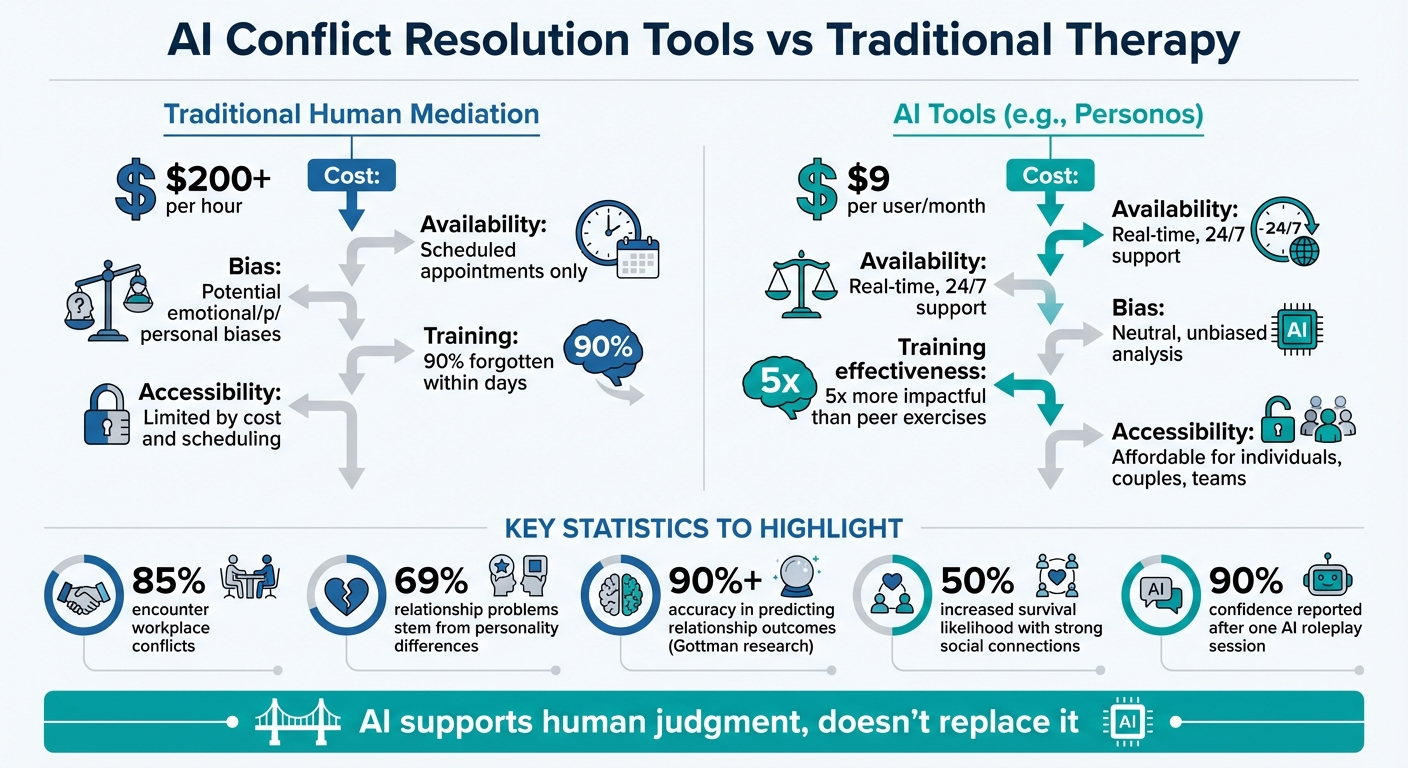
AI Conflict Resolution Tools vs Traditional Therapy: Cost and Effectiveness Comparison
AI-Powered Conflict Resolution: Enhancing Communication & Understanding in Relationships
Personos: AI-Powered Conflict Resolution
Personos is built on the Five-Factor Model of personality psychology, creating profiles that highlight each individual's communication style and emotional triggers. By focusing on personality-based insights, it delivers guidance tailored to your unique circumstances rather than relying on generic solutions.
A quick personality assessment unlocks a dashboard filled with dynamic reports and practical insights. With its AI-driven conversational interface, Personos offers real-time support during moments of tension, providing context-specific prompts to help you communicate with empathy. Here's a closer look at how it works:
"Personos gives people the confidence to communicate with empathy, not just efficiency." - Nick Blasi, Co-Founder and COO, Personos [7]
Core Features
Personos combines tools like conversational coaching, personality reports, communication prompts, group dynamics analysis, and task tracking to help you navigate conflicts effectively. Its conversational interface acts as a real-time coach, offering feedback during tough conversations. Personality reports provide detailed insights into individual traits, while communication prompts suggest adjustments to align with the other person's style. For teams or couples, group dynamics analysis pinpoints potential friction areas early, helping to prevent conflicts before they escalate. Together, these features create a dynamic framework for resolving disputes.
How It Resolves Conflicts
By leveraging personality insights, Personos helps prevent misunderstandings from spiraling into larger issues. For example, understanding that one person prefers direct communication while another needs time to process emotions allows you to adapt your approach, reducing impulsive reactions and fostering trust through consistent, empathetic interactions.
Executive leadership coach Mike Walker, who incorporates Personos into his practice, highlights its transformative impact:
"Personos helps clients organize often overwhelming amounts of mental and physical information to make better, creative, more informed decisions that incorporate their values and preferences, as well as those with whom they are interacting." [7]
This method provides a safe environment to practice challenging conversations, offering immediate feedback that reinforces effective communication strategies.
Pricing
Personos Pro is priced at $9 per seat per month, making it accessible for individuals, couples, and organizations. Whether you're part of a nonprofit, an educational institution, or a business aiming to enhance team dynamics, this pricing model ensures affordability. Coaches and therapists can use it to extend their support between sessions, while couples can gain access to professional-grade personality insights without the ongoing expenses of therapy.
Predictive Analytics for Preventing Conflicts
Building on AI's ability to assist in real-time, predictive analytics takes things a step further by identifying potential conflicts before they escalate. By analyzing digital communication, AI can pick up on early signs of tension. A key tool in this process is sentiment analysis, which evaluates the emotional tone of messages to determine if they convey anger, sadness, or neutrality.
But it doesn’t stop at sentiment. These systems can identify unusual communication patterns, such as sudden delays in response times, which might indicate stonewalling or emotional withdrawal [8]. They also flag language that shifts from addressing specific actions to attacking someone’s character. For example, phrases like "you are obnoxious" instead of "your arriving late caused the meeting to overrun" are clear markers of potential conflict [4].
Dr. John Gottman’s groundbreaking research revealed that specific communication patterns can predict relationship outcomes with over 90% accuracy [8]. Today, AI tools are trained to recognize these same patterns in digital conversations, providing an opportunity for early intervention.
Why Early Detection Matters
Spotting conflict in its early stages can prevent minor misunderstandings from spiraling into major issues. When AI identifies rising tension, it gives you the chance to adjust your communication approach before things escalate. This is crucial because studies show that strong interpersonal skills are closely linked to long-term mental health and success [4].
"The ability to communicate in a way that transforms conflict and interpersonal differences into opportunities for connection and understanding is a skill that everyone can learn."
– Anne Hsu and Divya Chaudhary, Queen Mary University of London [4]
Early detection also reduces cognitive overload. Emotional stress can cloud judgment, leading to impulsive decisions that strain relationships. AI helps by simplifying complex emotional cues, allowing you to respond thoughtfully instead of reacting defensively [3]. Addressing issues like blame-shifting or negative framing as they arise strengthens communication habits, improving every interaction. These predictive tools work hand-in-hand with AI-driven mediation, creating a comprehensive system for fostering relationship stability and growth.
sbb-itb-f8fc6bf
AI Mediation and Coaching Tools
Unbiased AI Mediation
AI mediators bring consistent neutrality to the table, avoiding the pitfalls of bias or emotional fatigue [9][6]. This reliability creates an environment where both partners can express themselves freely, without fear of favoritism or judgment.
With asynchronous communication, each person can share their perspective privately and without interruptions. This approach minimizes power struggles and ensures confidentiality [9][5][10]. Once both sides have provided their input, the system generates objective summaries that clearly present each viewpoint. These summaries help couples see each other's perspectives without the emotional filter of defensiveness [9].
Additionally, these tools promote the use of Relationship-Preserving Language by identifying and flagging judgmental phrases. For example, if a message says, "you're obnoxious", the AI might suggest a more neutral alternative like, "when you arrived late, the meeting ran over" [4]. Research indicates that this method reduces the desire for retaliation and shortens the time negative memories linger [4].
This neutral mediation sets the stage for the next step: building proactive communication skills.
Scenario Training and Feedback
AI coaching tools offer a safe space to practice de-escalation techniques. Features like "Message Makeovers" allow users to rephrase hypothetical judgmental statements into more diplomatic ones [4]. This hands-on exercise helps users develop communication habits that prevent conflicts from spiraling out of control.
In a 2023 study, every participant revised their messages until the AI deemed them acceptable, using the system's feedback as a guide [4]. The AI evaluates your communication style in real time, pointing out problematic language and suggesting empathetic alternatives. Tools like Personos take it a step further by analyzing your unique conflict patterns and tailoring feedback to provide personalized insights [1][2].
How to Implement AI Conflict Resolution Tools
Integration Steps
Start by choosing an AI tool that aligns with your needs. For example, Personos offers personality insights at a reasonable cost [12]. You can refer to the Personos pricing details mentioned earlier for budget-friendly options.
Next, establish clear ethical guidelines. These should focus on protecting data privacy, ensuring transparency in how analyses are conducted, and regularly checking for biases [11]. As Jeff Seul, a lecturer at Harvard Law School, emphasizes:
"AI must be positioned as a support to human judgment, not a replacement for the nuanced cultural, historical context, and live human empathy that a peace process would demand" [13].
It's also crucial to train all users on the tool's capabilities and limitations. While AI can be excellent at spotting patterns and suggesting neutral language, it lacks the human touch - like empathy and cultural sensitivity - that's essential in conflict resolution [13]. A "human-in-the-loop" approach works best, where AI provides insights but final decisions rest with people [11][16].
Regular calibration checks are another must. AI tools can misinterpret emotional nuances or carry biases from their training data. By scheduling periodic reviews, you can ensure the system stays aligned with your values and delivers fair recommendations [11]. Considering that 85% of employees encounter workplace conflicts [11], these checks are especially critical when scaling such tools for larger teams.
Once the tool is integrated, focus on tracking outcomes, as outlined in the next section.
Tracking Results
Success in conflict resolution isn’t about eliminating disagreements entirely - it’s about improving communication. Research highlights that 69% of relationship problems stem from fundamental personality differences and are often unsolvable [15]. The aim is to manage these differences constructively, fostering healthier dialogue.
Keep an eye on behavioral changes. Look for signs like increased use of "I" statements, effective repair attempts (e.g., "I hear you"), and progress from gridlocked arguments to productive discussions [15]. Another key indicator is whether both sides clearly express their positions before attempting persuasion, which reflects healthy conflict management [15].
Leverage Natural Language Processing (NLP) to monitor shifts in sentiment and flag early signs of tension [11]. Tools like Personos can assist by generating dynamic personality reports and offering proactive communication prompts tailored to specific relationships or teams.
Finally, evaluate practical outcomes. These might include improved satisfaction levels, faster conflict resolution, and reduced manual work in managing disputes [12][14]. For workplace settings, track engagement levels and whether team members feel their voices are heard during discussions. In personal relationships, assess whether partners are successfully using strategies like 15–20 minute self-soothing breaks during heated moments and following through on healing requests made during AI-supported sessions [15].
Conclusion
AI tools are transforming the way we approach conflict resolution by offering solutions that are both accessible and cost-effective. Traditional human mediation can cost upwards of $200 per hour[5], but platforms like Personos provide actionable insights for just $9 per seat per month. These tools remove the emotional and personal biases that often derail face-to-face disputes, creating a space where both sides can feel genuinely heard. This affordability not only lowers financial barriers but also encourages better communication habits.
But there’s more to it than just saving money. AI tools also help sharpen communication skills through low-pressure practice sessions. Studies show that 90% of traditional training is forgotten within days, while AI roleplay tools can deliver learning outcomes five times more impactful than peer-to-peer exercises[17]. Many users report feeling more confident after just one session, with these skills easily translating to real-world situations. Clinical psychologist Harvey Lieberman highlights this shift:
"AI is already helping people think, cope, and connect. These tools are beginning to function as prosthetic relationships - not replacing intimacy, but supporting the emotional and cognitive work it requires."[18]
The benefits don't stop at immediate skill-building. Improved communication fosters long-term relationship stability. Data shows that strong social connections can increase the likelihood of survival by 50% over an average of 7.5 years[19]. By leveraging AI for tasks like conflict prevention, real-time sentiment analysis, and proactive communication prompts, tools like Personos help individuals and partners address underlying tensions before they escalate. Whether it’s practicing a tough conversation or monitoring behavioral trends over time, AI brings the structure and neutrality needed for healthier, more productive interactions.
As discussed earlier, AI-driven personality insights and unbiased mediation strategies can lead to more constructive conversations. However, it’s crucial to remember that AI is a tool designed to support - not replace - human judgment. When used thoughtfully, with ethical guidelines, regular updates, and a human-in-the-loop approach, these tools empower people to communicate better, resolve conflicts faster, and ultimately build stronger, more meaningful relationships.
FAQs
How does Personos use AI to fairly resolve conflicts in relationships?
Personos uses the well-established Five-Factor Model of personality to guide conflict resolution. By relying on this scientifically backed framework, it delivers personalized insights and recommendations that cater to the specific traits and dynamics of each relationship.
To keep the process fair and unbiased, Personos incorporates regular human oversight and detailed audits of its AI systems. This ensures the analysis stays precise, balanced, and relevant to real-life relationship challenges, giving you the tools to address conflicts with confidence and understanding.
What are the main advantages of using AI tools for resolving relationship conflicts compared to traditional methods?
AI tools bring a fresh approach to resolving relationship conflicts by delivering real-time, personalized insights that go beyond what traditional methods typically offer. By analyzing language, tone, and personality cues, these tools can identify signs of tension early and provide immediate, data-backed suggestions to enhance communication and manage emotions more effectively.
Take platforms like Personos, for example. They use personality psychology to offer tailored advice and proactive prompts, enabling partners to adapt their communication styles on the fly. Unlike traditional approaches, AI tools are available 24/7, offering consistent and unbiased support without the need to schedule appointments. This unique blend of instant feedback, customization, and round-the-clock accessibility positions AI as a quicker and more adaptable option for addressing and resolving conflicts.
How can AI tools use predictive analytics to prevent conflicts in relationships?
AI tools leverage predictive analytics to detect early signs of potential conflict by analyzing communication patterns. These patterns might include tone, response times, or repeated language that signals tension. By identifying these subtle indicators, AI can offer proactive suggestions - like rephrasing a message, adjusting timing, or taking a brief pause - to help de-escalate situations before they turn into larger issues.
Platforms like Personos take this concept even further by integrating communication data with detailed personality profiles. This allows the AI to predict potential clashes based on personality traits and provide tailored advice. For example, it might suggest that an extroverted team member take a step back during discussions with an introverted colleague. These personalized insights not only help prevent misunderstandings but also promote smoother communication and stronger collaboration, ultimately boosting team morale and productivity.