AI Tools for Building Adaptive Leadership Skills
Four AI tools that offer real-time coaching, behavioral insights, and predictive analytics to build adaptive leadership and stronger team dynamics.
Nick Blasi

AI Tools for Building Adaptive Leadership Skills
In a fast-changing, AI-driven workplace, leaders need to master flexibility, resilience, and continuous learning. Traditional methods like static workshops no longer suffice. AI tools are stepping in to help leaders make faster decisions, improve team collaboration, and prepare for disruptions. Here’s a quick overview of four tools designed to sharpen leadership skills:
- Personos: Offers personality-based coaching for better communication and team dynamics.
- Flowprofiler: Focuses on behavioral insights, helping leaders perform effectively under pressure.
- Splunk Adaptive AI: Combines operational data with leadership insights to predict challenges and guide decisions.
- Situational: Delivers real-time, context-aware advice for handling urgent decisions and team interactions.
Each tool targets specific areas like emotional intelligence, decision-making, and scenario planning, making leadership development an ongoing, embedded process. Businesses using these tools report improved leadership confidence, faster decision-making, and stronger team cohesion.
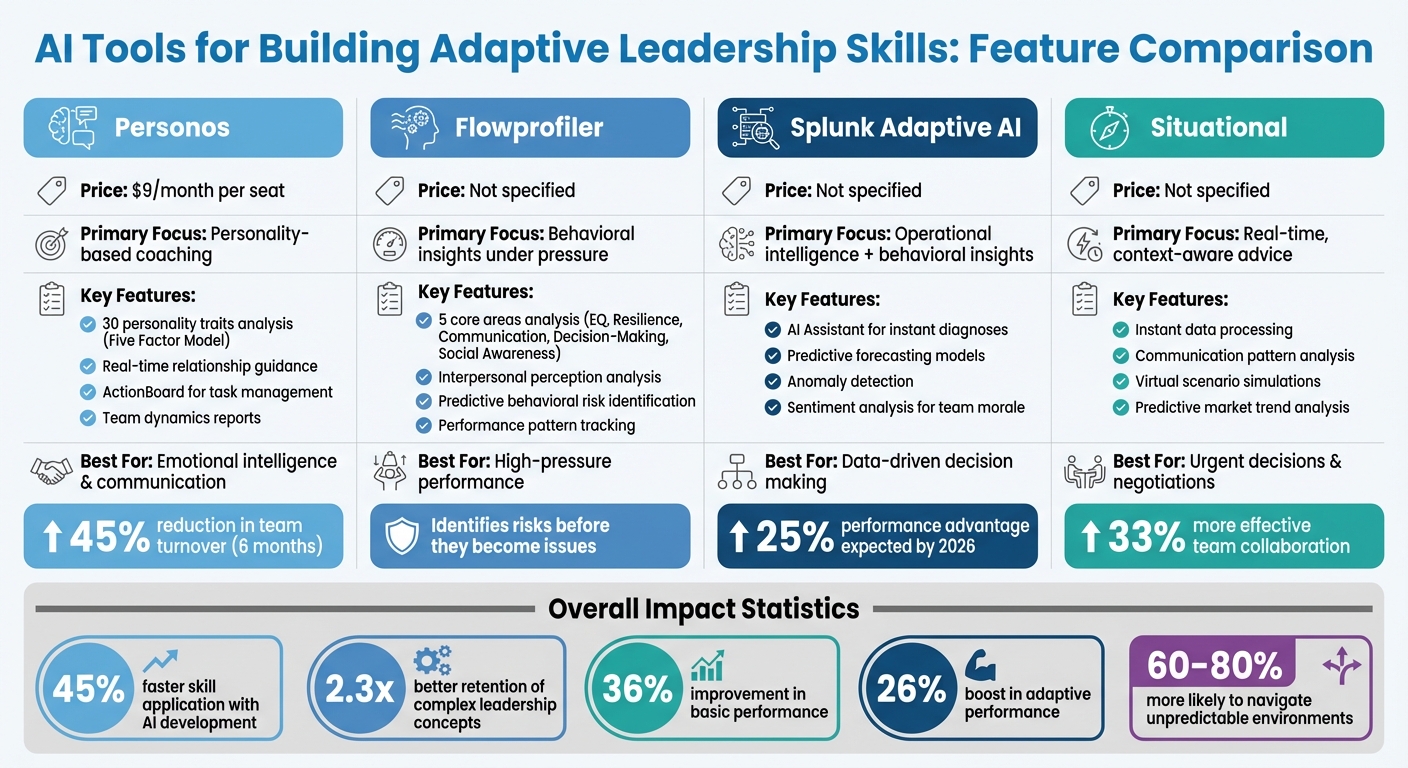
Comparison of 4 AI Leadership Development Tools: Features and Capabilities
1. Personos
Real-time insights
Personos provides instant, personality-driven advice through conversational AI, designed to help leaders navigate high-pressure situations effectively. By combining personality profiles with situational context, the platform delivers personalized recommendations that feel both timely and precise. At its core, it uses the Five Factor Model (FFM) - evaluating 30 personality traits on an 80-point scale - to create highly detailed profiles that reflect individual differences.
Leaders can simply type "@" followed by a team member's name to receive specific, context-aware guidance based on their relationship dynamics. For instance, in a tense team meeting, the AI might suggest: "Adjust your tone - team member X responds better to collaborative language."
"I've coached C-suite executives for 15 years, and Personos changed my practice overnight. It surfaces blind spots I would have taken months to uncover."
- David Kim, PCC and Executive Leadership Coach [8]
This capability doesn’t stop at individual interactions; it extends to team-wide dynamics as well.
Interpersonal dynamics support
Personos also provides relationship and group analysis reports, which help leaders decode team dynamics. By understanding how different personalities interact, leaders can tackle performance challenges and improve team cohesion.
"We reduced team turnover by 45% in six months. Personos helped us understand why certain team dynamics weren't working and gave managers the exact words to fix it."
The platform’s ActionBoard transforms these insights into actionable tasks with just one click, ensuring that guidance translates into measurable outcomes. Leaders can even integrate their own frameworks, tailoring the AI’s feedback to fit their unique management style. Importantly, all conversations remain private and accessible only to the user, fostering a safe environment for tackling sensitive team issues.
Focus on emotional intelligence
Beyond improving team interactions, Personos sharpens leaders’ emotional intelligence. By analyzing personality traits, it offers insights into empathy, emotional regulation, and relationship management - skills that are critical for effective leadership [10]. The platform also provides proactive prompts - short, actionable tips delivered at the right moments - to encourage growth in managing difficult relationships or navigating unpredictable team dynamics.
At just $9 per month per seat, the Pro Plan includes access to Personos Chat, ActionBoard, Dynamic Reports, and Prompts [8]. This pricing makes it an accessible option for organizations looking to develop leaders with stronger interpersonal and adaptive skills.
Lessons in Leadership | Leading with Agility in the Age of AI | October 30, 2025
This session explores how personalized AI feedback is transforming executive coaching and team management.
2. Flowprofiler
Flowprofiler takes leadership to the next level by focusing on real-time behavioral insights. It helps leaders navigate high-pressure situations by quantifying behaviors and offering data-driven feedback. This complements adaptive leadership approaches, enabling faster and more informed decisions during uncertain times.
Real-time insights
Flowprofiler delivers objective evaluations of behavioral tendencies, particularly when traditional methods fall short. It emphasizes how leaders perform under pressure - a key factor during disruptions. By providing a clear analysis of default behaviors, it empowers leaders to make immediate and intentional adjustments [11].
The platform examines five core areas: Emotional Intelligence, Resilience, Communication, Decision-Making, and Social Awareness [11]. These insights ensure leaders avoid falling into outdated patterns, echoing Peter Drucker’s warning: "The greatest danger in times of turbulence is not the turbulence, it is to act with yesterday's logic" [11]. This heightened awareness becomes a powerful tool when conventional strategies fail to deliver.
Interpersonal dynamics support
Effective communication is critical, especially during periods of change. Flowprofiler helps leaders understand how their communication style impacts team engagement. By analyzing interpersonal perceptions - how team members actually interpret their messages - it enables leaders to adjust their approach to maintain trust and morale [11]. This fosters stronger social awareness, revealing perspectives leaders might otherwise miss.
"To have that insight into how people are day to day and under pressure can really help our leaders motivate, manage and set objectives."
With this focus on relationship dynamics, leaders can create environments where teams feel supported and equipped to tackle uncertainty. By understanding team perceptions, leaders can also anticipate and address risks before they escalate.
Predictive capabilities
Flowprofiler doesn’t just explain what went wrong after the fact - it identifies potential behavioral risks before they turn into performance issues. By examining how leadership behaviors shift under increasing complexity, the tool highlights when strengths might be overused [12]. This proactive approach mirrors strategic planning, allowing leaders to stay ahead of challenges rather than reacting to them [12].
3. Splunk Adaptive AI
Splunk Adaptive AI takes leadership to the next level by connecting operational intelligence with behavioral insights. It shifts leaders from merely reacting to issues toward creating proactive strategies. While many tools focus on understanding behavior, Splunk stands out by applying artificial intelligence directly to operational data. This eliminates delays and equips leaders to anticipate disruptions before they affect teams or customers. It’s especially effective for managing distributed systems and tackling complex organizational challenges where traditional methods often fail.
Real-time insights
Splunk’s AI Assistant for Observability provides instant diagnoses and actionable recommendations during critical incidents. For example, during a June 2025 service interruption, a Fortune 500 engineer used the AI Assistant to pinpoint the root cause, suggest fixes, and generate an incident report - all in seconds, requiring only final human approval [13]. This speed transforms crisis management, turning potential disasters into manageable situations.
By processing data locally to minimize latency, Splunk ensures that insights are delivered exactly when they’re needed [14]. This allows leaders to make quick, informed decisions even in uncertain and rapidly changing conditions, helping teams stay on track.
Predictive capabilities
Splunk shifts IT operations from reactive troubleshooting to a predictive intelligence model. By building forecasting models, it helps leaders anticipate demand spikes, detect anomalies, and foresee outages or security issues before they escalate [14].
The platform also uncovers "unknown unknowns" - hidden issues buried within complex logs from distributed systems [14]. This ability to reveal unseen patterns provides leaders with insights they might otherwise miss. Andy Thurai, Field CTO at Splunk, highlights the importance of this approach:
"In an era where every second counts, predictive operations are not just a competitive advantage. They're a survival strategy" [14].
Organizations adopting adaptive AI are expected to outperform their competitors by 25% by 2026 [15]. This predictive layer not only enhances operational decision-making but also strengthens leaders’ ability to navigate interpersonal dynamics effectively.
Focus on emotional intelligence
Splunk also supports leaders in developing self-awareness by analyzing their communication styles and decision-making patterns during meetings [13]. This feedback is crucial, especially since only 10% of leaders can accurately identify their own development needs without external input [13]. Additionally, the system uses sentiment analysis to monitor team morale and engagement in real time [2].
4. Situational
Situational adds another layer of support for leaders, equipping them to handle moments that require immediate action - whether it's resolving team disputes, responding to sudden market changes, or navigating high-pressure negotiations. Instead of focusing on past performance, this tool zeroes in on real-time events, offering actionable, context-aware insights.
Real-time insights
When decisions can’t wait, Situational steps in with the right information at the right time[6][7]. It processes complex data instantly, helping leaders evaluate their options without getting bogged down in analysis. By summarizing key meeting materials and relevant data, the platform allows leaders to concentrate on strategic decisions rather than data crunching[6]. This capability works seamlessly with tools designed to enhance real-time communication, ensuring leaders stay focused on what truly matters.
Interpersonal dynamics support
Navigating tough conversations is easier with Situational’s ability to analyze communication patterns and suggest personality-based language strategies[7]. Whether it’s a performance review or a negotiation, the platform offers tailored guidance that aligns with both the leader’s and the recipient’s communication styles. This not only fosters trust but also strengthens collaboration. Research shows that teams led by adaptable leaders work together 33% more effectively[1].
Predictive capabilities
Situational doesn’t just react - it anticipates. Using predictive analytics, it identifies emerging market trends and flags potential organizational challenges before they escalate[2][5]. Leaders can also engage in virtual simulations to test their responses to various scenarios, helping them prepare for real-world challenges[2]. As Soren Kaplan explains:
"AI can predict potential challenges and organizational shifts by analyzing data trends and historical performance. This allows leaders to be proactive rather than reactive"[2].
Organizations that incorporate AI into their learning strategies are 60% to 80% more likely to navigate unpredictable business environments effectively[16]. This proactive approach gives leaders an edge in managing the complexities of today’s fast-paced world.
Advantages and Disadvantages
Each of the tools discussed earlier brings its own strengths and challenges. Knowing where each platform shines - and where it might fall short - can help decision-makers select the best fit for their needs.
Personos stands out in high-pressure interactions by delivering real-time, personality-focused guidance. Its 30-facet personality mapping enhances self-awareness and customizes communication strategies through the intersection of AI and psychology. That said, its success relies heavily on the quality of the input data and context provided[7].
Flowprofiler focuses on identifying leadership strengths and areas for growth, enabling the creation of tailored coaching plans[2]. It offers a reliable framework for understanding individual differences.
Splunk Adaptive AI excels in predictive analytics, helping forecast market trends and identify potential organizational challenges before they arise[2]. This forward-thinking approach is invaluable for strategic planning. However, its emphasis on data patterns can sometimes overlook emotional and human elements[3].
Situational delivers rapid, context-aware insights, simplifying complex data into actionable advice when quick decisions are needed. Still, relying too much on automation could risk losing the human touch that's crucial in leadership[3]. Interestingly, organizations that incorporate AI development report 45% faster skill application and 2.3x better retention of complex leadership concepts[1].
Conclusion
The tools discussed earlier illuminate a clear path toward mastering adaptive leadership. For high-pressure conversations, Personos stands out by offering real-time, personality-focused insights that help refine your approach on the spot.
Combining human intuition with AI-driven precision can lead to noticeable improvements in leadership outcomes. Research highlights that organizations leveraging this blend experience a 36% improvement in basic performance and a 26% boost in adaptive performance[4]. As the Center for Creative Leadership aptly states:
"Measurement without purpose is just noise. The most sophisticated AI tool isn't useful if it doesn't help leaders change what matters."[17]
When selecting tools, prioritize those that fit seamlessly into your daily routines. Opt for platforms that provide timely support during critical moments - when decisions carry the most weight. Consider whether your organization needs a focused transformation for a few executives or a scalable solution for the whole team.
The urgency of developing adaptive leadership is underscored by key data points[1]. AI-powered tools equip leaders to respond effectively to change, fostering agility and resilience. These technologies enhance your ability to navigate challenges, build trust, and create meaningful progress.
FAQs
Which AI tool is best for my leadership goals?
When it comes to choosing the right AI tool, it all boils down to your leadership goals. If you're looking for personality-driven coaching or need help with conflict resolution, Personos is a standout option. It provides customized insights to improve communication and decision-making within your team.
On the other hand, if your priority is developing adaptive leadership skills, AI frameworks or simulation tools can be incredibly effective. These platforms are designed to help leaders navigate and manage change more effectively.
The key is to align the tool with your objectives - whether that's coaching, scenario-based training, or building trust within your team. Matching the platform to your specific needs ensures a more focused and impactful leadership development experience.
How do I measure ROI from AI leadership tools?
Measuring ROI from AI leadership tools starts with setting clear, outcome-focused metrics. These should align with areas like enhanced leadership effectiveness, better team communication, and improved conflict resolution.
To gauge progress, monitor performance metrics, engagement levels, and the trust of stakeholders. A mix of quantitative data - such as productivity improvements and noticeable behavioral shifts - and qualitative feedback offers a well-rounded perspective on the impact and value these tools bring to the table.
How can we use AI coaching without losing the human touch?
AI coaching serves as a complement to human empathy and judgment, not a substitute. Tools such as Personos offer real-time insights, tailored strategies, and ongoing support between sessions. These features help coaches better prepare for discussions and gain a deeper understanding of their clients' needs.
To keep the human element intact, it's crucial to blend AI-driven insights with authentic empathy and ethical awareness. By letting AI handle tasks like data analysis, coaches can dedicate their energy to building trust and nurturing genuine connections with their clients. This balance ensures that technology enhances the coaching experience without overshadowing the personal touch.