AI Team Personality Study: Key Findings
Use Five Factor data and AI to flag team patterns, improve communication, and prevent burnout—only with consent and privacy.
Nick Blasi

AI Team Personality Study: Key Findings
Here’s the short answer: personality can help teams work better, but only when people use it with context, consent, and good judgment. From what I see in this study, the strongest point is simple: match people’s trait patterns to the work, don’t reduce them to labels, and don’t let AI make people calls on its own.
If you manage a nonprofit team, care staff, or coaching group, this means a few things right away. Five Factor Model data has research behind it, trait mix can help or hurt depending on the job, and AI is most useful when it flags patterns early such as tension, feedback mismatch, or stress buildup. But machine-made personality scores can vary in quality, so I’d treat them as a prompt to look closer, not as proof.
Here’s the article in plain English:
- Personality matters most when it fits the role
- Trait diversity can help problem solving, but it can also add friction
- FFM-based assessments are more grounded than fixed type labels
- AI can spot team patterns fast, but thin data can lead to bad reads
- Raw personality scores should stay private
- Managers should get action steps, not trait labels
- Consent, access limits, and clear use rules are a must
- Context-aware tools are safer than generic behavior-guessing tools
Using personality insights to strengthen coaching and team performance
Quick Comparison
| Option | Main input | What I’d use it for | Main risk |
|---|---|---|---|
| FFM self-report | Survey answers | Personal insight and team discussion | People may shape answers |
| Human-rated review | Observation and interviews | Added human context | Bias and hard scaling |
| AI-inferred scoring | Behavior or language patterns | Early pattern flags | Uneven accuracy |
| Context-aware platform | FFM data plus team context | Day-to-day guidance | Needs clear privacy rules |
One stat stands out to me: the FFM looks at 30 traits on an 80-point scale, which gives a much more detailed picture than simple type systems. That level of detail can help, but only if you use it to guide communication, role fit, and conflict handling, not to box people in.
My takeaway: use personality data to shape personality-based feedback, meetings, and team support. Use AI to point out patterns. Keep private data private.
What Research Says About Team Personality and Performance
For managers, the main issue isn’t whether personality matters. It’s when it changes how a team performs. Personality tends to matter most when it lines up with the work itself, the people on the team, and the setting around them. The FFM measures personality across 30 traits on an 80-point scale, which gives leaders more detail than preset personality labels [1]. Even then, context still shapes whether a trait helps the team or gets in the way [1].
Traits Most Often Linked to Stronger Team Outcomes
The clearest pattern is trait-task fit, not broad team averages. In plain English, the goal is to use a person’s trait strengths for the right kind of work instead of leaning on the whole team’s average profile [1]. In nonprofits, care teams, and coaching settings, that can mean matching people to roles based on communication style, decision-making approach, and how they deal with conflict, not just general performance scores.
When Trait Diversity Helps and When It Creates Friction
Trait diversity can help with creativity and problem solving, but it can also slow a team down [1][2]. A common sticking point is a mismatch in communication styles. One person may want direct, fast exchanges, while another may need more discussion and processing time. These patterns are much easier to deal with when the team names them early.
What Managers Should Not Oversimplify
Personality is one input, not a rule for making decisions. Results still depend on context, history, goals, and group dynamics [1]. So yes, personality can guide action, but it should never replace judgment, team history, or situational awareness [1].
That distinction matters because the next step is figuring out what AI can measure with consistency, and where it can point teams in the wrong direction.
What AI Can Measure in Personality Assessment
Now that the article has covered what personality predicts, the next step is how AI measures it. That part matters because the method shapes how much trust you can place in the result and how you should use it.
Self-Report, Interviewer-Rated, and Machine-Inferred Scores Compared
There are three main ways to collect personality data, and each comes with tradeoffs.
Self-report FFM tools are validated [1]. They can give deep personal insight, but there’s a catch: people can shape their answers, on purpose or not, to come across better than they are.
Interviewer-rated assessments add human context. That can help, since a person can notice tone, behavior, and nuance that a form might miss. But they’re tough to scale, and interviewer bias can slip into the results.
Machine-inferred scores work fast and can spot subtle patterns across large amounts of data. That’s a big part of their appeal. Still, their reliability can vary, and they need context-aware guidance to stay on track [1][3].
| Assessment Route | Strengths | Key Tradeoffs |
|---|---|---|
| Self-Report (FFM) | Validated; deep individual insight | Susceptible to impression management |
| Interviewer-Rated | Adds human context and observation | High bias risk; hard to scale |
| Machine-Inferred | Scales fast; detects real-time patterns | Uneven reliability; requires context-aware guidance |
Use AI to flag patterns, not to judge people [2].
Where AI Shows Promise and Where Caution Is Needed
AI is at its best when it spots patterns across a lot of information. That’s where it can help teams see issues earlier than they might otherwise. As Personos co-founder and COO Nick Blasi notes, AI can surface tension early, before it appears in reviews or exits [3].
That said, fast output is not the same as a score you should trust. If the tool is working with thin data, it can read too much into too little. And if it ignores team context, the guidance can turn generic fast, which makes it much less useful in day-to-day decisions [1][2].
Those limits matter most when managers use personality data to reduce conflict, prevent burnout, and guide team communication.
What These Findings Mean for Nonprofit Leaders, Care Teams, and Coaches
Using Personality Insight to Reduce Conflict and Improve Communication
Personality signals can help teams adjust communication, feedback, and meeting structure before conflict starts to snowball.
That can look pretty simple in practice. A manager might change how they give feedback based on a team member's temperament. A meeting lead might reshape a discussion to cut friction between people with very different work styles. A coach might bring up a hard topic at a calmer moment with a client who tends to shut down under pressure. These are concrete moves, and personality insight helps make them possible.
AI can also help here. It can suggest a different way to frame feedback or recommend changes to meeting structure when a blunt approach is likely to go badly.
The point is not to label people. It’s to pick the right approach for the moment. Those same signals can also stop small tensions from turning into chronic stress.
Supporting Burnout Prevention and Team Sustainability
Burnout in helping professions often builds through repeated friction. Think mismatched communication, tension between coworkers, and misunderstandings that never get cleared up. Personality data can help managers spot those patterns sooner.
When leaders know how people tend to react under stress, they can shape check-ins and peer pairings around actual differences in temperament and capacity. That matters in busy nonprofit and care settings, where one bad pattern can keep repeating until someone checks out or leaves.
AI can flag conflict patterns before they show up in performance reviews or turnover. That gives managers a better shot at protecting team stability and continuity of care.
This is also where privacy and consent move to the center of the conversation, not the sidelines.
Privacy, Consent, and Ethical Guardrails
Personality data is sensitive. Before any tool is rolled out to a team, managers need clear answers to three questions:
- Who can see what?
- Was consent given freely?
- What decisions will this data not be used to make?
Raw personality scores should stay private to the individual. What managers or peers receive should be translated into practical guidance, not trait labels or number-based ratings.
Telling a supervisor that someone "scores low on agreeableness" invites misuse. Telling them that the person responds better to direct, structured feedback gives them something they can act on without reducing that person to a score.
Platforms built for helping professionals, like Personos, can mask identifying details before analysis. That’s why care settings need tools made for sensitive human work, not generic corporate software.
AI Personality Tools in Practice: What to Look For
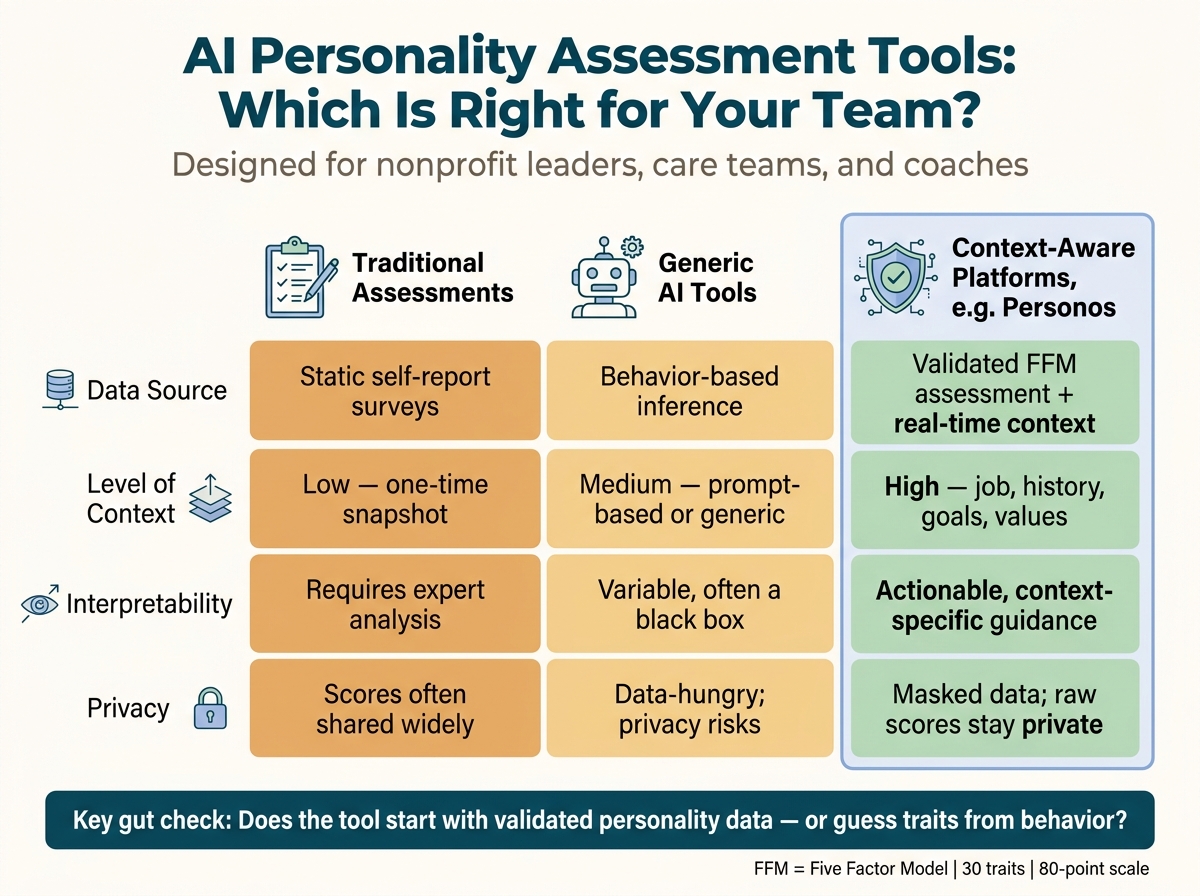
AI Personality Assessment Tools Compared: Traditional vs. Generic AI vs. Context-Aware Platforms
Traditional Assessments vs. Generic AI Tools vs. Context-Aware Platforms
For managers, the big question isn’t which tool seems the smartest. It’s which one is usable, valid, and safe in actual team settings.
Not all personality tools work the same way, and that matters a lot in helping work. Traditional assessments depend on static type labels. They’re simple to use, but they can flatten people into fixed categories. Generic AI tools may spot patterns from behavior, but that can create privacy and validity problems. The key difference is this: does the tool use validated personality data in context, or does it just guess traits from behavior?
| Feature | Traditional Assessments | Generic AI Tools | Context-Aware Platforms (e.g., Personos) |
|---|---|---|---|
| Data Source | Static self-report surveys | Behavior-based inference | Validated FFM assessment + real-time context |
| Level of Context | Low (one-time snapshot) | Medium (prompt-based or generic) | High (job, history, goals, values) |
| Interpretability | Requires expert analysis | Variable, often a black box | Actionable, context-specific guidance |
| Privacy | Scores often shared widely | Data-hungry; privacy risks | Masked data; raw scores stay private |
A simple gut check helps here: ask whether the platform starts with validated personality data or tries to infer traits from behavior.
Where Personos Fits for Helping Professionals
This difference hits hardest in helping professions, where context and confidentiality shape almost every call a manager makes.
Personos uses FFM-based profiles along with contextual information to give real-time guidance at the individual, relationship, and group levels. It also includes prompts and an ActionBoard to support follow-through. Before analysis, Personos masks identifying details and keeps raw scores out of outputs shown to colleagues [1].
Key Findings Managers Can Act On Now
The practical test is pretty simple. Does the tool help people communicate better day to day without exposing private information?
Managers should lean on validated assessment, human judgment, and context-specific guidance. In practice, that means using personality data to shape feedback style, meeting structure, and escalation paths. It also means putting masking, role-based access, and clear use limits in place from the start. If a vendor can’t explain its guardrails in plain English, leave it out.
FAQs
How accurate are AI personality scores?
AI personality scores can be fairly accurate. In some cases, models show an 80% to 85% correlation with human self-assessments. That sounds strong, and it is. But it doesn't mean the score is final or beyond debate.
Results can still shift. Bias can shape the outcome. So can social desirability, where people answer in ways that make them look better. Behavior can also change during an assessment, which adds another layer of uncertainty.
Tools like Personos can add more nuance by looking at personality in context, not just as a flat score. That said, experts still suggest a simple rule: treat these scores as working ideas, not hard facts, and weigh them alongside human judgment.
When should managers use personality data?
Managers should treat personality data as a starting point, not a box to put people in. It can help shape a hypothesis, but it should never replace human judgment or what you see day to day.
Used well, this kind of data helps managers spot friction early, before small issues turn into bigger ones. It can also help them adjust how they communicate and delegate work based on each person’s style.
Tools like Personos can help here by offering real-time, context-aware guidance based on the Five Factor Model.
How can teams protect personality privacy?
Teams can protect personality privacy with strict data safeguards and clear informed consent. The goal is simple: people should know what data is being used, how it’s being used, and who can see it.
Good tools should be open about how AI produces insights, give users control over their own profiles, and restrict access to authorized personnel only.
Platforms like Personos build this in from the start. Scores are hidden by default, data is encrypted, identifying information is masked before it reaches the AI, and personal data is not used to train AI models.