AI in Team Coaching: Benefits and Use Cases
AI coaching personalizes team development at scale, blending psychology and real-time guidance while keeping human oversight.
Nick Blasi

AI in Team Coaching: Benefits and Use Cases
AI is transforming team coaching by making it more personalized, efficient, and scalable. Tools like Personos, Cloverleaf, Lattice, Culture Amp, and Hone are helping managers improve feedback, analyze personality for team success, and support employee growth. Each platform offers unique features, from personality insights to real-time coaching nudges and live training sessions.
Key takeaways:
- Personos focuses on personality-driven insights using the Five Factor Model, offering real-time actionable guidance for $9 per seat/month.
- Cloverleaf integrates existing assessments (e.g., DISC, Enneagram) into daily tools like Slack and Microsoft Teams.
- Lattice ties AI coaching to performance data, emphasizing productivity and retention trends.
- Culture Amp provides AI-driven, just-in-time coaching based on engagement surveys and organizational data.
- Hone prioritizes live, cohort-based leadership training with hands-on practice.
These platforms cater to different needs, from personality-focused coaching to performance tracking or live learning. Choosing the right one depends on your team's goals and resources. A pilot program can help evaluate ROI and fit. For larger teams, Personos for organizations provides a structured way to strengthen collaboration and lower turnover.
7 Capabilities the Best AI Coaches Must Have For Your Organization
1. Personos
Personos stands out by focusing on personality psychology, using the scientifically validated Five Factor Model. This model evaluates 30 personality traits on an 80-point scale, offering a detailed and nuanced understanding of individuals.
Personality Insights
Personos creates a detailed personality profile for every user, shaping how interactions are tailored. Its Dynamic Reports - covering personal, relationship, and group insights - update in real time to reflect changing contexts. What sets this platform apart is its Transparent Reasoning feature, which explains the traits considered in every AI recommendation. This not only aids coaches in making informed decisions but also helps them deepen their expertise over time. These insights pave the way for analyzing team dynamics on a deeper level.
Team Dynamics Analytics
On a team level, Personos identifies shared strengths and potential blind spots, offering a clear picture of group dynamics. Its conversational AI integrates personality profiles with contextual elements like team goals, case histories, and prior interactions. This ensures guidance is tailored to the unique needs of the situation rather than offering one-size-fits-all advice.
Manager Enablement
Personos provides managers with an ActionBoard, a Kanban-style tool that transforms insights into actionable tasks. With just one click, managers can set trackable goals, monitor progress, and document results. Additionally, Personos Prompts deliver scheduled reminders - daily, weekly, or monthly - to keep personality insights front and center between coaching sessions. These tools help managers foster stronger team cohesion by turning insights into meaningful actions.
Scalability
At just $9 per seat per month, Personos is accessible for teams of all sizes. The AI handles the bulk of the work, from generating tailored reports to providing real-time guidance. This makes it an effective solution for coaching teams that may have limited resources. Studies indicate that AI-driven coaching tools can significantly enhance the support coaches offer without sacrificing quality [5].
Privacy and Transparency
Personos prioritizes privacy by ensuring individual personality scores remain confidential unless explicitly shared within a coaching relationship. This prevents the "labeling" issue, where personality data might be misused to categorize individuals rather than support them. Coupled with its transparent AI reasoning, this approach promotes psychological safety. These features highlight how Personos combines privacy and transparency to create a trustworthy environment for AI-powered team coaching.
2. Cloverleaf
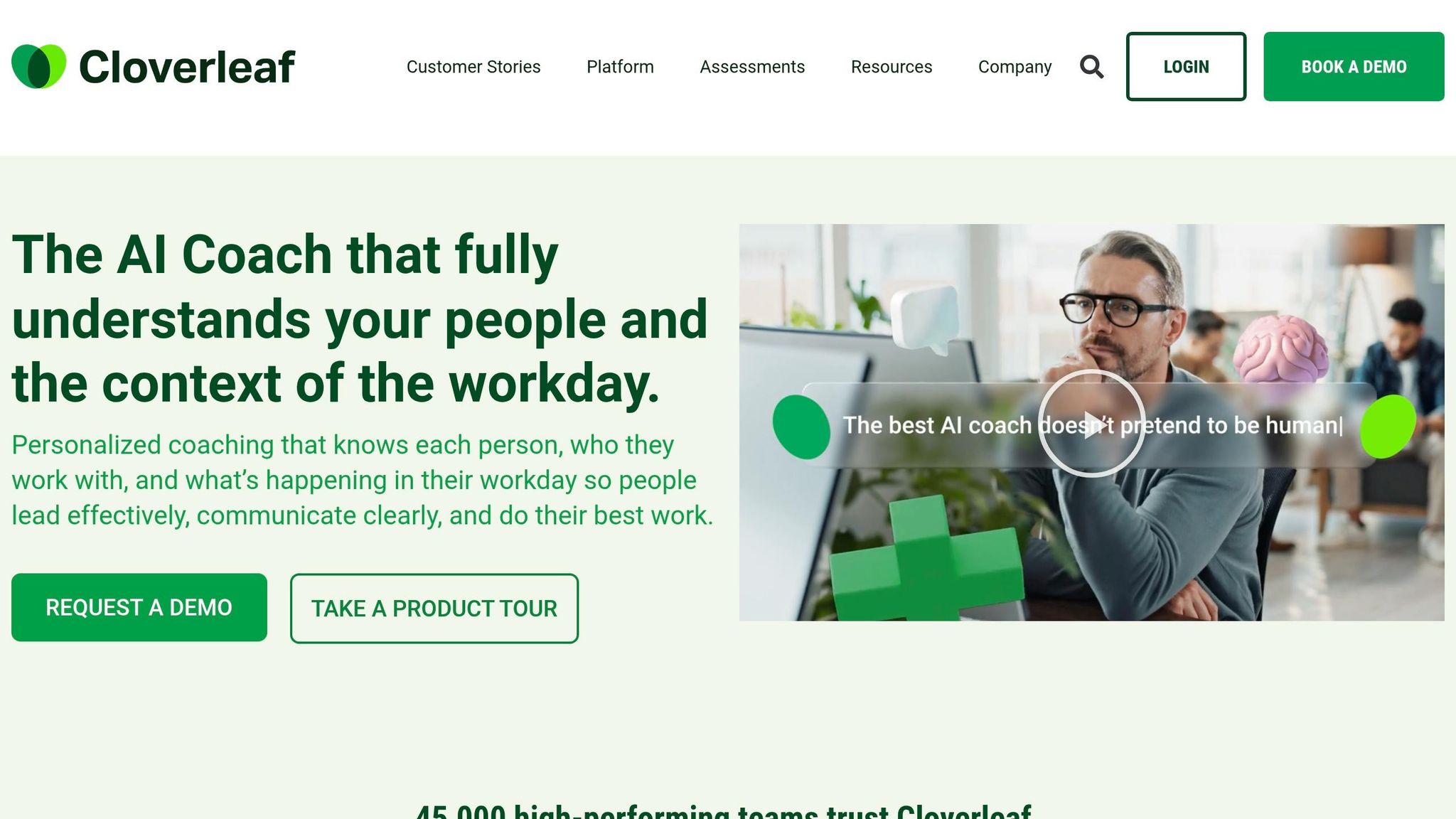
Cloverleaf brings together several well-known personality and strengths assessments, like DISC, Enneagram, 16 Types, and CliftonStrengths, into one platform. Instead of creating its own model, Cloverleaf integrates tools that teams may already use, embedding them directly into daily workflows.
Personality Insights
Cloverleaf provides insights through contextual coaching nudges delivered directly to platforms like Slack, Microsoft Teams, and calendar apps. This eliminates the need to log into a separate dashboard. Quan Campbell, Senior Director of Experiences and Programming at Blanchard, highlights its value:
"It helps connect with people and I love that it shows me how to tailor my message to each teammate based on what they need." [1]
The Discover feature allows employees to ask work-specific questions - like how to handle sensitive feedback - and receive advice tailored to the personalities involved. A role-play simulation tool further enhances preparation for challenging conversations by modeling responses based on behavioral data.
Team Dynamics Analytics
Cloverleaf's coaching tools analyze interactions between teammates, identifying potential friction points before they become issues. Jenny Harris, SVP of Global Business Services and Chief Procurement Officer at Duracell, shared:
"Cloverleaf is still giving us insights about teammates who've worked together for a decade. That's powerful." [1]
The platform scales personalized coaching by generating over 5 million insights monthly for 45,000 teams [7]. Users have reported an 88% improvement in team communication and an 83% boost in psychological safety [8].
Manager Enablement
Cloverleaf equips managers with relationship briefings before one-on-ones or team meetings. These briefings help managers tailor their approach, offering feedback or resolving conflicts in ways that align with each team member's preferences.
Scalability
Designed for large organizations, Cloverleaf integrates seamlessly with HRIS systems like Workday. Pricing starts at $7,000 per year [6], making it a strategic investment for enterprises. Additionally, organizations report an average 32% reduction in assessment-related costs by consolidating tools into a single platform [1][8].
Privacy and Transparency
Cloverleaf prioritizes security and compliance, holding SOC 2 Type II certification, ISO/IEC 27001 compliance, and alignment with GDPR and CCPA standards [1][6]. Users control the visibility of their personal data, and the platform's enterprise integrations meet stringent security requirements. Up next, we'll explore other platforms to compare different AI approaches to team coaching.
3. Lattice
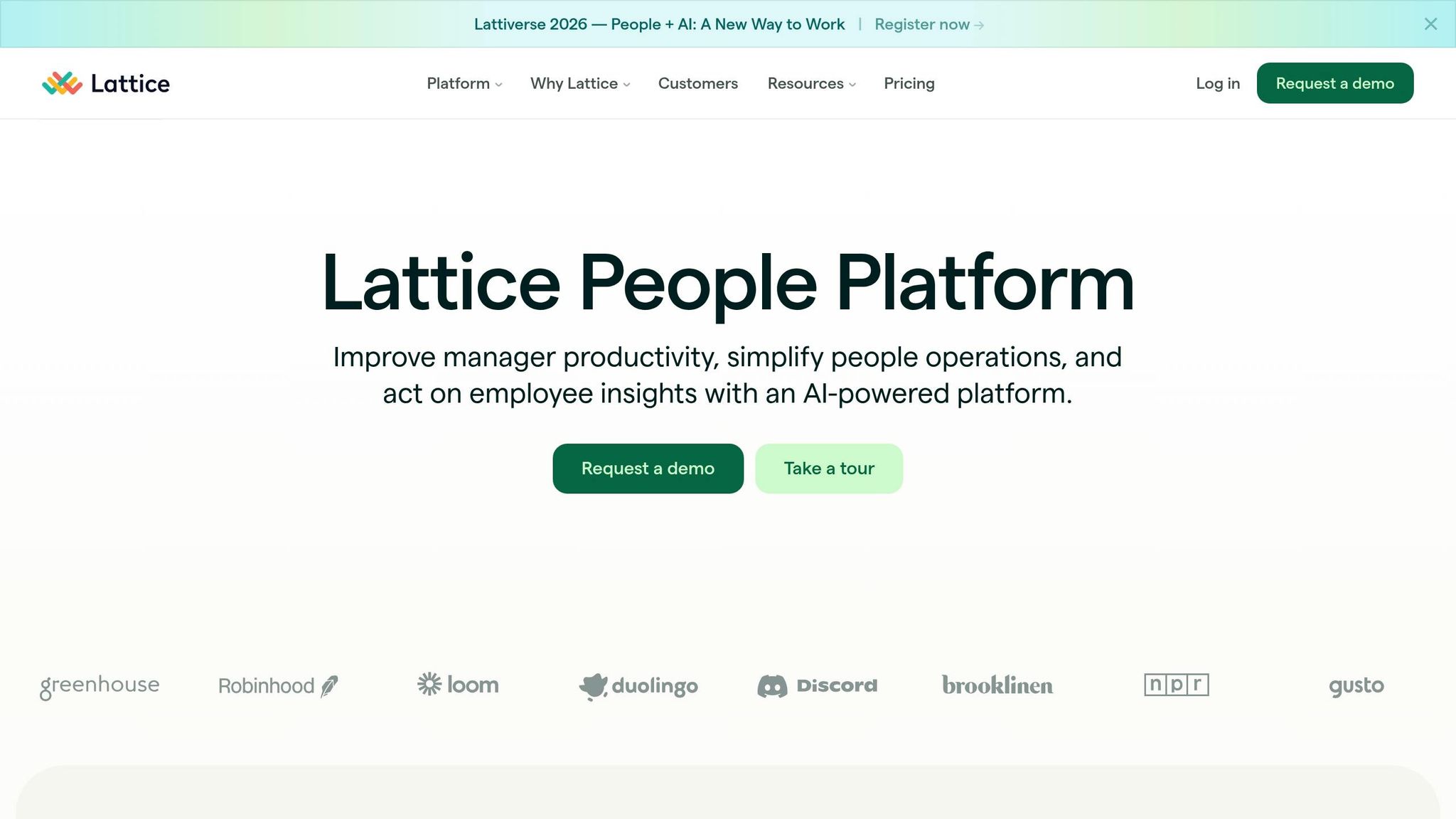
Lattice stands out among AI-driven coaching tools with its performance-centered strategy. Lattice is a people management platform designed to streamline performance reviews, track goals, and boost employee engagement. It supports HR teams in managing the entire employee journey.
Personality Insights
Instead of focusing on personality traits, Lattice uses performance data and engagement signals. By analyzing pulse surveys, meeting notes, and goal-tracking data, it provides coaching based on behaviors and results rather than personality-driven insights.
Team Dynamics Analytics
Lattice keeps an eye on team health by tracking engagement surveys and performance trends over time. This allows managers to spot shifts in team sentiment and address potential issues early. Its emphasis on productivity metrics and retention risks offers a practical approach that complements platforms more focused on interpersonal dynamics.
Manager Enablement
Lattice strengthens the manager-employee connection with tools for structured 1-on-1 meetings, feedback templates, and goal alignment. These features help managers lead more effective and focused coaching sessions.
4. Culture Amp
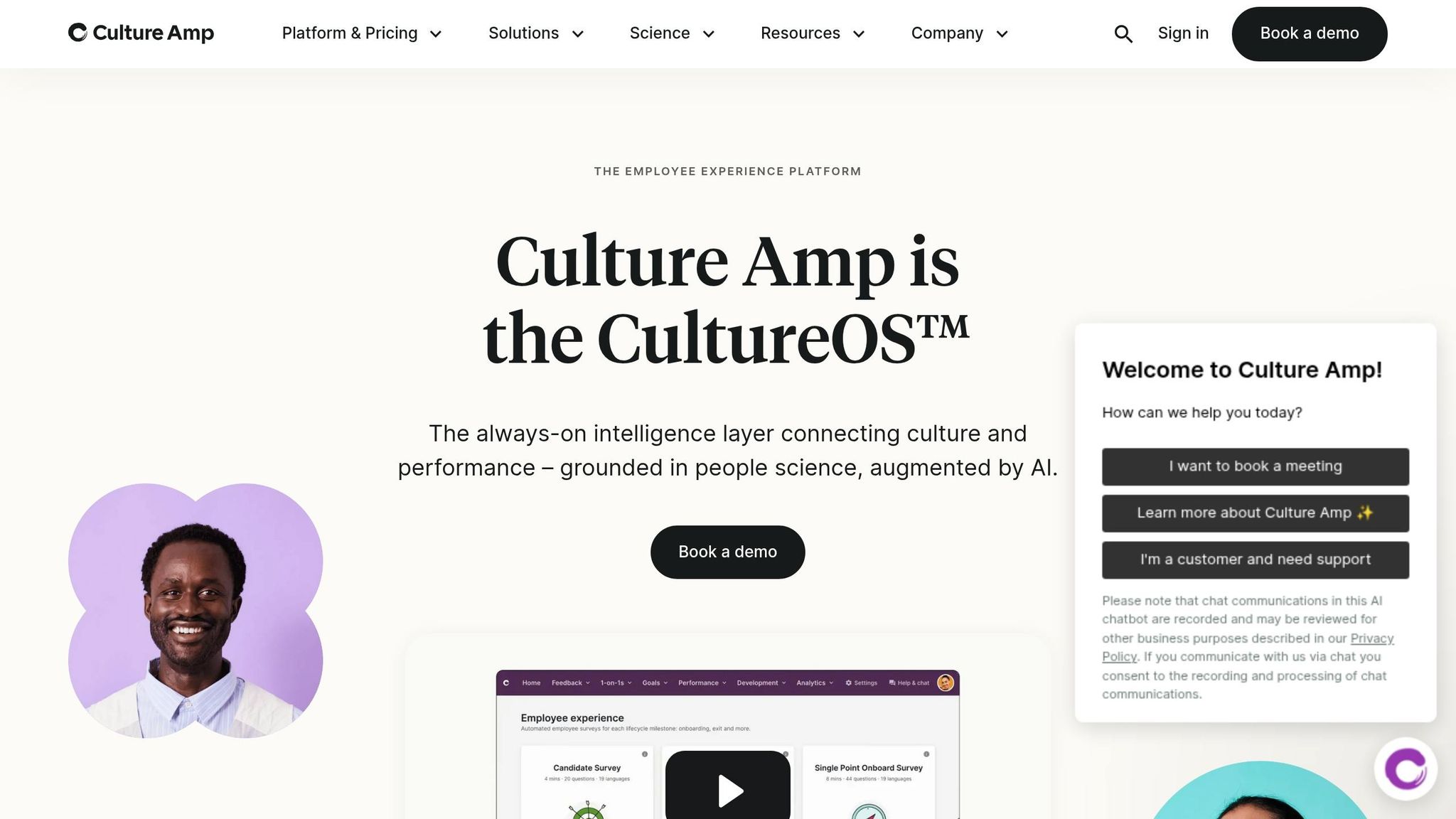
Culture Amp takes a different approach to management development. Instead of focusing on traditional personality or productivity metrics, it equips managers with tools to handle real-world challenges effectively. The platform currently supports 25 million employees across over 6,500 companies, drawing insights from 1.5 billion workplace data points collected over the past decade [10].
Personality Insights
Rather than relying on standard personality tests, Culture Amp's AI Coach uses research-based leadership frameworks and organizational data to help managers grow their self-awareness. The emphasis is on practical behavior - what managers say and do in difficult conversations - rather than assigning personality types. This makes it especially useful for managers who need immediate, actionable guidance before a challenging one-on-one discussion, not just theoretical advice from a workshop.
Team Dynamics Analytics
Culture Amp integrates its AI insights with the Engage survey tool, allowing managers to quickly identify team issues and take action. The AI provides tailored talking points and drafts team messages based on actual survey data and the organization’s unique context [10]. Chris Mander, Culture Amp’s Chief Product Officer, explains:
"AI Coach is not just about providing advice; it's about enabling managers to develop crucial skills, navigate difficult conversations, and inspire meaningful action within their teams." [10]
This approach ensures coaching strategies are directly informed by real team dynamics.
Manager Enablement
One of the platform’s strengths is addressing the communication gap in leadership. While 84% of leaders say they communicate business goals effectively, only 23% of employees feel adequately informed [9]. Culture Amp’s AI Coach steps in with "just-in-time" coaching, offering precise language suggestions and role-play scenarios right before critical moments like performance reviews or sensitive discussions [9]. This real-time support helps managers build confidence and improve communication.
Scalability
Personalized coaching has traditionally been limited to senior executives, but Culture Amp is changing that. By leveraging AI, the platform delivers consistent, high-quality coaching to managers at all levels without driving up costs [9]. This enables organizations to extend leadership development to mid-level and new managers, fostering stronger teams throughout the company. Richard Taylor, Senior Vice President of People Experience at Nasdaq, highlights this shift:
"Culture Amp's combination of evidence-backed coaching and AI-powered insights democratizes access to personalized guidance, empowering managers to lead with confidence in any situation." [10]
Privacy and Transparency
Culture Amp ensures that managers remain in control. While the AI provides actionable guidance, all decisions are left to the manager. Coaching sessions are confidential, offering a safe space for reflection and practice. The system doesn’t override human judgment. As Culture Amp puts it: "The AI coach is simply there to guide their decision-making process... it's ultimately up to the manager to decide what to take away and implement from the coaching session." [9]
This balance between AI support and human decision-making sets Culture Amp apart, offering a thoughtful approach to leadership development.
5. Hone
Hone stands out by focusing on live, cohort-based training sessions to develop leadership skills. Unlike other platforms that lean on passive data collection or personality assessments, Hone prioritizes interactive, real-time learning led by instructors. These sessions are designed to provide hands-on practice and immediate feedback, making the learning process both practical and engaging.
Personality Insights
Instead of traditional personality profiling, Hone helps managers build self-awareness through live exercises. Participants get to practice real-world scenarios, receiving feedback from peers and instructors in the moment. This approach encourages managers to better understand their communication and leadership styles through active participation.
Team Dynamics Analytics
Hone doesn't rely on analytics dashboards to track team dynamics. Instead, it focuses on fostering observable behavioral changes. By working through scenarios in a live group setting, teams naturally uncover and address their dynamics. This interactive, practice-based method adds a human element that complements the digital insights offered by AI-driven platforms like Personos.
Manager Enablement
Hone is particularly effective at equipping managers with critical skills. Through expert-led instruction, live peer coaching, and one-on-one sessions, managers gain practical experience in areas such as handling tough feedback, promoting inclusive discussions, and creating psychologically safe environments. These synchronous learning experiences provide immediate opportunities to apply and refine new skills, ensuring accountability and growth.
Scalability
Hone's model allows organizations to scale live training sessions across distributed teams, offering a cost-effective alternative to traditional executive coaching. While it may not focus as heavily on tailoring guidance for specific team dynamics as some AI-based platforms, it excels at making live, interactive training accessible to a broader audience.
Pros and Cons of Each Platform
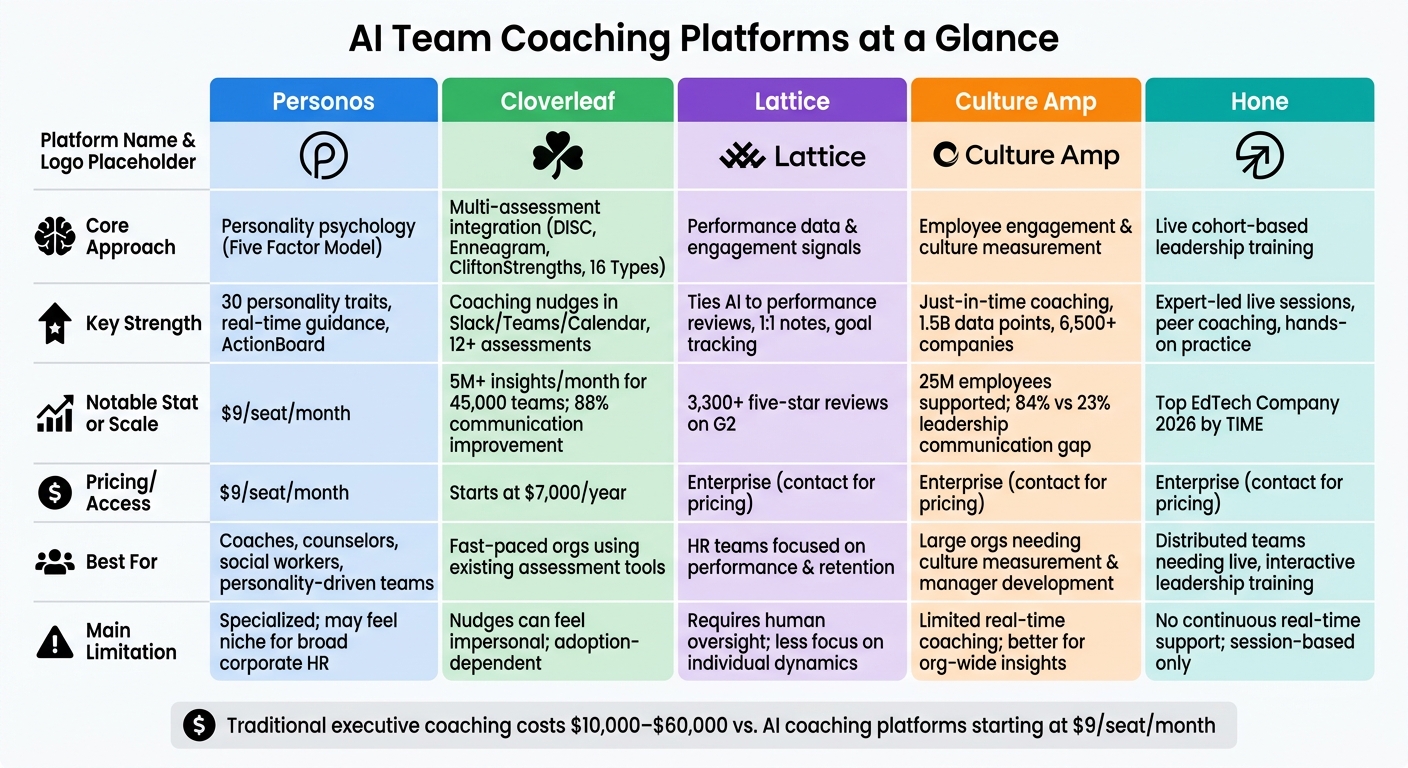
AI Team Coaching Platforms Compared: Features, Pricing & Use Cases
Building on our earlier review of AI-driven coaching techniques, let’s dive into a comparison of key platforms, focusing on their strengths and limitations. Each platform brings its own approach to improving team performance, making it important to weigh their features against your specific needs.
| Platform | Key Strengths | Notable Weaknesses |
|---|---|---|
| Personos | Uses the Five Factor Model to analyze 30 personality traits; provides real-time, situation-specific guidance; prioritizes privacy; offers tailored coaching and an ActionBoard for tracking behavioral progress; ideal for helping professionals. | Primarily designed for social workers, counselors, and coaches - may feel too specialized for broader corporate HR applications. |
| Cloverleaf | Incorporates over 12 validated assessments (e.g., DISC, Enneagram, CliftonStrengths); delivers coaching nudges directly through Slack, Teams, and calendars; emphasizes "others-awareness." | Automated nudges may feel impersonal; success depends on how well teams adopt and engage with the platform. |
| Lattice | Ties AI coaching to performance data from reviews and 1:1 notes; scales effectively across organizations; highly rated with over 3,300 five-star reviews on G2 [11]. | Requires human oversight to align AI insights with business goals; focuses more on organizational performance than individual team dynamics. |
| Culture Amp | Excels in employee engagement and culture measurement; recognized for its expertise in HR analytics. | Offers limited real-time coaching; better for organization-wide insights than addressing individual or team-level needs. |
| Hone | Combines live cohort sessions with AI, creating accountability and encouraging behavior change; recognized as a Top EdTech Company for 2026 by TIME [3]. | Less tailored to individual team interactions; relies on scheduled sessions instead of providing continuous, real-time support. |
When choosing a platform, it’s crucial to consider more than just technical features. For instance, Personos stands out for blending psychology with actionable guidance, making it particularly effective for professionals who value personality-driven coaching. Cloverleaf, on the other hand, integrates coaching into daily tools like Slack, making it easier to adopt in fast-paced environments. Meanwhile, Lattice shines in leveraging performance data but doesn’t offer the same depth of personality-aware coaching as Personos.
One major hurdle for all platforms is user adoption. Research indicates that coaching tied to personalized behavioral data engages users 31 times more effectively than generic advice [12]. Platforms like Cloverleaf, which integrate into tools employees already use, help overcome this challenge. However, platforms requiring separate logins often struggle with lower engagement rates.
"AI coaching for teams is an always-available, context-aware coach that automates improvement and growth by helping people collaborate better - right inside their daily workflow." - Cloverleaf [4]
Cost is another important factor. At just $9 per seat per month, Personos offers a budget-friendly option for personality-focused coaching. This is a stark contrast to traditional executive coaching, which can range from $10,000 to $60,000 [13]. Platforms like Hone and Lattice, while feature-rich, are generally better suited for larger enterprises with the resources to support their offerings.
Conclusion
Each platform brings its own strengths to the table when it comes to AI coaching. The best choice depends on your team’s specific priorities. For example, if your organization values personality-aware coaching tailored for professionals like social workers or counselors, Personos delivers focused solutions at just $9 per seat per month - a fraction of the cost of traditional programs [15]. On the other hand, platforms like Cloverleaf, Lattice, Culture Amp, and Hone cater to distinct needs such as integrating coaching into daily workflows, linking it to performance development, measuring engagement on a large scale, or offering live cohort-based leadership training.
What ties these platforms together is their emphasis on personalization. This focus is what makes AI coaching so effective. In fact, research reveals that 76% of workers prefer robust learning and development opportunities [14].
"The real power of AI in coaching is its ability to personalize at scale. It can tailor content to an individual's needs, making development more precise and impactful." - Kevin Gagan, Senior Client Partner, Korn Ferry [14]
To make the most of AI coaching, it’s important to align it with your team’s dynamics and ensure human oversight remains central. A smart way to start? Run a focused pilot program. Select one high-impact team, establish a clear baseline, and test the platform over 2–6 weeks. This method minimizes risk while providing valuable data to assess the return on investment [2].
While AI coaching enhances speed, consistency, and scalability, it’s not a substitute for human judgment. Instead, it’s a tool that amplifies the impact of human coaching. By recognizing patterns in behavior, AI provides coaches with deeper insights to drive better outcomes.
FAQs
How do I choose the right AI coaching platform for my team?
When selecting an AI coaching platform, focus on tools that deliver personalized guidance, make coaching accessible to everyone, and lighten your workload. Look for platforms that provide real-time, context-aware insights, especially those using proven models like the Five Factor Model.
Platforms such as Personos are worth considering. They offer features like dynamic reports, tailored prompts, and tracking tools designed to boost results, minimize burnout, and maximize the reach of coaching efforts.
Most importantly, ensure the platform matches your team’s specific needs and supports ethical, practical coaching solutions.
Will AI coaching expose or misuse employee personality data?
AI coaching tools, such as Personos, emphasize ethics and privacy, but challenges arise when data isn't handled with care. To avoid misuse or breaches of trust, strict data governance and transparency are essential. Experts suggest treating AI-generated outputs as starting points rather than final decisions - particularly for critical matters like pay or promotions. This approach ensures that sensitive personality data is managed responsibly and ethically.
How can I prove ROI from an AI coaching pilot?
Tracking measurable outcomes is key to proving ROI. Focus on improvements in areas like team performance, engagement, or specific metrics such as cohesion scores, turnover rates, or performance ratings. Start by comparing baseline data with results after implementation. For instance, AI coaching has been shown to enhance team cohesion, lower turnover, and increase overall satisfaction.
To present clear value, combine hard data - like platform analytics and Net Promoter Scores (NPS) - with direct participant feedback. This approach provides concrete evidence of progress while aligning outcomes with the organization's goals.