AI Skills-Gap Assessment: What Teams Need
Begin AI training by mapping role-based skill gaps with limited job data, manager review, and clear privacy controls.
Christian Thomas

AI Skills-Gap Assessment: What Teams Need
If you want AI training to work, start with the gap, not the course. I’d sum up the article this way: teams should compare current skills to role needs, use a small set of job-related data, keep staff informed about data use, and have managers review results before any training decision is made.
Here’s the short version:
- The goal is staff development, not employee surveillance.
- The input should be limited and job-related, such as job descriptions, learning records, assessments, manager notes, and work samples.
- The output should guide 3 things: baseline AI training, tool-specific training, or coaching.
- Human review still matters because AI cannot judge empathy, judgment, leadership, or role context on its own.
- Privacy and consent matter because trust drops fast when staff do not know what data is used or who can see it.
- The best use case is targeted support, especially for teams with high caseloads and little time for trial-and-error training.
A simple way to think about it: if a team spends $500 to $2,000 per employee per year on training, a poor match between training and job needs can waste both time and budget. A skills-gap review helps point that spend toward the work people are actually doing.
What teams need most is not more data. They need clear role requirements, limited data use, manager review, and follow-up after training.
That is the core of the article in one view:
| Area | What matters |
|---|---|
| Purpose | Staff training and development |
| Main inputs | Role needs, assessments, feedback, work evidence |
| Main users | L&D, HR, supervisors, department leads |
| Main decisions | Basic AI training, tool training, coaching |
| Human role | Check results before action |
| Main risk | Using unclear or overbroad staff data |
| Best fit | People-focused teams where trust and judgment matter |
If I were putting this into practice, I’d use the assessment as a training roadmap, not as a score that stands on its own.
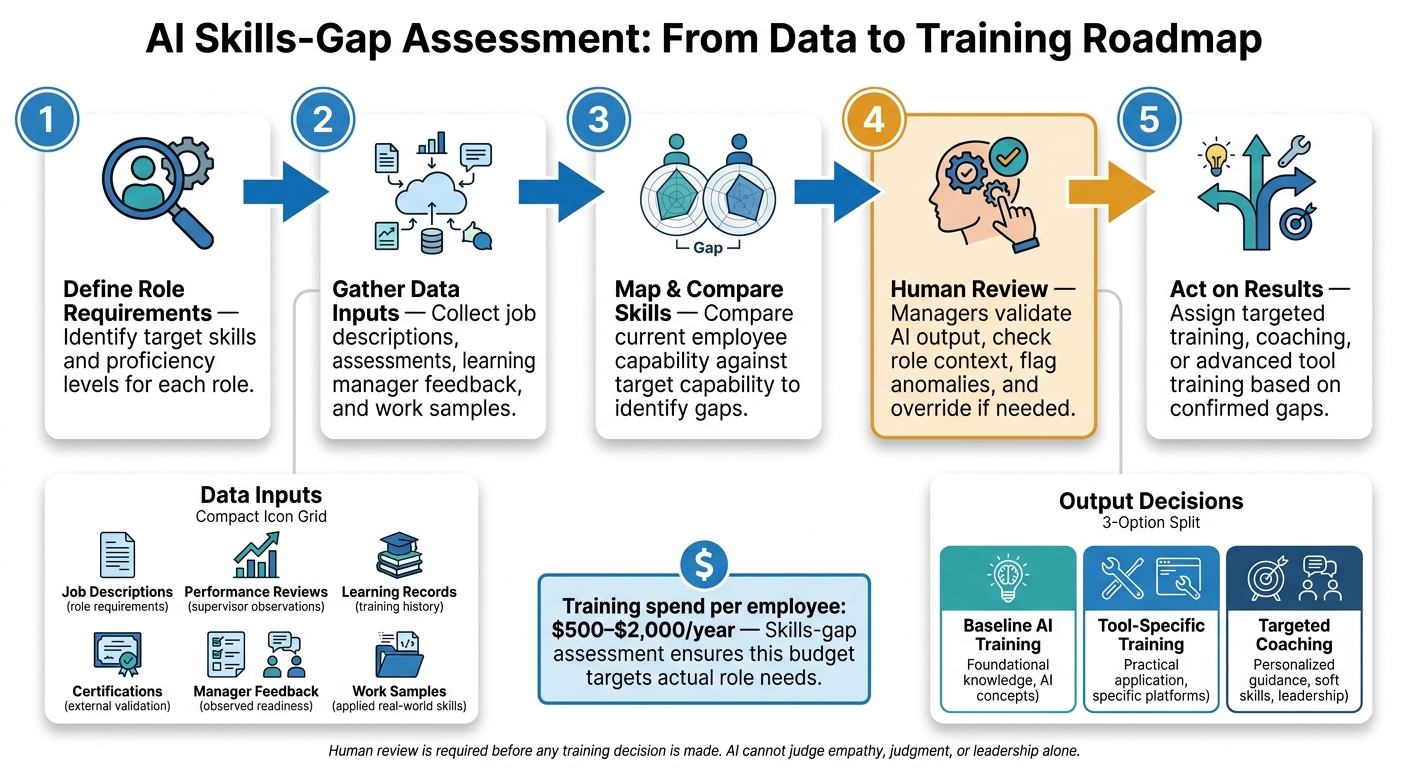
AI Skills-Gap Assessment: From Data to Training Roadmap
Navigating the AI Skill Gap with AI Readiness Assessments
What AI Skills-Gap Assessment Is and What Data It Uses
An AI skills-gap assessment looks at what employees can do today and compares that with what a role calls for. The goal is simple: find the gaps that matter so training points at actual needs, not guesses.
At the center of it is a clear way to compare skills, roles, and the evidence behind both.
How the Assessment Works
Most teams follow a pretty direct process. They define role requirements, map skills to proficiency levels, compare current capability with target capability, and then show the gaps in dashboards or gap maps.
That matters because a gap is only useful if people can see it clearly. If the comparison is fuzzy, the training plan usually is too.
Data Sources Teams Typically Use
It helps to use more than one input. A single source can tilt the picture. When teams combine sources, they get a better read on actual capability.
Typical inputs include job descriptions, reviews, learning history, certifications, personality assessments, manager feedback, and work samples.
| Data Source | What It Captures |
|---|---|
| Job descriptions | Role requirements and target skills |
| Performance reviews | Supervisor observations and feedback |
| Learning records | Training completed and module progress |
| Certifications | Verified external validation |
| Assessments | Structured measures of skill level |
| Manager feedback | Observed strengths, gaps, and readiness |
| Work samples | Applied skills in real work contexts |
Privacy, Consent, and Context
Use only the data tied to the development goal. Staff should know what is being collected, why it is being collected, and who can access it. Those basic guardrails go a long way in building trust.
It also helps to set firm limits on data use. Skill data should stay with the people who need it, not drift across the organization without a clear reason.
With scope and access defined, the next step is deciding who should use the assessment and which decisions it should inform.
Who Should Use It and What Decisions It Supports
Once skill gaps are mapped, the next step is simple: figure out who should use those findings and what choices they should guide.
Teams and Roles That Benefit Most
Learning and Development teams are the clearest place to start. But they shouldn't work alone. HR, department heads, program directors, and supervisors all have a role here.
For helping organizations, such as nonprofits, social service agencies, and coaching or counseling teams, the stakes are more specific. Social workers, case managers, counselors, and similar staff need to look at readiness in a way that goes past basic AI literacy. In people-centered work, the aim isn't just AI fluency. It's using AI without losing trust, empathy, or sound judgment.
Decisions It Helps Teams Make
A well-run assessment helps leaders decide whether employees need:
- baseline AI training
- advanced tool training
- targeted coaching
It also helps teams shape development plans and direct training spend based on actual role needs instead of assumptions.
For helping professionals, the main issue isn't only AI literacy. It's also protecting empathy, judgment, and trust in client work.
Even when the results look clear, managers still need to review the findings before using them to shape training plans.
How Much Human Review AI Skills-Gap Assessment Needs
AI can sort through skills data fast. But managers still need to check the output before it shapes any training plan. That step keeps the assessment connected to the actual job, instead of letting a model make the call on its own.
What Managers and Staff Still Need to Review
Start with the inputs. Job descriptions, past coaching notes, and role context need to be accurate and up to date, because the output depends on the quality of the role details and the judgment behind them. Managers should also line up the result with what they already know about the role and flag anything that feels off.
Human judgment still matters most for empathy, insight, creativity, and leadership.
A Practical Review Schedule
Review the assessment again after major role changes. In practice, it helps to check each assessment before it becomes part of a training plan, then come back to it from time to time. If the result no longer fits the role, override it and recalibrate with HR or department leads.
Why Transparent AI Matters in People-Centered Work
People are more likely to trust AI when they can see how it reached a recommendation. Clear tools make it easier to validate, question, or adjust the result.
Personos shows the situational factors behind its guidance, helping managers review the logic before acting [1].
Once the results are checked, they can feed training, coaching, and follow-up.
Where AI Skills-Gap Assessment Fits in Staff Development
From Assessment to Training and Follow-Up
Once managers validate the results, the next step is training and follow-up. The assessment should help set priorities, assign targeted training, and track whether skills improve on the job. AI can group related skills so teams focus on the highest-priority gaps. Reports can also give managers coaching prompts and follow-up points.
How It Can Work Alongside Other Support Tools
Training plans show what to learn. Support tools help people use that learning when the pressure is on.
Skills-gap software can show what to train, but it doesn't show how someone will apply that skill in a live interaction. For helping professionals, Personos can add real-time guidance during hard conversations and help track follow-through after training.
Conclusion: What Teams Actually Need
In practice, AI skills-gap assessment works best as a training roadmap, not a standalone report. Teams need a role-based skills framework, targeted training plans, and follow-up through coaching or check-ins. Every result should connect back to actual job requirements and serve as an input for development, not a final judgment.
FAQs
How is this different from a performance review?
Unlike performance reviews, which happen from time to time and look back at what already happened, AI-driven skills-gap assessments offer continuous, real-time guidance. The focus shifts from a fixed, top-down review to steady development that fits into day-to-day work.
Instead of waiting for a formal review cycle, you get context-aware insights and clear nudges during everyday interactions. That means help in the moment, not months later, so you can improve communication, handle conflicts better, and build stronger working relationships as situations unfold.
What data should we avoid using?
Avoid unverified self-reported data, generic datasets that treat everyone the same, and static snapshots. They can reflect social desirability instead of actual behavior, miss differences across age groups, industries, and backgrounds, and overlook how team dynamics shift over time.
Instead, use transparent, scientifically validated models so the insights feel personal, useful, and less likely to lean on bias.
How often should teams reassess AI skill gaps?
Teams should move away from annual training cycles and use continuous, real-time assessment instead.
Modern AI-driven platforms like Personos swap static snapshots for dynamic profiles that update through ongoing behavioral data. That gives teams a clearer view of skill gaps as they show up, not months later. With daily, weekly, or monthly nudges, people can work on issues while they're still small and easier to fix.