AI Role-Play: 4 Staff Conflict Practice Scenarios
Use four short AI role-plays to rehearse clear handoffs, fair resource allocation, communication norms, and supervision plans.
Nick Blasi

AI Role-Play: 4 Staff Conflict Practice Scenarios
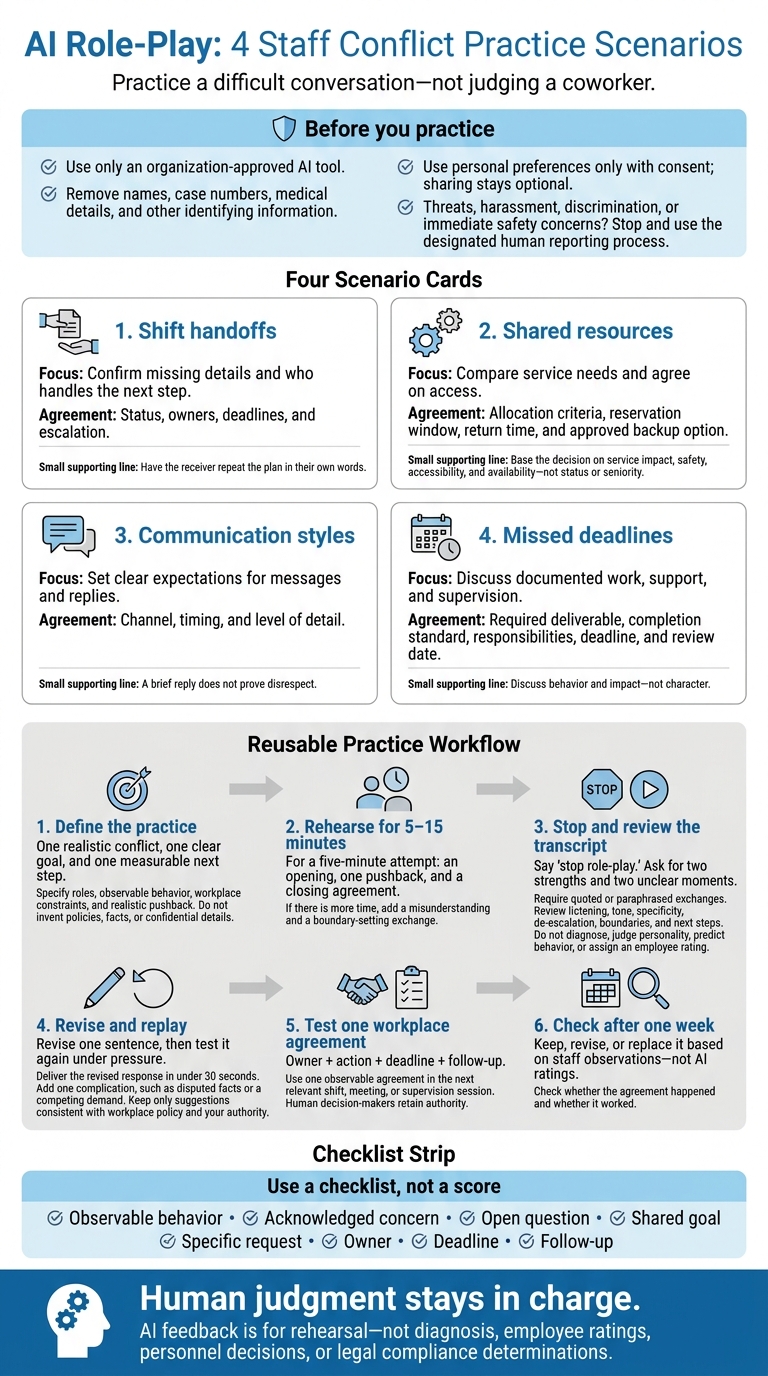
I use AI role-play to practice a difficult conversation, not to judge a coworker. In a 5–15-minute session, I can test an opening, respond to pushback, and work toward one agreement with an owner, deadline, and follow-up.
These four scenarios focus on:
- Shift handoffs: Confirm missing details and who handles the next step.
- Shared resources: Compare service needs and agree on access.
- Communication styles: Set clear expectations for messages and replies.
- Missed deadlines: Discuss documented work, support, and supervision.
Before practicing, I use an approved tool, remove private details, and include personal preferences and personality traits only with consent. Personos is one optional tool, subject to workplace approval. I ask for feedback tied to my actual words, revise one sentence, and try again.
The test is whether the agreement works at work, not whether AI likes my wording. <u>Human judgment stays in charge</u>, especially for safety, reporting, accommodations, and personnel decisions.
AI Role-Play: 4 Staff Conflict Scenarios and Practice Steps
AI Role Play for Conflict Resolution | Interactive Learning Demo
Set Up a Safe AI Practice Session
- Use only an organization-approved AI tool.
- Check whether it stores or reuses prompts. Follow workplace rules for access, retention, and incident reporting.
- Remove names, case numbers, medical details, and any other identifying information.
- If the situation involves threats, harassment, discrimination, or immediate safety concerns, stop and use the designated human reporting process.
Use this setup for every scenario below.
Define the Roles, Conflict, and Goal
Keep the practice focused on one realistic conflict, one clear goal, and one measurable next step. Aim for a concrete working agreement, not winning an argument or changing someone’s personality.
Fill in this reusable prompt with observable actions, work limits, and a clear next step:
You are role-playing as [coworker, supervisor, or direct report]. This is a de-identified workplace situation: [brief facts]. I am [my role], and the other person is [their role]. The observed behavior is [specific words or actions, without assumptions about motives]. Constraints include [shift schedule, staffing, policy, deadline, safety issue, or resource limit]. Respond with realistic workplace pushback. Do not invent policies, facts, or confidential details. Stay in character until I say “stop role-play.” Help me practice this agreement: [specific agreement with an owner, action, deadline, and way to confirm it]. After 5–15 minutes, stop and give transcript-based feedback on listening, tone, specificity, de-escalation, boundaries, and next steps. Do not diagnose, label, rank, or rate either person.
Use Only Consented Personality Context
Use only preferences the person has voluntarily shared, such as their preferred level of detail, directness, or processing time. Sharing must stay optional, and staff must be able to revise or withdraw their input.
Use these preferences to adjust phrasing, pacing, and detail. Don’t use them to infer traits, diagnose someone, or assign a fixed label. If no personality context is available, or someone declines to share it, use this neutral prompt:
Do not infer personality, motives, diagnoses, or communication style. Respond as a reasonable coworker in this role who has the stated workplace constraints. Ask clarifying questions, acknowledge relevant concerns, and provide realistic pushback. Keep the discussion focused on observable behavior, work requirements, and a mutually workable next step.
If someone withdraws consent, follow organizational procedures for removing their contributed information.[2][3]
Practice, Then Ask for Specific Feedback
Set a 5–15-minute timer and rehearse before asking for coaching. For a five-minute attempt, practice an opening, one pushback, and a closing agreement. If you have more time, add a misunderstanding and a boundary-setting exchange.
Then say “stop role-play” and ask for feedback based on the actual transcript:
Identify two strengths and two unclear moments. Quote or paraphrase the relevant exchange. Review listening, tone, specificity, de-escalation, boundaries, and next steps. Suggest one revised response I can practice. Do not diagnose, judge personality, predict behavior, or assign an employee rating.
Practice the revised response once more. Keep only suggestions that fit your authority and workplace policy. Use the feedback to revise the role-play, not to judge the person.[4][6]
Next, apply this structure to the four conflict scenarios.
Optional Practice Support With Personos
Personos offers optional practice support for helping professionals working through shift handoffs, shared resources, communication style mismatches, and supervision conversations. Its chat tool can combine a de-identified situation, role, goal, and personality context shared with consent to suggest rehearsal prompts and wording.[7][1][8] Use it to rehearse conflict conversations, not for diagnosis or decision-making. Don’t enter confidential case details, diagnoses, or private personnel data.
For example, use it to rehearse a respectful conversation about a late handoff.
Relationship and Group Dynamic Reports can point to possible communication mismatches and team dynamics. Treat these as conversation starters, not findings about coworkers. Check suggestions against observed behavior, staffing limits, and your authority to make an agreement.
Personos says profiles and conversations stay private to the user, identifying details are masked, and data isn’t used for training. Connected people receive AI guidance focused on collaboration, not one another’s scores.[1][8] Before using it, have your organization verify permissions, data visibility, security, retention, deletion, export options, approval for staff or client information, and how consent can be withdrawn.[1]
Use scores and explanations only to test wording, not to infer intent, rate employees, or replace supervision or HR judgment. The available sources don’t provide independent outcome evidence that Personos reduces staff conflict, burnout, or turnover.
With those checks in place, Personos can serve as optional rehearsal support for the four practice scenarios below.
1. Missing Information at Shift Handoff
Practice Goal and AI Role
Use the same safe-practice setup for this shift-handoff scenario, addressing common conflict triggers through role-play. Play the incoming employee, and ask AI to play a rushed outgoing coworker who thinks the handoff is complete.
The appointment is confirmed, but transportation isn’t. Ask AI to reveal the transportation gap, a time-sensitive medication check, and pushback one at a time. The goal is a clear handoff agreement, not winning an argument.
Opening Line and Consented Context
Start the practice with:
I want to make sure the next shift has what it needs. Can we review the handoff and identify anything still unclear?
If AI pushes back, acknowledge the time pressure and name the transportation gap:
I know you need to leave, and I want to keep this to two minutes. I’m missing the transportation status and the backup plan. Can we confirm who will call and when before you go?
Feedback on the Conversation
Ask AI to point out the exact wording that clarified facts or left uncertainty. Use the table to check whether both people understand the same plan. Have the receiver restate it and ask questions.
Check Incomplete handoff Clear handoff Facts Appointment confirmed. Tuesday, 10:00 a.m.; transportation pending. Understanding Receiver says “okay.” Receiver restates the gap and asks questions. Risks No contingency stated. Escalate if transportation is unconfirmed by 3:00 p.m. Ownership Someone should call. Jordan calls by 3:00 p.m.; Casey checks at 3:15 p.m.
Agreement and Next Steps
End the rehearsal by confirming status, owners, deadlines, and escalation. In this practice, unresolved concerns go to the supervisor at the deadline. Have the receiver repeat the plan in their own words.
For real handoffs, verify critical details in the official record and follow your organization’s escalation procedure. Use the same pattern in the next practice scenario.
2. Competing Requests for a Shared Resource
Practice allocating a shared resource fairly when two staff members need it at the same time.
Practice Goal and AI Role
Keep the same safe-practice setup, but focus on resource allocation. Ask AI to play a respectful coworker who needs the same shared vehicle. Practice making your request, comparing needs, and deciding how to allocate it under pressure.
Have AI question your urgency, cite a past exception, and suggest an alternative. The goal is to support service needs, not prove status.
Opening Line and Consented Context
Start with:
We both need this resource, so let’s compare the deadlines, constraints, and impact before deciding.
Use only personality reports and preferences the person has consented to share to guide tone and pacing, not priority.
For example, use a need for detail or discomfort with uncertainty.
Ask which deadline cannot move, what service would be affected, and whether another time slot or backup option would work.
Feedback on the Conversation
Check whether you started with neutral questions, acknowledged the coworker’s need, and confirmed that the past exception still applies. Tie urgency to a clear consequence. Confidence and seniority do not prove greater need.
Agreement and Next Steps
Record the allocation criteria, reservation window, return time, and approved backup option. Base the decision on service impact, safety, accessibility, and availability, not status or seniority.
Set a follow-up date to check whether the booking process needs changes. If neither request has a workable alternative, involve a supervisor and document the decision rather than letting AI make the final call.
3. Different Communication Styles
When the conflict is about tone rather than the task, use the same role-play structure to test how directness and warmth come across.
Practice Goal and AI Role
Practice a style mismatch: one person sends short, task-focused messages, while the other prefers warmth and discussion. Focus on how that gap slows coordination, creates friction, or leads people to misread intent.
Ask AI to play the colleague by giving brief replies, resisting clarification, or treating directness as dismissive. Practice asking what would help rather than defending your tone.
Opening Line and Consented Context
I think we may be communicating differently. What information and format help you act confidently?
Keep the same setup, with the conflict centered on communication style rather than personality labels. Use only the preferences shared with consent that apply to this exchange. Ask whether a short action list with background information would work or whether a quick conversation would help.
Feedback on the Conversation
Ask AI to review your clarity, curiosity, and emotional impact. Have it point out one effective phrase and one to revise.
A brief reply does not prove disrespect. Practice restating the concern in your own words, then checking whether you understood it correctly.
Agreement and Next Steps
Agree on the channel, timing, and level of detail so the next exchange is easier to act on. Use chat for quick coordination, email for routine updates, and a call for complex disagreements.
Define urgent messages by their deadline, consequence, and required action. Subject to workplace policy, use a 15-minute acknowledgment window for urgent messages during work hours and one business day for routine messages.
Include the purpose, owner, deadline, and requested response in updates. Discuss unresolved disagreements privately before using the supervisory process.
Replay the conversation once with warmer wording or more time to process, then compare which version was clearer and easier to act on.
4. Missed Deadlines and Supervision
Use the same role-play structure, but slow down and ground each response in documented behavior. Remove identifying details, rehearse one exchange, get feedback based on the transcript, and replay once.
Practice Goal and AI Role
Practice a supervision conversation about repeated missed deadlines or incomplete documentation. Ask AI to play one reaction per round: pushback, anxiety, withdrawal, or a long explanation.
Gather dates, work requirements, prior coaching, and support already offered. Do not let AI invent medical facts. Explain the documented impact, discuss barriers, and agree on support, expectations, and follow-up to help reduce burnout. The goal is a calm, factual plan, not a disciplinary verdict.
Opening Line and Consented Context
I want to discuss the pattern I’ve observed, understand what is contributing to it, and agree on the support and expectations going forward.
Use only preferences the employee has consented to share that affect the conversation, such as written instructions or a pause before answering. Confirm who can access the rehearsal, and leave out private medical and personnel details.
Feedback on the Conversation
Ask AI to assess evidence, listening, pacing, and retaliation risk. Did you describe behavior rather than character? Explain the impact accurately? Acknowledge feeling singled out? Check understanding? Ask for one sentence to revise.
If the employee mentions a possible accommodation need, continue the performance discussion and start the interactive process without requesting unnecessary medical details.[9][10] Then replay the exchange with a tighter opening and clearer expectations.
Agreement and Next Steps
Document the behavior, impact, employee’s perspective, support, expectations, deadline, and follow-up.[11] Specify the required deliverable, completion standard, measurable expectations, employee and supervisor responsibilities, and review date. Separate temporary support from lasting changes.
Follow policy and consult HR about accommodation requests, discrimination or retaliation concerns, disputed records, safety concerns, or required review before discipline. AI cannot determine misconduct, disability status, legal compliance, or discipline. Use its feedback for rehearsal, not personnel decisions, and replay the conversation with a different employee response.
Check AI Feedback and Practice Again
After each of the four role-plays, repeat the exchange using the same checklist. Use a checklist, not a score: observable behavior, acknowledged concern, open question, shared goal, specific request, owner, deadline, and follow-up.
Ask AI to quote the transcript line supporting each feedback point, explain the issue, and offer one direct rewrite and one collaborative rewrite. Have it separate facts from assumptions about intent or personality. A feedback claim without a quoted line is not evidence of a communication problem.
After reviewing the wording, make a second pass for privacy and policy risks. Check privacy, safety, discrimination, retaliation, policy, and escalation, with attention to workplace consequences such as exposed client information or unfair treatment. For each flag, ask what evidence triggered it and what human review is needed.[4][2]
Revise one sentence, then test it again under pressure. Deliver the revised response in under 30 seconds. Then ask AI to add one complication, such as disputed facts or a competing demand. Compare both attempts against the same checklist. Does the new wording make the next action clearer? That matters more than whether AI calls it more empathetic.
Save only the development notes you need: practice date, scenario category, revised sentence, agreed behavior, owner, deadline, and follow-up result. Protect consented personality information with approved access and retention controls. Don’t keep unnecessary profiles or transcripts.[13][14] Never treat AI feedback as a personnel assessment.[6]
With organizational approval, Personos’ ActionBoard can track agreed actions and follow-up dates, not speculative trait judgments.[5][12]
Conclusion: Put 1 Clear Agreement Into Practice
End each practice scenario with one concrete workplace agreement. Aim for four outcomes: reliable handoffs, fair resource allocation, clearer communication norms, and accountable supervision.
Choose the scenario with the highest recurring risk. Use the same consent-based setup to rehearse one revised response, then test one observable agreement during the next relevant shift, meeting, or supervision session.
After one week, check whether the agreement happened and whether it worked. Keep, revise, or replace it based on staff observations, not AI ratings. If it failed, revise the wording before repeating the conversation.
Keep personality context voluntary and limited to the practice purpose. Protect private information. Let observed behavior and human judgment, not AI scoring or personality labels, guide the next workplace decision.
FAQs
How can I make AI pushback more realistic?
Use Personos to add specific personality traits, situational context, and background information to your practice scenarios. These details help the AI base its responses on psychological principles instead of giving generic feedback.
Personos also explains which traits and principles shaped its pushback. Knowing why you’re meeting resistance helps you practice your responses and adjust your approach with more confidence.
What if my coworker rejects the agreement I practiced?
Start by easing tension with calm language focused on resolving the conflict. Then confirm next steps and invite your coworker’s buy-in by linking the agreement to what matters to them.
Personos can help you tailor the conversation to both of your communication styles, using context shared with consent for that situation. You don’t need to share anyone’s personality scores. You can also ask Personos Chat for real-time guidance tailored to your roles and team dynamics.
How can I tell if role-play improves real conversations?
Compare interactions before and after role-play. Look for fewer misunderstandings and conflicts over shift handoffs or shared resources. Check whether staff are more open to feedback, adjust their communication to the person and context, and support psychological safety during supervision.
Personos uses full context and personality profiles and tracks continuity over time. It helps you put rehearsed responses into practice, then refine them based on outcomes and AI feedback.