AI Role-Play Reviews Track De-escalation Skill Growth
Track de-escalation practice with consistent AI role-plays, 0–2 observable scoring, supervised retests, and strict safety stop rules.
Christian Thomas

AI Role-Play Reviews Track De-escalation Skill Growth
I use AI role-play reviews to track practice progress, not prove crisis readiness. My approach: keep the scenario fixed, score observed behaviors on a 0–2 scale, and save the exact words behind each rating.
Here’s what I track:
- Practice: Review listening, validation, response choices, and safety decisions. Leave anything I cannot observe unscored.
- Improvement: Revise one response, check AI feedback with a supervisor, and retest after two to four weeks.
- Transfer: Try unfamiliar scenarios and keep those results separate from repeated practice and live work.
- Safety: Use fictional details, approved tools, and clear stop rules. Follow established emergency procedures when danger is real.
I can use a task tool to organize goals and review dates, but <u>human review stays in charge</u>. Better scores are training indicators, not proof that I’m ready to handle a crisis.
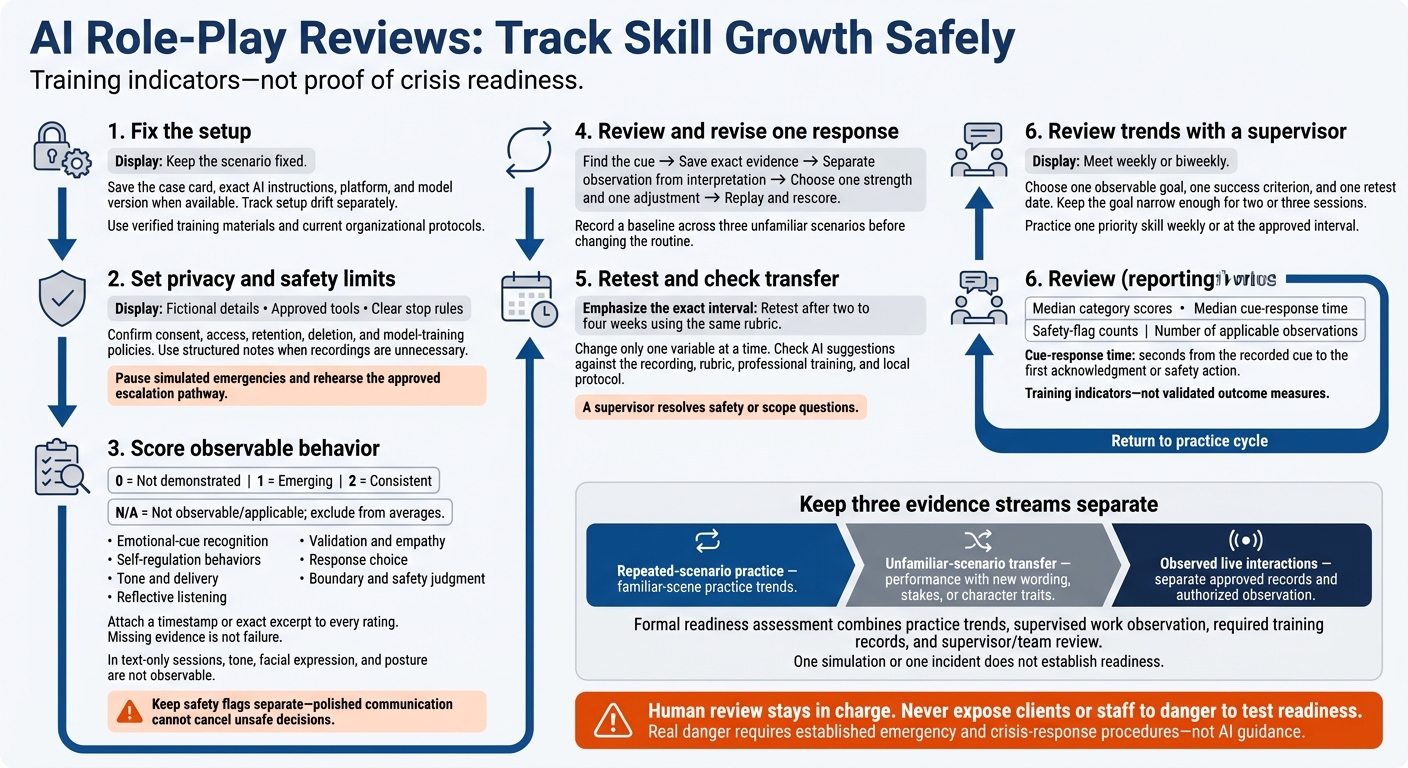
AI Role-Play Reviews: Track Skill Growth Safely
1. Set Up Consistent Role-Play Sessions
Define the Scenario, Goal, and Safety Limits
Use the same setup each time so score changes reflect behavior, not changes to the scenario. Create a reusable case card that includes the practitioner role, fictional client role, setting, problem, escalation level, available supports, goal, time limit, and fixed emotions and personality details.
Save the exact AI instructions, platform name, and model version when available. Keep the setup unchanged across sessions, then change only one variable at a time. Track setup drift, such as changed facts, intensity, or AI wording, separately from practitioner skill growth.
Build your checklist from verified training materials and current organizational protocols to reduce burnout among social workers, not an AI-generated standard. Score whether the practitioner reflects, validates, asks a relevant open question, uses nonjudgmental wording, states a clear limit, and pauses for a response. SAMHSA and CMS guidance support these behaviors.[2][3]
With the scenario set, decide what can be recorded and when the session must stop.
Protect Privacy and Set Stop Rules
Use entirely fictional details, not real cases with names swapped out. Before recording or uploading anything, confirm organizational rules for consent, approved tools, access, retention, deletion, and the use of inputs for model training. Removing identifiers alone doesn't guarantee privacy. Use structured notes when recordings aren't needed.[5]
Write stop rules into the instructions. Pause the exchange for simulated imminent self-harm, threats of violence that appear believable, access to a weapon, medical emergencies, or situations beyond the practitioner’s role. Then rehearse the approved escalation pathway.
Set a clear handoff point rather than improvising. The AI must not improvise a clinical or emergency response. Real danger requires human intervention and established emergency procedures.[6]
Create a Session Record
Use the same fields each time so you can compare scores and notes across sessions.
Record the session type, date, time, time zone, scenario ID, and format (text, voice, or video). Include the practitioner’s role and goal; the AI’s role, facts, and emotions; the exact prompt; platform name; model version; transcript; timing; checklist scores; reviewer notes; stop-rule events; and next target.
Keep scripted emotions separate from observed behavior. In text-only sessions, mark tone, facial expression, and posture as not observable. End the record with three fields: observed evidence, reviewer interpretation, and next action. Use that record as the baseline for the next scored attempt.
2. Score and Review Each Attempt
Score Observable Behaviors
Score each behavior, not the practitioner as a whole. Attach a timestamp or exact excerpt to every rating using the anchors below. “Consistent” means the behavior held throughout this attempt, not that it has been proven across situations. Leave missing evidence unscored. Missing evidence is not failure.
| Criterion | Not demonstrated | Emerging | Consistent | Not observable/applicable |
|---|---|---|---|---|
| Emotional-cue recognition | Misses a clear cue | Responds late or after prompting | Responds promptly to the stated concern or observable change | No relevant cue recorded |
| Self-regulation behaviors | Repeatedly interrupts or reacts to protect their own position | Pauses or adjusts inconsistently | Uses pauses and controlled turn-taking throughout | Relevant actions not recorded |
| Tone and delivery | Recorded delivery adds pressure | Volume or pace varies unhelpfully | Delivery stays measured and allows responses | No audio available |
| Reflective listening | Ignores or distorts the concern | Repeats words without checking meaning | Accurately reflects the concern | No opportunity to reflect |
| Validation and empathy | Dismisses the concern | Acknowledgment is vague or qualified | Acknowledges the experience without endorsing unsupported claims | No relevant opportunity |
| Response choice | Pushes an unsuitable next step | Offers a partly useful response | Chooses a proportionate question, option, or next step | Insufficient context |
| Boundary and safety judgment | Misses a required limit or escalation | Recognizes the issue but delays action | Follows role limits and required procedures promptly | No relevant safety decision |
Score pacing separately from wording. Even a respectful sentence can be rushed or interrupted. Assess posture, gestures, and distance only when visible, and don't assume they mean the same thing for everyone. Validation acknowledges someone's experience, not the truth of every accusation.
Keep safety flags separate. Polished communication cannot cancel an unsafe promise, a missed risk, or a failure to seek help.
Replay, Review, and Revise
Follow the same review sequence each time. This keeps feedback focused on a specific change rather than a general impression.
- Find the escalation point or stalled exchange, then mark the first observable cue immediately before it.
- Record the exact wording, along with any recorded tone, timing, interruptions, or actions. Label simulated intensity as falling, steady, rising, or unclear.
- Separate what happened from what you think it meant. Choose one strength and one adjustment.
- Replay with a shorter, safer, or more clarifying response. Log the revised score and its supporting evidence.
Check AI feedback instead of taking it at face value. Compare each suggestion with the recording, rubric, professional training, and local protocol. If they conflict, document the disagreement. Ask a supervisor to resolve safety or scope questions before you adopt the suggestion. A favorable reaction from the simulated character does not establish clinical appropriateness.
Compare Original and Revised Responses
The supplied fictional housing-referral comparison below tests wording alone. Delivery and timing stay unchanged. All reactions are hypothetical, not reported outcomes.
| Element | Original attempt | Revised attempt | Reviewer reasoning |
|---|---|---|---|
| Cue | Client reports referrals do not accept their voucher and repeats that the deadline is close | Same cue | Record the repeated concern, not an assumed emotion |
| Wording | Those are the referrals available. You need to apply quickly. | You’ve received referrals that do not fit your voucher, and the deadline is close. Which barrier should we check first: eligibility, location, or timing? | Replace the dismissive explanation with reflection and a focused question |
| Delivery | Keep the recorded baseline pace and volume | Keep both unchanged | Test pacing in a separate replay |
| Timing | Respond after the client finishes | Same turn-taking | Avoid changing several behaviors at once |
| Simulated effect | Hypothetically, intensity stays high | Hypothetically, intensity decreases slightly; uncertainty remains | Neither reaction proves the response was appropriate |
| Reviewer decision | Concern went unacknowledged | Reflection improves; referral availability still needs checking | Do not promise an unverified option |
Repeat the same scene once. Then test the selected skill in a different scenario with unfamiliar wording, stakes, or character traits. Track that transfer result separately from this attempt’s score. Script familiarity and AI variability can affect the replay, so improvement here is practice evidence, not crisis-readiness evidence.
AI Roleplay for De-Escalation Training: Build a Custom Simulator Without a Developer
3. Track Progress Across Practice Sessions
After scoring each attempt, compare results across dates, scenarios, and delays.
Log Skill Trends and Retest After a Delay
Keep three separate evidence streams. Use the rubric’s category labels, mark unobservable or inapplicable categories N/A, and leave N/A scores out of averages. Measure cue-response time in seconds, from the recorded cue to the first acknowledgment or safety action. Don’t infer when recognition occurred.
| Evidence stream | Date and scenario details | Applicable rubric scores and cue-response time | Safety review | Reviewer and next target |
|---|---|---|---|---|
| Repeated-scenario practice | Date (MM/DD/YYYY), scenario ID, emotional presentation, retest interval | Applicable ratings and timing | Flags and follow-up | Reviewer and one target |
| Unfamiliar-scenario transfer | Date, new scenario ID, emotional presentation, time pressure | Ratings and timing, kept separate from familiar attempts | Flags and follow-up | Reviewer and one target |
| Observed live interactions (separate record) | Date and brief approved context | Observed behavior, kept separate from simulation scores | Organizational documentation procedures | Authorized observer and follow-up |
Retest after two to four weeks using the same rubric. Then check performance across different emotional presentations and simulated time pressure. Report median category scores, median cue-response time, and safety-flag counts, along with the number of applicable observations. Label these summaries training indicators, not validated outcome measures.[7][8][9][10]
Use the log to choose one skill to work on next, rather than several at once.
Choose One Practice Goal With a Supervisor
Meet weekly or biweekly to review scoring and safety decisions. Compare two reviewers’ independent ratings of the same recording, and document their agreed interpretation of the rubric. Choose one observable goal, one success criterion, and one retest date.
Keep the goal narrow enough to work on over two or three sessions. If scores drop, check scenario difficulty, missing context, and scoring consistency before changing the coaching. Add guided practice, supervision, or workload support as needed, and follow established escalation procedures for repeated safety flags.
Treat score changes as training data, not a personal evaluation. Share only appropriately aggregated learning indicators with managers or funders. Don’t claim that these indicators show improved client outcomes.[7][9][10]
Use Personos to Organize Development Tasks
Start task tracking only after the scoring method is fixed.
Personos is an optional tool for organizing practice goals, prompts, and review dates. Treat its guidance as coaching support, not a scoring system, outcome measure, or readiness test. Get consent and organizational approval before entering personal information, and keep identifying details to a minimum.[11]
Conclusion: Separate Practice Progress From Crisis Readiness
Use the practice logs above to track growth, not judge readiness. A stronger role-play result shows learning, not crisis readiness. You can also elevate client relationships with personality psychology to improve communication outcomes. Consistent scenarios, observable scoring, and one change per review help show where skills are improving.
Use Several Sources to Assess Readiness
After repeated reviews, include practice trends as one part of a formal readiness assessment. Draw on several evidence sources. One simulation or one incident does not establish readiness.[4][2]
| Evidence source | What it shows | Main limits | Appropriate use |
|---|---|---|---|
| AI role-play score | Cue recognition, tone, and response choices under controlled conditions | Cannot reproduce actual danger, medical issues, physical risk, organizational constraints, or real responder coordination | Identify skill gaps and track practice trends |
| Supervised work observation | Behavior amid uncertainty, distractions, changing risk, organizational constraints, and responder coordination | Covers only observed situations; privacy and safety limits apply | Add context to competency review |
| Required training records | Completion of required safety and role training | Completion alone does not prove reliable performance | Verify prerequisites and refresher training |
| Supervisor/team review | How combined evidence meets role-specific standards and organizational policy | Depends on evidence quality and coverage | Support formal readiness decisions |
Never expose clients or staff to danger to test readiness. Use only permitted, supervised observations from actual work.[12][2]
Use the combined evidence to set your baseline and review schedule.
Set a Baseline and Review Schedule
Record a baseline across three unfamiliar scenarios before changing the routine. Practice one priority skill weekly or at the approved interval. Then review category trends during scheduled supervisor meetings.
Use the two- to four-week retest to check retention and unfamiliar scenarios to check whether skills carry over. Keep these findings in the practice record, separate from formal readiness decisions.[4]
When the situation is real, the process changes. Imminent danger, suspected overdose, another medical emergency, and threats of harm require established emergency and crisis-response procedures, not AI guidance. Follow site protocols, coordinate with designated responders, and call 911 when an immediate emergency response is needed. 988 provides behavioral-health crisis support when immediate physical intervention is not required.[13][14]
FAQs
How can I tell skill growth from script memorization?
Across repeated simulated conversations, check whether your tone and responses shift with emotional cues and situational details, or whether you keep using the same phrasing. Explain why you chose each approach, linking your reasoning to traits and the situation.
Review practice results separately from crisis performance. Then compare the two to see whether gains from practice carry over when pressure and context change [1][2].
What if my supervisor and AI score me differently?
Treat the scores as two separate signals, not one “truth.” Look at how your supervisor and AI read the same emotional cues, tone, and response choices. Personos explains the research-backed reasoning behind its guidance so you can compare the two, and it doesn’t need to share your scores with anyone. [1][2]
What evidence beyond role-play supports crisis readiness?
Beyond role-play, evidence includes Five Factor Model research on relationship dynamics and performance [1]. Personos coaching reports assess trauma responses, resource readiness, and stability factors. Shared ActionBoards track measurable progress [1]. Communication that takes personality into account can reduce misunderstandings and help people stay open to what's being said [1].
These sources can guide readiness assessments, but practice results should be evaluated separately from performance in actual crises.