How AI Reads Emotional Context in Client Talks
AI can flag speech cues to guide questions, but humans must verify interpretations and lead client care.
Christian Thomas

How AI Reads Emotional Context in Client Talks
I use AI to help decide what to ask, not what a client feels. A pause, faster speech, or repeated concern can prompt a check-in: “Would you like more time, or should we address a concern first?”
My approach comes down to 3 steps:
- Read: Review words, available audio cues, and approved notes. Text-only tools cannot hear tone, and past notes may be wrong or outdated.
- Respond: Check possible meanings with the client, then adjust pace, wording, or options.
- Document: Record what the client confirms and who will handle each next step, not an AI-generated emotion label.
I also explain recording and AI use separately, limit shared data, check for errors and bias, and test one low-risk task before expanding. <u>I never wait for AI confirmation when safety concerns arise.</u>
Tools such as Personos can help me plan conversations and follow-up using personality and relationship context. They do not read emotions directly or replace my judgment.
Customer Sentiment Analysis with APEX and AI
How AI Turns Conversation Signals Into Guidance
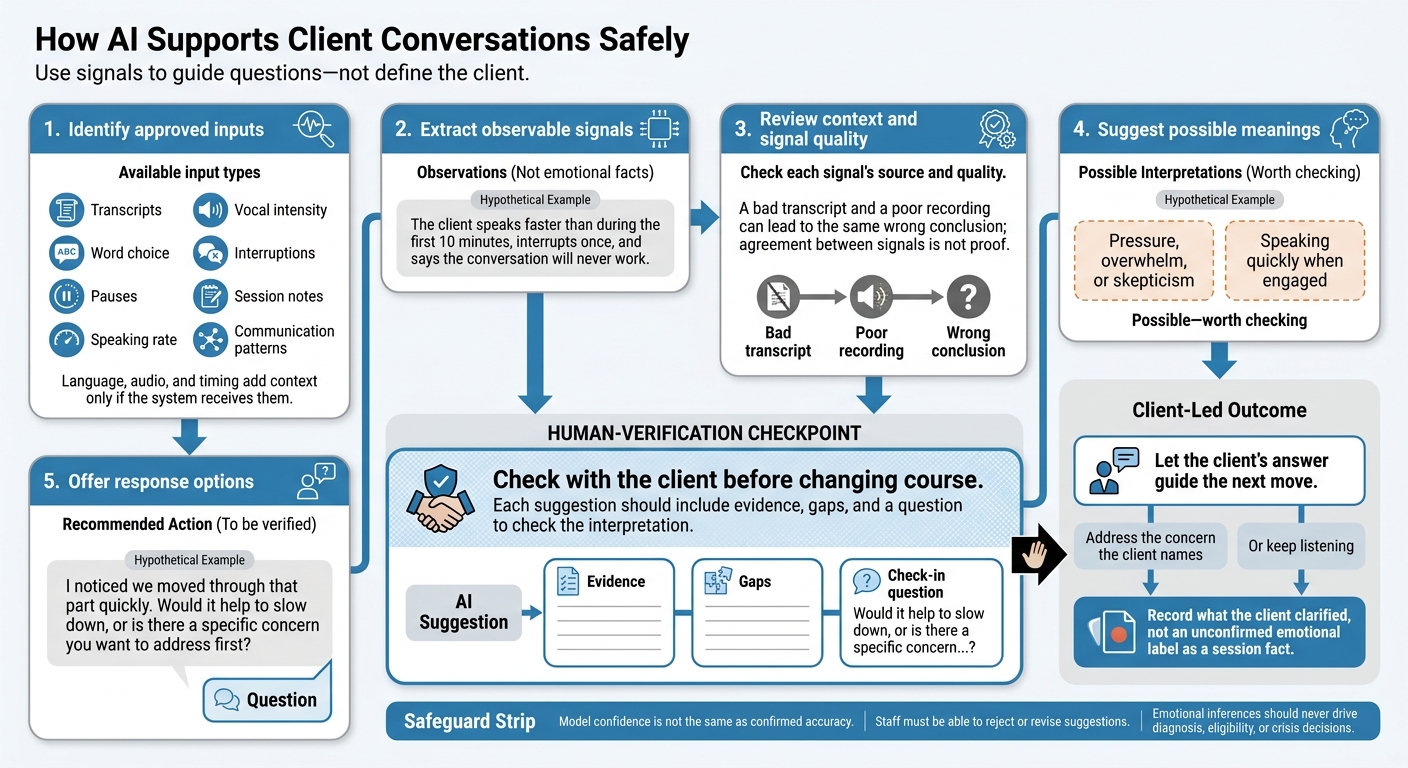
How AI Supports Client Conversations Safely
Moving from consent to staff action takes a few steps: identify approved inputs, extract observable signals, review context, suggest possible meanings, and offer response options. Inputs may include transcripts, word choice, pauses, speaking rate, vocal intensity, interruptions, session notes, and communication patterns. Each suggestion should include evidence, gaps, and a question to check the interpretation.[6][7]
Then separate what the system observed from what it thinks those observations mean.
Language, audio, and timing add context only if the system receives them. Signals that agree aren't proof: a bad transcript and a poor recording can both lead to the same wrong conclusion. Confidence should depend on context and signal quality, not just the number of signals. Ask the tool to show each signal's source and quality rather than a single emotion label.[6]
Separate Observations From Possible Meanings
Hypothetical example: The client speaks faster than during the first 10 minutes, interrupts once, and says the conversation will never work. Those are observations. Pressure, overwhelm, or skepticism are possible meanings; speaking quickly when engaged is another explanation. Check before changing course by saying: I noticed we moved through that part quickly. Would it help to slow down, or is there a specific concern you want to address first?
Let the client's answer guide the next move. Staff can address the concern the client names or keep listening instead of automatically following the AI's preferred interpretation. Record what the client clarified, not an unconfirmed emotional label as a session fact. This ensures data integrity when using the Five Factor Model for AI-assisted therapy.
Consider Other Explanations
Compare observations, possible meanings, other explanations, and safer responses side by side.
| Observed signal | Possible meaning | Alternative explanation | Response |
|---|---|---|---|
| Several seconds of silence after a question | Uncertainty, distress, or mistrust | Translating, processing, audio delay, or needing privacy | Offer time, then ask whether rephrasing would help. |
| Absolute statements such as you never listen or nothing will change | Feeling unheard or discouraged | Habitual wording, emphasis, or a recent bad experience | Ask which event or missed concern to address first. |
| Increased vocal intensity or faster speech | Frustration, fear, or urgency | Background noise, hearing differences, microphone distortion, or enthusiasm | Ask what feels most urgent without calling it anger. |
Use these alternatives to slow down, reframe, and ask one clarifying question before acting.
Model confidence is not the same as confirmed accuracy. A confident output can still be wrong for this client, language, or setting. Prefer suggestions labeled possible or worth checking, with other explanations visible. Staff must be able to reject or revise suggestions. Emotional inferences should never drive diagnosis, eligibility, or crisis decisions.[6][7][8]
How Staff Can Respond and Build Trust
When AI flags a possible emotional pattern, respond to what the client means, not the label. AI output is a prompt for a human response, not a final assessment of the client.
Match Language and Pace to Client Needs
If AI flags overload, frustration, or withdrawal, adjust your response, not your view of the client. If the client seems overloaded, use short sentences and ask one question at a time. For frustration, acknowledge the concern before explaining policy. For withdrawal, give the client space rather than repeating prompts. If concerns are mixed, reflect both.
Check whether the client wants a phone call, text, written information, an interpreter, a support person, or more time.[9][10][14] Matching their pace reduces friction; acknowledging their concerns builds trust.
Acknowledge Concerns Before Offering Solutions
Name the concern, not the emotion. Use personality psychology and reflective listening to check your understanding before offering options.[17][18] When a decision goes against the client, explain why and what options remain. If the client distrusts the agency, don’t debate their account or expect immediate trust. Explain what is required, optional, and confidential under the policy that applies.[11][12][9][10]
The scripts below show how to acknowledge concerns, match the client’s pace, and discuss next steps.
Practice scripts only; verify policy, deadlines, and options before use.
Situation Generic reply Context-sensitive reply Missed housing appointment We missed you at today’s appointment. Would you like to reschedule, tell me what made today difficult, or receive the information another way? We did not connect today. The appointment was about your rental-assistance application, and no decision was made today. Would you like to reschedule now, or should I send the available times by text? Confirm the preferred contact method. Adverse eligibility decision Your application was denied. You can appeal. The application was not approved because the agency listed missing income documentation. Would you like to review the notice now or receive a copy? Verify the appeal deadline and agree who will follow up. Distrust of a case-management agency We are here to help, so you need to cooperate. You are not required to decide this before you understand how the information will be used. Would you prefer to review the consent form together, involve an advocate, or take a break? Ask what would help you decide whether to continue today.
Use a Before, During, and After Checklist
Put interpretation into practice: read → respond → document.
- Before: read. Review only permitted, relevant records. Check communication preferences, accessibility needs, and prior commitments. Prepare only options allowed by policy.
- During: respond. Notice how the client is responding now, check tentative AI interpretations with them, and adjust your language, pace, format, or level of detail. Ask one question at a time when appropriate. If distress escalates or safety concerns arise, follow safety procedures immediately to reduce burnout. Do not wait for AI confirmation.
- After: document. Record facts, the client’s words, decisions, preferences, and follow-up separately from AI interpretations. Specify who will act, what will happen, and by when. Check whether your response helped and whether the client wants a different follow-up method. Follow agency rules for storing or sharing AI-generated content.[13][15][16]
How Personos Supports Client Communication
Personos is an AI-powered personality and context tool for helping professionals. It uses personality profiles shared with consent, relationship information, goals, and practitioner-provided context to suggest communication strategies.
Personos supports interpretation and planning, but it doesn’t replace live interpretation. The practitioner still needs to check the client’s current experience through conversation. Its role is to help with preparation and follow-through.
Prepare With Personality and Relationship Context
Personos says its Five Factor Model assessment measures 30 personality facets on an 80-point scale.[1] Use the profile to anticipate which approach might work best: a clear agenda, time to reflect, plain language, or multiple options. Treat Dynamic Reports as planning aids, not diagnoses or fixed explanations.
Ask Chat for options, then review the Scientific Explanation to understand the traits and situational details behind its guidance. A relationship report can help identify friction between communication styles without assigning blame.
Plan and Track Follow-Up
After the conversation, use the same context to keep next steps consistent. Personos Prompts offer short suggestions. ActionBoard tracks agreed follow-up, owners, due dates, and check-ins to help maintain continuity, not contact clients on its own.[1]
Current evidence does not show reduced burnout or better outcomes.
Compare Tools by Purpose and Workflow
Personos fits best when you need to prepare for difficult conversations and carry out agreed follow-up using personality and context. It is not designed to read emotion directly. Before adopting it, verify its current capabilities, privacy terms, retention rules, and integrations.
That purpose sets Personos apart from tools that only score sentiment or draft responses.
| Tool category or product | Primary purpose | Input context | Human oversight |
|---|---|---|---|
| Generic sentiment tools | Classify text as positive, negative, or neutral | Messages or transcripts | Check meaning and context |
| Voice analytics systems | Analyze pace, pauses, pitch, or other vocal features | Audio or recorded calls | Check recording consent, accuracy, and limitations related to culture or disability |
| General-purpose AI assistants | Draft, summarize, brainstorm, or answer questions | User-provided prompts and files | Verify facts, privacy, and suitability |
| Personos | Personality-guided communication planning and follow-up for helping professionals | Profiles, relationship details, goals, and permitted notes | Validate inputs, recommendations, and workflow fit [1] |
How to Use AI Safely and Check Results
Protect Consent and Client Privacy
Set consent and privacy rules before AI informs client-facing decisions.
Where feasible, obtain informed consent in plain language. Explain what AI analyzes, why, who can access the data, how long it’s kept, whether it’s used to train models, and how clients can decline or withdraw. Explain recording, transcription, and analysis separately. U.S. recording-consent rules vary by jurisdiction. Upload only the data needed for the task.[25][28][29]
Require a written review of the data flow and vendor. Cover encryption, access controls, multifactor authentication, logs, incident response, third parties, storage location, retention, deletion, export, and training use. Get limits in the contract, rather than relying on marketing claims. Check HIPAA and 42 CFR Part 2 separately when protected health information (PHI) or covered substance-use records are involved.[22][23][25][26][27][28]
Check Bias and Reading Errors
AI outputs are hypotheses, not conclusions, even when they look convincing. Use AI to support decisions, not make them. It can flag possible emotional cues, but it shouldn’t decide what a client feels or make high-stakes decisions on its own. Staff must independently review the underlying words or transcript, compare the output with the client’s stated experience, document their reasoning for actions with serious effects, and escalate uncertainty through existing procedures.[24]
Vocal cues can prompt follow-up. They do not prove intent, honesty, diagnosis, or risk.[24]
| Limitation | Potential consequence | Safeguard |
|---|---|---|
| False-positive emotion detection | Ordinary pauses, frustration, or direct speech get labeled as hostility, distress, or resistance | Present outputs as hypotheses; ask open questions before acting |
| Missed distress or muted emotion | A client’s risk or need for support gets overlooked | Follow the organization’s normal screening, supervision, and crisis protocols independently of AI |
| Differences associated with culture, race, gender, age, accent, communication style, or disability | Unequal labels, inappropriate responses, or loss of trust | Test performance across relevant client groups; provide accessible alternatives and don’t treat group averages as individual facts |
| Language, dialect, translation, or transcription errors | The system analyzes words the client didn’t say or misses negation, sarcasm, or code-switching | Review audio or the original language when possible; allow corrections and avoid automated action based on uncertain transcripts |
| Missing nonverbal and situational cues | The system misreads meaning because it cannot reliably assess context, relationship history, surroundings, or body language | Ask the client and practitioner for context; don’t infer emotion from vocal patterns alone |
| Automation bias | Staff accept a confident-sounding output despite contradictory evidence | Require a documented independent assessment, display uncertainty, and conduct supervision audits |
| Overinterpretation of vocal patterns | Tone or pace gets treated as proof of intent, deception, diagnosis, or safety risk | Separate observations from interpretations and use validated clinical or organizational procedures for high-stakes judgments |
Test Usefulness Before Expanding
Once safeguards are in place, pilot one narrow, low-risk workflow at a time. Don’t start with autonomous crisis triage or eligibility decisions.
Establish a baseline for client-reported communication quality and completion of agreed follow-ups, then compare pilot results against it. Track client feedback, inappropriate suggestions, missed concerns, and correction rates across relevant client groups where lawful and ethically appropriate.
Limit extra sensitive-data collection, define who can access pilot data, and set a short retention period. Verify privacy claims and how the integration actually works before processing client data.
Expand only after the pilot shows a benefit without new privacy, equity, or trust problems.
Conclusion: Keep Human Judgment at the Center
Use emotional signals to guide questions, not define the client. Read tone, wording, pace, conversation history, and session notes alongside the client’s stated concerns and circumstances. Treat interpretations as tentative, check your understanding, and match your language and pace to the need the client actually expresses.[20][19]
Personality context can help staff prepare, but it must sit alongside the current conversation. Emotional signals guide the moment; personality guidance informs broader communication patterns. A platform such as Personos can support context-aware preparation and follow-up. Staff should verify its guidance and keep it open to revision, rather than treat it as a fixed description of the client.
AI can support interpretation, but staff remain responsible for empathy, trust-building, crisis response, consent, and confidentiality. Better context doesn’t shift that responsibility: AI’s role is to support human judgment, not replace it.[30][21]
FAQs
What should I do when AI contradicts a client?
When AI guidance conflicts with what a client says, put the therapeutic alliance first. Treat AI as a tool for reflection, not a source of absolute truth. Personos explains the reasoning, personality traits, and psychological principles behind its suggestions, so you can review them before choosing your next step.
Use that context to balance empathy with objectivity, reframe the conversation, or validate the client’s perspective without setting aside your professional judgment or intervention style.
How can I use AI if a client declines recording?
If a client declines recording, you can still use AI. Manually enter session notes, observations, and specific challenges into a platform like Personos. Personos uses those details and the client’s personality profile to offer tailored guidance for de-escalation, validation, and reframing.
Without a live recording, this approach helps preserve session privacy while offering personality-aware advice you can put into practice to build trust and handle difficult interactions.
How do I know AI guidance is building trust?
See the research-backed reasoning behind each recommendation [1][2]. Personos explains how situational details, personality traits, and psychological principles shape its advice [1][3]. That transparency helps you act with confidence: you know the guidance fits your professional context and the dynamics of your client relationships [1][4][5].