How AI Promotes Equity in Workplace Communication
AI tools—real-time bias detection, participation analytics, personalization, and objective feedback—reduce communication bias and improve workplace inclusion.
Rachel Johnson

How AI Promotes Equity in Workplace Communication
AI is changing how we communicate at work, helping to reduce bias, improve collaboration, and make workplaces more inclusive for everyone.
Here’s how:
- Real-time feedback tools: AI identifies biased language or microaggressions instantly, suggesting neutral alternatives to improve communication.
- Participation tracking: It ensures quieter voices are heard by analyzing meeting dynamics and encouraging balanced contributions.
- Personalized communication: AI tailors messages based on individual styles, helping managers connect better with employees.
- Objective evaluations: AI reduces bias in performance reviews by focusing on measurable outcomes instead of subjective opinions.
For example, companies like Merck have seen 74% of employees revise their wording after AI flagged bias, while IBM’s AI tools improved employee autonomy by 15%. These tools don’t just improve communication - they help build trust and fairness across teams.
The key takeaway? AI isn’t here to replace human judgment but to guide it with data-driven insights, creating workplaces where everyone’s voice matters.
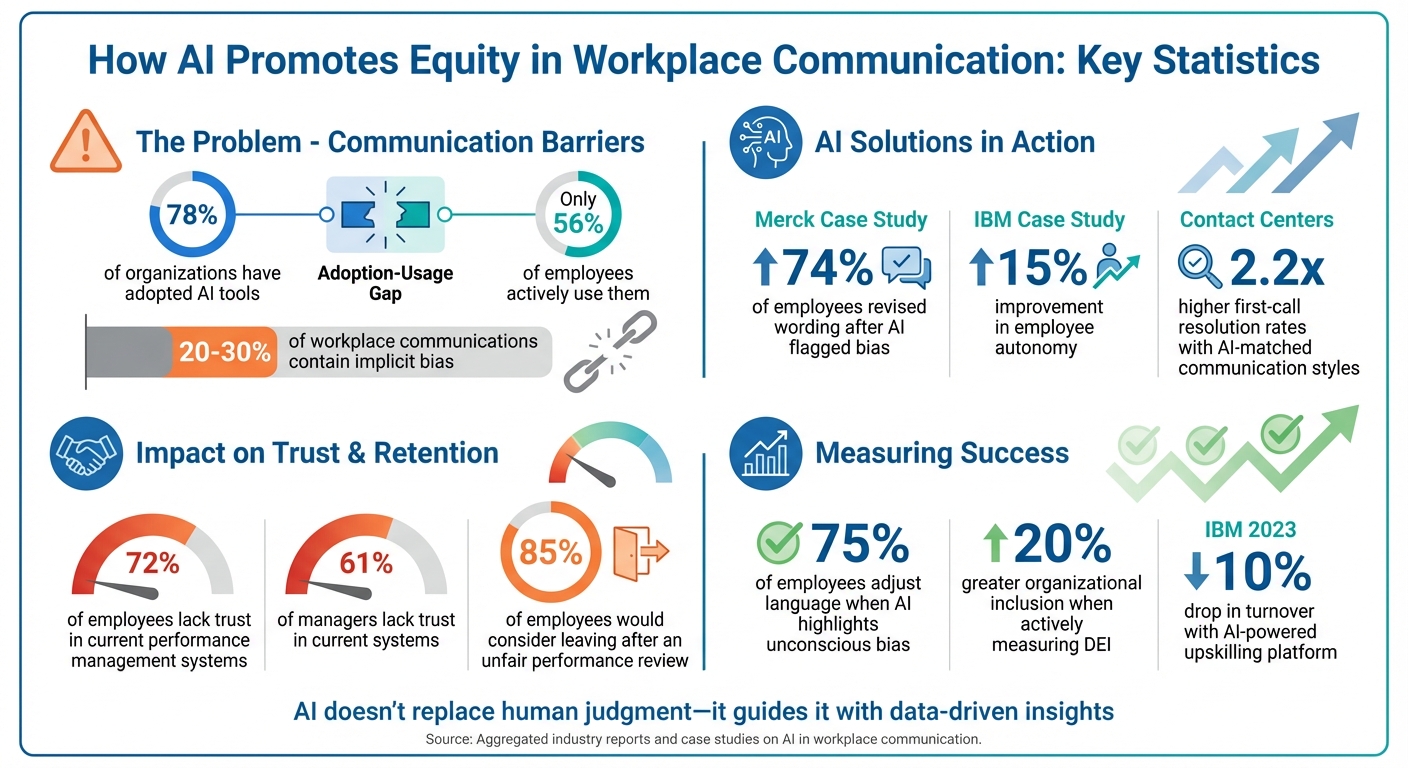
AI Impact on Workplace Communication Equity: Key Statistics and Outcomes
Workplace Power Dynamics and Communication Barriers
Common Communication Barriers
Workplace hierarchies often create gaps in access and understanding. For instance, when only certain team members have access to advanced tools, these "technological asymmetries" can skew how contributions are perceived and lead to unfair assumptions about competence [5].
Marginalization in the workplace can drain motivation and weaken team bonds. Hierarchical imbalances often suppress supportive behaviors and silence diverse perspectives. On top of that, conversational dominance and microaggressions can further alienate voices that are already underrepresented [5][2].
"GenAI tools will impact our conversational habits, which direct what we say and who we hear." - Megan Reitz and John Higgins, Harvard Business Review [6]
Interestingly, while 78% of organizations have adopted AI tools, only 56% of employees actively use them. This disparity creates a two-tier system that reinforces existing power structures [5]. These communication barriers highlight the pressing need for AI solutions that can help balance workplace dynamics.
How Technology Addresses Power Imbalances
AI can play a pivotal role in addressing these imbalances by offering neutral, data-driven insights. For example, it can analyze language and participation patterns to identify domination or biased language, allowing for timely interventions [1].
Real-time feedback tools can flag disrespectful tones and provide confidential suggestions for more inclusive wording [2]. Additionally, voice-based analysis of turn-taking can identify when certain individuals dominate conversations, prompting moderators to include quieter team members [4][2].
AI Strategies for Promoting Equity in Communication
Real-Time Bias Detection and Language Optimization
AI has the ability to analyze workplace communication in real time, spotting biased language and suggesting neutral alternatives. For instance, it can identify terms like "aggressive" when describing women or "promising" when referring to men and recommend adjustments to make the language more inclusive [7][2].
In 2024, Merck introduced the Workhuman Inclusion Advisor, a tool designed to flag potentially biased language in employee recognition messages. The results were striking: 74% of Merck employees opted to revise their wording after the AI highlighted issues. Celeste Warren, Merck's Vice President of Global Diversity and Inclusion, explained:
"It helps us recognize people and ensure we're using words that are inclusive and instill confidence, and it really helps people feel good about their reward" [10].
AI doesn’t stop at language - it also ensures evaluations are based on objective metrics like project completion rates and goal achievements, reducing the influence of affinity or recency bias [7]. Additionally, it can identify microaggressions in both written and verbal exchanges, fostering a more respectful environment [2].
Interestingly, research shows that 20-30% of workplace communications contain implicit bias, even in seemingly positive contexts. When AI tools highlight these unconscious biases in real time, 75% of employees choose to adjust their language [10]. Maria Valero, Editorial Strategist at Workday, emphasizes the impact:
"AI acts as a transparent, objective partner to managers, making sure the rules of success are clear and applied equally to all" [7].
Beyond real-time bias detection, AI is reshaping communication by personalizing interactions to enhance inclusivity.
AI-Driven Personalization for Inclusive Interactions
AI doesn’t just detect bias; it also personalizes communication to align with individual styles, creating a more inclusive environment. Tools like Personos use personality insights to craft tailored prompts for situations like performance reviews, promotions, and conflict resolution. By adapting to individual communication preferences, these tools reduce friction and ensure messages resonate [9].
When communication styles clash, inclusivity can suffer. Research from Cornell University highlights that mismatched AI suggestions can lower user confidence, particularly for minoritized gender groups [8]. Tools that adapt to personal preferences help bridge these gaps, making everyone feel valued and understood.
AI also enhances team dynamics by matching individuals based on compatible communication styles. For example, in a study of 445 businesses using AI in contact centers, companies achieved 2.2 times higher first-call resolution rates when AI detected customer emotions and paired them with representatives who matched their communication style [2].
IBM's "Opportunity Team Builder" takes this concept even further. It assembles sales teams by analyzing social skills and predicting team impact. The AI not only identifies the best candidates for the project but also ensures diversity by filling skill gaps with professionals from different backgrounds. This approach creates balanced teams that consistently deliver stronger results [2]. These personalized strategies are paving the way for more equitable communication at every level of the workplace.
Improving Team Dynamics with Personos
Dynamic Personality Reports for Balanced Communication
Personos combines personality psychology with AI to create detailed reports that reveal how communication styles shape team dynamics. By analyzing patterns in idea sharing, questioning, and feedback, it highlights areas that might go unnoticed by traditional management.
For instance, if certain individuals dominate conversations while others remain quiet, Personos identifies these imbalances and provides insights into the underlying reasons. This approach shifts the focus to data-driven coaching, helping managers address each team member's strengths and challenges effectively [7].
Consider this: 72% of employees and 61% of managers lack trust in their organization's current performance management systems [7]. Personos bridges this trust gap by turning communication patterns into actionable insights. Instead of relying on subjective opinions, managers gain access to concrete data about how individual contributions influence team efficiency and decision-making [7].
Armed with these insights, Personos also offers tools designed to promote continuous and equitable collaboration.
Proactive Prompts and Task Tracking for Equal Collaboration
Personos steps in before problems escalate. The platform provides proactive communication prompts tailored to each team member's personality profile. These prompts guide managers in adapting their communication style, whether they're preparing for a performance review, resolving conflicts, or delegating tasks. This personalized approach ensures that messages align with each individual's preferences, reducing misunderstandings.
Additionally, Personos integrates personality insights into task tracking, ensuring that workflow management remains fair and inclusive. By linking contributions to personality data, the platform prevents status hierarchies and guarantees recognition for all team members, regardless of their communication style. This transparency is particularly important, as 85% of employees say they'd consider leaving after receiving a performance review they believe is unfair [7]. By addressing these concerns, Personos helps improve retention and morale while fostering a more cohesive team environment.
Measuring the Impact of AI on Workplace Equity
Metrics for Measuring Equity
While AI plays a role in fostering balanced workplace communication, measuring its impact is where the real progress begins. Tracking specific metrics allows organizations to turn diversity, equity, and inclusion (DEI) goals into tangible outcomes. Research shows that companies actively measuring DEI, holding teams accountable, and embedding inclusion into talent processes experience up to 20% greater organizational inclusion compared to their peers [12]. The key lies in focusing on clear, actionable data rather than vague impressions.
Start by examining employee sentiment across areas like fair treatment, inclusion, psychological safety, trust, and belonging [12]. These insights reveal how employees perceive communication equity in their day-to-day work. Additionally, track process equity metrics throughout the employee lifecycle to identify and address biases quickly. For example, consistently higher performance ratings for certain communication styles could signal underlying inequities [11][14].
Don’t stop at overall averages - dig deeper by monitoring trends over time. This approach helps uncover disparities within specific teams or departments that might be hidden in broader data [12]. By tracking these metrics, organizations can create a foundation for continuous, data-informed improvement.
Using Data to Drive Continuous Improvement
Organizations are moving away from annual surveys and adopting "just-in-time" pulse surveys to capture employee sentiments in real-time, especially in dynamic hybrid work settings [12]. These shorter feedback cycles allow managers to address communication inequities more effectively and without delay.
Quantitative data is a great starting point, but it works best when paired with qualitative insights. For instance, focus groups or listening sessions can help uncover the root causes behind declining participation in virtual meetings. Issues might range from technology challenges to scheduling conflicts or even a lack of inclusion in decision-making processes. Combining AI-driven insights with tools like implicit association tests can also provide a way to track shifts in unconscious biases over time [13].
A strong example of this approach comes from IBM. In 2023, the company rolled out an AI-powered upskilling platform that used transparent algorithms and diverse training data. The results? A 15% boost in employee autonomy and a 10% drop in turnover across its global teams [15]. IBM’s success stemmed from its commitment to continuously monitoring equity metrics and refining the platform based on employee feedback. This case highlights how data-driven strategies can lead to meaningful, lasting change.
sbb-itb-f8fc6bf
Best Practices for Human Oversight in AI Tools
Ensuring Transparency and Accountability
AI tools in workplace communication demand thoughtful oversight. Companies must establish clear systems to monitor these tools, ensuring transparency in how they function and the decisions they influence. For example, in 2024, Microsoft revealed that 77% of cases handled by its Sensitive Uses and Emerging Technologies team involved generative AI[17]. Without proper oversight, rushing these tools into use can lead to unintended problems.
One effective strategy is human-in-the-loop (HITL) oversight, which helps prevent "deskilling" - a situation where employees lose critical abilities due to over-reliance on automation. HITL also ensures that decision-making remains a human responsibility[16]. A practical example comes from Deutsche Telekom AG, which, in the mid-2010s, formed a Workforce Analytics Expert Group. This group reviewed how employee data was utilized, requiring management to consult with a works council before adopting new technologies. The result? Improved service quality scores and greater trust in tools like speech analytics[3].
Transparency is another key element. Clear documentation about how AI operates, its limitations, and its intended use fosters trust among employees[17]. LinkedIn set a strong example in 2024 by becoming the first professional networking platform to display C2PA Content Credentials for all AI-generated images and videos[17]. These efforts illustrate how robust oversight can pave the way for better integration of AI insights with human understanding in workplace communication.
Combining AI Insights with Emotional Intelligence
While AI excels at identifying patterns, it cannot replace the human touch, especially in sensitive workplace interactions. The most effective use of AI lies in leveraging its insights for coaching and development rather than for punitive measures or surveillance. Treating AI outputs as flexible guidelines allows organizations to adapt responses to specific contexts[18].
Consider the Writers Guild of America, which negotiated contract terms requiring full disclosure of AI-generated material, empowering writers to decide how to incorporate AI into their work. Similarly, National Nurses United introduced an "AI Bill of Rights" to ensure AI tools enhance, rather than undermine, human expertise[3]. These examples highlight the importance of maintaining a balance in AI-augmented environments. By doing so, organizations can ensure that technology enhances equitable communication while preserving the human judgment necessary for inclusive and effective workplace interactions.
LEA EP132: How AI Impacts Biases & Inequities In The Workplace With Kieran Snyder
Conclusion
AI is reshaping workplace communication by tackling power dynamics head-on. Tools like real-time bias detection help identify microaggressions as they happen, while meeting analytics ensure that quieter voices in a team are heard. These technologies rely on data-driven insights, helping to bridge trust gaps by moving feedback away from subjective opinions and toward objective evaluation.
Take Personos, for example. This platform uses AI to deliver personality insights that promote fairness across an organization. By combining dynamic personality reports with tailored communication prompts, managers can now offer personalized coaching to entire teams - something that was once reserved for executives. This approach reduces unconscious bias in everyday interactions, making equity more accessible on a larger scale.
Of course, none of this works without human accountability. As Megan Smith-Branch, Deputy Lead for Responsible AI at Booz Allen, puts it:
"The beauty of technology is that it magnifies human fault objectively. We are living in a time when technology is providing us a playbook on how to address systemic issues" [19].
AI should act as a guide, not a ruler. It can provide recommendations, but the responsibility for turning those recommendations into action lies with people [2].
FAQs
How does AI identify and suggest improvements for biased language in real time?
AI-powered tools work behind the scenes as you type, using advanced language models and a carefully designed bias lexicon to spot terms or phrases that might carry unintended bias. These systems look for patterns that could signal exclusion, such as gender-specific language, assumptions tied to age, or expressions rooted in specific cultural contexts. When the tool flags a potentially biased term, it explains why the term might be problematic and suggests inclusive alternatives that align with your intended message.
These recommendations appear instantly within your writing interface, giving you the chance to refine your text before sharing it. By providing real-time feedback and practical suggestions, tools like Personos help promote communication that’s more inclusive, ensuring everyone on the team feels valued and understood.
How does AI help create more equitable communication in the workplace?
AI brings a fresh approach to promoting fairness in workplace communication by tackling power imbalances head-on. Through real-time analytics, it ensures every team member gets a chance to be heard. For instance, it can provide personalized prompts to encourage quieter individuals to share their thoughts, while also helping leaders guide conversations in a way that includes everyone. By analyzing personality traits and communication styles, AI offers tailored feedback that minimizes dominant-speaker bias, opening up the floor to a broader range of perspectives.
AI tools also play a key role in identifying and addressing biased language. They can suggest more inclusive phrasing and monitor communication patterns to ensure teams stay accountable in fostering fairness. These features don’t just tweak conversations; they help reshape team dynamics. The result? A workplace where everyone has an equal chance to contribute and influence decisions, building a more balanced and welcoming culture for all.
How does AI help create more inclusive team communication?
AI has the potential to make team communication more inclusive by tailoring interactions to suit each person’s communication style and needs. Through personality-based insights and real-time analytics, it can spot when certain voices are being overlooked and offer suggestions to ensure everyone has a chance to contribute. Additionally, AI can help balance discussions by moderating overly dominant participants and identifying subtle biases, like gendered language or stereotypes, fostering a fairer and more respectful dialogue.
When implemented thoughtfully, AI can promote equity in the workplace by delivering immediate, data-backed feedback and encouraging diverse participation. By prioritizing transparency, involving employees in the process, and regularly checking for bias, organizations can leverage AI to build a team environment where every voice is heard and valued.