AI-Powered Roleplay for Conflict Training
AI roleplay turns workplace conflict into a practical training tool, building empathy and communication through realistic simulations and instant feedback.
Christian Thomas

AI-Powered Roleplay for Conflict Training
85% of employees face workplace conflict, yet only 60% receive training to handle it effectively. This gap leads to missed deadlines, reduced productivity, and high turnover. AI-powered roleplay offers a practical solution by simulating real-life conflict scenarios with virtual AI personas.
Key benefits include:
- Real-time feedback: AI analyzes tone, language, and emotional cues to suggest better communication strategies.
- Safe practice environment: Rehearse difficult conversations without real-world risks.
- Empathy-building: Experience both sides of a conflict to improve understanding.
- 24/7 accessibility: Train anytime, eliminating scheduling barriers.
Platforms like Personos enhance this training with personality insights, dynamic scenarios, and actionable reports, making it easier to master conflict resolution outcomes. At $9 per seat per month, this training is scalable for teams of any size.
AI roleplay transforms conflict into a learning opportunity, helping employees improve communication, teamwork, and emotional intelligence.
Benefits of AI Roleplay in Conflict Training
Improving Active Listening and Empathy
AI roleplay offers a unique way to build empathy by letting you step into different roles during conflict scenarios. For instance, one session might have you acting as a frustrated employee, while another places you in the shoes of a stressed manager. Experiencing both sides of a situation helps you grasp the deeper reasons behind someone's behavior, not just the surface-level reactions.
The system tracks how well you recall key points, respond to emotional cues, and use neutral language. It also highlights subtle missteps, such as assuming a colleague is "stressed" instead of neutrally observing that "the situation seems challenging." By encouraging objective language, AI minimizes assumptions that can intensify workplace conflicts.
If you use phrases likely to escalate tension - like "You're wrong" - the AI suggests more empathetic alternatives, such as, "I see it differently - can we explore both perspectives?" Research indicates that using "I-language" (e.g., "I feel this way") significantly reduces perceptions of hostility [4]. The AI helps you practice these techniques until they become second nature, combining empathetic communication with instant feedback to refine your skills in real time.
Real-Time Feedback and Pattern Recognition
Alongside empathy-building, AI provides immediate corrections to improve your communication. Natural language processing (NLP) flags judgmental phrases, exaggerations, commanding tones, and blame. Sentiment analysis evaluates emotions like joy, anger, or frustration by analyzing your words, tone, and pacing [5].
The system’s instant feedback, paired with visual dashboards, helps you identify and adjust problematic patterns before they escalate. It reveals insights you might overlook, allowing you to steer conversations more effectively.
"Our AI training allows businesses to boost customer service while controlling costs. Agents achieve full proficiency faster, leading to higher customer satisfaction. The [AI] ecosystem enhances key performance metrics like first call resolution, handle time, and NPS."
– Pj Singh, Chief Digital Officer, iQor [1]
Unlike human trainers, whose feedback can vary based on mood or personal biases, AI ensures consistent and impartial responses. Advanced tools like Personos use pattern recognition to deliver actionable insights tailored to your unique communication style and the specific dynamics of each conflict.
Risk-Free Practice for High-Stakes Scenarios
AI provides a safe space to practice handling difficult situations without real-world consequences. Whether you're giving critical performance feedback, mediating a heated team disagreement, or managing an upset customer, these scenarios often carry professional risks.
A 2025 study by Sam Houston State University explored this concept with seven graduate students role-playing supervisor-employee conflicts. Acting as supervisors, the students practiced with AI portraying a "challenging employee." The study showed measurable improvements in communication skills and increased confidence in navigating tough conversations [6]. In another experiment, 64.52% of participants using AI reached a "Conflict Resolved" outcome, compared to 60.71% with human counselors [7].
AI allows you to experiment freely, apply feedback instantly, and refine your approach until mastery is achieved. Researchers refer to this as "cognitive scaffolding", where the system temporarily reduces the mental strain of high-stakes situations. This enables you to focus on learning effective communication strategies rather than being overwhelmed by anxiety. Unlike human trainers, who may experience compassion fatigue or unconscious bias, AI delivers consistent, reliable responses every time [7].
Mediation Training 2.0 - Human + AI-Assisted Simulations
Traditional Conflict Training vs. AI Roleplay
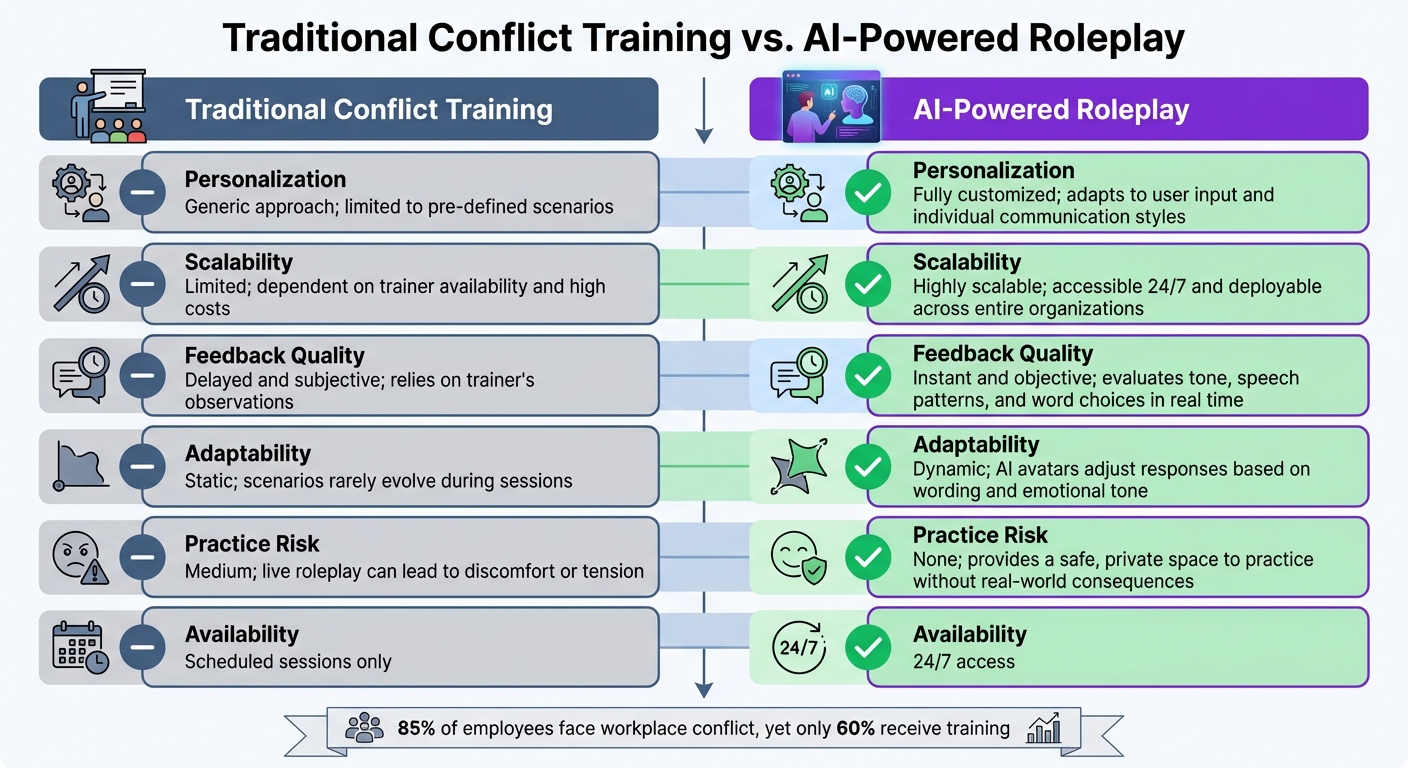
Traditional vs AI-Powered Conflict Training Comparison
Traditional conflict training typically happens through one-off workshops or scheduled mediations. These sessions are often costly, time-intensive, and limited by the availability of trainers. Anne Hsu from the School of Electronic Engineering and Computer Science at Queen Mary University of London highlights a major issue with this approach:
"Traditional conflict‐resolution training is mostly delivered in one‐off sessions with practice opportunities limited to a fixed number of pre‐defined role play scenarios. This is insufficient for acquiring the notoriously difficult skill of communicating effectively amidst conflict" [4].
AI-powered roleplay offers a game-changing alternative. Instead of waiting for a scheduled session, you can practice conflict scenarios anytime - day or night. The feedback is immediate, objective, and tailored to your specific communication style, analyzing word choices, tone, and patterns in real time. Studies show that AI platforms encourage more frequent practice by eliminating the logistical barriers of traditional methods [1].
Another advantage of AI roleplay is its ability to create a psychologically safe environment. Practicing difficult conversations with colleagues or supervisors can feel awkward or even intimidating. With AI, you get a private, judgment-free space to experiment, make mistakes, and refine your skills without the fear of social repercussions [1][3].
Comparison Table
| Feature | Traditional Conflict Training | AI‐Powered Roleplay |
|---|---|---|
| Personalization | Generic approach; limited to pre-defined scenarios [4] | Fully customized; adapts to user input and individual communication styles [2][3] |
| Scalability | Limited; dependent on trainer availability and high costs [1][4] | Highly scalable; accessible 24/7 and deployable across entire organizations [1][2] |
| Feedback Quality | Delayed and subjective; relies on trainer's observations [1] | Instant and objective; evaluates tone, speech patterns, and word choices in real time [1][2] |
| Adaptability | Static; scenarios rarely evolve during sessions [4] | Dynamic; AI avatars adjust responses based on your wording and emotional tone [2][3] |
| Practice Risk | Medium; live roleplay can lead to discomfort or tension [1] | None; provides a safe, private space to practice without real-world consequences [1][3] |
The move from traditional training to AI-powered roleplay isn’t just about making things easier - it’s about creating a better way to build real communication skills. With unlimited practice opportunities and precise, actionable feedback, AI roleplay tackles the limitations that have long hindered traditional conflict training methods.
Personos Features for Conflict Roleplay
Personos combines personality science with AI to create conflict training tailored to your unique communication style. By using the Five Factor Model (FFM), it scores 30 facets of personality on an 80-point scale [8]. This approach generates countless personality combinations, making simulations feel as realistic as the workplace conflicts you might face. Here's how Personos enhances conflict roleplay with its specialized AI features.
Personalized Conversational AI
Personos' AI chat doesn't just respond - it adapts to the context of your conversation. By entering "@" followed by a name, you can load relationship or group profiles. This ensures that the AI adjusts its responses based on the type of relationship you're practicing, whether it's a coaching session, a disagreement with a colleague, or a tough conversation with a loved one.
"Personos changes itself at a system level to give you the best guidance." – Personos [8]
What sets this system apart is its transparency. Every suggestion the AI provides comes with an explanation of the personality traits, situational factors, and psychological principles that influenced it. This clarity helps you understand the "why" behind each conflict resolution strategy.
Dynamic Personality Reports
Personos goes beyond real-time interactions by offering detailed analyses to refine your conflict strategies. It generates three types of reports - individual, relationship, and group - based on your personalized 30-facet profile. Relationship reports are particularly helpful, as they map out how two personalities interact and highlight potential friction points before they escalate. Each report includes 10–15 actionable sections tailored to your context.
"Every report is created just for you, leveraging your unique 30-facet personality profile and individual context." – Personos [8]
The platform also bridges the gap between insight and action with its ActionBoard feature. With just one click, you can turn insights from these reports into trackable tasks, helping you move from understanding to resolution.
Real-Time Communication Prompts
Personos supports you in the moment with real-time prompts designed for evolving scenarios. These prompts are concise, actionable, and come with examples and explanations. This way, you're not just following advice - you’re also improving your emotional intelligence. Need to explore further? The "Discuss in Chat" feature allows you to test alternative responses or run through "what if" scenarios step by step.
You can also rate the prompts after using them, helping the AI refine its suggestions to better suit your communication challenges over time.
Group Dynamics and Relationship Analysis
Personos isn’t just for individual roleplay - it also evaluates team interactions to identify potential conflict triggers. Group reports analyze collective personality patterns, offering insights into how a team functions and where friction might arise. Before a critical meeting, these reports can help you understand group dynamics and avoid unnecessary tension. The system evolves as team members or contextual details, like past coaching notes, are updated.
For leaders and mediators, specialized coaching reports provide actionable data to guide conflict resolution between individuals. This makes it easier to scale conflict training across an organization while still maintaining the personalized approach that makes roleplay effective.
sbb-itb-f8fc6bf
Common Conflict Scenarios for AI Roleplay Training
Personos leverages real-time feedback and empathy-building exercises to simulate common conflict triggers and everyday workplace conflicts. These simulations target scenarios that, when unresolved, can consume up to 15% of work time [9]. By adapting to your communication style, the platform introduces challenging personalities and dynamics, equipping you to handle a variety of workplace challenges effectively.
Team Disagreements and Problem-Solving
Team conflicts often arise from personality clashes or miscommunications that can spiral if left unchecked. For example, imagine a senior team member dismissing others' ideas outright or an employee who agrees in meetings but undermines progress by "forgetting" critical tasks. Personos creates these scenarios to help you practice collaborative language and active listening. It also highlights phrases that could escalate tensions and suggests empathetic alternatives, preparing you to navigate these tricky situations with confidence.
Performance Feedback and Difficult Conversations
Giving feedback - whether during annual reviews, salary discussions, or addressing misconduct - can be a minefield. The goal is to provide constructive criticism without triggering defensiveness or damaging relationships. Personos offers roleplay opportunities with AI personas that simulate defensive responses. As you practice, the platform provides real-time prompts to guide your tone and word choice, helping you avoid behaviors like self-centered language or disrespect. This ensures your feedback remains constructive and emotionally aware.
Customer Service and Conflict Resolution
Customer service often demands quick thinking and emotional intelligence to de-escalate conflicts. Personos trains professionals to recognize emotional triggers and use de-escalation techniques effectively. By analyzing your tone, pitch, and pacing, the platform ensures you maintain empathy even under pressure. Pj Singh, Chief Digital Officer at iQor, highlights the benefits:
"Our AI training allows businesses to boost customer service while controlling costs. Agents achieve full proficiency faster, leading to higher customer satisfaction" [1].
Additionally, the platform’s sentiment analysis identifies emotions - whether positive, negative, or neutral - and pinpoints feelings like frustration or anger. This allows you to adjust your approach mid-conversation, enhancing the overall interaction [5].
Workplace Mediation and Negotiation
Mediating workplace disputes requires neutrality and a collaborative approach to avoid falling into bias. Personos equips managers with tools to handle multi-person conflicts, encouraging dialogue without dictating outcomes. Features like relationship and group analysis reports identify friction points early, while coaching insights provide actionable strategies for resolution. By practicing open-ended questions and concise summaries, you can ensure all voices are heard and guide discussions toward solutions [9].
Scenario Alignment Table
| Scenario Category | Developed Skills | Personos Features Used |
|---|---|---|
| Team Disagreements | Active listening, perspective-shifting, collaborative language | Personalized Conversational AI, Real-Time Communication Prompts |
| Performance Feedback | Delivering constructive criticism, self-regulation, empathy | Dynamic Personality Reports, Real-Time Communication Prompts |
| Customer Service | De-escalation, emotional intelligence, verbal defusing | Real-Time Communication Prompts, Relationship Analysis |
| Workplace Mediation | Neutral facilitation, collaborative dialogue, solution development | Relationship Analysis, Group Dynamics Reports |
| Negotiation | Finding mutual solutions, creative compromise, persistence | Dynamic Personality Reports, Task Tracking |
Implementing Personos for Conflict Training Programs
Designing Structured Training Programs
Start by setting clear learning objectives that align with your organization's specific challenges. For instance, if your team frequently handles customer service disputes, focus on skills like de-escalation and emotional awareness. If internal disagreements are more common, emphasize active listening and cooperative communication. With Personos, you can create AI-driven roleplay scenarios tailored to these real-world situations, ensuring that training feels relevant and directly applicable. Plus, the platform provides real-time, personalized feedback to enhance learning.
Combine AI feedback with human oversight for a well-rounded training experience. While Personos delivers objective, data-driven insights on communication patterns and potential conflict triggers, managers or coaches can add the human touch, offering context and empathy that AI alone can't replicate. This “human-in-the-loop” method ensures employees benefit from both analytical precision and personalized guidance [1].
Finally, use analytics to refine and adjust your training objectives over time, ensuring they remain aligned with your organization's evolving needs.
Tracking Progress and Measuring Impact
Personos includes real-time analytics to help you monitor improvements in communication skills. Before starting, establish clear benchmarks, such as achieving an 85% conflict resolution rate, an 8/10 communication effectiveness score, or a 7/10 empathy rating [2]. The platform's psycholinguistic tools identify problematic behaviors, like using judgmental language or making exaggerations (e.g., "you always..."), providing actionable insights [4].
Review these analytics to pinpoint areas where teams struggle the most and adapt future training sessions accordingly. For example, if data shows that employees often escalate conflicts during performance reviews, you can design targeted roleplay scenarios to practice delivering constructive feedback. This iterative process ensures your training remains relevant and effective as workplace dynamics shift, feeding valuable insights back into your structured programs [2].
This ongoing tracking and refinement make it easy to scale and sustain effective training initiatives.
Scalability for Teams and Organizations
At $9 per seat per month, Personos offers an affordable solution for organizations of all sizes. Its 24/7 availability allows employees to train at their own pace, eliminating the need for costly live workshops or external consultants. This flexibility ensures consistent, high-quality training across departments, locations, and time zones - all while maintaining a personalized approach. Whether you're a small team or a large organization, Personos makes conflict training both accessible and practical.
Conclusion
AI-powered roleplay through Personos is changing the way individuals and organizations approach conflict training. With workplace conflict being a common challenge and many employees lacking formal training, the demand for accessible and effective solutions is more pressing than ever. Personos bridges this gap by using advanced AI features like conversational intelligence, personality-driven insights, and team dynamics analysis to deliver a training experience that goes beyond traditional methods.
Personos offers a practical, user-friendly solution for conflict resolution. It provides a safe space where employees can receive real-time, unbiased feedback on their communication habits. This allows them to practice crucial skills like de-escalation, active listening, and negotiation. Studies show that AI-based platforms can significantly boost training participation rates, which leads to noticeable improvements in conflict resolution, communication, and empathy.
With pricing set at $9 per seat per month and 24/7 availability, Personos makes professional conflict training accessible for businesses of any size. It eliminates the scheduling hurdles and high costs often associated with traditional training programs. Whether you're looking to enhance customer service, strengthen teamwork, or develop leadership skills, the platform tailors its approach to meet your specific needs.
Continuous practice is the key to mastering conflict resolution. By simulating a variety of personalities, cultural settings, and challenging scenarios, Personos helps users develop the emotional intelligence and communication skills needed for growth - both personally and professionally. The outcome? Quicker decision-making, improved team morale, and a more cooperative work environment where conflicts become opportunities to build understanding rather than barriers to progress.
Visit https://personos.ai to see how Personos can transform your organization's approach to conflict resolution and communication.
FAQs
How can AI roleplay improve empathy and communication in conflict resolution?
AI-powered roleplay offers a dynamic way to practice navigating conflicts in a controlled, interactive setting. By mimicking real-life conversations, the AI adjusts its responses based on tone, word choice, and emotional cues. This helps users grasp how their communication impacts others, encouraging them to see situations from different viewpoints and fine-tune their interpersonal skills.
One standout feature is the system's ability to deliver instant feedback. It highlights potentially judgmental phrases and suggests alternative wording to help defuse tense moments. Through exposure to a variety of personalities and conflict triggers, participants can develop flexible approaches, building confidence in managing difficult conversations. These roleplay sessions transform abstract ideas like empathy into tangible, everyday habits.
How does Personos offer a cost-effective solution for conflict training in organizations?
Personos offers a cost-effective solution to traditional conflict training by leveraging AI in place of pricey in-person workshops and external consultants. With its scalable platform, organizations can run endless role-play scenarios customized for their teams, cutting out the need for extra facilitators or expensive training spaces.
The platform provides real-time, tailored coaching during simulated conversations, allowing employees to develop conflict-resolution skills without stepping too far away from their daily responsibilities. This not only reduces indirect labor costs but also boosts overall efficiency. On top of that, organizations have reported saving an average of $3,200 per employee each year - thanks to fewer grievances, faster conflict resolutions, and reduced turnover. These benefits make Personos a practical and financially sound choice for improving workplace dynamics.
How is real-time AI feedback different from traditional conflict training methods?
Real-time AI feedback differs from traditional conflict training in three key ways:
- Immediate insights you can act on: AI delivers guidance in real time during interactions. It analyzes emotional signals, like signs of anger, and suggests changes to tone, phrasing, or timing on the spot. Traditional methods, on the other hand, often rely on feedback that comes later, such as in post-session reviews.
- Tailored recommendations: AI adapts its advice to fit an individual’s personality and the specific context of a situation, offering solutions that work for large groups without losing relevance. In contrast, human-led roleplaying exercises are limited by the availability of facilitators and often stick to preset scenarios.
- Trackable results: AI monitors ongoing metrics, such as how often conflicts escalate or how quickly resolutions are reached, giving organizations a way to measure improvement over time. Traditional training usually leans on qualitative observations and periodic evaluations instead.
These features make AI-driven feedback not only quicker and more precise but also capable of scaling in ways conventional methods simply can't match.