AI-Powered Personality Insights for Employee Engagement
AI analyzes personality and communication to boost engagement, predict turnover, and provide real-time coaching and feedback.
Christian Thomas

AI-Powered Personality Insights for Employee Engagement
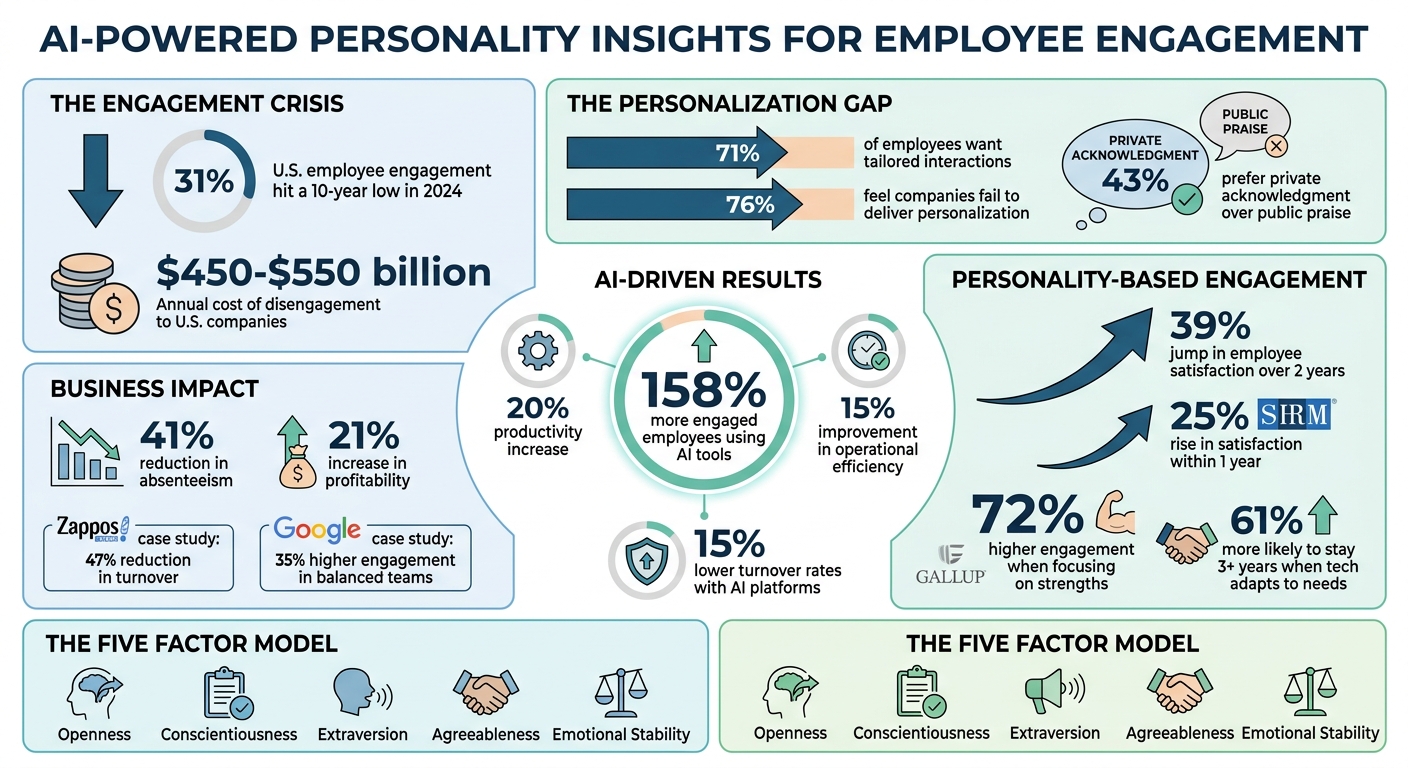
AI tools are reshaping how companies engage employees by analyzing personality traits and communication patterns in real time. With U.S. employee engagement hitting a 10-year low in 2024 (31%), traditional HR methods are falling short. AI-based systems, rooted in the Five Factor Model (Openness, Conscientiousness, Extraversion, Agreeableness, Emotional Stability), use data from workplace tools like Slack and Gmail to provide tailored insights that improve engagement, reduce turnover, and boost productivity.
Key Takeaways:
- Personalization Matters: 71% of employees want tailored interactions, but 76% feel companies fail to deliver.
- AI Benefits: Employees using AI tools are 158% more engaged, with productivity up by 20%.
- Real-Time Insights: AI detects disengagement early, offers personalized coaching with AI, and helps align roles with personality traits.
- Case Studies: Companies like Google and Zappos have reported up to 47% reductions in turnover by leveraging personality data.
Tools like Personos stand out by offering real-time coaching, dynamic personality reports, and actionable insights for managers and teams. These systems aren't just tracking data - they're changing how organizations support and retain employees. For businesses, the message is clear: understanding and acting on personality insights is key to improving workplace engagement.
AI-Powered Personality Insights Impact on Employee Engagement Statistics
The Power of AI in Measuring Employee Engagement
AI-driven platforms are now supporting practitioners with personality-based interventions to refine these engagement strategies.
How Personality Affects Employee Engagement
Personality traits are enduring characteristics that influence how employees approach challenges, complete tasks, and interact with others in the workplace [7]. Since these traits tend to remain stable over time, they serve as reliable indicators of behavior and engagement on the job.
When an employee's personality aligns with their role and the company culture, the results can be powerful. A review of 81 studies found that a strong personality-job fit is closely linked to higher performance and engagement levels [7]. Employees in well-matched roles often show greater job satisfaction and commitment. On the flip side, a poor fit can lead to issues like increased absenteeism, low morale, and even stress-related health problems such as hypertension [7].
Another key factor is the gap between what employees expect and what they experience at work. For example, 71% of employees want personalized interactions, but 76% report feeling frustrated when companies fail to meet this need [2]. Recognition preferences also vary - 43% of employees prefer private acknowledgment from their manager rather than public praise [4]. These findings highlight the limits of generic HR practices, such as standardized feedback or one-size-fits-all training programs. This sets the stage for AI-driven solutions that can adapt engagement strategies to individual personality profiles.
The Science Behind Personality Measurement
The Five-Factor Model (FFM), or Big Five, is widely regarded as the most effective framework for assessing personality in workplace settings [6][7]. This model breaks personality into five dimensions: Openness, Conscientiousness, Extraversion, Agreeableness, and Emotional Stability [6][7]. Understanding these traits is essential for aligning roles with individual strengths, which can significantly enhance engagement.
Each of these traits impacts engagement differently. For instance, Conscientiousness is a strong predictor of reliability and task performance, while Extraversion is linked to thriving in social, team-oriented, and leadership roles [7]. Employees high in Agreeableness excel in teamwork and customer-facing roles, and those with high Openness often lead innovation and adapt well to change [7]. Emotional Stability, on the other hand, helps employees handle stress and remain resilient under pressure.
AI systems now use the FFM to analyze personality data at scale. For example, some platforms can process 500 employee records in just 1.2 seconds using clustering methods like K-means. In one study, AI-driven personality matching correctly identified suitable candidates for team roles in 87% of cases [1].
Why Personality-Based Approaches Work
Using personality insights, organizations can create engagement strategies that are tailored to individual traits. This approach acknowledges employees as individuals rather than treating them as interchangeable. Research shows that companies adopting these strategies see tangible benefits, including a 41% reduction in absenteeism and a 21% increase in profitability [4]. Additionally, AI-powered learning tools that incorporate personality data have improved operational efficiency by up to 15% and boosted productivity by 20% [2]. Employees who feel that workplace technology adapts to their needs are also 61% more likely to stay with their company for more than three years [2].
| Personality Trait | Influence on Engagement | AI-Driven Strategy |
|---|---|---|
| Conscientiousness | Improves reliability and task performance | Structured goals and career progression dashboards |
| Extraversion | Enhances engagement in social and leadership roles | Pairing with mentors and offering social recognition |
| Agreeableness | Supports teamwork and customer service | Assigning team-based projects and collaborative workflows |
| Openness | Encourages creativity and adaptability | Recommending creative projects and stretch opportunities |
| Emotional Stability | Aids in stress management and resilience | Providing AI-driven wellness tools for real-time support |
How AI Uses Personality Data to Improve Engagement
AI isn't just about gathering personality data - it’s about using that data to refine communication, anticipate challenges, and deliver precise coaching. This evolution from traditional HR practices to AI-driven strategies is reshaping how companies engage their workforce, keeping employees more connected and satisfied. By leveraging tailored insights, organizations can take proactive steps that directly enhance retention and team productivity.
Personalized Communication and Feedback
AI tools analyze how employees interact and adjust communication to suit individual preferences. Through Natural Language Processing, platforms like Slack and Microsoft Teams are scanned in real time to detect emotional states, stress levels, or dissatisfaction [8][9]. Using the Big Five personality framework, machine learning models categorize employees to identify their communication styles and strengths [1][5].
By grouping employees into compatible profiles, AI helps reduce workplace friction [1]. Generative AI further supports managers by drafting personalized recognition and feedback that align with each employee’s preferences. Since employees value acknowledgment that feels genuine, AI enables managers to deliver praise in ways that truly resonate [4].
Managers also receive real-time "nudges" from AI, offering specific suggestions for communication strategies based on engagement signals [9].
Rob Hosking, Executive Director at Robert Half, notes: "AI gives HR leaders a way to close that gap. When used thoughtfully, it helps tailor experiences around how people learn, work and stay engaged" [3].
The results speak for themselves: AI-powered platforms report 15% lower turnover rates and significant improvements in team clarity [5].
Predicting Turnover and Disengagement
AI systems go beyond surface-level metrics, monitoring behavioral patterns and comparing them to historical data from employees who left the organization. This allows companies to spot disengagement trends before they escalate into resignations [8]. By analyzing pulse surveys, written communication sentiment, and workload data, AI identifies warning signs that traditional annual reviews often overlook.
Key indicators like declining sentiment, communication exclusion, and excessive overtime are tracked [3][8]. For example, if AI detects a 30–60 day dip in metrics such as "role clarity" or "recognition", it prompts managers to initiate targeted feedback sessions [9]. Personality-based clustering has also shown an 87% success rate in matching employees to teams where they thrive, directly supporting retention efforts [1]. Companies using these strategies have reported a 41% drop in absenteeism and a 21% boost in profitability [4].
Real-Time Coaching and Development
AI-driven coaching builds on personalized feedback and early issue detection to deliver immediate, tailored guidance. Unlike traditional programs that apply a one-size-fits-all approach, AI coaching adapts to individual needs in real time. It identifies skill gaps and recommends personalized development opportunities or stretch assignments based on personality profiles [3][8]. Employees no longer receive generic training but instead follow learning paths tailored to how they learn and stay motivated.
Tools like Personos take this concept even further. Based on the Five Factor Model, which measures 30 personality traits on an 80-point scale, Personos provides managers with real-time advice during challenging situations. By integrating complete personality profiles and contextual data, the platform offers communication strategies and approaches tailored to both the manager and employee.
Personos also emphasizes transparency by explaining the personality traits behind each recommendation, helping managers develop their expertise over time rather than relying solely on AI. Its ActionBoard feature translates insights into actionable tasks, ensuring coaching conversations lead to measurable outcomes. At $9 per seat per month, Personos is specifically designed for professionals handling complex interpersonal dynamics.
This shift toward continuous, AI-powered coaching couldn’t come at a better time. U.S. employee engagement recently hit a 10-year low of 31% [9]. As Austin Braham from Everworker puts it:
"Engagement scores don't change because your employees don't care; they don't change because your organization can't act quickly and consistently enough" [9].
Case Studies: AI-Powered Personality Insights in Action
AI isn't just a buzzword - it’s proving its worth in real-world applications, especially when it comes to improving team dynamics. By leveraging AI-driven personality insights, companies are finding smarter ways to cut turnover, boost engagement, and enhance collaboration. Let’s dive into how some organizations are making this work.
Reducing Turnover Through Optimal Role Alignment
Take Google, for example. In 2020, they adopted the Predictive Index to better understand employee behavior and motivations. The results were eye-opening: teams with a balanced mix of personality types saw a 35% higher engagement rate compared to teams that were more uniform. This approach didn’t just improve team morale - it also helped the company maintain retention rates well above the industry norm [10].
Meanwhile, Zappos decided to focus on role alignment using the Myers-Briggs Type Indicator (MBTI). By matching employees to roles that suited their natural personality traits, they achieved a 47% drop in employee turnover within the first year of employment. That’s nearly half the turnover rate slashed, all by making sure people were in the right roles [10].
Studies show these methods aren’t just one-off successes - they can be applied to large-scale operations effectively [1]. And the benefits don’t stop with retention; they ripple out to improve how teams work together.
Better Team Collaboration and Fewer Conflicts
AI tools are also helping companies tackle workplace dynamics. Organizations that use personality assessments report a 39% jump in employee satisfaction over two years, thanks to smoother team interactions and fewer conflicts [10]. The Society for Human Resource Management (SHRM) backs this up, noting a 25% rise in satisfaction and engagement within just a year of using these assessments [10].
Gallup research adds even more weight to the argument: companies that focus on employee strengths see 72% higher engagement [10]. These numbers highlight how understanding individual personalities can lead to stronger, more cohesive teams.
These case studies make one thing clear: AI-powered personality insights don’t just improve individual experiences - they reshape the workplace as a whole, creating environments where both people and teams thrive.
Why Personos Works Better for Employee Engagement
Personos stands out in the world of employee engagement tools by focusing on something most HR platforms overlook: actionable, real-time insights. Built on the scientifically backed Five Factor Model, it moves beyond the limitations of generic HR tools by offering precision and guidance that adapts to the moment.
Christian Thomas, CEO and Co-Founder of Personos, captures this idea perfectly:
"AI has made us more efficient in how we work and communicate, but not smarter about how we connect with people."
In essence, Personos doesn’t just tell you what someone’s personality is - it shows you how to work with them effectively, right when it matters.
Features Designed for Workforce Engagement
Personos offers three key features that turn personality insights into practical results:
- Dynamic Reports: These aren’t static documents. They evolve as your team grows, providing tailored insights for individuals, relationships, and groups.
- Personos Chat: This feature adapts communication styles in real time, making workplace interactions smoother.
- ActionBoard: It tracks commitments and progress, ensuring that insights lead to measurable improvements.
Unlike typical HR tools that focus on automating processes, Personos prioritizes workplace empathy. As Nick Blasi, Co-Founder and COO of Personos, explains:
"Personos gives people the confidence to communicate with empathy, not just efficiency."
This approach addresses a critical issue: managers are responsible for 70% of the variance in team engagement levels [12]. By making professional-grade insights accessible to all employees - not just executives - Personos ensures that everyone can benefit. This is particularly important when you consider the staggering cost of disengagement, which drains U.S. companies of $450 billion to $550 billion annually [11].
How Personos Compares to Other HR Tools
Personos performs better than traditional HR tools and passive AI platforms in several key areas:
| Feature | Personos | Passive AI Tools (e.g., Erudit) | Traditional HR Tools |
|---|---|---|---|
| Data Source | Brief personality assessment (Big Five) | Analysis of corporate logs (Slack, Gmail, Teams) | Annual or pulse surveys |
| Primary Focus | Workplace empathy and connection | Classifying engagement levels via NLP | Process and efficiency tracking |
| Output Type | Real-time coaching prompts and interactive chat | Engagement scores and classification reports | Static data and historical trends |
| Accessibility | Available to all workforce levels | Typically used by HR/Management | Often limited to leadership |
| Customization | Integrates unique coaching playbooks and models | Standardized analysis algorithms | One-size-fits-all metrics |
Mike Walker, Executive Leadership Coach and Founder of Dynamic Decisions Coaching, sums it up well:
"Personos connects the dots between personality and performance."
This ability to link personality insights with actionable strategies for motivation, coaching, and collaboration is what drives the platform’s success. For example, AI frameworks using personality matching have achieved an 87% success rate in identifying the right candidates for team composition, processing 500 personality records in under 1.2 seconds [1]. But Personos doesn’t stop at speed - it ensures these insights lead to real progress. The ActionBoard, for instance, turns data into commitments, helping teams track and achieve their goals.
Conclusion
The findings and examples shared earlier highlight a crucial shift in how AI-powered personality insights are transforming employee engagement. Rather than relying on outdated, reactive methods, these tools enable organizations to adopt proactive strategies. By examining communication patterns and personality traits in real time, AI helps predict turnover risks, reduce conflicts, and tailor the employee experience far beyond what traditional annual surveys can achieve. The combination of speed and precision makes these tools highly scalable and effective in today's fast-paced work environments [1].
But speed and precision alone won't cut it. Rob Hosking, Executive Director at Robert Half, emphasizes the importance of intentional development:
"AI-powered personalization is not a trend to chase. It's a capability to develop carefully... it helps HR leaders elevate their role from program owners to strategic partners" [3].
This shift - from static data to actionable insights - is where the real potential lies. Tools that provide personalized feedback, enable proactive interventions, and offer real-time guidance are redefining employee engagement. Instead of delivering reports that sit untouched, these platforms empower HR teams to act immediately and effectively.
Among these, Personos stands out by going beyond traditional HR systems and passive AI tools. While other platforms focus on classifying engagement levels or tracking past behaviors, Personos delivers real-time coaching prompts, dynamic insights into workplace relationships, and an ActionBoard that turns personality data into measurable progress. This approach doesn’t just boost satisfaction scores - it builds environments where employees communicate better, feel understood, and stay longer. In hybrid and remote work settings, where physical cues are often absent, these AI-driven insights become even more critical.
For companies aiming for sustainable success, the choice is clear: settle for tools that simply measure engagement or invest in platforms like Personos that actively enhance it.
FAQs
Is using personality-based AI at work actually accurate?
AI-powered personality analysis can achieve an accuracy of up to 82% in identifying traits associated with workplace success. This level of precision makes it a dependable option for evaluating employees and improving team dynamics. Using scientifically backed frameworks like the Five Factor Model, tools such as Personos deliver insights that can help boost engagement and foster better collaboration among team members.
How can companies use these insights without violating employee privacy?
Companies can boost employee engagement by leveraging AI-powered personality insights while safeguarding individual privacy. The key is to rely on aggregated, anonymized data rather than tracking specific employees. Being upfront about data collection and its purpose is equally important - employees need to understand that these insights are intended to enhance workplace experiences, not to penalize anyone. Tools like Personos set an example by focusing on ethical data practices. They provide scientifically backed, privacy-conscious solutions that aim to improve team well-being and performance without resorting to intrusive monitoring.
What’s the fastest way to pilot personality-driven engagement without disrupting teams?
The fastest way to introduce personality-driven engagement without interrupting team workflows is by leveraging AI-powered personality analysis tools. For example, platforms like Personos deliver real-time insights, detailed reports, and actionable tips tailored to both individual and team personalities. These tools fit effortlessly into existing workflows, offering immediate guidance on communication and collaboration approaches. This helps build trust and improve engagement while ensuring teams stay cohesive and productive.