Can AI Personality Tools Predict Team Compatibility?
AI personality tools can guide communication and test coordination changes — but shouldn’t decide hiring, promotions, or assignments.
Rachel Johnson

Can AI Personality Tools Predict Team Compatibility?
I’d use AI personality tools to start a conversation about team conflicts, not predict who will work well together. My starting point: choose 1 coordination problem, test a small change, and track results such as missed handoffs or follow-up delays.
The Five Factor Model describes 5 trait dimensions, but that doesn’t validate an AI tool’s team-fit score. Workload, job demands, and supervision matter, too.
Here’s what I’d check before using a tool:
- Proof: Has it been tested for the specific job, purpose, and team outcome?
- Limits: Can staff challenge results, request accommodations, and participate without pressure?
- Data: Who can access profiles, how long are they kept, and are they used for model training?
I’d treat Personos or similar tools as communication aids, not hiring guides. <u>I’d keep compatibility scores out of hiring, promotion, and assignment decisions</u>, and test workflow changes without client data first.
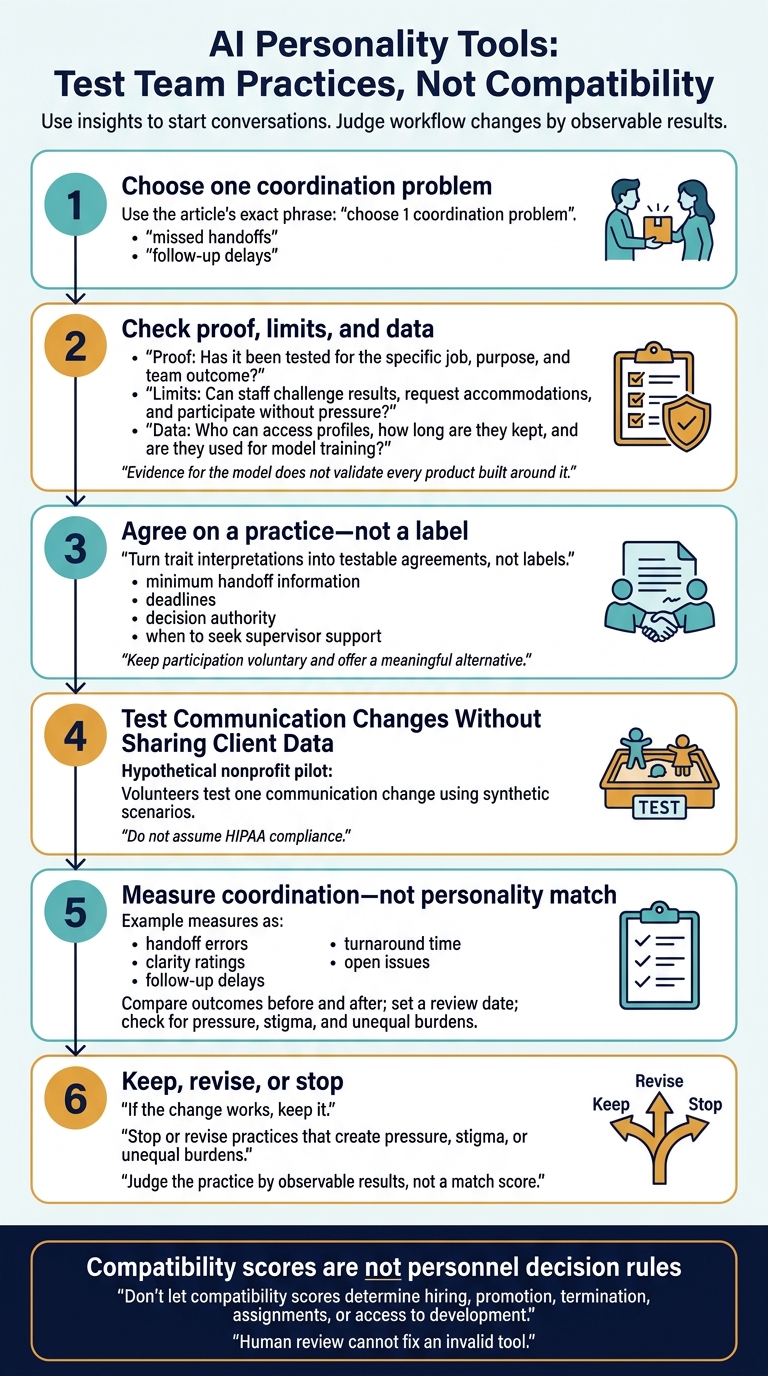
AI Personality Tools: Test Team Practices, Not Compatibility
What Personality Assessments Can Tell Teams
Team compatibility depends on working patterns, not similar personalities. Look for clear communication, reliable coordination, trust, healthy disagreement, and progress toward shared goals. Assessments can help staff discuss what supports these behaviors, but matching profiles don’t prove that people will work well together. AI can flag possible friction points, but it cannot prove team fit. Use the results to shape team practices, not rank people.
| Cautious use | Unsupported claim |
|---|---|
| Discuss preferences for private, written, or live feedback. | A score guarantees a successful partnership. |
| Ask employees to confirm or challenge a stated tendency. | A profile reveals someone’s true character. |
| Check whether agreed meeting and handoff rules improve coordination. | Trait scores alone show which team practices will work. |
Traits Suggest Preferences, Not Fixed Behavior
The Five Factor Model measures openness, conscientiousness, extraversion, agreeableness, and emotional stability on continuous scales, not rigid types. A scientifically validated assessment may suggest how comfortable someone feels with structure, ambiguity, social interaction, feedback, planning, cooperation, and change. Treat these results as questions to discuss, not instructions for how someone will behave. The U.S. Office of Personnel Management notes that the traits relevant to performance depend on the job.[5]
Evidence for the model does not validate every product built around it. AI systems that infer personality from facial cues, voice, or interview wording need separate validation before use in compatibility scoring. Even accurate trait inference does not mean accurate compatibility prediction. Professional guidance calls for evidence that AI assessments measure job-related characteristics accurately, consistently, and fairly.[6][7] The question isn’t who matches. It’s what the job demands.
Job Demands and Team Conditions Matter
Keep preferences, skills, and job requirements separate. Preferring independent work does not establish sound judgment, and being outgoing does not establish client interviewing skill. For case-management work, examine documentation, referrals, client contact, urgent decisions, shared coverage, workload, and supervision separately. OPM reports that personality measures are generally less predictive than work samples, simulations, and several other selection methods.[5]
When staff report different planning preferences, agree on minimum handoff information, deadlines, decision authority, and when to seek supervisor support. These agreements let different approaches work without assigning roles by personality. Track missed handoffs and follow-up delays to assess the practice, not the pairing. Focus on whether the workflow rules help staff coordinate, rather than whether their personality labels match.
Why Compatibility Scores Can Mislead
A compatibility score can look precise and still be wrong. A fluent AI explanation may make it sound more certain without adding evidence. Ask which team outcome the score predicts, how it reports uncertainty, and whether anyone has tested the prediction. The main risk is mistaking the score for evidence.
| Error source | Team decision risk | Safeguard |
|---|---|---|
| Unreliable measurements | Scores vary too much to compare teammates reliably. | Request reliability and measurement-error data; don’t read too much into small differences. |
| Biased trait inference | Differences in language, culture, or disability are mistaken for personality traits. | Check subgroup validation, accessible formats, accommodations, and error rates. |
| Missing context | The score leaves out current workload, authority, or team changes. | Check current working conditions before interpreting scores. |
| Unsupported predictions | A plausible pattern is treated as a forecast. | Require evidence for the team outcome; label untested claims as hypotheses. |
Then ask whether the tool is valid for this exact use.
Check Reliability and Validity for Each Use
Check whether the tool produces consistent results, measures the intended trait, predicts a defined team outcome, and adds value beyond interviews or work samples. Request technical evidence for the intended use, not just a single “accuracy” claim.
Look for studies of comparable teams with a coordination outcome defined in advance, such as reliable handoffs. General vendor documentation doesn’t establish that a particular employer’s use is appropriate. The EEOC calls for validation for the positions and purposes involved. SIOP likewise calls for job analysis and evidence supporting the intended use. Require that evidence before considering the tool for hiring or team placement.
Even a well-built model can mislead when its input data are incomplete or uneven.
Account for AI Errors and Missing Context
A plausible explanation doesn’t prove that personality caused a conflict. Training-data bias and incomplete profiles can distort AI interpretations. Culture, language, disability, and stress can affect people’s responses without changing the underlying trait.
Require accessible administration, subgroup validation, accommodations, and checks for differences in error rates across relevant groups.
Keep Compatibility Scores Out of Personnel Decisions
When jobs are at stake, treat the score as background information, not a decision rule. Don’t let compatibility scores determine hiring, promotion, termination, assignments, or access to development.
Use structured interviews, work samples, simulations, and documented behavior instead. Make reviewers accountable for recording job-related evidence, checking accommodations, and providing a way to challenge incorrect information. Human review cannot fix an invalid tool.
Turn Personality Insights Into Team Practices
Once a tool is validated for a narrow use, turn its output into team routines.
Set Rules for Human Review and Data Use
Turn trait interpretations into testable agreements, not labels. Use them to guide meeting preparation, feedback channels, and conflict-escalation plans. Keep participation voluntary and offer a meaningful alternative. Let participants question or correct interpretations without penalty, and bring in a trained reviewer when needed.
Keep development data separate from selection, promotion, scheduling, assignment, and discipline. Record agreed behaviors, not personality labels.
A responsible-use checklist should cover the purpose, access limits, accessibility, deletion rules, and who handles human review. It should also include checks for outcomes and unintended effects.
A context-aware tool can help teams plan these routines without treating traits as labels.
Use Personos for Team Communication Guidance
Personos uses Five Factor Model profiles to provide context-specific guidance for individuals, relationships, and groups.[8] These features support communication planning, not selection or compatibility claims. Check current terms, security documentation, and contracts before use.
Test Communication Changes Without Sharing Client Data
Test the workflow in a low-risk pilot before using client data.
Hypothetical nonprofit pilot: Pilot one communication change with volunteers using synthetic scenarios, then compare handoff errors and clarity ratings before and after. Measure coordination outcomes, not personality match. Stop or revise practices that create pressure, stigma, or unequal burdens.
Before using client data, verify access, retention, deletion, encryption, subprocessors, breach terms, and training limits. Do not assume HIPAA compliance. Crisis protocols, clinical judgment, mandated reporting, supervision, and emergency escalation remain primary.
Conclusion: Improve Coordination, Not Compatibility Rankings
Validated assessments can help with self-reflection and coaching for a defined purpose, but they don’t reliably predict team fit. Compatibility scores should not determine hiring, promotion, assignments, or access to opportunities.[4][3] A better test is whether a small workflow change helps people coordinate.
Choose one coordination problem and test one low-risk change.
Separate brainstorming from decision-making. Set a review date and track turnaround time and open issues. Discuss whether the change helped - and whether it created new burdens.
If the change works, keep it. Judge the practice by observable results, not a match score.
FAQs
How can I verify a vendor’s validation claims?
Check that the assessment uses scientifically established frameworks, such as the Five Factor Model (FFM) [1][2]. Look for signs of transparency, too, such as EdSafe AI Alliance membership [1][3].
Review how the assessment protects privacy and guards against misuse. Personos, for example, never uses assessment data to train models. It also keeps scores hidden by default to help prevent misuse in hiring or team assignments [1][3][4].
What should I do if my AI profile feels inaccurate?
To make your AI profile more accurate, add personal context: your professional goals, job description, relevant past experiences, or current circumstances. The system uses this information in its chats, reports, and prompts.
You can also create a private profile for someone else and, if you choose, complete a mini questionnaire. Or invite them to share their own self-assessed scores to help improve accuracy.
How can I separate personality friction from workload problems?
Look at individual working styles alongside outside pressures, such as role expectations, team norms, and workload. Personos pairs personality profiles with this context to tailor its guidance.
Its relationship-specific reports highlight communication styles and conflict triggers, helping you judge whether friction comes from differences in working habits or a workload that exceeds someone’s capacity.