AI Personality Scores: Self-Reports vs. Observer Ratings
AI personality scores reflect the supplied perspective — they can match self-reports or observers, but should not be treated as sole truth.
Christian Thomas

AI Personality Scores: Self-Reports vs. Observer Ratings
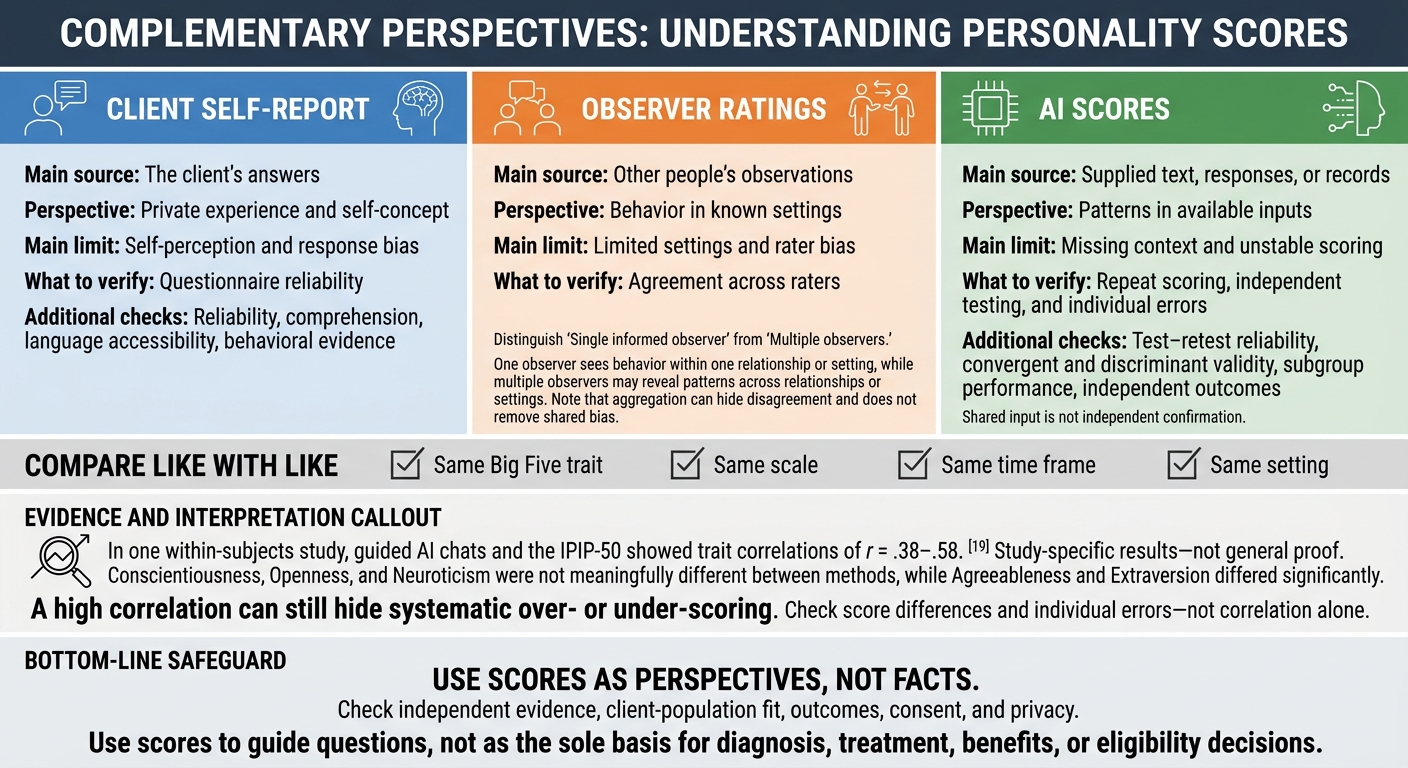
An AI personality score can match a client’s self-report without matching what others observe. Compare the same Big Five trait, scale, time frame, and setting before interpreting a mismatch. In one study, AI chat scores and questionnaire results correlated at r = .38–.58, but correlation does not mean identical scores.
The key differences:
- Self-reports describe private feelings and self-perception, but answers can shift with mood or how questions are understood.
- Observer ratings describe behavior in known settings, but depend on familiarity, context, and bias.
- AI scores reflect the data supplied, which may leave out either perspective.
Quick Comparison
| Check | Client self-report | Observer ratings | AI scores |
|---|---|---|---|
| Main source | The client’s answers | Other people’s observations | Supplied text, responses, or records |
| Main limit | Self-perception and response bias | Limited settings and rater bias | Missing context and unstable scoring |
| What to verify | Questionnaire reliability | Agreement across raters | Repeat scoring, independent testing, and individual errors |
For tools such as Personos, agreement alone is not enough. Check results for each trait, fit with the client population, outcome data, consent, and privacy. Use AI-driven personality feedback to guide questions, not as the sole basis for diagnosis, treatment, benefits, or eligibility decisions.
AI Personality Scores vs. Self-Reports and Observer Ratings
AI Scores vs. Client Questionnaires
Compare Correlations and Score Differences
When comparing AI scores with a client questionnaire, you're testing whether AI tracks self-report, not observer ratings. Questionnaires cover private experiences that behavior-based AI may miss.
Use a named Five-Factor inventory, such as the IPIP-50. Before comparing results, match trait definitions, scoring direction, and item detail.[5]
In one within-subjects study, guided AI chats and the IPIP-50 showed trait correlations of r = .38–.58. Conscientiousness, Openness, and Neuroticism were not meaningfully different between methods, while Agreeableness and Extraversion differed significantly. Treat those results as study-specific, not general proof.[8]
A high correlation can still hide systematic over- or under-scoring. Report each trait separately, with confidence intervals where available. Don't rely on a single overall “accuracy” figure.
| Evaluation measure | What it captures | What it misses |
|---|---|---|
| Correlation (Pearson/Spearman) | Whether AI and questionnaire scores vary together or rank clients similarly | Absolute score differences and individual error |
| Mean score difference | Average over- or under-scoring | Individual disagreement and preserved rankings |
| Absolute-agreement intraclass correlation | Agreement in both rank and level on compatible scales | Whether either method accurately captures the trait |
| Bland–Altman analysis | Limits of agreement and whether disagreement changes across the score range | Whether either method accurately captures the trait |
Check questionnaire reliability separately using internal consistency and test–retest stability. For AI, repeat scoring with controlled prompts and equivalent context, then check stability across sessions. Document any scale conversions. Putting scores on the same numerical range doesn't automatically make them comparable.[5]
Weigh Private Experience and Self-Report Bias
Standardized questionnaires give clients a structured way to report private feelings, motives, emotional intensity, and other internal experiences that may not appear in conversational data. Still, answers can reflect self-perception, social desirability, mood, literacy, fatigue, or how someone interprets an item. Privacy and perceived consequences matter, too. A client may answer differently during an eligibility assessment than in a private, non-evaluative session.
Before interpreting a mismatch, check item understanding, language support, time, privacy, and the period or setting the client had in mind. Agreement offers evidence about that questionnaire in that setting, not proof of true personality. If the AI saw the questionnaire answers, a match doesn't prove it can infer those traits from other data.[2]
The next test is whether the same pattern holds for people who know the client.
AI Scores vs. Observer Ratings
Comparing AI with people who know the client tests convergence, not truth. Observer ratings offer another perspective, not a final answer. Credentials alone don’t ensure accuracy. Access, familiarity, and conflicts of interest also shape ratings.[9][11]
This distinction matters because observers see behavior in context, not the client’s private experience.
Compare One Observer With Multiple Observers
Separate one observer’s impression from agreement across observers. Record each person’s relationship length, familiarity, contact frequency, settings, and recent contact. Keep individual ratings, and compare AI agreement with each rating as well as any combined score.
Clarify whether ratings describe typical behavior, a specific episode, or behavior under stress. Match the trait, scale, time frame, and context, then report both correlation and mean difference. Check interrater reliability: low agreement may reflect different settings rather than AI error.
Pooling ratings can reduce individual noise, though gains often level off after two to four raters. It cannot remove shared stereotypes or institutional expectations. Before claiming that pooling improves agreement with AI, cite independent research that includes a defined sample, prespecified traits, confidence intervals, and an external outcome.[10]
Weigh Observed Behavior and Observer Bias
Use this guide to assess when observer ratings may align with AI, based on what each source can access.
| Observer | What they see | Settings observed | Main bias risks | Appropriate uses |
|---|---|---|---|---|
| Professionals with repeated client contact | Communication, attendance, dependability, follow-through, and responses during services | Appointments, coaching sessions, crisis contacts, team meetings, or program activities | Halo effects, institutional expectations, documentation habits, role-based judgments, and limited exposure outside services | Evaluating service-related behavior, interaction patterns, and changes during care |
| Close contacts | Routines, relationships, emotional reactions, and patterns over time | Home, family, social, and sometimes financial or caregiving situations | Conflict, loyalty, privacy concerns, stereotypes, selective memory, and relationship-specific expectations | Evaluating everyday functioning and traits less visible in formal appointments |
| Casual acquaintances | Visible social behavior and first impressions | Public, workplace, school, or occasional social settings | Stereotypes, recency effects, restricted observation, and overreliance on salient behavior | Evaluating visible traits such as sociability or conversational style, but not private experience or long-term dependability |
What observers can see helps explain why agreement varies by observer type. They see behavior, not private worry, shame, motives, or intrusive thoughts. Frequent interaction can improve judgments. Intimacy is especially useful for less visible traits, such as emotional stability, but familiarity can also harden expectations and make change harder to see.[12]
Separate observations from trait labels. Ask what happened, how often, and over what period. Document barriers before interpreting missed contacts as low conscientiousness. Behavior during appointments may differ from behavior at home. Use independent observers and blinded scoring where feasible, and give clients a chance to explain the context behind reports. These steps help limit halo effects, conflict, and overgeneralization.[11]
Apply These Checks to Personos
For Personos, compare outputs with both self-report and observer ratings before using a score in practice. Match the trait, scale, time frame, and context. Examine agreement and meaningful score differences, then clarify which observations led to conflicting trait labels.
Why Agreement Varies by Trait and Context
Even when the trait label stays the same, agreement depends on how visible the trait is, what each source can access, and the context. Client narratives may align with self-reports, while notes and transcripts may align with observer ratings. But a match can come from shared input rather than independent confirmation. That’s why validation for each trait matters more than a single overall score.[15]
Distinguish Visible Behavior From Inner Experience
Extraversion shows up in social initiative and energy; Conscientiousness in follow-through; Agreeableness in cooperation; Openness in curiosity and imagination; and Neuroticism in worry or reactivity. Clients can describe private experiences. Familiar observers see repeated behavior.[13][14][16]
Each source sees a different part of the person. They aren’t interchangeable.
| Source | Perspective | Common errors | Validation checks |
|---|---|---|---|
| Client questionnaire | Private experience and self-concept | Misunderstood items, recall errors, response styles | Reliability, comprehension, language accessibility, behavioral evidence |
| Single informed observer | Behavior within one relationship or setting | Overgeneralizing from one setting | Familiarity, observation period, behavior-based ratings |
| Multiple observers | Patterns across relationships or settings | Unequal familiarity, aggregation that hides disagreement | Interrater reliability, setting-specific results, transparent aggregation |
| AI scores | Patterns in available inputs | Missing context, proxy variables, unstable scores | Test–retest reliability, convergent and discriminant validity, subgroup performance, independent outcomes |
Why Neither Source Is a Perfect Benchmark
A label like organization can mean planning, punctuality, persistence, or order, depending on the rater and relationship. Self-report bias doesn’t always mean self-flattery. Clients may downplay strengths, overreport difficulties, misunderstand items, or describe a temporary crisis instead of a stable pattern. What each source can see, and in which relationship, helps explain disagreement. Neither source is automatically wrong.[13][14]
Agreement across a sample does not prove accuracy for each person. Correlation shows how scores move together across a sample, not how closely each person’s score matches the benchmark. Check absolute differences and individual errors alongside correlations, confidence intervals, subgroup results, and missing-data patterns. A strong sample average can hide large errors for clients whose language or circumstances differ from those in the validation sample.[7]
Clarify Disagreement Before Assigning a Trait
Hypothetical case: If a client reports high Conscientiousness but a case manager sees missed appointments during a housing crisis, compare the time frames: the mismatch may reflect different observation windows rather than a wrong trait label. Check whether transportation loss, unstable housing, work demands, sleep disruption, medical needs, or acute stress drove the misses. If AI saw only crisis-period notes, label the score as context-limited.
Use that context check to assess whether the score is usable.
Review Validation Evidence Before Using Scores
Define the decision first. Low-stakes communication prompts need less evidence than decisions about diagnosis, treatment, benefits, or eligibility. Document the intended use, possible harm, and limits. Validity applies to a specific use, not a product label. A score may help when it fits the intended perspective, but it should not be treated as ground truth.[17][18] Then check whether the evidence supports that use.
Request Independent Evidence Across Methods
Compare the score with independent benchmarks. Request a validation report that compares scores separately with an established Five-Factor questionnaire and, with consent, informed observers.
The report should include trait-level correlations, agreement coefficients, score differences, confidence intervals, reliability, sample characteristics, missing-data handling, and subgroup results. Observer comparisons should report results for single raters and multiple-rater averages separately, along with interrater reliability. The evidence should match your client population.[18]
Check that the comparison was independent. Request a data-flow diagram, training/evaluation splits, and controls that keep benchmark answers out of prompts, retrieval, and training data. This helps distinguish scoring benchmark answers from inferring traits.
Check Outcomes, Consent, and Data Access
Look for comparisons with standard practice that show gains for the intended purpose, such as client-reported understanding or shared-goal completion. Agreement with questionnaires or observers alone is not enough. You also need outcome evidence.
Before uploading information, explain what clients can decline, who can see results, and how clients can challenge interpretations. Verify retention, deletion, model-training use, access controls, and third-party sharing. Share only the information needed.
Set a review date and reassess after major changes. Scores from a crisis or another unstable period should not be treated as permanent. If the evidence or safeguards fall short, do not use scores for high-stakes decisions.[19][20][21][22]
Apply These Checks to Personos
Personos should meet the same standard. Personos uses Five-Factor profiles and context in conversational chat and relationship-specific reports. Ask whether each feature interprets a supplied profile, uses practitioner observations, or independently infers traits.
Request evidence for the intended use. Before entering sensitive case information, verify current consent, access, retention, deletion, and privacy terms. Contextual explanations can help you review suggestions, but they do not establish clinical suitability. For those in leadership development, AI is also transforming executive coaching through similar data-driven insights.
Conclusion: Use Scores as Perspectives, Not Facts
When AI scores agree with a client questionnaire, they match the client’s self-report. When they agree with observer ratings, they match others’ judgments of behavior in known settings. Neither is a perfect benchmark.[6][24]
When scores conflict, check what each source measured, the time period it covered, and the situations it reflected. Then ask the client to confirm, reject, or qualify the interpretation. Favor clear evidence across methods rather than whichever score seems most convincing.[25]
Use AI tools for helping professionals to support communication, not to settle judgments or make decisions about diagnosis, crisis, eligibility, or access on their own. The aim is better questions and better human judgment, not a fixed personality label.[23][26]
FAQs
How should I weigh conflicting personality scores?
Give self-assessments more weight when personality scores conflict, but also consider observations from people who know the client. Each source offers a different perspective. Neither gives a perfect account.
Personos lets users invite clients to complete self-assessments, which can make profiles more reliable than third-party observations alone [1][3]. Using self-reported data within a scientifically validated framework, such as the Five Factor Model, can help professionals better understand their clients [1][4].
How much score disagreement is acceptable?
The provided sources do not define an acceptable level of disagreement between self-reports and observer ratings. Personos gives priority to self-assessed scores when available, treating them as more accurate than external observations alone. Still, neither source offers perfect ground truth.
Its scientifically validated Five Factor Model measures 30 traits on an 80-point scale. This level of detail supports a nuanced reading of the results, rather than jumping to conclusions when scores don’t line up.
When should I reassess an AI personality score?
Reassess your AI personality score when your interactions, relationships, or goals change and you need updated reports. Personos creates dynamic, AI-generated reports based on your personality profile, background, and situation. Each report combines your 30 traits on an 80-point scale with real-time, role-specific information, keeping the guidance relevant to your current work setting.