AI Personality Reports for Team Collaboration
Use AI personality trait reports to spot recurring team friction, set simple communication norms, and protect privacy in nonprofits.
Nick Blasi

AI Personality Reports for Team Collaboration
If your team keeps running into the same friction, personality data can help you set better work rules.
I’d boil the article down to this: use AI-based trait reports to spot repeat issues in tone, pace, handoffs, role clarity, and support work, then turn those patterns into simple team norms. The article also makes three limits clear: don’t treat people like labels, keep personal scores private, and use reports only for clear work purposes.
Here’s the full takeaway in plain English:
- I can use trait data to map how people communicate, decide, and react under stress
- I can track repeat problems with a friction log
- I can turn those repeat problems into rules for feedback, urgency, and handoffs
- I should use confidence labels like Extracted, Inferred, and Ambiguous
- I should protect access with clear privacy rules and tools like SSO and SOC 2 Type II
- I should start with one team for 30 to 90 days, then review what changed
A few details stand out. The article points to 30 traits on an 80-point scale, not fixed types. It focuses on U.S. nonprofit and social service teams, where meeting time is tight and staff load is high, so any system has to fit into work that already exists.
If I were applying this fast, I’d do three things first:
- Build a plain-language team map of work styles
- Log repeat friction by pattern, not by person
- Set a few written rules for communication and handoffs
That is the core idea of the article in one line: use personality reports to make teamwork more predictable without putting people in a box.
How to Read Work Style Patterns from Trait Data
Personality trait data is most useful when you treat it as a picture of how someone tends to work in specific situations, not who they are [1]. That shift matters. You're not trying to label people. You're trying to see what each person needs to do solid work.
Once you can read those patterns, it gets much easier to spot where work styles may collide. The Five Factor Model breaks personality into 30 specific facets measured on an 80-point scale [2]. That level of detail can shape how a team works day to day. Things like structure vs. flexibility, quick decision-making vs. deliberation, verbal discussion vs. written reflection, and steadiness under pressure all affect meetings, deadlines, and handoffs.
Match Common Traits to Daily Team Behavior
These patterns usually show up fast. In a crisis team, one person may think out loud while another needs time to read notes and sort through details. If the team makes room for only one style, one person feels ignored and the other feels rushed. That's not a personality problem. It's a work design problem.
| Work Style Pattern | How It Shows Up | Common Friction Point |
|---|---|---|
| High structure | Follows checklists, prefers set agendas | Can clash with flexible, improvisational teammates |
| Fast processing | Decides quickly, moves on | May leave deliberate thinkers behind in group decisions |
| Verbal collaboration | Thinks out loud, prefers live discussion | Can frustrate teammates who need written context first |
| High emotional steadiness | Stays calm under pressure | May seem detached during emotionally intense moments |
Use patterns like these to find where routine tasks, not personal flaws, create friction.
Build a Basic Team Personality Map
Start by gathering personality data from each team member. The aim is simple: spot shared tendencies and meaningful differences. Then turn that into plain-language notes about the team's likely strengths and blind spots.
For example, a team that clusters high on verbal collaboration and fast processing may do well in live problem-solving but still need a separate process for documentation. A team that leans toward deliberation and written reflection may produce thorough case notes but move more slowly during time-sensitive handoffs.
Tools like Personos support this process through Group Reports, which factor in all team members' profiles and generate guidance on how to engage effectively as a unit [2]. Keeping individual scores private can also help people participate more honestly. Staff are more likely to engage openly when they know their data won't be exposed to colleagues. That can make a big difference in meetings, supervision, and any setting where trust between staff is essential.
Those differences often show up first as repeated friction, which the next section helps you track.
How to Spot Friction Points Before They Become Conflict
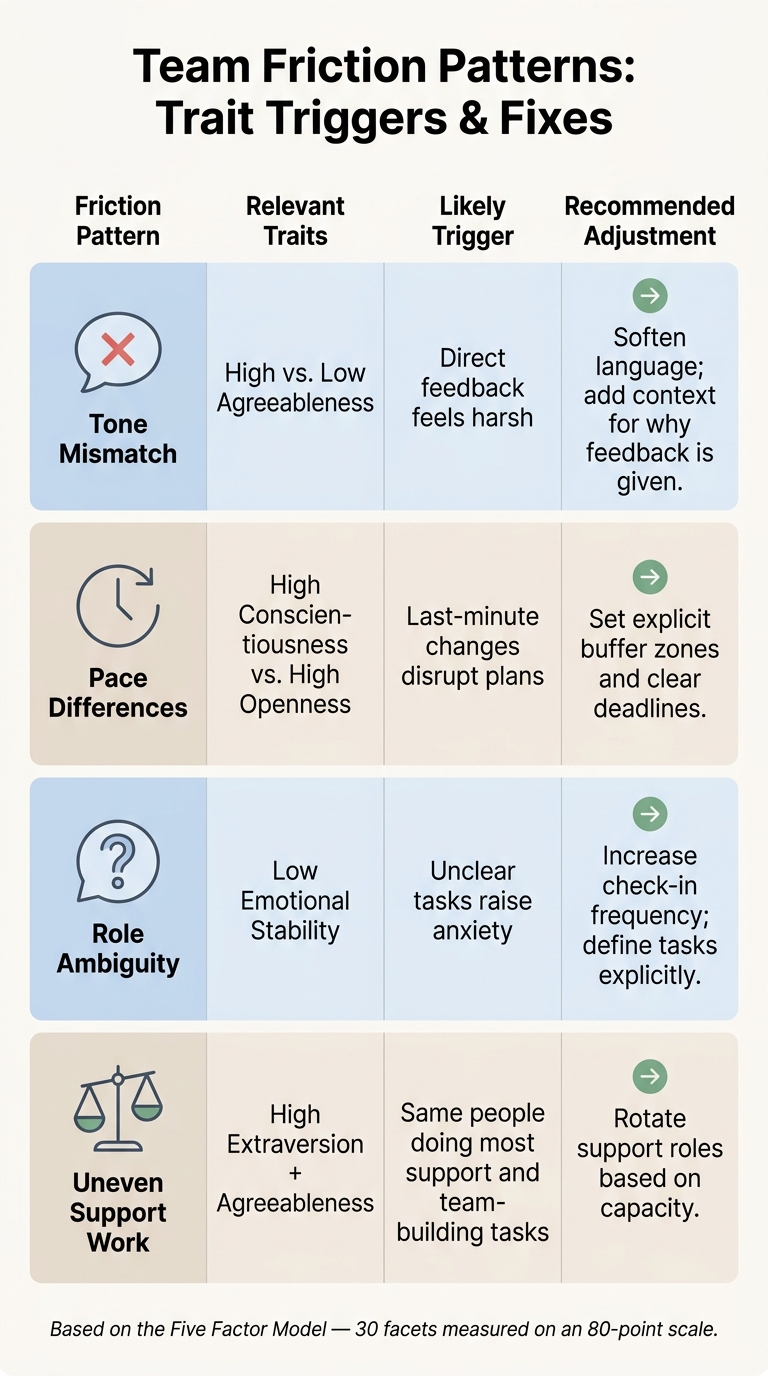
Team Friction Patterns: Trait Triggers & Fixes
Once you’ve mapped the team’s main traits, use that map to catch repeat collisions early.
Most team tension doesn’t come out of nowhere. It builds through small moments that happen again and again: blunt emails, rushed decisions, or tasks that keep landing on the same person. Trait gaps help you sort that friction into a few clear buckets, like tone, pace, role clarity, or support work. And that matters, because the fix depends on the type of friction you’re dealing with.
Use Trait Patterns to Identify Likely Team Friction
Some patterns are easy to spot once you know the signs. For example, a low-agreeableness communicator may come across as harsh to a teammate high in agreeableness. If no one names that gap, the same conflict can keep looping.
Pace differences show up all the time too. A highly conscientious team member who plans weeks ahead may feel genuine stress when a colleague makes last-minute changes. That often leads to tension around timing, deadlines, and change.
Uneven support work is another common issue, and it often slips under the radar. Team members who score high on both extraversion and agreeableness tend to take on more of the informal support work. They check in on colleagues, smooth over group tension, and pick up team-building tasks. Over time, that can leave the same people carrying too much.
Track Recurring Issues with a Friction Log
A simple friction log can help. Think of it as a running record of repeat problems tied to specific situations. You’re not documenting who caused the problem. You’re tracking what keeps happening and which trait dynamic may help explain it.
Log each recurring pattern in plain language, then connect it to a likely trigger.
| Friction Pattern | Relevant Traits | Likely Trigger | Recommended Adjustment |
|---|---|---|---|
| Tone mismatch | High vs. low agreeableness | Direct feedback feels harsh | Soften language; add context for why the feedback is given |
| Pace differences | High conscientiousness vs. high openness | Last-minute changes disrupt plans | Set explicit buffer zones and clear deadlines |
| Role ambiguity | Low emotional stability | Unclear tasks raise anxiety | Increase check-in frequency; define tasks explicitly |
| Uneven support work | High extraversion + agreeableness | Same people doing most support and team-building tasks | Rotate support roles based on capacity |
When the same entries keep showing up, that’s your signal. It usually means your communication rules, feedback norms, or handoff steps need to change.
How to Plan Communication and Workflow by Trait Profile
Use personality reports to set plain rules for access, sharing, and day-to-day workflow. The goal is simple: less guesswork, fewer repeat problems, and a fairer split of work. If the same tension keeps showing up in the friction log, turn that pattern into a clear communication rule or handoff rule. In case conferences, supervision, and crisis response, that kind of clarity helps the team avoid confusion and uneven load sharing.
Create a Team Communication Charter
A team communication charter should spell out who can access reports, which insights can be shared, and how each insight is labeled. Use confidence tags like Extracted, Inferred, or Ambiguous so people can see how much weight an insight should carry and avoid reading too much into it [3].
The charter should also explain how the team will use reports in supervision, case consults, and routine check-ins. That matters just as much as deciding who gets to view them. A report sitting in a folder doesn't help much. A report tied to clear team habits does.
Adjust Feedback, Urgency, and Handoffs by Work Style
Use confidence tags as a simple filter when giving feedback, sending urgent requests, and handing work off to someone else. Treat extracted insights as stronger evidence. Treat inferred insights as tentative. And don't turn ambiguous results into standing rules.
That keeps the charter grounded in daily practice instead of letting it become a document people ignore. In real meetings, this can help teams decide when to be direct, when to pause and ask for context, and when not to make too much of a weak signal.
Protect Privacy and Avoid Misuse
Once the team has agreed on how reports will be used, set rules for storage and protection. Limit access to authorized staff, and define approved uses for supervision, case review, and team planning. Use enterprise security controls such as SOC 2 Type II and SSO [4].
Reports should help people work better together. They should not become shortcuts for labeling people or boxing them into fixed roles.
How to Apply These Findings in Nonprofit and Social Service Teams
Nonprofit and social service teams have a very specific problem: any new method has to fit into schedules that are already packed. If it adds work, it probably won't stick.
That’s why the best move is to use the friction patterns and communication rules already identified, then fold trait insights into routines the team already has in place. Think case conferences, crisis response, and supervision. Done well, this can save time instead of adding one more task to the pile.
In many nonprofit settings, the fastest wins come from using these rules inside meetings staff already hold.
Use AI Reports in Case Conferences, Crisis Teams, and Supervision
In a case conference, work style data can make roles clearer before the meeting even begins. It helps teams decide who should facilitate and who should document next steps, so the conversation has more direction from the start.
The same idea works in higher-pressure settings, where both speed and steadiness matter. In crisis response, pair people whose work styles balance each other under pressure. If a pairing creates more tension than calm, a supervisor can step in early and adjust it instead of letting the same issue play out again and again.
Supervision is another place where trait-aware reports can help. Managers can use them to match the feedback format to the staff member. Some people do better with a written follow-up. Others respond better in a live conversation.
General Team Tools vs. Personos for Helping Professionals
For helping professionals, generic team tools may fall short. They can help with broad communication coaching, but that may not be enough in settings where the work is personal, fast-moving, and sensitive.
Personos is built for helping professionals. It adds role-specific, privacy-aware guidance for individual, relationship, and group dynamics. ActionBoard tracks follow-up and progress for supervision and reporting.
Conclusion: Start Small and Turn Insight into Team Habits
Start with one team for 30 to 90 days. Set a few trait-based norms, then review whether friction drops before scaling up. Keep the pilot tight: one team, one workflow, and one review cycle.
FAQs
How accurate are AI personality reports?
AI personality reports can work well for team collaboration. Some specialized reports reach 82% accuracy, which is a strong result. Platforms like Personos make these reports more useful by combining 30 scientifically validated personality traits with real-time context.
That said, these reports should support human judgment, not take its place. Used the right way, they help teams spot communication patterns, build trust, and deal with conflict with more confidence.
How do we use reports without labeling people?
Use personality reports as tools for self-discovery and growth, not fixed labels. They should open the door to conversation, not define a person from the start.
The best approach is collaborative. Let people review their own insights, compare reports with direct observation, and revisit them from time to time to check for accuracy and fair treatment.
That way, personality-aware communication can build understanding instead of putting people in boxes.
What should a 30- to 90-day pilot measure?
A 30- to 90-day pilot should track whether communication gets easier and whether the team feels better day to day. Look at productivity, satisfaction, and any drop in meeting time and email volume.
It also helps to watch turnover and less formal signals, like morale, engagement, and whether more people are taking part in conversations. Personos can connect personality insights to measurable outcomes with tools like the ActionBoard.