AI and Personality in Intercultural Coaching
Explore how AI personality tools and human coaches compare in intercultural communication—strengths, limits, and why a hybrid approach often works best.
Rachel Johnson

AI and Personality in Intercultural Coaching
AI is reshaping how we approach intercultural coaching, offering tools that analyze personality traits and communication styles in real-time. Platforms like Personos use advanced AI to provide scalable, data-driven insights, helping users develop empathy and improve communication across diverse cultural settings. However, human coaches excel in building trust, understanding subtle nuances, and providing emotional depth. While AI delivers affordability and instant feedback, it often lacks the cultural sensitivity and empathy that human-led coaching provides. A hybrid approach combining AI's efficiency with human expertise may offer the best results.
Key Takeaways:
- AI Advantages: Cost-effective, scalable, 24/7 availability, real-time feedback.
- Human Coaches: Better at emotional understanding, nuanced feedback, and trust-building.
- Challenges: AI can misinterpret subtle cultural cues; human coaching is less scalable and more costly.
Quick Comparison:
| Criteria | AI Tools | Human Coaches |
|---|---|---|
| Personalization | Data-driven, fast | Relies on human interaction |
| Empathy | Simulated, limited depth | Genuine, trust-based |
| Scalability | High, cost-efficient | Limited, expensive |
| Real-Time Feedback | Instant | Scheduled sessions only |
| Cultural Sensitivity | May oversimplify or bias | High, based on experience |
AI and human coaching each have strengths and limitations. Combining both could balance scalability with emotional intelligence for effective outcomes.
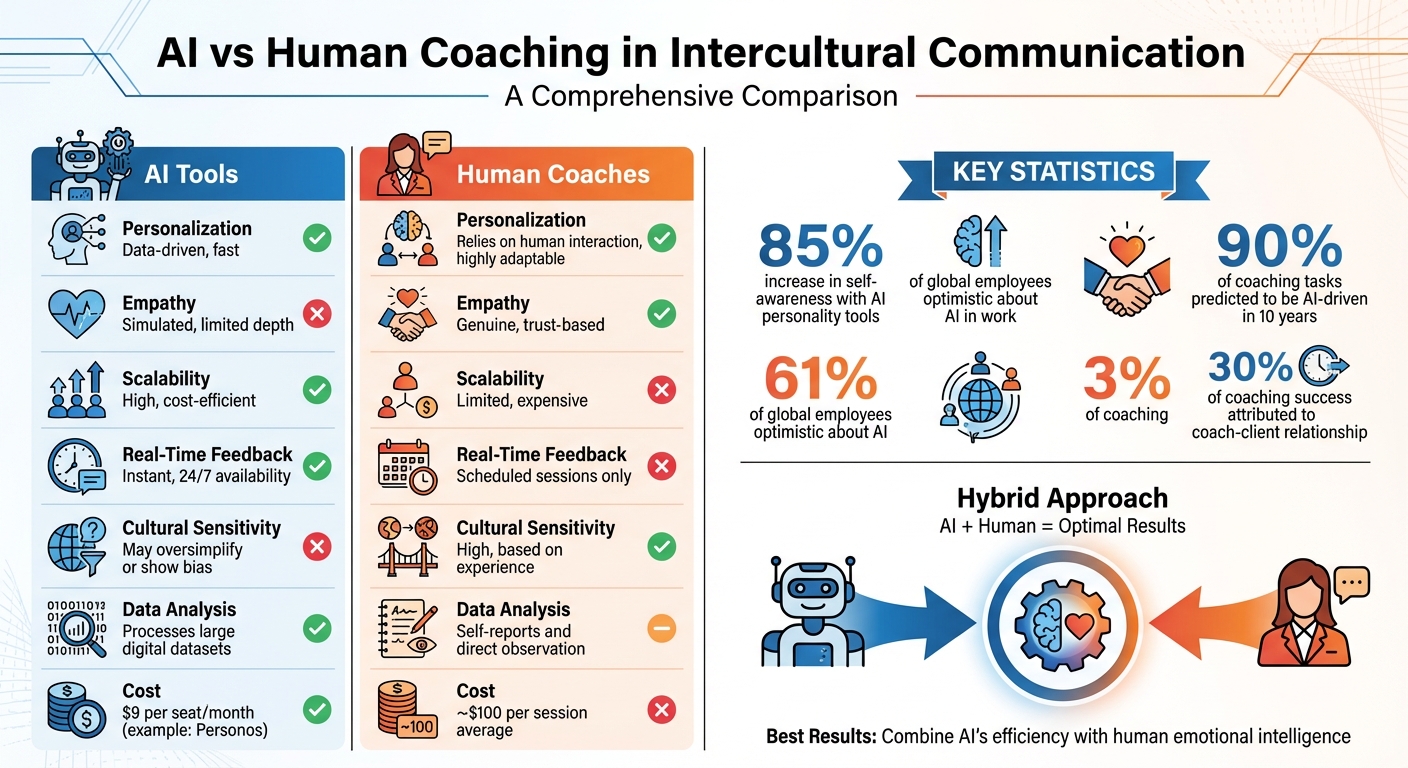
AI vs Human Coaching in Intercultural Communication: Complete Comparison
1. AI-Driven Personality Insights (e.g., Personos)
AI tools are reshaping how personality is analyzed in intercultural coaching. Traditional methods, like the Big Five or MBTI, rely on static questionnaires. In contrast, AI-driven platforms analyze diverse data sources - text, voice, video, and even social media - to predict personality traits in real time [4]. The adoption of advanced deep learning models, such as Convolutional Neural Networks (CNNs) and Transformers like BERT and GPT, has surged since 2018. These technologies excel at detecting intricate, non-linear patterns in human behavior that are often missed by manual analysis [4].
Personalization
AI systems adapt their responses to align with individual personality profiles. For instance, research highlights how chatbots calibrated to users’ levels of Extraversion and Agreeableness can significantly boost engagement by mirroring their traits [7]. Platforms like Personos take this a step further by analyzing digital footprints to generate dynamic, personalized personality reports.
Cultural nuances are another critical aspect of personalization. AI demonstrates different orientations based on the language it operates in. For example, GPT, when used in Chinese, reflects a more interdependent social orientation and a holistic cognitive style compared to its English usage [5][11]. Jackson G. Lu, Associate Professor at MIT Sloan, explains:
When used in Chinese (versus English), GPT exhibits a more interdependent (versus independent) social orientation and a more holistic (versus analytic) cognitive style [5][11].
Coaches can enhance these insights by using cultural prompts, asking the AI to adopt specific cultural roles. This approach helps align the analysis with the coachee’s background, fostering immediate empathy during live interactions [5].
Empathy Development
AI doesn’t just analyze - it helps users develop empathy. By offering real-time feedback on tone, pacing, and participation, AI tools refine intercultural communication skills [8]. For example, in cross-cultural simulations, AI can detect whether users recognize subtle cultural cues like indirect communication or hierarchy-sensitive responses. It then provides immediate corrective strategies [10]. These tools create opportunities for practicing "code-switching" and navigating challenging conversations, such as balancing East Asian politeness with German directness [10].
The results are tangible. AI-powered personality tools have increased self-awareness among users by 85% [9]. Additionally, 61% of global employees express optimism about how AI will transform their work [8]. Kevin Gagan, Senior Client Partner at Korn Ferry, emphasizes:
The real power of AI in coaching is its ability to personalize at scale. It can tailor content to an individual's needs, making development more precise and impactful [8].
Scalability
AI’s ability to scale is a game-changer for personality-based coaching. Traditional coaching often struggles with limitations like cost, scheduling, and availability. AI removes these barriers, enabling automated personality profiling on a large scale [4]. What was once an exclusive resource for senior executives is now accessible to employees at all levels. For example, platforms like Personos provide these services for just $9 per seat per month, making comprehensive intercultural coaching affordable for entire teams.
AI also ensures constant availability. Unlike human coaches, who are bound by time zones and working hours, AI offers 24/7 support [8][10]. Studies even show that participants can build a "working alliance" with AI coaches comparable to the collaborative relationships they form with human coaches [3].
Real-Time Feedback
The ability to receive instant feedback revolutionizes learning in intercultural communication. During meetings, AI can provide actionable suggestions like “Speak less” or “Avoid repetition,” helping users identify and adjust their communication patterns on the spot [8].
For intercultural scenarios, real-time feedback becomes even more impactful. AI simulations allow users to practice culturally adapted strategies, such as using "SBI-Feedback" (Situation-Behavior-Impact) tailored to hierarchy-oriented or indirect cultures like Japan or India. This hands-on, scenario-based training offers practical guidance, contrasting with theoretical frameworks like Hofstede’s cultural dimensions, which often remain abstract. By focusing on actionable behaviors, AI-driven coaching takes a more practical approach than conventional methods [10].
2. Traditional Intercultural Coaching Methods
Traditional intercultural coaching leans heavily on human expertise and structured frameworks to develop cultural competence. Unlike AI's reliance on data, these methods emphasize the collaborative relationship between the coach and the client. Research highlights that this relationship accounts for 30% of the variation in coaching success [3].
Personalization
Traditional coaching offers a deeply personalized experience, built through human interaction rather than AI's instant, data-driven feedback. Coaches often use frameworks like DELTA to tailor their strategies, taking into account cultural values and individual motivational needs. The process typically starts with aligning on cultural expectations, followed by adapting feedback styles to respect cultural norms. For instance, in cross-cultural teams, skilled coaches focus their feedback on task-related aspects instead of personal traits. This approach minimizes the risk of defensive reactions and fosters a more constructive dialogue [2].
Empathy Development
Empathy plays a central role in traditional coaching, and methods like role-playing simulations (e.g., BaFa BaFa or Ecotonos games) and reflective practices such as journaling and case studies are key tools. These hands-on techniques help build intercultural empathy, which is essential for effective communication. A study involving 244 international professionals revealed that "Openness" as a personality trait only enhances cultural intelligence when paired with "Agreeableness", a trait closely tied to empathy [12]. Programs that mix traditional teaching methods with experiential activities tend to deliver the best outcomes for cultivating cultural intelligence [6].
Scalability
One of the major challenges of traditional coaching is scalability. For many organizations, especially small and medium-sized enterprises, offering human-led coaching is often too costly, and the limited number of available experts makes it difficult to serve large groups at once [13]. This constraint highlights a key difference between traditional methods and AI-driven coaching, particularly when it comes to the timing and availability of feedback.
Real-Time Feedback
Traditional coaching typically happens during scheduled sessions, which means feedback is retrospective rather than real-time [1][3]. Unlike AI, human coaches can't process large volumes of data or detect subtle behavioral patterns during live interactions. While human coaches excel in providing deep moral insights and emotional nuance, they lack the speed required for "just-in-time" feedback during negotiations or meetings [1][13]. Ricardo Melo, PCC from Argentina, explains:
AI and big data will make coaching more precise, identifying real-time patterns for effective adjustments and improved results [1].
sbb-itb-f8fc6bf
Pros and Cons
When it comes to intercultural coaching, both AI-driven personality insights and traditional coaching methods bring distinct advantages and limitations to the table. Understanding these differences can help organizations and coaches determine which approach - or combination - fits their goals best. Let’s break down the key points.
AI-driven tools stand out for their scalability and affordability. They can serve thousands of users simultaneously, making them a cost-effective option. For instance, while human coaching sessions in Africa average around $100 each, AI platforms offer real-time support at a fraction of that cost. Tools like Personos (https://personos.ai) use AI and principles of personality psychology to provide instant, data-backed insights for improving communication and resolving conflicts - all for just $9 per seat per month.
However, AI has its shortcomings. It struggles with genuine empathy and often misreads subtle cultural nuances, particularly in high-context cultures like Japan or China. This is largely because many AI systems are trained on Western-centric datasets, which can introduce bias. As Terblanche and colleagues point out:
AI's lack of empathy and emotional intelligence make human coaches irreplicable [14].
Traditional coaching methods, on the other hand, shine in areas that require a strong human connection. The coach-client relationship plays a pivotal role, accounting for 30% of coaching success. Human coaches excel at offering empathy, moral reasoning, and cultural sensitivity, which are essential for navigating complex, evolving goals. However, traditional coaching faces challenges in scalability. The limited availability of trained professionals and the high costs involved make it difficult for smaller organizations to implement human-led coaching on a large scale.
| Criteria | AI-Driven Personality Insights | Traditional Intercultural Coaching |
|---|---|---|
| Personalization | Strong in data processing but weak in nuanced context [4] | Highly adaptable to complex human values and contexts [3] |
| Empathy Development | Simulated; lacks true emotional depth [3] | Built on trust, rapport, and genuine empathy [3] |
| Scalability | Excellent; global reach at low cost [14] | Limited by coach availability and high fees [14] |
| Real-Time Feedback | Available 24/7 [14] | Periodic; restricted to scheduled sessions [14] |
| Data Analysis | Processes large digital datasets [4] | Relies on self-reports and direct observation [4] |
| Cultural Sensitivity | Inconsistent; may oversimplify or show bias [13] | High; informed by lived experience and deep empathy [1] |
A blended approach that combines AI's powerful analytics with the emotional intelligence of human coaches could address many of these challenges [13].
Conclusion
Choosing between AI-driven tools and traditional coaching methods ultimately depends on your organization's needs and goals. Each approach offers distinct strengths, and the decision should align with the specific challenges and objectives at hand.
AI tools like Personos (https://personos.ai) are ideal for large-scale, data-driven tasks. They excel in analyzing complex personality patterns and delivering actionable insights at scale. These platforms offer features like real-time communication tips, conflict resolution strategies, and goal tracking, making them a practical choice for distributed teams. AI works best for initial evaluations, ongoing support between coaching sessions, and cost-efficient implementation across global organizations.
On the other hand, traditional coaching methods bring value where empathy, cultural sensitivity, and nuanced decision-making are crucial. Human coaches are adept at interpreting subtle cultural cues and fostering genuine connections - skills that are especially important in high-context environments where implicit communication plays a key role. They are indispensable for personalized support, navigating delicate cultural dynamics, and building trust through emotional engagement [3][15].
The most effective solution often lies in combining both approaches. AI can handle data analysis, pattern recognition, and round-the-clock availability, while human coaches provide the emotional intelligence and contextual understanding that machines cannot replicate. Together, they form a well-rounded coaching framework. As David Peterson, former Senior Director of Coaching at Google, aptly stated:
In 10 years, 90% of what coaches do today will be done by artificial intelligence [3].
Still, the remaining 10% - the deeply human aspects like empathy, moral judgment, and authentic connection - will continue to be indispensable for meaningful intercultural coaching. By blending AI's efficiency with the human touch, organizations can better navigate the complexities of diverse cultural environments.
FAQs
How does AI improve intercultural coaching compared to traditional methods?
AI is reshaping intercultural coaching by offering real-time insights into personality traits, cultural nuances, and sentiment, allowing for more personalized and empathetic communication. Unlike conventional methods that depend largely on intuition and experience, AI-based tools provide data-driven recommendations that adjust dynamically to the needs of individuals and groups.
Take platforms like Personos, for instance. They utilize AI-powered personality models to create tailored reports, proactive communication suggestions, and group analyses. These tools equip coaches to better understand cultural subtleties and build stronger connections. The result? Improved communication and faster development of meaningful relationships in culturally diverse settings.
What challenges does AI face in understanding cultural differences?
AI tools often face challenges when it comes to understanding cultural nuances. A major reason for this is that many models are built using datasets that might lean toward biases or reflect mainly Western viewpoints. This can result in misunderstandings of culturally specific values, idioms, or even distinct communication styles. Instead of capturing these subtleties, AI often generalizes its responses based on broad patterns, which can miss the finer, context-driven details crucial in cross-cultural interactions.
Another limitation is the lack of integration with personality or behavioral insights. Without these, AI tends to rely on generic coaching templates that don’t dive into the deeper relational dynamics shaped by cultural differences. On top of that, ethical concerns - like transparency, the risk of reinforcing stereotypes, and the absence of human empathy - underscore why blending AI tools with human expertise is essential. This combination ensures coaching remains both culturally aware and genuinely personalized.
Can combining AI and human coaching enhance intercultural communication?
Blending AI with human coaching offers a powerful way to enhance intercultural communication. AI tools can process real-time data to identify personality traits, cultural norms, and communication styles. They provide actionable insights, such as suggesting tone adjustments or recommending culturally appropriate phrasing, which can help bridge gaps in understanding and make interactions smoother.
On the other hand, human coaches contribute empathy, emotional intelligence, and the ability to make nuanced judgments. They ensure that AI-generated suggestions are applied thoughtfully and respectfully. This combination of technology and human insight creates a dynamic coaching experience that builds trust, minimizes misunderstandings, and helps individuals navigate intercultural communication more effectively.