AI Mentor Matching: How Personality Profiles Help
Match mentors by goals, expertise, availability and mutual choice; use personality profiles only to guide communication and protect privacy.
Rachel Johnson

AI Mentor Matching: How Personality Profiles Help
I’d match mentors by goals, expertise, availability, and mutual choice first, not personality scores. I’d use personality profiles to help partners discuss feedback and meeting preferences, then confirm what works through conversation.
Why that order? A 2025 study of 76 mentor–mentee pairs linked shared traits with greater satisfaction, but complementary strengths did not predict learning and development.
Here’s the approach I’d use:
- Let AI suggest options, not assign partners. Staff review each option, and both participants can decline.
- Keep assessments optional. Ask for consent, limit data access, and offer an equivalent route without personality testing.
- Separate matching from communication support. Tools such as Personos can help partners prepare after they accept a match.
- Check in within 30 days, or after two or three meetings, whichever comes first.
My rule: treat profiles as conversation prompts, while keeping <u>people in charge</u>.
Personality Quizzes Won't Find You a Mentor | ragTech Ep. 057 ft. @ainlovescode
What Matters More Than Personality Similarity?
Personality can help shape how people communicate. But other factors should drive the match.
A comfortable match isn’t always a productive one. Personality may suggest an interaction style, but it cannot predict mentoring success on its own. A 2025 study followed 76 mentor–mentee pairs over nine months. Shared traits were linked to greater mentee satisfaction, but complementary strengths did not predict learning and development experiences.[11]
Put goals, expertise, availability, boundaries, and participant preferences before personality similarity. Start with written goals and evidence that the mentor can teach the skills the mentee needs. Then check capacity, values, and willingness to work together.[8][9][10]
When Can Complementary Strengths Help a Match?
Shared preferences may make communication easier. Complementary strengths may offer ways to learn. Neither guarantees success.
An outreach worker seeking better planning skills chooses a more structured mentor with relevant planning experience. Before accepting, they agree on meeting frequency, preparation, feedback, and how much structure feels helpful rather than controlling. The reason for the match is the learning goal - not a personality score.
Treat profiles as starting points, not proof. Check their suggestions through conversation and records.
| Matching factor | Profiles can hint at | Profiles cannot confirm | What people must verify |
|---|---|---|---|
| Communication style | Interaction preferences | Meeting format | Discuss format and preparation |
| Feedback preferences | Sensitivity or directness | Constructive delivery | Ask how feedback should be given |
| Developmental goals | Learning tendencies | Actual priorities | Written goals |
| Expertise | No reliable evidence of skill | Mentoring ability | Experience and skills review |
| Availability | No scheduling evidence | Capacity to meet | Calendar and workload review |
| Values | General tendencies | Shared commitments | Values discussion |
| Relationship expectations | Structure preferences | Boundaries and responsibilities | Mentoring agreement |
Once these checks narrow the options, participant choice should determine the final pairing.
Why Should Participants Choose Their Matches?
Choice builds buy-in and protects agency. Let participants review finalists and share their preferences before approval. Both people must accept the match: a mentee’s preference does not establish a mentor’s willingness or capacity.[6][8]
Staff should check conflicts of interest, supervisory or evaluative power, prior disputes, accessibility needs, language preferences, concerns about culture or identity, safeguarding requirements, and realistic workload. Either person can decline or request rematching without penalty. AI recommendations never override refusal or staff judgment.[6][10]
How Should AI Support Mentor Matching?
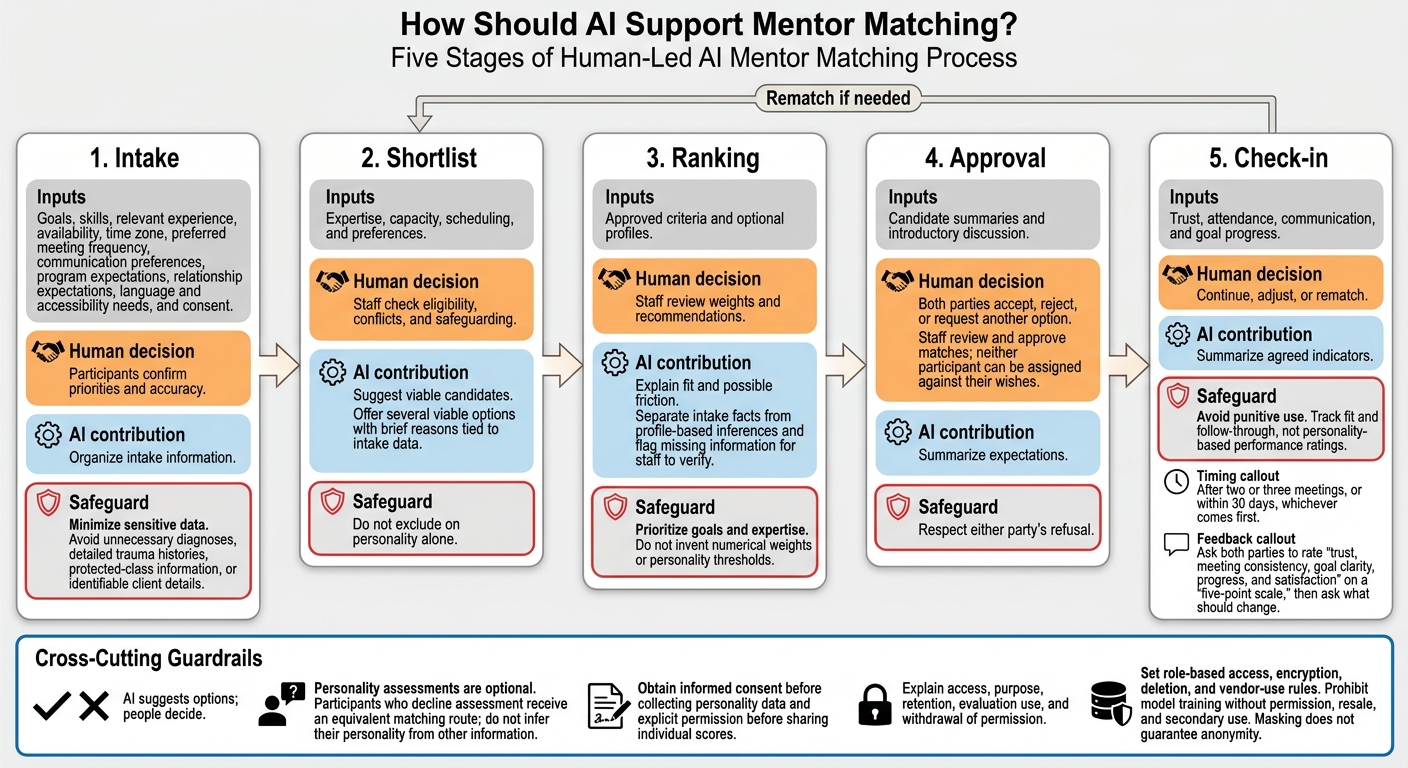
AI Mentor Matching: A Human-Led Workflow
Once goals, expertise, and participant choice are set, the matching process should stay transparent and human-led.
Use AI to organize options, not assign relationships. Staff approve the criteria, review recommendations, and make the final match. AI explains how each option fits the intake data, keeping facts separate from profile-based inferences. Profiles may suggest communication styles and likely friction points, but they don't determine success.[12][13][14]
What Are the Steps From Intake to Match Approval?
Collect both parties’ goals, skills, relevant experience, availability, time zone, preferred meeting frequency, communication preferences, program expectations, and relationship expectations. Include language and accessibility needs. Avoid unnecessary diagnoses, detailed trauma histories, protected-class information, or identifiable client details. Let participants confirm that their information is accurate before generating recommendations.
| Stage | Data used | Human decision | AI contribution | Safeguard |
|---|---|---|---|---|
| Intake | Goals, skills, availability, preferences, expectations, and consent | Participants confirm priorities and accuracy | Organize intake information | Minimize sensitive data |
| Shortlist | Expertise, capacity, scheduling, and preferences | Staff check eligibility, conflicts, and safeguarding | Suggest viable candidates | Do not exclude on personality alone |
| Ranking | Approved criteria and optional profiles | Staff review weights and recommendations | Explain fit and possible friction | Prioritize goals and expertise |
| Approval | Candidate summaries and introductory discussion | Both parties accept, reject, or request another option | Summarize expectations | Respect either party’s refusal |
| Check-in | Trust, attendance, communication, and goal progress | Continue, adjust, or rematch | Summarize agreed indicators | Avoid punitive use |
Offer several viable options, each with brief reasons tied to intake data. Show which criteria shaped each suggestion and flag missing information for staff to verify. Participants who decline assessment should receive an equivalent matching route. Don't infer their personality characteristics from other information.[16][17]
How Can Programs Protect Data and Track Results?
Get informed consent before collecting personality data and explicit permission before sharing individual scores. Explain who can see the results, why they're needed, how long they'll be kept, whether they'll be used for evaluation, and how participants can withdraw permission.
Before launch, set rules for role-based access, encryption, deletion, and vendor use. Prohibit model training without permission, resale, and secondary use. Mask identifiers where feasible, but don't treat masking as a guarantee of anonymity.[12][14][15][18]
After approval, the system should track fit and follow-through, not score people.
Schedule a check-in after about 30 days. Ask both parties to rate trust, meeting consistency, goal clarity, progress, and satisfaction on a five-point scale. Then ask what should change.
Track time to match approval, acceptance, rematching, and whether participants had multiple viable options. Check that participants who opted out still received equivalent choices. Review unequal delays or rejection patterns without turning personality scores into performance ratings. Where feasible, compare results with the previous process, while recognizing that better results alone don't prove AI caused them.
Where Does Personos Fit in Mentor Matching?
After staff approve a match, Personos helps participants prepare to work together. It offers personality-aware preparation for helping professionals, including coaches, counselors, and nonprofit staff.
How Can Personos Support Mentoring Conversations?
Personos uses the Five Factor Model and measures 30 personality facets on an 80-point scale.[1][7]
A mentor might use that information to explore whether a mentee prefers structured planning, exploratory discussion, direct feedback, or more time to process emotionally difficult topics. Ask whether written next steps would help, rather than assuming that a conscientious person needs a detailed plan.
Dynamic Reports show personal, relationship, and group patterns. Prompts remind participants to follow agreed practices between meetings, while ActionBoard tracks agreed development tasks.
How Does Personos Compare With Matching Software?
Matching software organizes pairings. Personos helps people work together once they're paired. Its role is communication support, not match selection. Check current features and controls before buying.
| Tool category | Conversation support | Participant choice | Privacy |
|---|---|---|---|
| Dedicated matching software | Varies; may include check-ins | Verify preferences and overrides | Verify access and retention controls |
| Personos | Contextual chat, relationship reports, Prompts, and ActionBoard | Matching decisions remain with staff and participants | Scores private unless shared by consent |
Personos also emphasizes Transparent Reasoning, which shows why it suggests an approach for discussion rather than automatic judgment.[1] Use that information to support participants' goals, choices, and privacy. Before buying, also check the current contract and access settings.
Conclusion: Start With Goals, Choice, and Privacy
Match people based on development goals and mentor expertise, not personality similarity. Use Five Factor Model profiles only to guide communication.[5] Let that standard guide the rest of the process.
AI should suggest options, while staff and participants make the final decision. Start with a small, voluntary pilot. Publish clear matching criteria: goals, expertise, availability, accessibility, and preference. Keep staff review in place, allow participants to decline without penalty, and explain how to request a rematch.
Once a match is approved, protect the data used to make it through consent, access limits, and retention rules.[19][20][21]
Check in separately with mentors and mentees after two or three meetings, or within 30 days, whichever comes first. Expand only when their feedback confirms better relationships, privacy, and choice.
FAQs
What if my Five Factor profile conflicts with my preferences?
If your Five Factor Model profile doesn’t seem to match your preferences, personality is only one part of who you are. Platforms like Personos also account for your goals, professional history, and values. That context helps make sense of differences between your traits and stated preferences, so the guidance better fits your situation.
How can staff prevent bias in AI mentor recommendations?
Staff can help prevent bias by choosing platforms that put transparency and data privacy first. Personos keeps individual personality scores private, explains the research-backed psychological principles and traits behind each recommendation, and masks identifying information before it reaches the AI [1][2][3][4]. These safeguards help staff understand the recommendations and reduce the risk of uninformed decisions and bias linked to identifying information.
How can I tell if mentoring improves learning, not just satisfaction?
Look beyond rapport. Measure actual performance and progress toward development goals [1]. Similar personalities can help people feel comfortable, but tailoring communication to personality can reduce misunderstandings and help mentees stay open to constructive feedback [1][2].
Platforms like Personos offer an ActionBoard to track development goals alongside qualitative insights. Use these measures to separate actual skill growth from pleasant conversations or short-term agreement [1][3].