AI Manager Coaching: 9 Skills New Leads Need
New managers: use AI to prep and rehearse tough conversations, feedback, and goals; keep pay, discipline, and safety decisions human.
Christian Thomas

AI Manager Coaching: 9 Skills New Leads Need
If you're a new manager, AI can help you prepare, practice, and reflect. It should not make people decisions for you.
I’d sum up the article like this: use AI around hard conversations, not instead of them. The piece focuses on 9 core manager skills and shows where AI fits, where it does not, and when a human or HR team must step in.
Here’s the full scope in plain English:
- Listen first
- Communicate with clarity
- Give behavior-based feedback
- Handle conflict early
- Lower tension when talks get heated
- Set clear goals
- Delegate and set boundaries
- Recognize effort and support growth
- Build trust while keeping accountability
A few data points stand out:
- 39% of U.S. managers have hard talks with direct reports at least weekly
- Only 14% of employees get recognition from their manager at least weekly
- Employees who get both frequent feedback and recognition show 61% engagement, versus 38% for those who get feedback without the same level of recognition
What I like about this article is that it keeps the line clear:
- Use AI to draft talking points
- Use AI to rehearse a 1:1
- Use AI to review tone and personality types
- Do not use AI to decide misconduct, pay, promotion, discipline, termination, or crisis response
It also repeats one point that matters a lot: remove names and private details, and escalate harassment, discrimination, threats, self-harm risk, safety issues, and legal matters to the right people right away.
If I had to boil the article down to one sentence, it would be this: AI can help you practice the job of managing people, but you still have to do the human part yourself.
Promoted but Unprepared: How AI Coaching Is Helping New Leaders | All Things Work
What AI Coaching Can and Cannot Do for New Leads
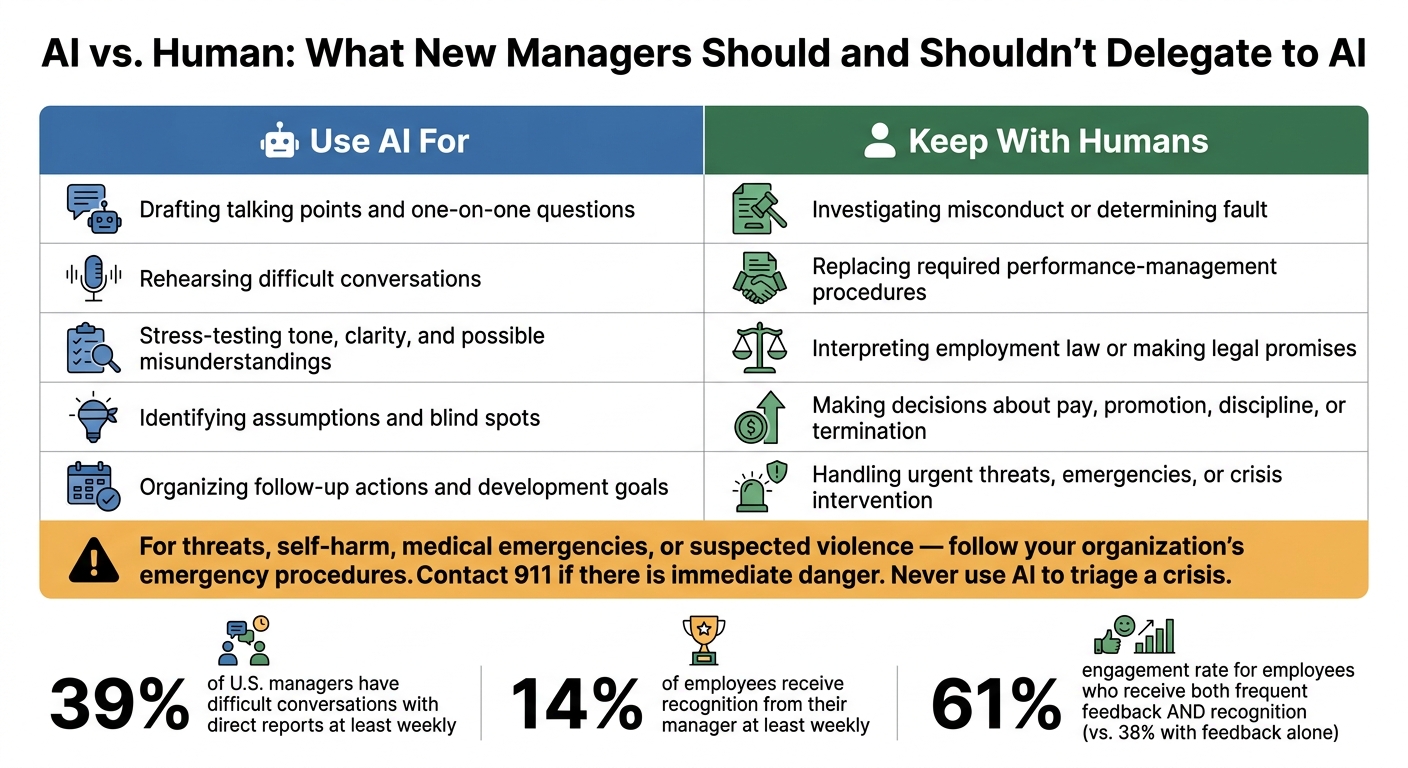
AI vs. Human: What New Managers Should and Shouldn't Delegate to AI
AI coaching is at its best before or after a hard conversation, not in the middle of it acting like the manager. You can use it to sketch out talking points, practice what you want to say, and sort out follow-up steps.
The survey data points in that direction too. But AI still misses the mark on spontaneity, context, and plain human connection.
Use AI for preparation only. Keep misconduct, performance, pay, promotion, termination, and crisis decisions with people.
| Use AI for | Keep with humans |
|---|---|
| Drafting talking points and one-on-one questions | Investigating misconduct or determining fault |
| Rehearsing difficult conversations | Replacing required performance-management procedures |
| Stress-testing tone, clarity, and possible misunderstandings | Interpreting employment law or making legal promises |
| Identifying assumptions and blind spots | Making decisions about pay, promotion, discipline, or termination |
| Organizing follow-up actions and development goals | Handling urgent threats, emergencies, or crisis intervention |
For urgent situations such as threats, self-harm concerns, a medical emergency, or suspected violence, stop and follow your organization's emergency procedures. If there's immediate danger, contact 911. No AI tool should be used to triage or manage a crisis [1].
AI can help you get ready for the conversation. But active listening happens in the moment, and that's where the manager has to step in.
1. Active Listening and Perspective-Taking
When you move from peer to lead, people start paying close attention. They notice favoritism. They notice when concerns get brushed off. They notice when decisions seem to come out of nowhere. Listening is one of the first ways new leads build trust before they try to shape how the team works. It comes first because every other leadership skill depends on understanding what’s ACTUALLY going on.
Research summarized by the Center for Creative Leadership links manager empathy with stronger performance ratings and treats listening as a core leadership behavior.[2] If you skip that step, small misunderstandings can sit there and grow. It also gets harder to spot concerns early, while there’s still time to deal with them.[2]
A simple sequence can help:
- Pause
- Listen
- Reflect
- Clarify
- Summarize
Pause what you’re doing. Reflect back what you heard: "What I'm hearing is that the deadline shifted without enough notice." Then clarify with a direct open question: "Which part of the handoff caused the biggest problem?" After that, summarize the next step you both agree on. The point is to check meaning, not just repeat words.[2]
Perspective-taking is where many new leads trip up. It does not mean agreeing with everything. And it does not mean letting go of accountability. It means asking, "What facts does this person have that I might not?" before you respond.
Say an employee misses a handoff. Before jumping straight to the standard, ask what got in the way. Then state the expectation. You can do both at once: understand the situation and still hold the line. For example: "I hear that the request changed late. Going forward, flag that risk before the deadline." That approach keeps empathy in the conversation without wiping out consequences.
AI can help before the meeting. You can use it to role-play a defensive employee or draft neutral follow-up questions. For example:
"An employee says, 'Nobody tells me anything until the last minute' - give me three possible concerns behind that statement and five non-defensive questions"
That gives you drafts to test, not answers to impose. Use the output as a starting point, then check it with the employee. If the issue involves harassment, discrimination, accommodations, mental health concerns, or formal complaints, take it to HR or the right human channel, not an AI tool.
Once you can listen well, the next step is making your message clear enough for the team to act on.
2. Clear Team Communication
Once you know how to listen, the next job is making sure your message lands. That’s where clear communication comes in. Listening should lead to action.
At this stage, you’re not just keeping track of your own tasks. You’re turning priorities into clear expectations for the team. When that translation breaks down, people get fuzzy on who owns what, when work is due, and what matters most.
Listening matters only if it shapes what you say next. Regular meetings can help engagement, but only if they bring clarity, responsiveness, listening, and follow-through. Trust comes from the quality of the interaction: clarity, responsiveness, listening, and follow-through.[4]
After any team update, each person should be able to answer these four questions: What are we trying to accomplish? What does success look like? Who owns the next step? When will we check progress? If even one person can’t answer them, the message needs work.
A simple way to structure updates is to move through four parts:
- Context
- Action
- Reason
- Check-in
For example: "The client onboarding queue increased by 20% this week. Jordan will review the oldest 10 cases by 3 p.m. Thursday to protect our response-time target. Please flag any case that requires legal or compliance review before proceeding." Then ask, "What questions or capacity concerns should we address before you start?"
AI can help tighten the wording before you send it. You can use it to rewrite a vague note, role-play a confused team member, or spot unclear ownership before you hit send. But you still need to check every fact, deadline, and policy reference yourself. AI can smooth out the language, but it can’t read team history, office tension, or workload. Once the message is clear, the next step is giving feedback that helps people do better work.
For harassment, discrimination, discipline, safety, or legal issues, send the matter to HR or the right human channel.
3. Constructive Feedback
Feedback helps close the gap between what's expected and what actually happens. For new managers, the job is simple to say and hard to do: correct behavior without hurting trust. If you handle it badly, trust takes a hit. If you handle it well, small problems don't have time to grow into performance issues.
Keep behavior feedback separate from personal judgment. Talk about what the person did, not who they are. The Center for Creative Leadership's SBI model gives you a clean way to do that: Situation, Behavior, Impact. For example:
In yesterday's client meeting, you interrupted twice before Jordan finished. That prevented the team from fully addressing the risk and forced a rehash later. Next time, let the speaker finish, then summarize the concern before responding.
Give corrective feedback in private, soon after the event, and in a calm, problem-solving tone. Stick to one or two high-impact behaviors. If you pile on five other issues, the message gets muddy fast.
Gallup data shows meaningful feedback drives engagement, while infrequent feedback does not. [5][6]
AI can help with prep work. You can use it to rewrite sanitized notes in SBI format, add two open-ended follow-up questions, and rehearse likely reactions. But AI can't verify your facts, read the history between two people, or judge workplace dynamics. That part is still on you.
Do not use AI for harassment, discrimination, retaliation, threats, safety, medical, disability, or legal issues. Send those to HR, employee relations, legal, safeguarding, or emergency support.
When feedback triggers defensiveness, the next skill is handling conflict without making it worse.
4. Conflict Response and Difficult Conversations
When feedback sparks resistance, this is where a new lead gets tested. The biggest mistake is waiting too long to deal with it. SHRM found that 39% of U.S. managers and supervisors have difficult conversations with direct reports at least weekly[7].
At the root of many bad conflict moments is a simple mix-up: treating conflict like a personal attack instead of a communication issue. Conflict researcher M. Afzalur Rahim put it well:
"Whether conflicts yield negative or positive consequences depends how conflicts are resolved."
That’s the point. The main risk is usually avoidance, not the conversation itself.
A useful way to handle this is the Situation–Behavior–Impact–Expectation–Question framework. It keeps the discussion tied to facts instead of emotion. Start with the specific situation. Then describe what you saw, not what you guessed. Explain the effect on the team. Name the standard that was expected. After that, ask an open question such as: "What was happening from your point of view?" That last part matters. It shifts the tone from a lecture to a coaching conversation.
Pushback is common. And when it happens, many leads go to one of two bad extremes: they back off, or they dig in. Neither helps. A better move is to acknowledge the other person’s view without letting go of the issue. You might say: "I hear that you experienced the meeting differently." From there, separate observations from interpretations, bring the focus back to the missed handoff information, and ask for a clear commitment.
If the conversation starts getting heated, de-escalation comes first.
You can also use AI before the meeting to practice. For example, it can role-play a defensive response, point out accusatory wording in your opening, or help you test neutral ways to start. Personos can help you see how the message may land with an anxious, defensive, or frustrated employee. But AI should not decide fault, investigate allegations, or take the place of HR guidance.
If the issue involves harassment, discrimination, retaliation, threats, or safety, stop and escalate to HR or the right human authority.
When tension keeps rising, the next move is de-escalation and emotional regulation.
5. De-Escalation and Emotional Regulation
When a conversation gets heated, your first job is not to solve the whole problem. It’s to get control of the moment. In tense situations, the lead gets tested first.
Conflict can set off a stress response fast. Your voice gets sharper, your thinking gets tight, and defensiveness starts to take over. Emotional regulation means noticing that reaction and slowing it down before it runs the conversation. De-escalation is the next part: the deliberate actions that bring the temperature down. A new lead needs both.
Use a simple script when you feel your own stress rising: Use CALM: check safety, acknowledge, listen, and move to the next step. Keep your words short, neutral, and specific.
"You expected more notice, and the short timeline has created pressure."
That’s the idea. Stabilize first. Analyze later.
AI can help most before and after the conversation, not in the middle of the escalation itself. Use it to rehearse calm replies, test neutral wording, and debrief afterward. Personos can also help with personality-aware practice. It can show how different communication styles land under pressure and help you spot escalation patterns before they happen again.
If there is a threat of violence, physical intimidation, a weapon, a credible self-harm risk, or a medical emergency, stop, disengage, and create distance. Follow your organization’s emergency procedures and contact security, HR, or emergency services as needed. Route policy violations through the proper human channel. A new lead’s job is to lower tension only when it is safe to do so.
6. Goal Setting and Performance Alignment
After de-escalation, the next job is to turn priorities into work people can actually do and measure. That’s what a new lead is there to do: take organizational priorities and turn them into clear action. When that step breaks down, people start guessing. And guessing usually leads to missed targets, mixed signals, and a lot of avoidable frustration.
The fix is a better conversation. Before assigning any goal, a new lead should be able to answer five plain questions:
- What result do we need?
- How will we know it's complete?
- What dependencies could affect delivery?
- What can this person decide without approval?
- When will we check progress?
SMART is a good gut check here: specific, measurable, achievable, relevant, and time-bound. For example:
"By June 30, reduce average first-response time from 24 hours to 12 while keeping customer satisfaction at 90% or higher."
That goal works because it says what needs to change, by when, and what can’t slip while doing it. Once the goal is clear, the manager and employee should say it back the same way. If each person describes it differently, the goal still needs work.
It also helps to build the goal with the employee, not just hand it over. Ask them where they see roadblocks, what resources are missing, and what a realistic milestone looks like. Then ask them to restate the goal in their own words. That small step can save a lot of cleanup later.
AI can help tighten the draft before the conversation. You can use it to turn a vague priority into measurable options, point out fuzzy terms like "improve" or "be more proactive", and role-play an employee who thinks the target is unrealistic. In plain terms, it helps you hear how the goal might land before you say it out loud. Still, any AI-written goal is just a draft. Check it for fairness, feasibility, and workload impact before you bring it into the conversation.
7. Boundary Setting and Delegation
Once goals are clear, the next step is deciding who owns each task and what the manager needs to stop doing. New leads have to assign ownership, guard their time, and stop holding work the team should handle. If that shift doesn't happen, the lead turns into the team's bottleneck.
Boundary setting and delegation work together. A boundary on its own doesn't fix overload if the lead still keeps the work. Delegation on its own doesn't help much either if people keep interrupting all day. One without the other falls apart fast.
Some managers lean toward over-accommodating people or sidestepping uncomfortable talks. That's where personality-aware coaching helps. It gives them a way to spot those habits early, before they harden into patterns.
It helps to frame boundaries as working agreements, not personal refusals. For example: "Routine questions go to the team channel. Urgent issues - safety, compliance, or work-blocking problems - come directly to me." That kind of statement is clear, easy to repeat, and cuts out the guesswork around what counts as urgent. Boundaries cut interruptions. Delegation helps the team take on more.
Once the boundary is set, the handoff needs the same level of clarity. Before handing off any assignment, use a short brief that covers:
- Task
- Outcome
- Authority
- Constraints
- Support
- Check-in points
Check-ins should feel like support, not surveillance. If a manager follows up too much after a handoff, trust can start to slip [9].
AI can help with practice and drafting. Use it to role-play resistance, spot missing decision rights, and compare vague handoffs against clear ones. High-stakes personnel decisions should stay with people. The goal is simple: give the team ownership without giving up control of the standard.
8. Motivation, Recognition, and Development
After delegation, the next job is keeping people engaged and helping them grow. Manager quality shapes a big share of team engagement, so what you do day to day matters.
Once ownership is clear, the next question is simple: do people still have the energy and support to do the work well?
A practical framework for new leads is the ACE model: Autonomy, Competence, and Connection. In a regular one-on-one, ask one question for each area: "Where do you want more ownership?" "What would help you do this better?" and "What would help you feel more connected here?" Then agree on one concrete action. The idea is straightforward. Autonomy, competence, and connection drive motivation.
Once you have a better read on motivation, recognition becomes one of the fastest ways to reinforce the behavior you want to see.
A 2024 Gallup/Workhuman survey of 4,439 U.S. adults found that only 14% of employees receive recognition from their manager at least weekly, yet employees who receive both feedback and recognition weekly are engaged at a rate of 61%, compared with 38% among those who get frequent feedback but less frequent recognition [5]. That gap is hard to ignore.
The fix is specific praise. Use behavior-impact-value: what they did, what changed, and what value it showed. "You clarified the handoff checklist before launch. That reduced confusion for the on-call team and demonstrated strong ownership." That lands much better than "Good work this week."
Recognition also works better when it points to the next skill to build. Praise the action, then connect it to growth. That helps people see that recognition is not just about making them feel good. It shows them where they're getting stronger.
You can use AI to draft recognition language or development questions, then check it against what you actually saw before you say it.
If an employee seems disengaged or resistant to development conversations, start with curiosity before jumping to conclusions. Ask about workload, role clarity, relationships, resources, and whether the proposed goal even matters to them. Sometimes the issue is not attitude. It's friction.
If the conversation points to burnout, harassment, discrimination, retaliation, or a safety concern, escalate through the proper human channel. A new lead's job is to notice and refer, not diagnose or handle it alone.
That follow-through is what turns motivation into trust.
9. Team Trust, Psychological Safety, and Accountability
Trust and psychological safety help new leads hear about problems early. Accountability keeps those talks honest. Trust comes from how you listen, communicate, give feedback, and handle conflict. It isn't some separate idea off to the side. It's the clearest sign that the earlier skills are either working or not.
Google's Project Aristotle found that psychological safety was the strongest team dynamic.[10][11] For a first-time lead, that matters in a very practical way: if people feel nervous about speaking up, you'll hear about trouble last.
Safety without accountability can turn into excuse-making around missed deadlines. Accountability without safety pushes problems underground. You need both: high candor and high standards.
One simple way to do that is with a two-part conversation. Start by understanding the situation: I appreciate you flagging this. What happened, and what do you need? Then state the expectation: We still need the client-ready draft by Thursday at 3:00 p.m. Please send me a revised plan by noon tomorrow. That balance matters. Stay respectful, but keep the commitment in plain view.
If the same issue keeps coming up, write down the key pieces:
- owner
- deliverable
- deadline
- success measure
- next check-in
Do that often enough, and people usually start surfacing issues sooner instead of waiting until things are off the rails.
Model the behavior yourself. Admit a mistake when it's appropriate. Ask what you may be missing. Thank people for bringing you bad news before you start digging into the details. The Center for Creative Leadership studied nearly 300 leaders over 2.5 years and found that teams with higher psychological safety reported better performance and less interpersonal conflict.[8]
An AI coach can help you practice these moments before they happen. You can ask it to role-play a reluctant employee, rewrite a blame-heavy message into a neutral one, or turn a vague expectation into a measurable commitment. Tools like Personos can add personality-aware guidance for these conversations, but treat the output as a draft.
A little caution goes a long way here. Remove names and personal details before entering anything. And never use AI-generated interpretations to judge intent or make employment decisions. If a situation involves harassment, discrimination, retaliation, threats, or a serious safety concern, stop and escalate right away to HR, legal, or the right authority. No coaching tool replaces that step. The practice routine below turns these habits into repetition.
A Simple AI-Assisted Practice Routine for New Managers
Build one skill at a time. At the start of each week, choose one observable behavior. Not a broad goal like "communicate better", but something you can actually track, like "ask two open-ended questions before offering advice in my next one-on-one." That kind of narrow target makes practice measurable and helps AI coaching stay specific instead of drifting into generic advice. You can use this same routine on the nine skills above, one by one, until the habit starts to stick.
From there, keep the routine simple: choose, prepare, practice, and reflect. Use an approved AI tool to help you map out a conversation, test language, or role-play likely responses. Only use approved, de-identified context: your role, the situation, the outcome you want, and the tone you want to strike. For example:
"Help me prepare for a 20-minute conversation with a team member who has missed two agreed deadlines. I want to be direct, respectful, and curious. Suggest three open-ended questions, a neutral description of the impact, and a way to confirm next steps."
Check your organization's approved-use policy before entering any workforce information into a public AI system.[3][13]
When the real conversation starts, don't cling to a script. The prep is there to sharpen your behavioral insights, not take it over. Afterward, turn the conversation into a short learning loop. Spend five to ten minutes on a quick debrief: What did I observe? What did I do? What was the effect? What will I adjust? A short note might say:
"I summarized the concern before responding. The employee identified workload as a barrier. We agreed to reprioritize Task A by Tuesday. Next time, I will confirm capacity before setting a new deadline."
Write down the behavior, the agreed next step, and store it according to policy.[12]
Treat every AI output as a draft, not a decision. Before you act on a suggestion, pause and ask: Is this accurate? Is it fair? Is it consistent with policy? What context might this advice be missing? Personos can help with personality-aware practice when your organization has approved that use, but it's still just an input, not the one making the call.
Some situations should never stay in rehearsal mode. Stop and escalate threats, harassment, discrimination, retaliation, self-harm concerns, and formal discipline issues to HR or the right authority. AI can help you practice. It should never decide whether to escalate.
Conclusion
No new manager walks in strong across all nine areas on day one. You get better through repetition, not overnight skill.
That’s why the aim is to practice all nine skills: listening, communication, feedback, conflict response, de-escalation, goal setting, delegation, recognition, and trust. Focusing on just one while ignoring the rest usually backfires.
Credibility comes from reliability. Say what you’ll do, do it, and if you miss, fix it fast. Repeated practice helps people remember more and perform better. That steady rhythm is where AI can be useful.
Use AI to rehearse, draft, and reflect. Tools like Personos can add personality-aware support when you’re getting ready for tough conversations. Listening, judgment, empathy, and high-stakes calls should stay with the manager.
The real edge is self-awareness. Notice your patterns, adjust in the moment, and bring that lesson into the next conversation. New leads don’t need perfect instincts. They need reps, honest reflection, and steady follow-through.
FAQs
How can I use AI without over-relying on it?
Choose AI tools that are transparent and help you make your own calls, instead of pushing you to follow automated directions.
For example, Personos shows the reasoning, psychological principles, and situational data behind its guidance. That gives you a clear view of why the tool is suggesting something, so you can judge the logic for yourself.
You stay in the driver’s seat. AI should back up your expertise, not take it over.
Which manager conversations should never involve AI?
The sources don’t point to any manager conversations that should never involve AI. Instead, they treat AI as a planning tool for high-stakes talks, including feedback, performance reviews, promotions, and negotiations.
The main point is using it safely and ethically. Personos is described as protecting privacy by masking identifying details and not sharing personality scores.
What skill should a new lead practice first?
Start with self-awareness. A personality assessment, such as Personos’ Five Factor Model assessment, helps new leads build a clear baseline and see how they tend to handle feedback, conflict, and team communication.
Because the guidance is tailored to your personality and situation, you get practical next steps right from the start.