AI in Leadership: Scenario Planning Made Simple
AI speeds scenario planning from weeks to minutes, builds living models, uncovers risks, and pairs with human judgment for smarter leadership decisions.
Rachel Johnson

AI in Leadership: Scenario Planning Made Simple
AI is reshaping how leaders prepare for the future. It transforms scenario planning - a method to anticipate multiple outcomes - by making it faster, smarter, and data-driven. Traditional planning methods often fail to keep up with rapid changes in markets, technology, and global events. AI solves this by analyzing vast amounts of data in real time, cutting planning time from weeks to minutes, and creating dynamic models that update automatically as new information appears.
Key Takeaways:
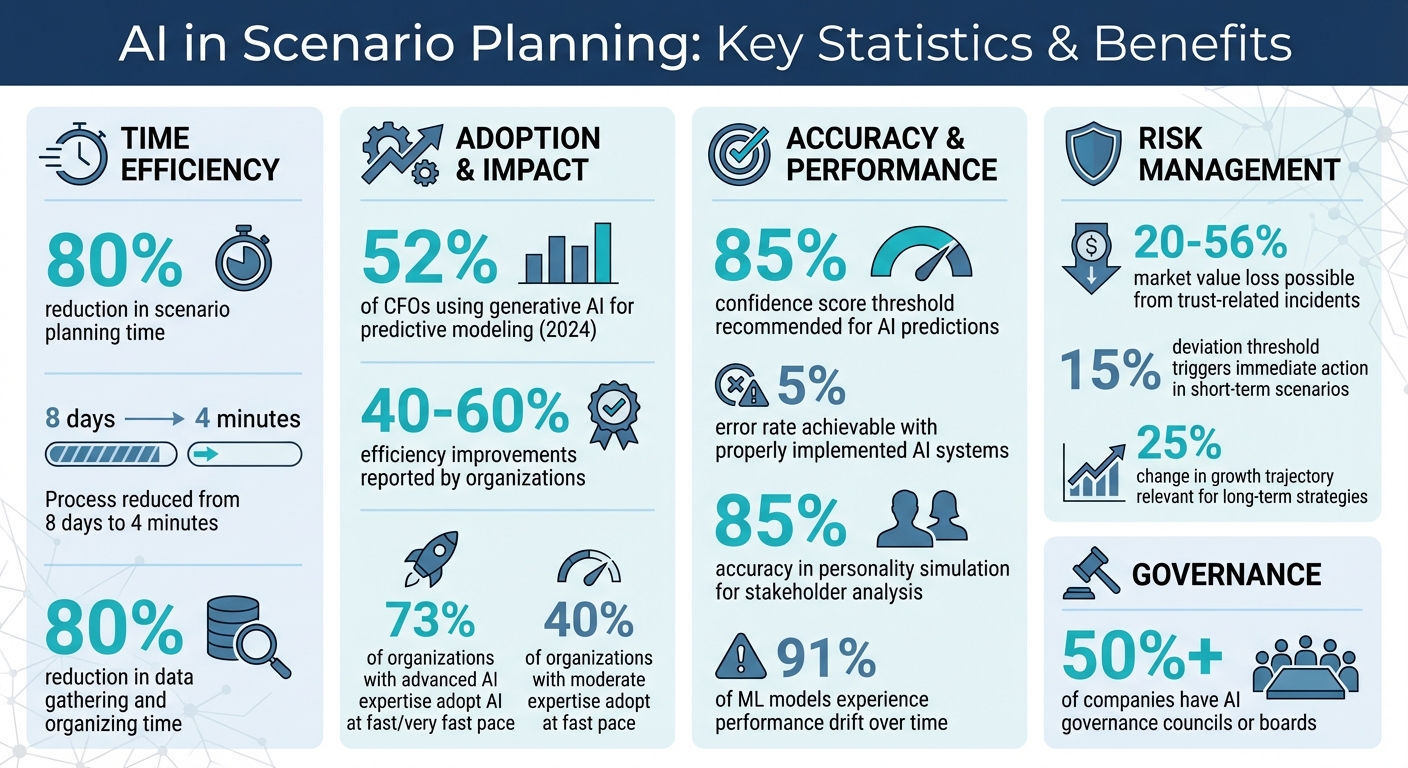
- Faster Processes: AI reduces scenario planning time by up to 80%.
- Real-Time Updates: Models adjust continuously using live data from financial reports, news, and social trends.
- Improved Accuracy: Tools like generative AI create detailed narratives and uncover patterns humans might miss.
- Balanced Approach: AI handles data complexity, but human judgment ensures decisions align with goals.
By combining AI with human insight, leaders can stress-test strategies, identify risks early, and make informed decisions. Tools like Personos even add a people-focused layer, resolving team conflicts and improving communication. AI-driven scenario planning is no longer optional - it's a necessity in today's fast-changing world.
AI Scenario Planning Benefits: Key Statistics and Impact Metrics
How AI Works in Scenario Planning
What is Scenario Planning?
Scenario planning is a structured approach to anticipating the future that helps leaders prepare for multiple possibilities rather than relying on a single prediction [1][7]. It asks a fundamental question: "What could happen?" and then builds strategies to address various outcomes. The method assumes that the future could differ significantly from the present due to external factors like political changes, economic shifts, technological advancements, or new regulations [7].
For decision-makers, scenario planning serves several essential purposes. It acts as a stress test for your strategy, evaluating how well it holds up under different conditions [7][6]. It also uncovers hidden assumptions and blind spots in your planning process [2][7]. Perhaps most importantly, it moves organizations away from reactive crisis management toward proactive preparation by establishing measurable "triggers" - indicators that signal when to activate pre-planned responses [1].
"Embracing uncertainty is all about planning many plausible future scenarios and recovery paths. That's how we can build out the kind of agility needed to navigate the great unknown." - Dr. Lance Mortlock, EY Canada Managing Partner [1]
Now, let’s dive into how AI is reshaping this traditional approach.
How AI Improves Scenario Planning
AI takes scenario planning from a time-consuming manual process to a fast, dynamic capability. What once took weeks can now be done in minutes - some platforms have cut the process from 8 days to just 4 minutes [9]. This speed is critical because traditional models often become outdated before they’re even finalized.
The true strength of AI lies in its ability to handle complexity on a massive scale. While traditional methods simplify variables to make them manageable, AI can analyze hundreds of interconnected variables all at once [9][5]. It uncovers hidden connections and patterns in large datasets that human analysts might overlook [9][11]. For example, organizations using AI for scenario planning have reported an 80% reduction in the time spent gathering and organizing data [9].
AI also introduces "living models" that update continuously as new data comes in [5]. Instead of relying on static annual or quarterly planning cycles, these systems pull real-time data from sources like financial reports, news updates, regulatory changes, and even social media trends. They then refresh scenarios to reflect the latest conditions automatically [5]. This shift to continuous planning allows leaders to identify emerging risks early - before they escalate into larger issues [9][11].
To understand how these advancements work, let’s break down the AI concepts behind them.
AI Concepts Leaders Need to Know
You don’t need to be a tech expert to benefit from AI in scenario planning, but understanding a few key concepts can help you interpret the results more effectively. These tools enhance decision-making by processing data and spotting patterns at lightning speed.
- Predictive analytics: This uses past data to identify trends and forecast future outcomes. Think of it as making educated guesses based on historical patterns [9].
- Machine learning (ML): ML takes predictive analytics further by creating systems that improve their accuracy over time as they process new data [9].
One of the most transformative tools today is generative AI (GenAI). Unlike traditional AI, which analyzes data, GenAI creates new content - such as detailed narratives about potential future scenarios [5][12]. Its use of controlled randomness, or stochastic processes, helps leaders explore unconventional possibilities they might not have considered [13].
When reviewing AI-generated scenarios, pay close attention to confidence scores. These scores indicate how certain the AI is about its predictions. It’s wise to focus on scenarios with confidence levels of 85% or higher [10]. Properly implemented AI systems can achieve error rates as low as 5%, but human judgment remains essential to interpret the context and make final decisions [11].
Getting Ready for AI-Driven Scenario Planning
Setting Clear Objectives
Start by defining your focal question - the specific strategic challenge you want to address [1]. Avoid vague goals like "improve performance." Instead, ask precise questions such as: What happens to our supply chain if two major ports shut down at the same time? or How will automation in customer service reshape our workforce needs? [5].
Focus your objectives on high-impact, highly uncertain variables [6]. For example, you might explore scenarios involving financial resilience (e.g., slow growth versus rapid recovery), workforce planning (e.g., spotting skill gaps before they become critical), or market expansion (e.g., analyzing the impact of competitor strategies). Trust is another crucial area - companies that fail to maintain stakeholder trust can lose between 20% and 56% of their market value, making this a priority for many organizations [6].
Organize your strategic moves into three categories: "no-regret moves," "options and hedges," and "big bets" [14]. This framework will help you decide where AI should focus its efforts first, ensuring the most pressing and uncertain areas get the attention they need.
Once your objectives are clear, the next step is preparing the data that will fuel your AI models.
Preparing Your Data
AI is only as good as the data it works with. Start by gathering data from a variety of sources, including financial records, operational metrics, HR data, and unstructured inputs like news reports and customer feedback [5]. As McKinsey’s Alexander D’Amico puts it:
"Companies that use generic inputs will produce generic outputs, which lead to generic strategies that, almost by definition, lead to generic performance or worse" [4].
Begin by identifying gaps in the data you're currently collecting. Are you tracking internal meeting summaries? Capturing specific operational trends? Monitoring competitors in real time? If not, start collecting these data streams immediately. Next, establish data governance protocols to ensure your datasets are accurate and reliable. Assign team members to maintain and validate critical data, implement standardized ETL (Extract, Transform, Load) processes, and conduct regular audits to check for errors or omissions. You can also use AI-powered action tracking to ensure these data-driven insights translate into measurable results. Set up response triggers - like a 15% fluctuation in cash flow - that notify leaders when it’s time to revisit scenarios.
Here’s a quick guide to ensuring your data meets quality standards:
| Quality Standard | What It Means | How to Achieve It |
|---|---|---|
| Completeness | All necessary fields are filled without missing values | Use automated validation tools |
| Accuracy | Data reflects actual business outcomes | Perform regular reconciliation |
| Consistency | Uniform formatting across datasets | Standardize ETL processes |
| Timeliness | Data is updated regularly | Automate data pipelines |
| Relevance | Data supports forecasting goals directly | Conduct periodic audits |
Once your data is in order, you can combine AI-driven analysis with human insights to create a well-rounded strategy.
Combining Human and AI Input
AI excels at processing massive datasets and running simulations, but it’s not a replacement for human judgment [1][4]. The best results come from a balanced approach.
Before diving in, ensure your leadership team understands the basics of AI. Leaders need to know how AI processes information, so they can craft better prompts and interpret results accurately [4][8]. Over half of companies now have an AI governance council or board to oversee how the technology is used [5]. You might consider setting up a similar group to review and validate AI outputs before they inform major decisions.
Adopt a "human-at-the-helm" approach rather than relying solely on automation [6]. The World Economic Forum explains:
"Machines can map the past and model probabilities, but the courage to imagine alternatives, to choose among futures, remains profoundly human" [8].
Leverage AI to simulate complex, low-probability scenarios that human planners might miss due to cognitive bias. Then, let human judgment guide the selection of the best strategic responses. This partnership ensures that while AI handles the heavy data lifting, the final decisions remain grounded in human insight and creativity [5].
Step-by-Step Guide to AI Scenario Planning
Define Your Objectives and Limits
Start by turning concerns into clear "what-if" questions. Instead of vague goals like "we need to improve performance", ask something specific: What happens to cash flow if our biggest client cancels their contract? or How do we handle a 3% increase in interest rates over the next six months? [9]. These targeted questions give AI a clear purpose.
Next, decide on planning timeframes. Short-term scenarios (0–6 months) focus on immediate risks like cash flow or working capital. Medium-term plans (6–18 months) deal with revenue growth or shifts in margins. Long-term scenarios (18+ months) explore market share and industry positioning [10]. Each timeframe has its own set of triggers - for example, a 15% deviation from baseline might require immediate action in the short term, while a 25% change in growth trajectory might be more relevant for long-term strategies [10].
Form a cross-functional team that includes leaders from Finance, Sales, Marketing, Product, and Legal. Use tools like SWOT or PESTEL to identify key forces shaping your business and pinpoint uncertainties that could have a major impact - whether positively or negatively [15]. These insights lay the groundwork for building effective AI models.
Gather and Connect Your Data
AI works best with a comprehensive view of your business. Bring together data from all corners of your organization - financial records, supply chain stats, HR systems, customer feedback, and even external sources like competitor news reports [5][4]. By 2024, 52% of CFOs were already using generative AI to create predictive models by integrating data that was previously siloed [5].
Don’t stop at public data. Use your proprietary insights to gain an edge. Internal metrics, customer sentiment, and ethnographic studies can provide unique perspectives that competitors lack.
Combine internal data with external signals. For example, link HR data with labor market trends to identify skill gaps early. Monitor competitor press releases, patent filings, and customer conversations to spot market changes before they hit your bottom line [4]. The goal is to build "living models" - forecasts that evolve as new information becomes available [5][1].
Set Up Your AI Tools
Once your data is unified, configure AI tools to focus on the metrics that matter most to your business. Whether it’s customer acquisition costs, churn rates, market size, or interest rates, ensure your tools are set to process these variables effectively [9][10]. Also, define action thresholds in advance - like triggering a contingency plan if a key metric deviates by 15% from its baseline [10][15].
Start small. Instead of trying to model your entire business at once, focus on a specific area, such as quarterly revenue forecasting or capacity planning for a single department [9][5].
Read and Understand AI Outputs
With your AI tools running, the next step is to interpret their outputs. AI will generate various scenarios - best case, worst case, and everything in between. Focus on separating critical "signals" from the "noise" [4]. Look for patterns to identify strategies that perform well regardless of the scenario - these are your "robust moves" [16].
Use narrative visualization to make complex data understandable. Dashboards and storylines that highlight financial and operational impacts can help get leadership on board [5]. As Dr. Lance Mortlock from EY Canada puts it:
"Humans can then shift away from feeding the data to focus on taking strategic action as AI offers continuous insight to guide them" [1].
Implement a "critic agent" - a secondary AI system designed to review the outputs of your primary models [4]. This helps catch biases, errors, or inconsistencies before decisions are made. However, human judgment remains essential. Always validate AI-generated scenarios against your market knowledge and strategic goals [5][1].
Turn Insights into Action
Translate scenarios into specific "if-then" plans. For example, if cash flow drops by 15%, activate a pre-planned cost-cutting strategy [16]. This ensures that insights lead directly to actionable steps.
Organize your strategies into three groups:
- Core plays: Tactics that work across multiple scenarios.
- Options: Low-cost experiments for emerging opportunities.
- Hedges: Protective measures for worst-case situations [16].
Set up leading indicators or "signposts" for each scenario to identify early which path is unfolding [16]. Assign clear responsibilities for monitoring these indicators and executing the plans. Accountability is key to turning AI-driven insights into decisive action [6]. This completes the cycle of AI scenario planning, bridging data insights with strategic decision-making.
Using AI to Reduce Risk
Identify Key Risk Areas
AI has become a powerful tool for identifying risks across financial, operational, and workforce dimensions. On the financial side, AI can simulate the impact of policy changes - like a 10% tariff hike or retaliatory trade measures - by analyzing multiple variables and their ripple effects on your business [17]. It stress-tests revenue forecasts against challenges like economic downturns and competitor pricing changes, while also tracking cash flow and margin fluctuations [9][5].
For operational risks, AI reveals "hidden risks" within supply chains. For example, it can identify vulnerabilities like over-reliance on a single transport route or port, which could become critical failure points [17]. A case in point: In May 2025, Fever-Tree utilized AI-driven geospatial analysis and real-time monitoring to safeguard its supply chain in the Democratic Republic of the Congo - a key source of quinine. By modeling conflict escalation and infrastructure risks, the company ensured both continuity and compliance [17].
When it comes to workforce risks, AI analyzes patterns such as employee attrition and productivity trends to predict future scenarios. It can also assess how automation might shift the demand for particular skills [9][5]. Additionally, AI evaluates localized risks by analyzing cultural data and social behaviors, ensuring that policies are tailored to specific markets [17]. Generative AI adds another layer of precision by structuring risk registers into "cause-risk-consequence" chains, helping to eliminate ambiguity and uncover gaps that human planners might overlook [18].
These insights create a strong foundation for setting specific risk thresholds in scenario planning.
Set Risk Limits in Your Scenarios
Before diving into AI-driven scenarios, it's crucial to establish clear risk thresholds [19]. Start by defining performance limits and automatic shutdown triggers - these are pre-set rules that deactivate a system if it fails to meet safety or accuracy benchmarks [21]. For instance, you might require human review for any scenario with a confidence score below 85% [10].
Incorporate human oversight at key decision points to approve high-impact outputs and flag unusual cases [19][20]. Input filters can block sensitive data, while prompt validation helps prevent issues like injection attacks or hallucinations [19]. Since 91% of machine learning models experience performance drift over time, it’s essential to define acceptable accuracy thresholds and retrain models when necessary [19].
Maintaining a model registry is another important step. This serves as a centralized record of all AI systems, tracking ownership, version history, and approval status to prevent unauthorized tools - often referred to as "Shadow AI" - from bypassing security protocols [19]. Treat large language models like external APIs: version them, test their outputs regularly, and document their behavior [19].
Compare Risk Trade-Offs
Once your risk limits are in place, the next step is to evaluate trade-offs to make informed decisions. AI dashboards simplify this process by converting complex data into visual narratives. This allows leaders to quickly assess compounded risks - scenarios where seemingly unrelated threats, like a cyberattack and new trade tariffs, intersect to create unexpected challenges. These tools also help identify "no-regret" moves - strategic actions that deliver value regardless of the scenario [5][3]. With AI generating scenarios in minutes, businesses can test capital allocation and operational disruptions on demand [5][1].
The table below illustrates how to weigh trade-offs across various risk dimensions:
| Risk Dimension | AI Capability | Leadership Evaluation Metric |
|---|---|---|
| Financial | Predicting market volatility | Balancing revenue impact and capital preservation |
| Operational | Modeling overlapping supply chain shocks | Weighing disruption costs against recovery speed |
| People | Identifying skill gaps and automation effects | Balancing productivity gains with employee trust and retention |
| Strategic | Detecting competitive signals (e.g., M&A, patents) | Comparing market share growth with entry risks |
As highlighted in the Workday CFO AI Indicator Report, "Scenario planning is a top-three transformation area for AI and ML at the enterprise level" [5]. By 2024, 52% of CFOs were already leveraging generative AI for predictive modeling [5]. This shift from periodic planning to continuous, real-time risk monitoring is quickly becoming the industry standard [5][3].
sbb-itb-f8fc6bf
Using Personos for People-Focused Scenario Planning
What Personos Offers
Traditional AI tools for scenario planning often focus on market trends but miss a crucial element: the human dynamics that drive success. Personos steps in to fill that gap. By combining AI with personality psychology, it provides real-time insights into how your team might respond to strategic changes.
Here’s what Personos brings to the table: it generates detailed personality reports for individuals and groups, uses conversational AI to craft personality-based language for strategic discussions, and offers proactive communication tools like ActionBoards. These boards help track commitments and ensure everyone stays aligned. By blending these human-focused insights with AI's technical analysis, Personos creates a more tailored and actionable approach to scenario execution.
Applying Personos Insights
Personos can help leaders anticipate communication hurdles before rolling out a new strategy. For example, say your AI models suggest pivoting to a new business model due to market disruption. Personos can predict how key stakeholders - like executives or board members - might react based on their personal motivators and trust-building styles. Using large language models (LLMs), it simulates individual personalities with an impressive 85% accuracy, enhanced further by a multi-agent approach [13].
Before taking action, you can generate custom reports to evaluate your leadership team's role fit and readiness for change. Personos then helps craft precise, targeted language for difficult conversations, aligning with each stakeholder's unique cognitive style. This proactive step reduces the risk of execution failures that often derail even the most well-thought-out plans.
Combining Personos with AI Planning
When you understand how your stakeholders are likely to behave, you can seamlessly integrate these insights into your broader AI-driven planning. Start by running traditional AI models to identify strategic challenges, then use Personos to assess stakeholder responses through its personality profiles. Incorporate these behavioral insights into your overall strategy, and use tools like Personos Chat and ActionBoards to deliver custom messaging and track team alignment.
"Collective intelligence should be vast and - this is essential - timely... Bringing AI into that process can supercharge your efforts and unearth extended value even as the environment remains uncertain." - Dr. Lance Mortlock, EY Canada Managing Partner [1]
Personos ensures that this "collective intelligence" includes the vital interpersonal dynamics that determine whether your team can carry out the plan effectively. At only $9 per seat per month, it’s an accessible solution for organizations of any size aiming to minimize execution risks in scenario planning. By integrating these human elements with data-driven insights, Personos bridges the gap between strategic forecasts and the leadership needed to make them a reality.
Making AI Scenario Planning Part of Your Leadership
Keep Your Scenarios Updated
With AI, scenario planning evolves from a once-a-year task into an ongoing process. Instead of relying on static quarterly models, you can use dynamic, real-time models that pull in data from markets, customers, and competitors. This shift allows your scenarios to adapt as conditions change, rather than waiting months for updates [5].
To make this work, consider applying the OODA loop framework - Observe, Orient, Decide, Act - and repeat the process continuously [13]. Equip your AI tools to monitor early signals in the market [3]. When a meaningful change is detected, update your scenarios immediately rather than waiting for the next scheduled review.
Take Novo Nordisk as an example. In 2024, the pharmaceutical company used strategic foresight to invest early in GLP-1 obesity medications. This move positioned them as a leader in weight loss and diabetes treatments well before their competitors caught on [3].
Build AI Skills in Your Leadership Team
For AI to truly benefit your organization, your leadership team needs more than just surface-level understanding. They must grasp not only what AI produces but also how it works. By 2024, 73% of organizations with advanced AI expertise reported adopting the technology at a fast or very fast pace, compared to just 40% of those with moderate expertise [6]. Building this kind of fluency involves understanding AI insights and mastering effective prompting techniques [4].
More than half of companies now have AI boards or governance councils in place to oversee deployment. These councils ensure that AI-generated scenarios are validated by human experts before implementation [5].
"Artificial intelligence can't - and, we believe, won't - replace human logic and interpretation in a complex domain, such as strategy." - Alexander D'Amico, Senior Partner, McKinsey [4]
This balance between AI and human judgment is key. While AI excels at processing vast amounts of data and updating scenarios in near-real time, human oversight is essential for strategic vision, ethical considerations, and final decision-making. This partnership between humans and AI reinforces the importance of collaboration discussed throughout this guide [4][1]. Understanding ethical oversight and AI bias is especially critical, as organizations risk losing 20% to 56% of their market cap following trust-related incidents [6]. As a leader, your role is to interpret AI outputs through the lens of your organization’s values and long-term goals.
As your team becomes more fluent in AI, consider complementing their skills with specialized tools designed to enhance their capabilities.
Get Continued Support with Personos
To strengthen your AI-driven scenario planning, consider integrating tools like Personos, which provides ongoing, human-centered strategic support as your plans and strategies evolve.
Personos helps monitor leadership adaptation and track commitments through its ActionBoards, ensuring your team stays aligned. When AI models suggest a change in direction, Personos can evaluate stakeholder readiness in real time. It even generates updated personality reports, offering insights into how team members might respond to new strategies. This allows you to address concerns proactively with targeted communication, reducing potential resistance.
Amplifying Agility With AI-Powered Scenario Planning
Conclusion
AI has transformed scenario planning from a slow, annual task into a fast-moving, real-time approach to strategy. This shift allows organizations to transition from simply reacting to proactively shaping their strategies, keeping them ahead of the curve.
With 52% of CFOs already leveraging generative AI for scenario analysis and organizations reporting efficiency improvements of 40%–60%, it's clear that AI's ability to process vast amounts of data and variables is a game-changer. These numbers highlight how AI can uncover hidden risks and support smarter decision-making [5] [9] [22].
"AI allows you to create new and more insightful scenario-related models... It becomes your source of truth, processing massive amounts of data quickly and calibrating scenarios in near‑real time."
– Dr. Lance Mortlock, Managing Partner, EY Canada [1]
The best strategies combine AI’s technical power with human judgment. While AI handles the heavy lifting - analyzing data and generating models - you bring the strategic vision, ethical perspective, and understanding of your team’s needs. Top AI tools for collaborative scenario planning like Personos enhance this partnership by adding personality-based insights, helping you predict how your team will respond to changes and ensuring smoother transitions during implementation.
FAQs
How does AI make scenario planning faster and more accurate?
AI transforms scenario planning by allowing organizations to generate multiple models and run simulations across extensive data sets in a fraction of the time. This means leaders can evaluate a broader range of possibilities without getting bogged down by complex processes.
On top of that, AI boosts precision by analyzing both structured and unstructured data in real time. This capability provides detailed, data-backed forecasts and insights, empowering leaders to make strategic decisions with greater confidence.
How does human judgment complement AI in scenario planning?
Human judgment is a key ingredient in AI-driven scenario planning, adding the context, intuition, and ethical perspective that algorithms simply can't provide. Sure, AI is great at crunching massive datasets, spotting patterns, and generating possible outcomes at lightning speed. But it’s up to leaders to step in and decide which of those scenarios truly align with their organization’s values, goals, and priorities.
AI brings a lot to the table by offering data-packed simulations and revealing options that might not be immediately apparent. Still, the final call depends on human insight - interpreting subtleties, weighing trade-offs, and thinking about long-term effects. This partnership between AI and human expertise ensures that strategic planning stays data-informed while remaining grounded in thoughtful, human-driven decision-making. Together, they create plans that are not only smarter but also more meaningful.
How does Personos help leaders improve communication and alignment during strategic changes?
Personos leverages AI-powered insights to refine communication and keep everyone aligned during strategic transitions. By analyzing personality data, it delivers real-time, personalized guidance that matches each stakeholder’s communication style. This approach helps leaders convey messages that are clear and consistent, reducing misunderstandings and ensuring teams remain aligned as strategies shift.
The platform goes further with its dynamic personality reports and relationship analysis tools, which help identify potential biases and foster better collaboration. Features like proactive communication prompts and task-tracking cues simplify updates and keep actions aligned, ensuring teams stay organized and on track. Tailored to U.S. workplace norms - such as familiar date and time formats (e.g., December 29, 2025, 9:30 AM ET) - Personos integrates effortlessly into American work environments, making it a practical solution for managing complex changes with clarity and efficiency.