AI Leadership Coaching Tools: Comparison
AI coaching tools differ by fit—choose frontline personality-aware support, manager competency tracking, team dynamics, or enterprise programs.
Christian Thomas

AI Leadership Coaching Tools: Comparison
If you need the short answer, here it is: Personos is the best fit for nonprofit frontline work, BetterUp and CoachHub fit large leadership programs, Rocky.ai fits daily self-coaching, Risely fits manager coaching, Cloverleaf fits team dynamics, and NAVRYN is harder to judge because public details are limited.
I see this comparison as a question of fit, not just features. The article compares 7 tools across 4 points:
- Coaching model
- Reporting
- Prompts and guidance
- Progress and team tracking
For nonprofit teams, the main split is simple:
- Personos focuses on frontline helping work, privacy, and visible progress
- BetterUp and CoachHub fit larger org-wide leadership programs
- Rocky.ai is more about short daily check-ins
- Risely is built for supervisor and manager coaching
- Cloverleaf is strongest for team communication and peer work
- NAVRYN offers many personality frameworks, but public reporting details are thin
A few facts stand out right away:
- Personos starts at $9 per seat per month
- Rocky.ai starts at $199/month
- CoachHub Executive says 91% of leaders report higher goal attainment
- Personos and NAVRYN both use the Five Factor Model, but Personos gives much clearer detail on reports, prompts, and tracking
If I were narrowing the list fast, I’d use this rule:
- Pick Personos for social workers, counselors, case managers, and supervisors
- Pick BetterUp or CoachHub for board-ready leadership programs at scale
- Pick Risely for manager skill tracking across competencies
- Pick Cloverleaf for team communication help inside Slack or Teams
- Pick Rocky.ai for light habit-based coaching
- Treat NAVRYN with caution until reporting and tracking details are clearer
7 Capabilities the Best AI Coaches Must Have For Your Organization
Quick Comparison
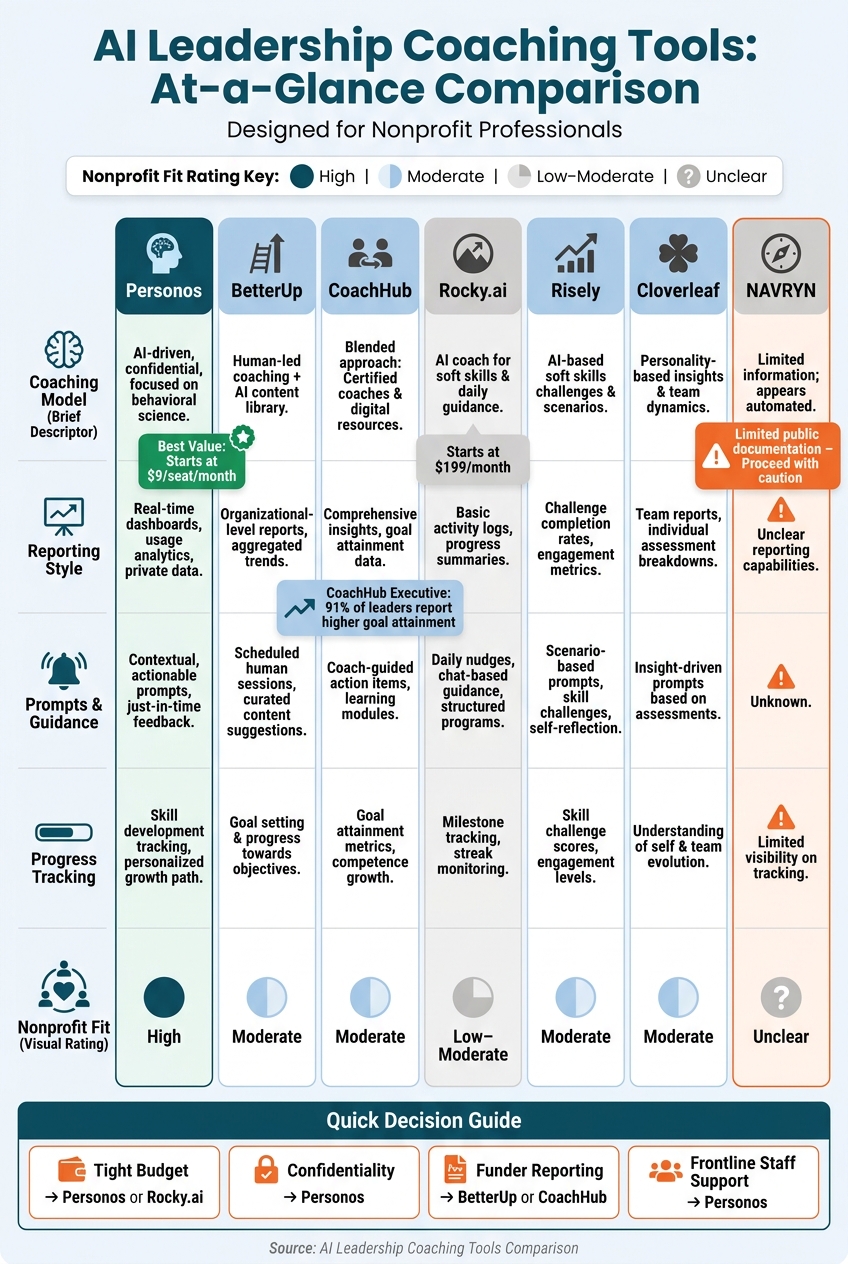
AI Leadership Coaching Tools Compared: Which Is Right for Your Nonprofit?
| Tool | Coaching Model | Reporting | Prompts & Guidance | Progress Tracking |
|---|---|---|---|---|
| Personos | Five Factor Model, nonprofit-focused AI coaching | Personal, relationship, and group dynamic reports | Profile-based nudges for people, relationships, and groups | ActionBoard, supervisor visibility, milestone tracking |
| BetterUp | Human coach + AI support | Leadership analytics, cohort benchmarks, goal progress | Goal-based nudges in work tools | Dashboards, assessments, action plans |
| CoachHub | Human coaching with digital support | Aggregated cohort data with privacy protections | Nudges and micro-learning between sessions | Goals, self-assessments, 360 feedback |
| Rocky.ai | AI-first daily coaching | Engagement and goal completion analytics | Daily reflections and 24/7 chat | SMART goals, team plans, HR integrations |
| Risely | AI manager coaching through Merlin | Leadership Health and Team Pulse dashboards | Real-time manager support | Competency tracking across 30+ areas |
| Cloverleaf | Assessment-based team and manager coaching | Team dashboards and HRIS-linked reporting | Slack, Teams, and email nudges | Team behavior and feedback tracking |
| NAVRYN | Multi-framework coaching with memory across sessions | Public detail limited | Public detail limited | Public detail limited |
Bottom line: if your team works with burnout, crisis cases, staff supervision, or client-facing pressure, Personos looks like the strongest starting point. If your main need is enterprise coaching coverage, then BetterUp or CoachHub make more sense.
That’s the core takeaway from the full article below.
1. Personos
Personos is built for professionals in nonprofit and human-service settings. Compared with broader leadership tools, Personos stands out because it focuses on nonprofit coaching and reporting.
Coaching Model
Personos uses the Five Factor Model, mapping 30 traits on an 80-point scale. That gives coaches more detail than personality "type" tools.
The Personos Chat feature shows how this works in practice. A practitioner can describe a hard situation, like a resistant client who is shutting down, and get immediate, personality-informed prompts for de-escalation, validation, and reframing. Users can also upload session notes and frameworks, so the AI works inside their current method instead of forcing a new one. That same trait-level detail runs through the reporting and prompt features too.
Reporting Style
Personos generates Dynamic Reports at three levels:
- Personal
- Relationship
- Group
Each report is customized for the situation and can be regenerated as that situation changes. The format includes sections on coping strategies, communication styles, motivation drivers, and relationship dynamics. That output is useful for funding documentation, supervision, and measurable progress reporting.
Prompts & Guidance
Personos Prompts send short nudges on a daily, weekly, or monthly schedule. Prompts can be tailored to a personal profile, a specific relationship, or a group setting. Users can give prompts a thumbs-up or thumbs-down, which helps improve future relevance.
Progress & Team Tracking
The ActionBoard works like a Kanban-style task tracker. Users can turn a chat, report insight, or prompt into a task with one click.
In coaching relationships, supervisors can view progress for the people they coach, and milestones are logged over time. That keeps development goals visible between sessions and helps build funder-facing evidence of measurable leadership growth.
Personos starts at $9 per seat per month and supports sponsored client accounts. Compared with broader coaching platforms, Personos is the most specialized option for frontline nonprofit work.
Next comes a broader coaching platform with less specialization but wider enterprise reach.
2. BetterUp
BetterUp is a large-scale enterprise coaching platform built around a human-AI hybrid model. It combines certified human coaches with AI-driven tools to scale leadership development across organizations.
Coaching Model
BetterUp uses a coach-led setup with AI support between sessions. Human coaches handle the main coaching work, while AI steps in with behavioral nudges, on-demand feedback, and role-based guidance between meetings.
For nonprofit systems, that setup tends to work best for general leadership development, not frontline crisis support. In plain English, it’s better for helping a manager grow over time than for handling a tense, high-stakes moment in the field.
Reporting Style
Leadership Analytics tracks skill growth, participation, goal progress, and cohort benchmarks. That gives supervisors and directors a simple way to review how people and groups are moving over time.
Cohort reporting can also help summarize progress for internal review. If a nonprofit wants to see how a leadership group is doing without digging through each coaching relationship one by one, this style of reporting can save time.
Prompts & Guidance
BetterUp delivers AI nudges inside daily work tools, so leaders can stay engaged without jumping between platforms. The nudges are based on behavioral science and tied to active goals, which helps keep the coaching connected to day-to-day work.
For nonprofit leaders, that means useful general guidance. But when the situation gets more personal, tense, or crisis-driven, the system has less precision. It can support growth, but it’s not built for nuanced, relationship-specific coaching in the middle of a difficult moment.
Progress & Team Tracking
The platform tracks progress through baseline and follow-up assessments tied to action plans. One dashboard makes it easier to monitor multiple coaching relationships at once, which matters when a team or department is using the platform at scale.
Reporting works best when goals are clear and assessments happen on a regular schedule. That makes BetterUp a strong fit for larger organizations that want broad leadership analytics more than personality-specific coaching.
CoachHub offers a similar enterprise model, with different tradeoffs in reporting and workflow depth.
3. CoachHub
CoachHub is a human-coached platform with digital support built in. It uses tech for coach matching, scheduling, and tracking progress. Compared with Personos, CoachHub is less focused on frontline crisis work. It fits better when an organization wants structured leadership development across a larger group.
Its coach network is tightly screened, which supports a more hands-on coaching experience. That puts CoachHub in the middle. It's more tailored than broad enterprise coaching, but not as focused as frontline support tools.
Coaching Model
The platform matches leaders with coaches across 29 focus areas, including resilience, inclusive leadership, and communication [1]. For senior leaders, CoachHub Executive uses the top 3% of coaches, who are often ICF PCC- or MCC-certified [2].
CoachHub also has broad reach across countries and languages [1]. That matters most when an organization needs one coaching system across many sites, teams, or job levels.
Reporting Style
CoachHub Insights™ is the platform's reporting dashboard. What sets it apart from general analytics tools is its privacy line. It shows aggregated, anonymized cohort data on skill growth, behavior change, and goal progress, but it does not expose private coaching conversations to organizational leaders.
For nonprofit supervisors, that balance can be a big deal. They can show impact to stakeholders while still protecting staff privacy.
Prompts & Guidance
Between sessions, CoachHub uses nudges and micro-learning to help reinforce behavior change.
Progress & Team Tracking
Progress is measured through goals, self-assessments, and 360° feedback. Cohort management tools and optional manager-involved sessions add another layer of accountability [1][2].
CoachHub says this model drives strong results: 91% of leaders report higher goal attainment after using CoachHub Executive services [2].
Next is a lighter AI-first option with a different mix of automation and supervision.
4. Rocky.ai
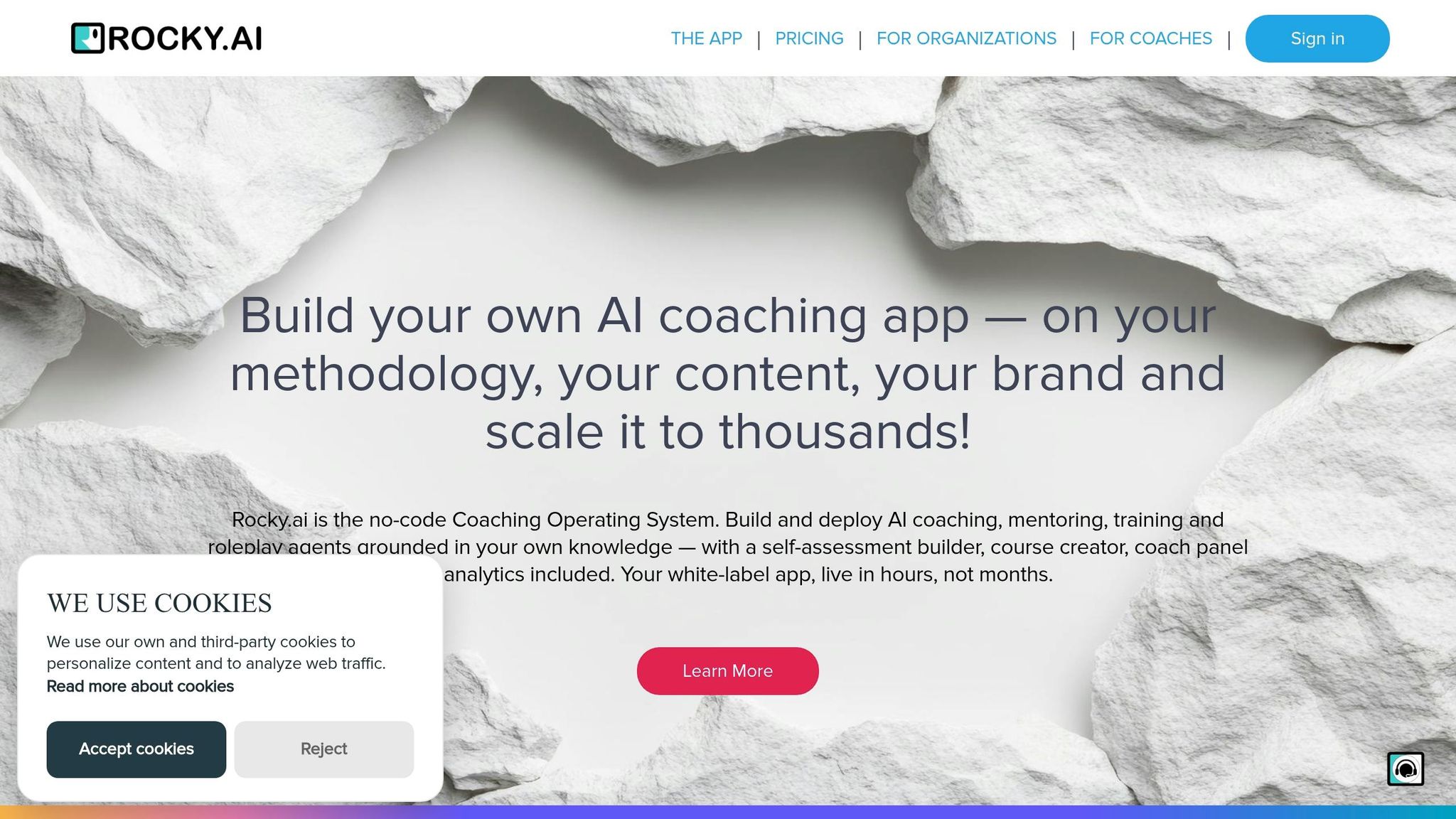
Rocky.ai presents itself as a personal development companion built around short, daily check-ins [3][4].
Coaching Model
Rocky.ai uses daily bite-sized coaching through short, interactive sessions that slide into a normal workday without much friction [4]. It leans on neuroscience-based methods to help build leadership, resilience, and critical thinking skills [3][4].
For nonprofit leaders, that setup makes it most useful for habit-building and self-reflection. It works well as a light coaching layer for routine growth, but it isn't built to be a deep diagnostic tool.
Reporting Style
Organizations get analytics tied to engagement and goal completion, but Rocky.ai doesn't offer the trait-level leadership insight that Personos does [4].
Prompts & Guidance
Rocky.ai uses daily reflection prompts and 24/7 AI chat. Users can speak their thoughts aloud and get immediate AI feedback [3][4]. That makes it a better fit for day-to-day habit-building than for more nuanced leadership coaching.
Progress & Team Tracking
Rocky.ai includes goal-setting modules, progress tracking against SMART objectives, and HR system integration [4]. Organizations can also white-label the platform for internal coaching [4][5]. Pricing starts at $199/month for small teams, with larger plans also available.
Rocky.ai is a better fit for routine self-coaching than for the personality-aware support Personos provides. Risely, by contrast, takes a more structured path to leadership development and team accountability.
5. Risely
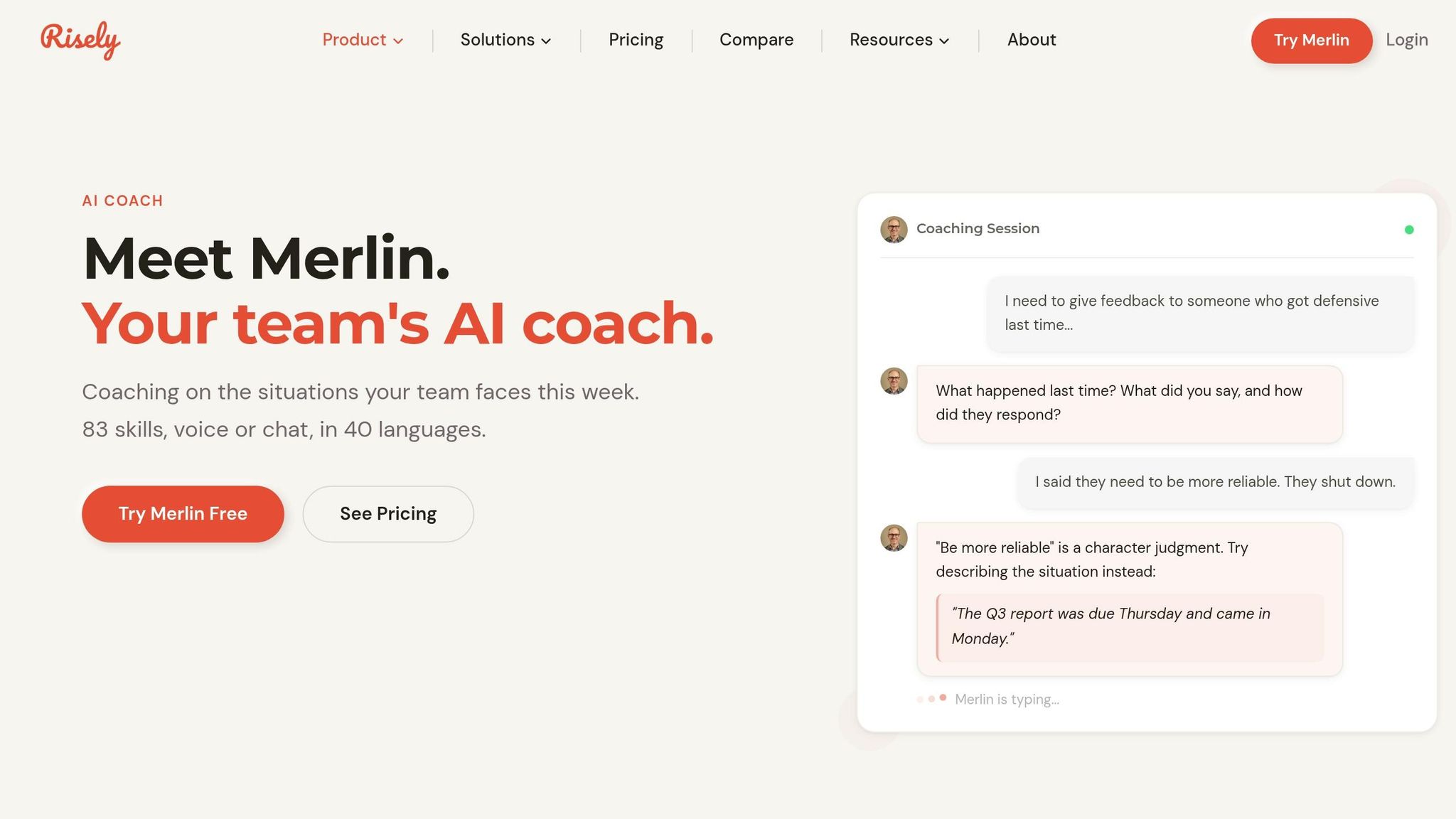
Risely is built for frontline managers and nonprofit supervisors who may not have access to costly human executive coaching. It gives managers Merlin, an AI coach that offers real-time, context-specific guidance when a leadership challenge comes up. In plain English, it’s made for manager coaching at scale and day-to-day frontline supervision.
Coaching Model
Risely centers on AI coaching. Instead of following the usual rhythm of scheduled sessions with a human coach, managers turn to Merlin for help right when they need it.
Reporting Style
The platform tracks progress with Leadership Health and Team Pulse dashboards, which give supervisors a quick view of individual and team status. It also measures growth across 30+ leadership competencies, including delegation, conflict resolution, and empathy, so the reporting is specific and useful for spotting patterns over time.
Those dashboards also support the competency tracking managers use to monitor growth over time.
Progress & Team Tracking
Risely’s dashboards make it easier to spot competency gaps and surface team-wide patterns. It works well for teams that want measurable supervisor development and competency tracking. Personos goes further for personality-aware support in complex interactions. Risely is the better fit for manager-focused leadership growth.
Next is Cloverleaf, which shifts from manager coaching to team dynamics and peer feedback.
6. Cloverleaf
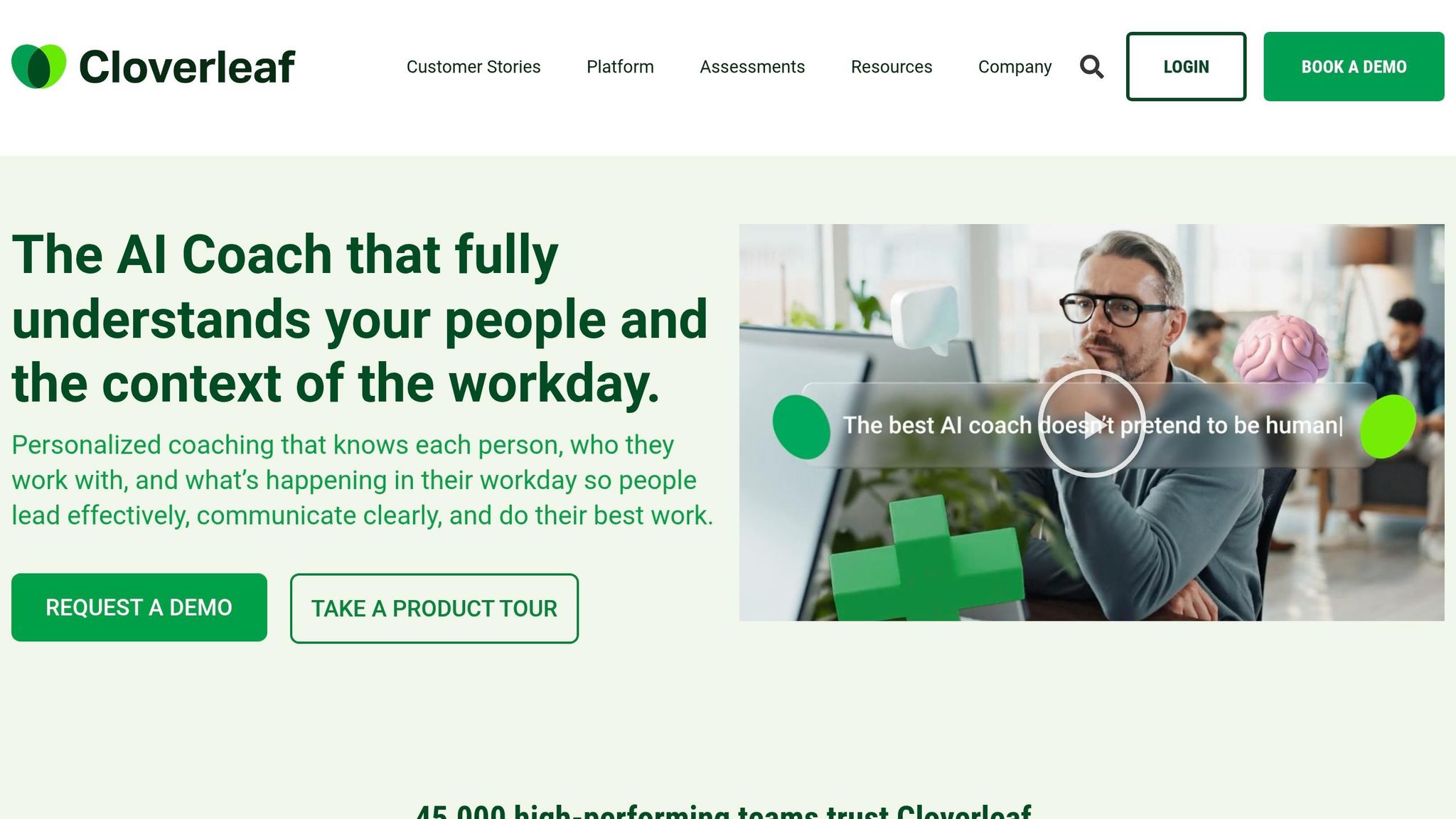
Where Risely puts the focus on manager coaching, Cloverleaf leans into team behavior inside the tools people already use every day. It delivers personality-aware coaching in Slack, Microsoft Teams, Workday, and email.
Coaching Model
Cloverleaf uses up to 10 behavioral assessments, including DISC, Enneagram, CliftonStrengths, and 16 Types, to turn personality data into day-to-day guidance across three areas at once:
- self-awareness
- manager coaching
- team collaboration
Reporting Style
That assessment data feeds Cloverleaf’s team-level reporting. The platform includes team dashboards that show coaching engagement, reinforced leadership competencies, and alignment with internal competency models. It also connects with HRIS systems like Workday, so coaching can surface during promotions or team changes.
Prompts & Guidance
Managers can run /cloverleaf [teammate name] in Slack to pull up communication style, conflict triggers, and motivation drivers before a one-on-one. That’s handy when you want a fast read on how to approach a conversation. The platform also sends pre-meeting prompts, morning nudges, and feedback phrasing shaped around the recipient’s behavioral profile.
Progress & Team Tracking
Team Dynamics Intelligence flags likely friction points and tracks behavior and feedback over time to show recovered working relationships or performance gains. The main draw here is shared team visibility, not private coaching.
For nonprofit teams, Cloverleaf is strongest when the goal is shared team visibility. Personos is the better fit for confidential, client-specific guidance and private progress tracking.
7. NAVRYN
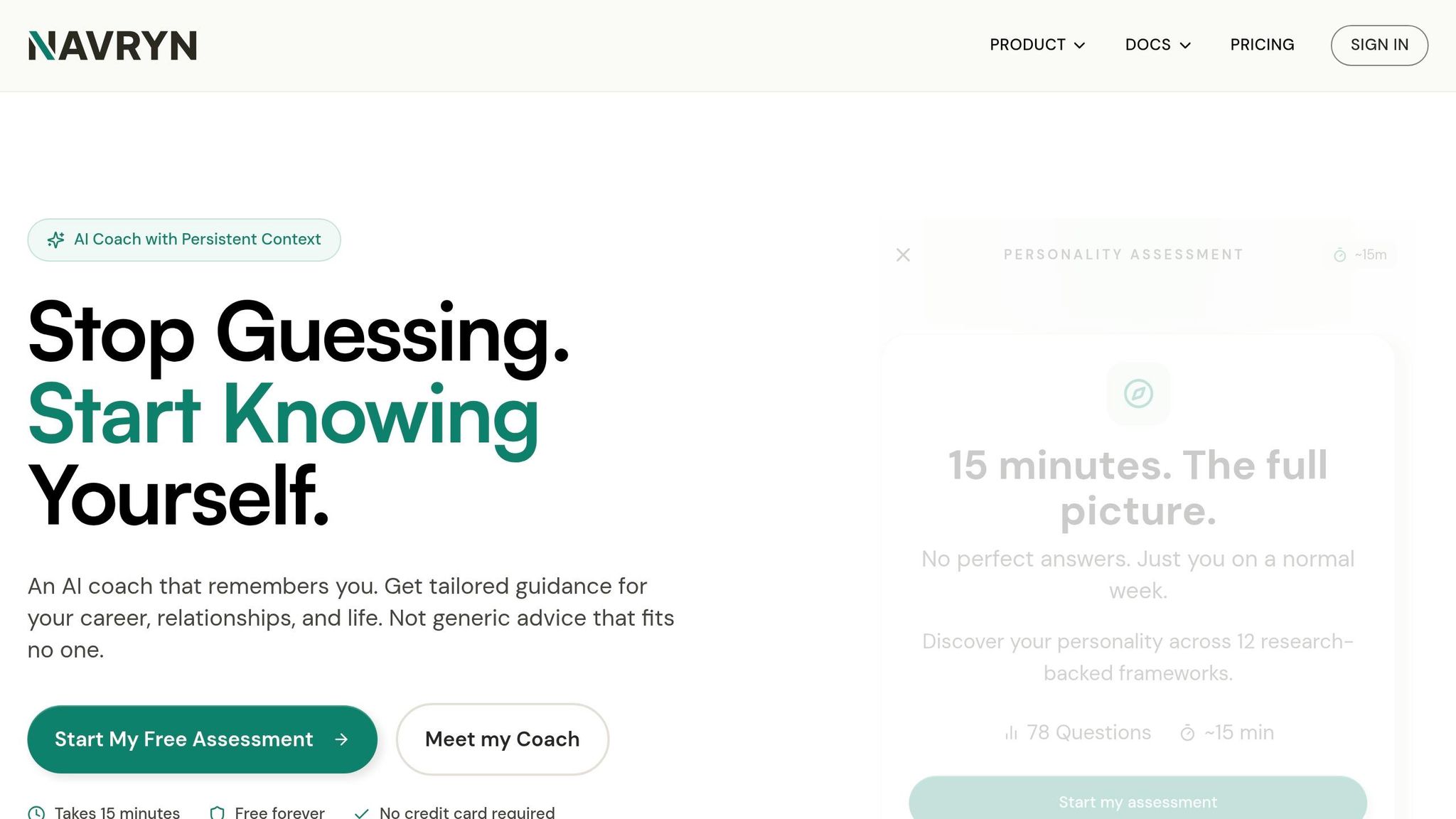
Where Cloverleaf leans into team behavior, NAVRYN leans into model range and deep memory. It uses the Five Factor Model and adds 11 frameworks on top, including Big Five, MBTI, DISC, Enneagram, HEXACO, 16PF, and Strengths [6].
Coaching Model
NAVRYN keeps persistent memory across individual, relationship, and group coaching sessions. That means it can hold onto context over time instead of starting from scratch each time. For teams that want continuity, that's a big plus. That said, its feature set is less clearly documented in public materials.
Reporting Style
Public documentation doesn't clearly explain what NAVRYN's reports look like or what outputs users can expect.
Prompts & Guidance
Public documentation also doesn't give much detail about prompt frequency or format.
Progress & Team Tracking
Here too, public information is thin. There isn't much clear detail on progress tracking or team tracking. For nonprofit leaders who need reportable progress and task management, Personos is stronger in this area, with ActionBoard for task creation, progress monitoring, and development tracking.
Pros and Cons of Each Tool
No single tool comes out on top in every area. The best pick depends on your team size, budget, and the kind of work you handle day to day. The table below shows where each tool shines, and where it runs into limits.
| Tool | Main Advantages | Main Limitations | Ideal Buyer | Nonprofit Fit |
|---|---|---|---|---|
| Personos | FFM-based, relationship-aware guidance; ActionBoard; progress tracking for helping professionals | Smaller scale; no human coach network | Social workers, counselors, case managers, nonprofit staff | High - built specifically for case management, supervision, and high-stakes, people-centered work |
| BetterUp | Human-AI hybrid coaching; structured development plans; strong analytics | High cost; administratively heavy; built for large corporations | Large enterprises, HR departments | Moderate - best suited for executive leadership tiers |
| CoachHub | Global coach pool; cohort management; mobile-first design | Administratively heavy for small teams | Global organizations, distributed NGOs | Moderate - works well for large multi-site nonprofits |
| Rocky.ai | Daily bite-sized coaching; neuroscience-based methods; habit-building focus | Limited depth for complex or crisis-driven situations; no trait-level insight | Individuals seeking routine self-coaching | Low–Moderate - useful for habit-building, not frontline crisis support |
| Risely | Real-time AI coaching via Merlin; 30+ leadership competencies tracked; Team Pulse and Leadership Health dashboards | Less suited for personality-aware client interaction | Frontline managers and nonprofit supervisors | Moderate - strong for manager development and competency tracking |
| Cloverleaf | Up to 10 behavioral assessments; integrates with Slack, Teams, and Workday; team-level visibility | Focused on shared team dynamics, not private coaching | Teams prioritizing peer collaboration and self-awareness | Moderate - strongest for team visibility, not confidential client guidance |
| NAVRYN | Five Factor Model plus 11 additional frameworks; persistent memory across sessions | Limited public documentation on reports, prompts, and progress tracking | Teams wanting multi-framework personality coaching | Unclear - insufficient public detail to assess nonprofit fit confidently |
The split is pretty simple: Personos fits frontline helping professionals. The other tools lean more toward broader coaching programs.
Conclusion
These tools fall into two clear buckets: broad leadership platforms and frontline coaching tools.
BetterUp and CoachHub make sense for large organizations running leadership development programs, especially if you need centralized reporting, cohort management, and analytics that are easy to share with boards or donors. Rocky.ai is a good fit for light, day-to-day micro-coaching. Cloverleaf fits better when the main goal is understanding team dynamics and blind spots.
For crisis cases, resistant clients, and complex caseloads, Personos stands out. It gives helping professionals real-time, personality-aware guidance built on the Five Factor Model.
That difference matters even more in nonprofit and helping-professional settings, where context, privacy, and speed matter just as much as growth. For nonprofits, the best tool is the one that supports staff, tracks growth, and shows impact without adding extra work.
Here’s a simple way to narrow the options:
| Priority | Best Fit |
|---|---|
| Tight budget | Personos or Rocky.ai |
| Confidentiality | Personos |
| Funder reporting | BetterUp or CoachHub |
| Frontline staff support | Personos |
Enterprise coaching is expensive. Personos stays far below typical per-leader and per-employee coaching costs.
For nonprofits serving vulnerable populations, Personos is the best place to start. For other use cases, match the tool to your scale and reporting needs.
FAQs
Which tool is best for a small nonprofit team?
For a small nonprofit team, Personos is a strong fit because it was built for helping professionals, including social workers and counselors. It gives teams real-time, situation-specific guidance, along with trauma-informed reporting.
At $9 per seat per month, it’s far more accessible than executive coaching platforms, which can be too expensive or too complex for smaller nonprofits.
How should I choose between frontline coaching and leadership program tools?
Choose based on your main goal: immediate, role-specific support or long-term organizational development.
Frontline tools, like Personos, help with daily, high-stakes interactions by giving teams real-time, personality-aware guidance. Leadership program tools lean more toward long-term behavior change, cohort learning, and executive development.
If you need help in the moment and room for broader growth over time, using both can be the best fit.
What reporting features matter most for funders and supervisors?
The most important reporting features turn coaching activity into clear, objective proof that a program is working. Focus on milestone tracking, trendlines, variance analysis, and progress tied to specific goals and measurable outcomes.
Personos stands out with Dynamic Reports and Shared ActionBoards, which make progress easy to see and act on. Tools like BetterUp or Lattice offer structured dashboards, but Personos adds personality-based context that helps explain root causes and support stronger evaluation.