AI in Leadership Coaching: Benefits and Risks
How AI expands access and personalization in leadership coaching, plus bias, empathy, and privacy risks—and a blended solution.
Nick Blasi

AI in Leadership Coaching: Benefits and Risks
AI is transforming leadership coaching by making it more accessible, personalized, and scalable. It provides leaders with instant feedback, tailored advice, and tools for goal-setting, while addressing challenges like high costs and limited availability in traditional coaching. However, AI struggles with emotional depth, bias in recommendations, and privacy concerns. The solution? A blended model combining AI's efficiency with human coaches' emotional intelligence.
Key Points:
- Advantages: Affordable, 24/7 access, scalable for all levels, and data-driven personalization.
- Challenges: Limited empathy, potential bias, and privacy risks.
- Best Approach: Pair AI tools with human expertise to balance efficiency and emotional connection.
AI tools like Personos use personality models to offer tailored advice, while human coaches handle complex, emotional scenarios. Organizations can start small by using AI for structured tasks like onboarding and goal tracking, reserving human coaches for nuanced issues. This balanced approach ensures leaders get the best of both worlds.
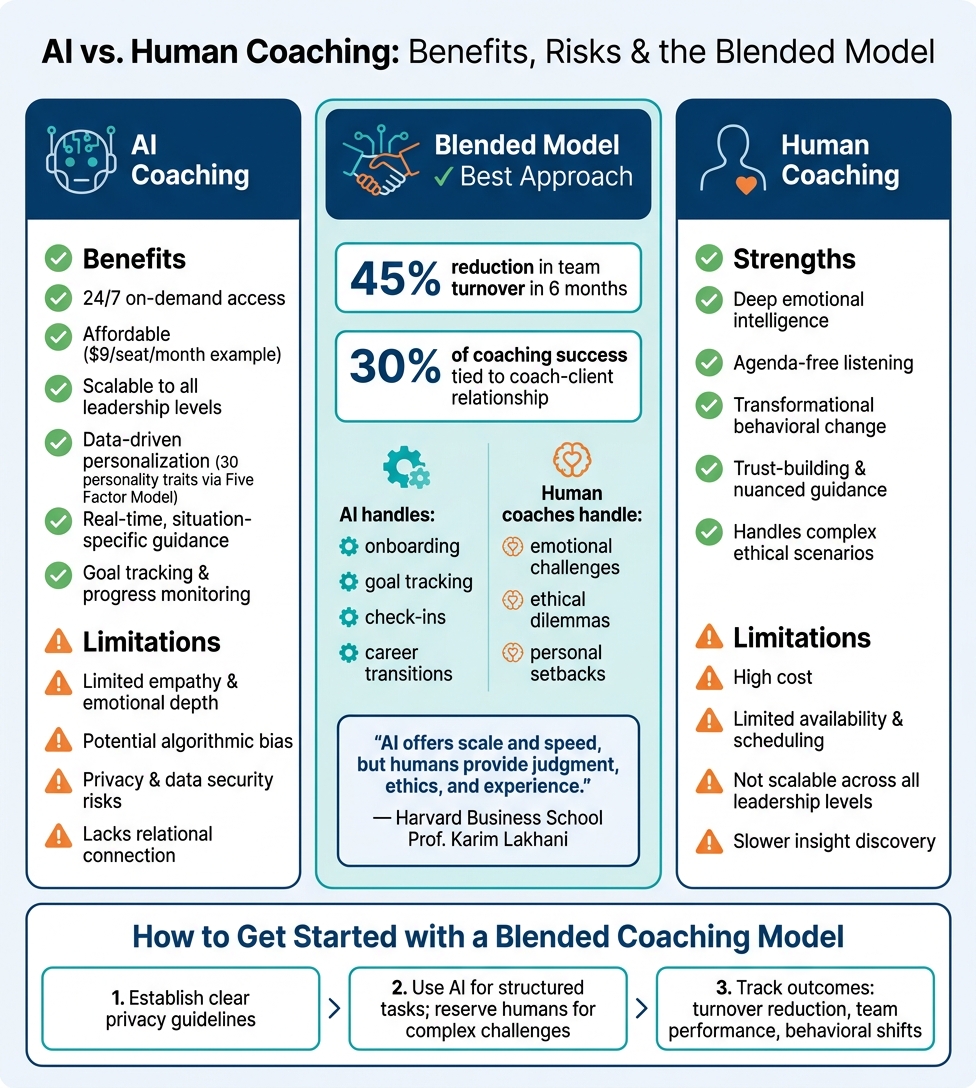
AI vs. Human Coaching: Benefits, Risks & the Blended Model
Key Benefits of AI in Leadership Coaching
Better Access and Scalability
AI is reshaping leadership coaching by addressing inefficiencies in traditional methods and making support more widely available. Instead of focusing solely on executives, it now extends to middle managers and frontline supervisors. Platforms like BetterUp and CoachHub blend digital tools with human expertise, ensuring consistent and scalable coaching. Meanwhile, AI-specific tools take it a step further by offering on-demand support without the hassle of scheduling. These tools provide features like goal tracking, scenario practice, and reflection prompts - all at a fraction of the usual cost. For instance, Personos offers its Pro plan for just $9 per seat per month, enabling organizations to provide personality-based coaching at scale [3].
As David Kim, an executive leadership coach, shared:
"I've coached C-suite executives for 15 years, and Personos changed my practice overnight. It surfaces blind spots I would have taken months to uncover. It's like having a co-pilot who never misses a detail." - David Kim, PCC, Executive Leadership Coach [3]
This expanded access is paired with AI's ability to tailor coaching to the unique needs of each leader, making the guidance more impactful.
Personalization Through Data-Driven Insights
AI's real power lies in its ability to personalize coaching. By analyzing individual personality traits, roles, and situations, AI delivers advice far more precise than generic tips tied to job titles.
A standout example is Personos, which uses the Five Factor Model (FFM) - a scientifically validated framework measuring 30 personality traits - to create detailed personality profiles. This approach allows the platform to offer situation-specific guidance. For example, a leader preparing to deliver difficult feedback can receive advice tailored to their communication style (see our guide on leadership communication styles) and their audience's likely response.
Sarah Mitchell, VP of Operations, highlighted this benefit, noting that her organization reduced team turnover by 45% in just six months. This success came after using Personos to pinpoint team dynamics issues and equipping managers with tailored strategies to address personality-driven conflicts [3].
On-Demand Coaching for Real Situations
Leadership challenges often arise in the moment - whether it's before a performance review, during a team conflict, or after a miscommunication that needs immediate attention. AI-powered tools make it possible for leaders to get real-time guidance when they need it most. By inputting their situation in plain language, leaders can receive step-by-step advice tailored to their specific circumstances.
Personos' ActionBoard takes this a step further by turning insights into actionable tasks. This feature ensures that leaders can bridge the gap between understanding the issue and taking effective action, making coaching a continuous, practical resource for everyday leadership challenges [2].
How AI Coaching Is Redefining Leadership Development
Risks and Ethical Concerns of AI in Leadership Coaching
While AI offers new possibilities for leadership coaching through greater accessibility and personalized coaching strategies, it also brings ethical challenges that can't be ignored.
Limited Empathy and Emotional Understanding
AI can track goals and suggest actionable steps but falls short when it comes to understanding emotional nuances, which are key to impactful coaching. Researchers Nam GY and Choi J studied over 1,123 minutes of AI coaching interactions and observed:
"AI coaching substitutes procedural aspects but lacks the deeper relational connection and collaboration necessary for effective human coaching." [1]
This limitation becomes especially clear in personal moments. Joon, a certified coach and study participant, shared, "the response felt impersonal and mechanistic" when discussing something personal [1]. While AI excels in tasks like recognizing patterns in client behavior and monitoring progress, it struggles to create the profound, human connection needed to inspire meaningful behavioral change.
Bias in AI Recommendations
AI systems are shaped by the data they are trained on, which means any biases in that data can seep into their recommendations. If the training data reflects limited demographics or historical inequities, the advice generated may lack relevance or fairness. Nam and Choi highlighted this issue:
"AI coaching provides general guidance but remains limited in customization because of predefined algorithms that lack responsiveness to individual client demands." [1]
For example, leaders from underrepresented groups might receive advice that doesn't consider their unique challenges. Some platforms, like Personos, address this by offering a Transparent Reasoning feature. This tool explains the reasoning behind each suggestion, empowering users to recognize when advice doesn’t align with their specific context [3]. However, biases are just one part of the equation - privacy concerns add another layer of complexity.
Privacy and Data Security Risks
Leadership coaching often involves sensitive discussions about team dynamics, performance issues, and strategic goals. AI tools that store transcripts of these sessions - whether text or voice - risk exposing proprietary or personal information [1]. Even a minor data breach can have serious consequences, damaging trust within an organization.
To address these risks, platforms like Personos focus on privacy-first measures. For instance, their data masking system anonymizes user information by replacing names with placeholders like "Jane Doe." Additionally, they ensure that user data isn’t used to train global AI models, and sensitive metrics like emotional or behavioral scores remain hidden unless the user chooses to share them [3]. These safeguards highlight the importance of combining AI with human oversight to minimize risks and maintain trust.
Blended Coaching Models: Combining AI and Human Expertise
The challenges outlined earlier - bias, limited empathy, and privacy concerns - don’t mean AI lacks a role in leadership coaching. Instead, these challenges highlight how AI shines when paired with human expertise. This combination creates an opportunity to integrate human coaches, ensuring emotional and ethical aspects of leadership are addressed effectively.
The Role of Human Coaches in AI-Supported Systems
AI and human coaches work best when their strengths complement each other. AI excels at structured tasks like tracking progress, analyzing data patterns, and delivering objective feedback. On the other hand, human coaches are indispensable for deeper, transformational work - navigating emotional complexities, fostering trust, and guiding significant personal growth. Since AI struggles with emotional nuance, human coaches ensure that the personal touch remains central to the coaching process.
As researchers Nam GY and Choi J explain, “AI coaching functions better as a complement than a substitute.” [1] For example, AI can effectively manage tasks like onboarding, goal clarification, and career transitions. However, when leaders face challenges like team conflicts, personal setbacks, or ethical dilemmas, human coaches step in to provide the nuanced guidance no algorithm can fully replicate.
"It is rare in a client's day that somebody will listen without an agenda." - Clara, Professional Coach [5]
This kind of attentive, agenda-free listening is something AI simply cannot mimic. In fact, the relationship between a coach and client accounts for 30% of the variance in coaching success [4], emphasizing the importance of human involvement even in AI-enhanced systems.
Personality-Centered Coaching With AI
One way to balance AI’s efficiency with human depth is through personality-centered coaching platforms. Tools like Personos use the Five Factor Model - a scientifically validated framework measuring 30 personality traits on an 80-point scale - to deliver tailored guidance based on a leader’s unique traits, communication style, and stress responses.
For coaches, this means skipping the surface-level discovery phase and diving straight into meaningful insights. Executive leadership coach David Kim, PCC, notes that Personos has helped uncover blind spots in his clients that might have taken months to identify otherwise [3]. Additionally, the platform’s ActionBoard transforms AI insights into actionable tasks, allowing coaches to track progress and make adjustments between sessions. At just $9/month per seat, it’s also a cost-effective way to expand coaching programs beyond senior leadership.
Steps for Organizations to Get Started
Blended coaching models offer practical solutions for immediate adoption. Implementing such a program doesn’t require a complete system overhaul. A good starting point is to pilot AI coaching in structured scenarios like onboarding new managers, supporting leadership transitions, or addressing team conflicts - situations with clear goals and timelines [1] [4].
Here are a few steps organizations can take:
- Establish clear privacy guidelines. Define what data the AI can store, who has access, and how session content will be protected. Platforms like Personos, which include data masking and avoid training on organizational data, help address privacy concerns [3].
- Reserve human coaches for complex challenges. While AI can handle routine tasks like check-ins and tracking progress, human coaches should lead emotionally sensitive or ethically complex discussions [1].
- Focus on outcomes, not just usage metrics. Track measurable changes like improved team performance, reduced turnover, and behavioral shifts - not just how often the platform is used. For instance, one organization using Personos to address team dynamics saw a 45% drop in team turnover within six months [3].
The aim isn’t to replace human coaches but to empower them to focus on the work that only they can do.
Conclusion: Balancing the Benefits and Risks of AI in Leadership Coaching
Key Takeaways
AI is reshaping leadership coaching by offering broader access, tailored personalization, and instant support. But alongside these advantages come challenges like algorithmic bias, lack of emotional depth, and privacy issues. The best way forward seems to be a blended model: letting AI handle structured, data-driven tasks while human coaches tackle the emotional and ethical aspects. As Harvard Business School Professor Karim Lakhani aptly states, "AI offers scale and speed, but humans provide judgment, ethics, and experience." [6]
One crucial step in this integration is ensuring transparency in AI processes. When leaders and coaches understand the psychological principles behind AI-driven recommendations, they can make informed decisions rather than relying on blind trust.
The Future of AI in Leadership Development
Looking ahead, AI in leadership coaching is set to evolve beyond merely responding to queries. The future lies in proactive tools that anticipate needs. Nudge-based systems, for example, provide bite-sized, timely suggestions between sessions, shifting the focus from periodic check-ins to continuous, context-aware growth. Platforms like Personos are already leveraging tools like the Five Factor Model's 30 traits to deliver personalized, context-rich interactions across individual and group dynamics, refining their guidance over time.
The real winners in this space won't be those who adopt AI the fastest but those who use it thoughtfully. Combining cutting-edge tools with skilled human insight, safeguarding employee data, and focusing on meaningful outcomes - like reducing turnover and improving team cohesion - will set organizations apart. This balanced approach underscores the article's central theme: the future of leadership coaching lies in harmonizing AI with human expertise.
FAQs
Can AI replace a human leadership coach?
AI might be a powerful tool, but it can't completely take the place of human leadership coaches - especially when it comes to the deeply personal, emotional, and relational sides of coaching. Sure, AI shines in tasks that are focused on achieving specific goals and can even provide tailored, real-time insights based on personality data. However, it falls short in areas like empathy, building genuine connections, and drawing from lived experiences - qualities that human coaches naturally bring to the table. Tools like Personos can enhance the coaching process, but they can't replicate the emotional depth and responsiveness that are key to a truly impactful coaching relationship.
How can I tell if AI coaching advice is biased?
Bias in AI coaching often stems from the quality of the training data. If the data mirrors societal prejudices or leaves out certain groups, the AI can unintentionally carry those biases forward. Another challenge is the lack of transparency in how AI systems make decisions, which can make it harder to detect these issues.
To minimize these risks, it's essential to focus on responsible data practices. This means using diverse and inclusive datasets, maintaining transparency in decision-making processes, and conducting regular checks to ensure fairness. Platforms like Personos take this approach seriously by prioritizing privacy and delivering unbiased, insightful feedback aimed at ethical coaching.
What should my organization do to protect coaching privacy?
To maintain privacy in coaching, it's crucial to establish clear guidelines for handling data securely. This includes using encryption, implementing secure login systems, and setting up strict access controls to limit who can view sensitive information. Always obtain explicit consent from clients before using their data and ensure compliance with privacy regulations like GDPR.
If you're using AI tools, make sure they are transparent in how they process data. Regularly test these tools for potential bias and train your team on best practices for secure data management. These measures not only protect client information but also help build trust and uphold ethical standards in AI-driven coaching environments.