How AI Improves Communication to Prevent Conflicts
How AI analyzes tone, sentiment, timing, and personality to give real-time feedback, predict conflict, and improve workplace communication.
Nick Blasi

How AI Improves Communication to Prevent Conflicts
AI tools are transforming communication by identifying potential conflicts before they escalate. They analyze tone, language patterns, and emotional cues in real-time, offering instant feedback to improve interactions. Tools like Personos even combine personality psychology with AI to provide tailored suggestions, helping teams address misunderstandings early. Key benefits include:
- Tone and Sentiment Analysis: AI detects subtle emotional shifts, such as frustration or defensiveness, in emails or chats.
- Bias Detection: Flags language patterns that might lead to miscommunication or tension.
- Real-Time Feedback: Offers suggestions to adjust tone or phrasing during conversations.
- Personality Insights: Matches communication strategies to individual traits for smoother interactions.
- Conflict Prediction: Spots early warning signs in conversation dynamics to prevent escalation.
AI-Powered Conflict Resolution: Enhancing Communication & Understanding in Relationships
sbb-itb-f8fc6bf
How AI Analyzes Communication
AI breaks down conversations into core linguistic elements, using techniques like part-of-speech tagging and dependency parsing to grasp both the meaning of individual words and how they connect within a sentence. This analysis lays the groundwork for identifying emotional cues and spotting moments of miscommunication in conversations[1].
Advanced Transformer models, such as BERT, take this a step further by capturing context in both directions. This allows them to pick up on subtle nuances that go beyond simple keyword matching. These systems can distinguish between general sentiment and specific emotions like joy, anger, fear, or surprise[1].
Detecting Tone and Sentiment with NLP
Modern AI tools don’t just flag obvious negative words. They can detect early signs of conflict brewing beneath the surface. For example, research shows that AI models can explain over 40% of the variance in dispute outcomes by analyzing emotional expressions in text. That’s a big leap compared to older methods, which only captured about 5%[6].
"Emotion detection differs from sentiment analysis by identifying distinct human emotion types such as joy, sadness, anger, fear, and surprise rather than just positive or negative valence." - Frontiers in Psychology[1]
AI can also identify patterns that hint at escalating conflict, such as Gottman’s Four Horsemen - Criticism, Contempt, Defensiveness, and Stonewalling. These patterns are often marked by phrases like "you always" or "you never", excessive punctuation (e.g., multiple exclamation points), or language that shifts blame[1]. In practical use, tools like Gmail’s smart replies have shown how AI can enhance communication. By 2017, these AI-driven suggestions contributed to 12% of Gmail’s messages - around 6.7 billion emails daily - and improved response speed by 10.2%[2].
Beyond tone and sentiment, AI digs deeper into linguistic patterns and timing cues that might signal underlying interpersonal challenges.
Identifying Bias and Miscommunication
AI systems are designed to scan for language patterns that might introduce bias or lead to misunderstandings. However, they’re not perfect. For instance, commercial smart-reply tools often lean toward a "positive sentiment bias", offering overly cheerful responses even when a neutral or more empathetic tone would be better suited to the situation[2]. This can sometimes make messages feel insincere during tough conversations.
"Because AI systems are not influenced by emotions or personal biases, they are less likely to make decisions based on subjective factors." - Miles Mediation & Arbitration[4]
AI also tracks subtle metrics that reveal relationship dynamics. For example, response times under 250 milliseconds can indicate strong social connections. On the flip side, longer delays or reduced messaging frequency might be flagged as early signs of withdrawal[1]. Additionally, AI can analyze writing styles to predict Myers-Briggs personality types with up to 81% accuracy. This can help identify potential clashes in communication styles[1].
While about 70% of human communication is non-verbal, AI is starting to tackle this area too. Newer tools are beginning to offer insights into body language and non-verbal cues during video calls, though text analysis remains the most advanced application for now[3][5].
Using AI for Conflict Prevention Through Predictive Insights
AI is reshaping conflict management by moving from reactive moderation to proactive prevention. Instead of stepping in after conflicts arise, AI now forecasts potential issues based on communication patterns. This shift allows for early intervention, helping to defuse tensions before they escalate [7].
Monitoring Patterns to Predict Conflict
AI systems excel at analyzing language cues and conversation dynamics to spot signs of potential conflict. By examining past interactions, these tools can detect underlying tension that participants may overlook in the heat of the moment [7][8]. Using advanced modeling, AI simulates potential outcomes of ongoing conversations, predicting whether discussions might spiral into incivility [8].
"Our approach samples multiple future conversation trajectories conditioned on existing conversation history using a fine-tuned LLM. It predicts the conversation outcome based on the consensus of these trajectories." - Yunfan Zhang, Researcher, Columbia University [8]
A study revealed that users who received AI-generated warnings were more likely to revise their messages compared to those without such tools [7]. This predictive capability seamlessly transitions into offering real-time guidance during communication.
Real-Time Alerts and Recommendations
Taking predictions a step further, AI provides real-time feedback as users compose messages. These systems flag potentially inflammatory language, encouraging users to reflect on their tone and make adjustments before sending [7]. When conversations show a high risk of escalating, the AI offers immediate suggestions to help users rethink their responses [7].
"Most participants report finding this proactive paradigm valuable, noting that it helps them to identify tension that they may have otherwise missed and prompts them to further reflect on their own replies and to revise them." - Jonathan P. Chang, Researcher, Cornell University [7]
This proactive approach allows individuals to address issues independently, reducing the need for intervention from managers or HR. By integrating these tools into platforms like email and messaging apps, AI can catch subtle shifts in tone that might otherwise lead to larger conflicts [7].
AI-Powered Personality Insights for Better Communication
Predictive AI is stepping into new territory by merging personality psychology with advanced analytics to fine-tune communication strategies based on individual traits. Tools like Personos use the Five Factor Model (FFM) to dive deep into 30 personality facets, scored on an 80-point scale. This approach goes far beyond generic advice, offering tailored insights into how different personalities interact and pinpointing areas where friction might arise. Here's how dynamic reports, personalized prompts, and group analysis are reshaping team communication.
Dynamic Personality Reports
Personos offers three types of reports: Personal (focused on self-awareness), Relationship (analyzing interactions), and Group (highlighting team dynamics and engagement strategies). These reports provide details on communication styles, collaboration preferences, and conflict triggers. The process starts with a quick personality assessment that takes about five minutes, but the insights it delivers cover a wide spectrum of personality variations [9].
Sarah Mitchell, MBA, and VP of Operations, shared her experience after her organization used Personos for six months. By equipping managers with tailored communication strategies and conflict resolution coaching, her team reduced turnover by 45% [10].
"Personos helped us understand why certain team dynamics weren't working and gave managers the exact words to fix it."
- Sarah Mitchell, MBA, VP of Operations [10]
Communication Prompts Based on Personality
Building on earlier real-time alerts, Personos offers bite-sized prompts designed to match individual personality traits. These suggestions help users navigate interactions, whether they’re coaching, collaborating with peers, or engaging with clients. Users can customize the frequency of these prompts, such as receiving daily advice for challenging clients or weekly tips to maintain overall team harmony [9].
David Kim, PCC, an Executive Leadership Coach, described the impact:
"It surfaces blind spots I would have taken months to uncover. It's like having a co-pilot who never misses a detail." [10]
The system doesn’t just deliver advice - it explains the personality traits and psychological reasoning behind each suggestion, helping users understand why a particular approach is effective.
Group Analysis for Team Harmony
For teams, Personos aligns individual motivators to encourage collaboration across roles. It identifies potential friction points and communication gaps early, offering guidance tailored to contributors, managers, or leaders. Organizations can even upload their own values to ensure the AI’s suggestions align with their internal culture [9].
Carla Mendoza, LCSW, an Addiction Recovery Counselor, highlighted how Personos supports her work:
"Personos helps me anticipate when a client is on the edge of shutting down and adjust my approach so we stay connected." [10]
The tool’s ActionBoard feature turns insights into actionable tasks, making it easier to move from understanding team dynamics to implementing effective strategies [9].
How to Use Personos to Prevent Conflicts
Personos simplifies conflict prevention with AI-driven personality insights in just four steps. While setup only takes a few minutes, the impact on team communication can be immediate.
Step 1: Set Up Personality Profiles
Start by completing the five-minute FFM assessment [9][11] to establish your baseline personality profile. Add context like your role, goals, and organizational values to customize the guidance. You can invite others to complete their assessments via email or, if your company domain is registered, directly add coworkers. Specify relationship types - like coworker, peer, or coach - to tailor the AI's recommendations. For team-wide use, create "Groups" by adding multiple members and providing context such as shared goals or past friction points.
A handy feature is the "@" mention in Personos Chat, which lets you pull up a specific personality profile during conversations for real-time conflict advice. Keep profiles updated with notes about recent interactions or stressors to ensure the AI's suggestions remain relevant.
Step 2: Enable Real-Time Monitoring
Set notification schedules in the Prompts section to receive guidance at intervals that suit your needs - daily for challenging clients or weekly for team dynamics. By typing "@" followed by a name or group in Personos Chat, you can instantly access personalized insights.
The platform integrates with tools like Slack and Microsoft Teams, allowing you to view personality insights without disrupting your workflow. Rate the AI’s suggestions to improve accuracy, and if you need more detail, use the "Discuss in Chat" feature for step-by-step guidance. Additionally, the "One-Click Task Creation" feature turns recommendations into actionable tasks on the Kanban-style ActionBoard, making it easy to move from insight to implementation.
Step 3: Review Reports and Apply Insights
Personos offers three types of reports - Personal (self-awareness), Relationship (two-person dynamics), and Group (team patterns) [10]. These reports combine personality data with contextual details, pinpointing potential conflict triggers and collaboration trends.
Each report includes actionable sections tailored to roles. For instance, if you're managing someone with low agreeableness and high neuroticism, it might suggest specific de-escalation techniques, backed by explanations of the underlying personality traits. The "Transparent Reasoning" feature helps you understand the psychology behind each suggestion, enhancing your ability to navigate interpersonal dynamics.
Use the ActionBoard to act on these insights immediately. Relationship reports can help you identify motivators for stakeholders and craft requests that align with their preferences. You can also upload your company’s values to ensure the AI’s recommendations align with your organizational culture. For performance reviews, these insights can guide you in delivering feedback effectively. Monitor the outcomes of these strategies to refine your communication approach over time.
Step 4: Track Outcomes and Adjust Strategies
The ActionBoard transforms personality insights into trackable tasks, allowing you to measure the success of your conflict prevention efforts. You can create tasks from reports or chat suggestions and track progress visually to identify which tactics work best.
Monitor changes in team dynamics as you implement these strategies. For example, one organization reduced turnover by 45% [10]. Update profiles with new context as situations evolve, and if a strategy isn’t delivering results, use the Chat feature to explore alternative approaches using the same personality data. By rating prompts and tracking outcomes, you contribute to a feedback loop that refines future recommendations. Regularly reviewing group reports can help you identify and address emerging friction points before they escalate.
Benefits of AI-Driven Communication Tools
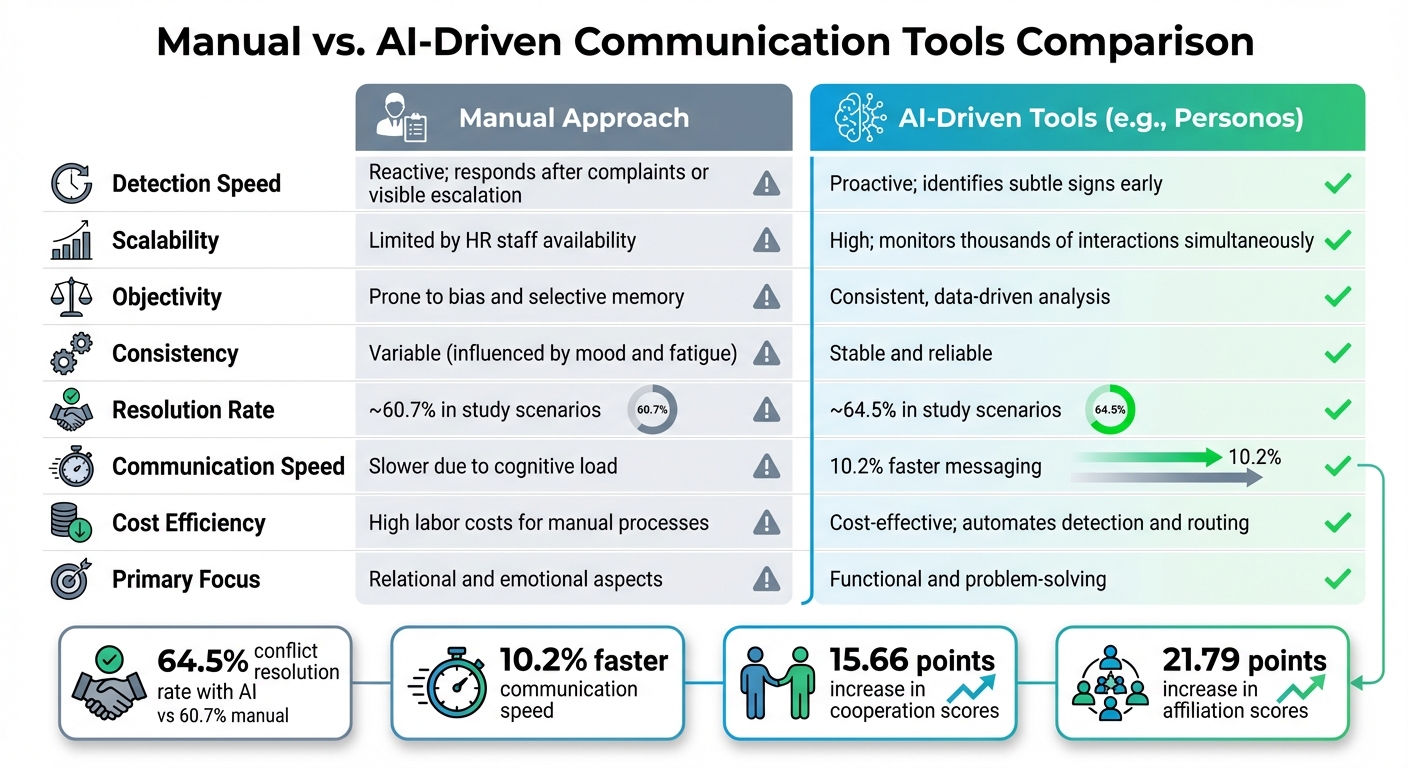
Manual vs AI-Driven Conflict Prevention: Speed, Accuracy, and Cost Comparison
AI-powered communication tools are reshaping conflict prevention, thanks to their ability to analyze data and offer practical solutions. These tools not only speed up communication but also improve how individuals perceive and interact with each other.
For instance, AI suggestions have been shown to increase communication speed by 10.2% and improve mutual perception in measurable ways. In randomized experiments, participants using AI guidance rated their partners as more cooperative and affiliative, with cooperation and affiliation scores increasing by 15.66 and 21.79 points, respectively [2].
But it’s not just about speed and perception. Tools like Personos excel at detecting early signs of conflict by spotting subtle behavioral changes and shifts in sentiment - long before they escalate. This proactive approach uncovers patterns that humans might miss until it's too late. In a direct comparison, 64.52% of participants using AI tools achieved "Conflict Resolved" status, outperforming the 60.71% rate seen with professional human counselors [13].
The Role of Rational Empathy
One standout feature of AI tools is what researchers call "Rational Empathy" - a form of data-driven understanding that remains unaffected by stress, fatigue, or personal bias. Unlike human mediators who may experience emotional exhaustion or unconscious biases, AI provides consistent and objective guidance across countless interactions. This reliability is particularly valuable in remote and hybrid work settings, where physical cues like body language are harder to detect.
"The future of conflict management lies in AI-powered intelligence combined with human empathy - creating workplaces where issues are addressed before they become crises." - Qandle [12]
Creating Psychological Safety
AI tools also contribute to psychological safety in the workplace. Employees often feel more at ease sharing sensitive concerns with an AI assistant, which encourages earlier intervention and fosters team harmony. Additionally, these tools promote the use of positive emotional language, reducing conflict and perceived dominance in conversations [2]. This shift creates a more balanced environment, making tough discussions easier to navigate.
Manual vs. AI Approaches Comparison
| Feature | Manual Approach | AI-Driven Tools (e.g., Personos) |
|---|---|---|
| Detection Speed | Reactive; responds after complaints or visible escalation | Proactive; identifies subtle signs early |
| Scalability | Limited by HR staff availability | High; monitors thousands of interactions simultaneously |
| Objectivity | Prone to bias and selective memory | Consistent, data-driven analysis |
| Consistency | Variable (influenced by mood and fatigue) | Stable and reliable [13] |
| Resolution Rate | ~60.7% in study scenarios | ~64.5% in study scenarios [13] |
| Communication Speed | Slower due to cognitive load | 10.2% faster messaging [2] |
| Cost Efficiency | High labor costs for manual processes | Cost-effective; automates detection and routing |
| Primary Focus | Relational and emotional aspects | Functional and problem-solving [13] |
AI-driven tools are proving to be a game-changer, offering faster, more consistent, and scalable solutions to communication challenges. Their ability to detect, analyze, and address issues early makes them indispensable for modern workplaces.
Conclusion
AI is reshaping how we communicate by spotting potential issues before they turn into conflicts. Using tools like natural language processing, sentiment analysis, and personality insights, AI can detect subtle shifts in tone or hidden biases that might signal brewing tensions.
Take Personos, for example. This tool blends personality psychology with AI to offer real-time communication guidance, detailed personality reports, and analyzing personality for team success. The result? Better interpersonal connections and fewer misunderstandings.
What's exciting is how these tools shift the focus to preventing conflicts rather than just managing them. By integrating into workplace communication platforms, they’re especially useful for remote teams, where nonverbal cues are harder to pick up. This creates a more seamless way to foster healthy collaboration.
AI-powered tools like Personos offer a practical way to enhance psychological safety, ease communication friction, and nurture stronger, more positive connections between people.
FAQs
How does AI identify emotional cues to improve communication?
AI leverages tools like natural language processing (NLP) and sentiment analysis to pick up on emotional signals in conversations. By examining elements like tone, word choices, and speech patterns, it identifies emotions such as anger, frustration, or stress with impressive precision. This ability helps AI spot early signs of tension or potential misunderstandings, offering a chance to address them before they grow into bigger issues.
What’s more, AI can analyze personality traits using models like the Big Five framework to get a sense of how individuals communicate and react emotionally. This deeper understanding allows AI to adapt communication approaches, making interactions smoother and less prone to conflict. By offering real-time feedback and practical suggestions, AI supports more positive and effective communication experiences.
How can AI tools like Personos help prevent workplace conflicts?
AI tools like Personos are transforming workplace communication by analyzing tone, language, and personality traits in real time. This allows organizations to spot potential misunderstandings or tensions early, giving them the chance to address issues before they escalate.
With personalized communication strategies and on-the-spot coaching, AI helps individuals handle sensitive conversations more effectively. For example, it can suggest tweaks to phrasing or tone to make interactions feel smoother and more constructive. What’s more, Personos uses personality-based insights to customize conflict resolution strategies, ensuring solutions match the needs of everyone involved. The result? Fewer miscommunications, stronger teamwork, and a more collaborative work environment.
How does AI help improve team communication and reduce conflicts?
AI tools are changing the way teams communicate by providing real-time insights into personality traits, communication styles, and emotional triggers. By analyzing patterns in tone and behavior, these tools can pinpoint potential sources of conflict early, giving teams the chance to address issues before they grow into bigger problems.
Take AI-powered platforms like Personos, for instance. They offer tailored recommendations to help team members adjust their communication approaches based on individual preferences. This not only encourages smoother collaboration but also builds trust and strengthens emotional understanding within the group. When teams grasp what motivates each person and what might trigger tension, they can minimize misunderstandings, foster stronger connections, and create a more efficient and cohesive work environment.