Can AI Help Client-Facing Staff Practice Empathy?
Use AI role-play for short fictional rehearsals: protect privacy, focus on observable behaviors, involve supervisors, and run a six-week pilot.
Christian Thomas

Can AI Help Client-Facing Staff Practice Empathy?
AI can help staff rehearse client conversations, but it cannot prove empathy or better care. I recommend starting with a 5–10-minute fictional role-play: practice listening, explaining a limit, and agreeing on one next step. Then review the feedback with a supervisor using AI-powered coaching and retry one behavior.
My approach keeps three rules upfront:
- Protect privacy: Use invented details and an approved tool. Never upload client records.
- Match the tool to the task: Use Personos for personality-informed planning, AI chat or role-play platforms for rehearsal, and people for coaching and judgment.
- Test before expanding: Run a six-week pilot. Track communication skills, staff confidence, and client outcomes separately.
The research needs a clear boundary: a review of 15 studies examined human-led communication training, not proof that AI rehearsal works. I would treat AI feedback as practice support, <u>not an empathy score</u>, and follow established procedures for safety concerns.
AI Roleplay for De-Escalation Training: Build a Custom Simulator Without a Developer
Protecting Client Privacy During Practice
Build scenarios around general communication problems, not edited client histories. Removing a name doesn’t make a case anonymous. An unusual job, a small-town location, a family detail, and an appointment date can identify someone when combined.[6]
Client Information to Keep Out of Prompts
Leave out names, initials, contact details, addresses, birth dates, exact locations, case and account numbers, and recognizable combinations of personal facts. HHS guidance says combined details can identify a person even without direct identifiers. HIPAA’s Safe Harbor method covers 18 categories of identifiers.[6][8]
Make up ages, dates, dollar amounts, employers, and family circumstances from scratch. Include only what’s needed for the communication goal. Do not upload case notes, transcripts, recordings, screenshots, or documents for practice. If you need real records, use a separate, approved workflow with its own privacy controls, such as those used to reduce burnout among social workers.
Tool Settings and Policies to Review
Before staff use a tool, have privacy and IT/security leads review its retention, storage, access, encryption, model-training use, and deletion practices, including backups. Review voice recording and transcription separately. Check what gets recorded, who can access it, and when audio and transcripts are deleted. Turn off optional recording, memory, and sharing unless approved.[9]
A paid or enterprise plan doesn’t prove that client data is adequately protected. Follow organizational policy and applicable confidentiality laws. HIPAA applies to covered entities and business associates. Where required, a business associate agreement and permitted-use controls must be in place.
If someone enters client information by accident, stop, notify the privacy lead promptly, and follow incident procedures. Deleting the chat may not remove every copy.[7]
Running an AI Empathy Practice Session
Remove identifiers from scenarios, then focus the rehearsal on behaviors you can observe. Set aside 5–10 minutes to role-play one narrow challenge, review a short rubric, and retry with one change.[10][11] Follow the earlier four-step structure and keep the goal specific: acknowledge frustration before explaining the delay. Practice empathic behaviors staff can repeat in live conversations.
Setting Up a Fictional Conversation
Act as a fictional client frustrated by a delayed application. Use only invented circumstances. Respond one turn at a time and give feedback only after I say stop. Do not request identifying information.
Giving Feedback on Communication Behaviors
After saying “stop,” ask the AI to review acknowledgment, questions, clarity, uncertainty, boundaries, and next steps. Have it check for blame and whether you offered solutions before understanding the concern. Request one exact excerpt and one revision, rather than personality labels or diagnoses.
Use this feedback as a practice aid, not an empathy assessment. A script, tone, or facial expression alone doesn't prove empathy. Pick one observable change for the retry, such as asking an open question before offering options. Record the learning goal and whether the behavior occurred, not an AI-generated empathy score.
If the role-play brings up policy, safety, or accessibility questions, consult a supervisor before retrying.
Knowing When to Involve a Supervisor
Ask a supervisor to review uncertain feedback involving trauma, disability-related needs, language differences, sarcasm, context, or policy. Their review helps keep rehearsal from drifting into unsafe or inaccurate advice. Clarify the appropriate response, then retry with one targeted change.
For threats, abuse, self-harm, medical or legal decisions, or urgent safeguarding concerns, follow established escalation procedures, not AI advice.
Comparing Tools for Empathy Practice
Empathy practice involves planning, rehearsal, feedback, and live coaching. Choose a tool for the task, not for how human it seems. Each type serves a different need, and its features and privacy protections aren't interchangeable.
Set privacy rules first. Then match the tool to the skill you want to practice.
| Tool | Practice purpose | Privacy requirements | Main limitations |
|---|---|---|---|
| Personos | Personality-aware communication planning and relationship insights | Use approved settings, get consent for real profiles, and keep fictional practice de-identified | Not a verified empathy assessment or a substitute for supervision |
| General-purpose AI chat | Flexible fictional scenarios, response drafts, and broad feedback | Use de-identified details and review retention and training settings | Feedback can be generic, inaccurate, overly agreeable, or inconsistent |
| Dedicated AI role-play platforms | Structured simulations, repeatable characters, and practice data; features vary | Check contracts, administrator controls, retention rules, and whether prompts are used for model training | Scenarios and scores may miss local policy, cultural context, or accessibility needs |
| Human-led role-play | Live coaching on emotional nuance, timing, and professional judgment | Share only the minimum necessary information under agency rules | Requires staff time, skilled facilitators, and psychological safety |
For teams using personality-informed guidance, Personos is the closest fit.
Using Personos for Communication Support
Personos gives helping professionals personality-aware guidance for difficult conversations and relationship dynamics, along with reminders and progress tracking.
Its role goes beyond drafting scripts: it helps staff adjust communication to personality patterns and relationship dynamics. Use it for planning, not as proof of empathy or a replacement for supervised role-play. Keep identifying client information out of fictional practice, even if the product offers masking or other privacy features.
Safeguards for Personality-Informed Guidance
Treat traits as a communication aid, not a diagnosis or a fixed explanation for someone's behavior. Don't infer a profile from one interaction or use personality data to judge eligibility, credibility, or risk. Check suggestions against the person's stated preferences, circumstances, and accessibility needs.
Before using real profiles, require consent, approved data handling, and human review. Confirm who can access the data, how long it's kept, whether it's used for training, and how deletion works. Product features don't replace safeguarding, professional judgment, or supervision.
Running a Small, Safe Team Pilot
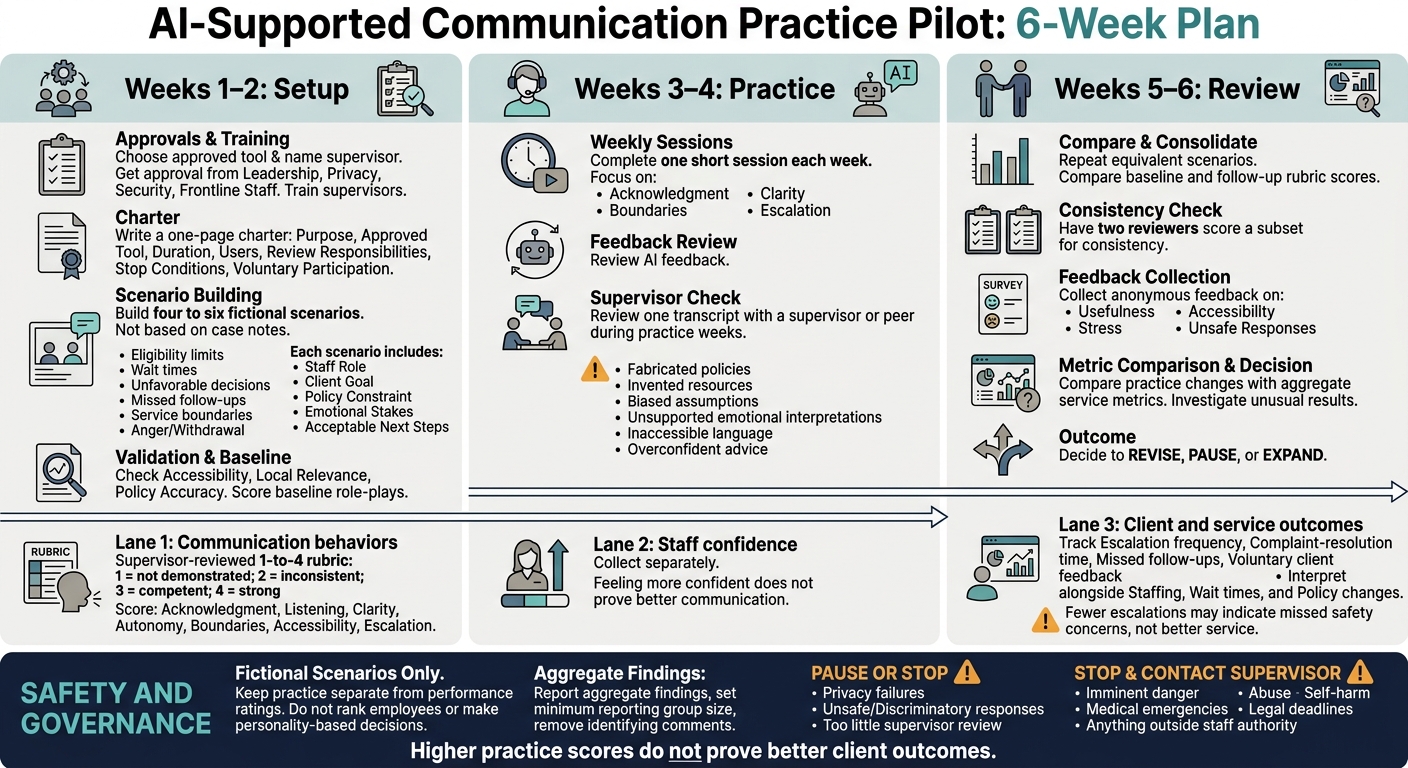
Six-Week AI Empathy Practice Pilot
After choosing a tool, test it in a tightly controlled pilot before rolling it out to more staff. Run a six-week pilot with an approved tool and a named supervisor: setup in weeks 1–2, practice in weeks 3–4, and review in weeks 5–6. Focus on acknowledgment, clarity, boundaries, and escalation. In week one, get approval from leadership, privacy, security, and frontline staff, then train supervisors.
During setup, review fictional scenarios and score baseline role-plays. During practice, staff complete one short session each week and review AI feedback. In the review phase, repeat equivalent scenarios and collect anonymous feedback on usefulness, stress, accessibility, and unsafe responses. Compare changes in rubric scores with aggregate service metrics. Check unusual results before deciding whether to revise, pause, or expand the pilot.
Use a written charter to keep the pilot narrow, safe, and focused on communication practice.
Pilot Rules and Practice Scenarios
Write a one-page charter that covers the purpose, approved tool, duration, users, review responsibilities, and stop conditions. State whether participation is voluntary. Keep practice separate from performance ratings: don't rank employees or make personality-based decisions. Staff should stop and contact a supervisor when a situation involves imminent danger, abuse, self-harm, medical emergencies, legal deadlines, or anything outside their authority.
Build four to six fictional scenarios around common conflict triggers and service challenges, not case notes. Cover eligibility limits, wait times, unfavorable decisions, missed follow-ups, service boundaries, and anger or withdrawal. Give each scenario a staff role, client goal, policy constraint, emotional stakes, and acceptable next steps.
Supervisors should check accessibility, local relevance, and policy accuracy before use and after policy changes. Train staff to flag fabricated policies, invented resources, biased assumptions, unsupported emotional interpretations, inaccessible language, and overconfident advice. During the practice weeks, review one transcript with a supervisor or peer.
Measuring Practice Gains and Client Outcomes
Measure behavior change first, then compare it with service metrics. Use a supervisor-reviewed 1-to-4 rubric: not demonstrated, inconsistent, competent, strong. Score acknowledgment, listening, clarity, autonomy, boundaries, accessibility, and escalation. Compare baseline and follow-up exercises using equivalent scenarios. Have two reviewers score a subset to check consistency. Collect staff confidence separately: feeling more confident does not prove better communication.
Track escalation frequency, complaint-resolution time, missed follow-ups, and voluntary client feedback separately from practice scores. Read these results alongside staffing, wait times, and policy changes. Fewer escalations, for example, may mean staff missed safety concerns rather than delivered better service.
Report aggregate findings, set a minimum reporting group size, and remove identifying comments from reports. Pause or stop the pilot for privacy failures, unsafe or discriminatory responses, or too little supervisor review. Higher practice scores do not prove better client outcomes.
Key Takeaways
The rule is simple: use AI for rehearsal, not empathy scoring. Practice a fictional conversation, get feedback on observable behaviors, and retry one specific moment. Keep the scenario fictional throughout.
use only approved AI tools and invented details. Removing a name alone does not make a scenario safe.[12][6] Even safe prompts need human review.
Better rehearsal does not prove better care. Treat these as separate outcomes, and use supervision for safety, ethics, or high-risk cases.
FAQs
How can I make fictional role-plays realistic without using client details?
Describe the setting, the goal of the conversation, and relevant personality patterns. Leave out identifying details, including real names and contact information.
If you’re using Personos, use placeholders for identities and include only high-level traits you have consent to use. Write prompts for the specific situation so feedback and practical, role-specific guidance stay accurate while protecting confidentiality.
What should I do when AI feedback conflicts with my supervisor’s advice?
Use the transparency features in tools like Personos to see why AI gives certain feedback [1]. Personos documents the personality traits, situational details, and psychological principles behind its guidance so you can weigh that advice against your supervisor’s expertise [1].
Private conversations give you room to work through those differences and any uncertainty before discussing them with your supervisor [1].
How can I tell whether practice skills transfer to real conversations?
Focus on how clearly the rehearsal feedback explains its guidance [1][2]. Personos shows which personality traits, situational details, and psychological principles shape each suggested approach [2][3]. That transparency lets you assess the reasoning, understand why an approach is recommended, and use it with confidence in real conversations instead of guessing [1][4][5].