5 AI Feedback Prompts for Practicing Empathy
Five de-identified AI prompts to practice paraphrase, acknowledge feelings, check assumptions, ask open questions, and repair misunderstandings.
Christian Thomas

5 AI Feedback Prompts for Practicing Empathy
I use AI to check my wording, not to decide what someone feels. I start with one short exchange, review one skill, and test a revised response by asking, “Did I get that right?”
These 5 prompts help me:
- Listen and paraphrase without adding advice.
- Acknowledge feelings without guessing.
- Check assumptions about motives or priorities.
- Ask open questions without pushing for an answer.
- Repair misunderstandings and take responsibility.
Before sharing anything, I remove identifying details and check privacy rules, consent requirements, and tool approval. This approach aligns with an AI framework for excellence in practice. Then I treat AI feedback as a draft, not a verdict. <u>The person’s response guides my next step.</u> AI does not replace professional judgment or urgent safety action.
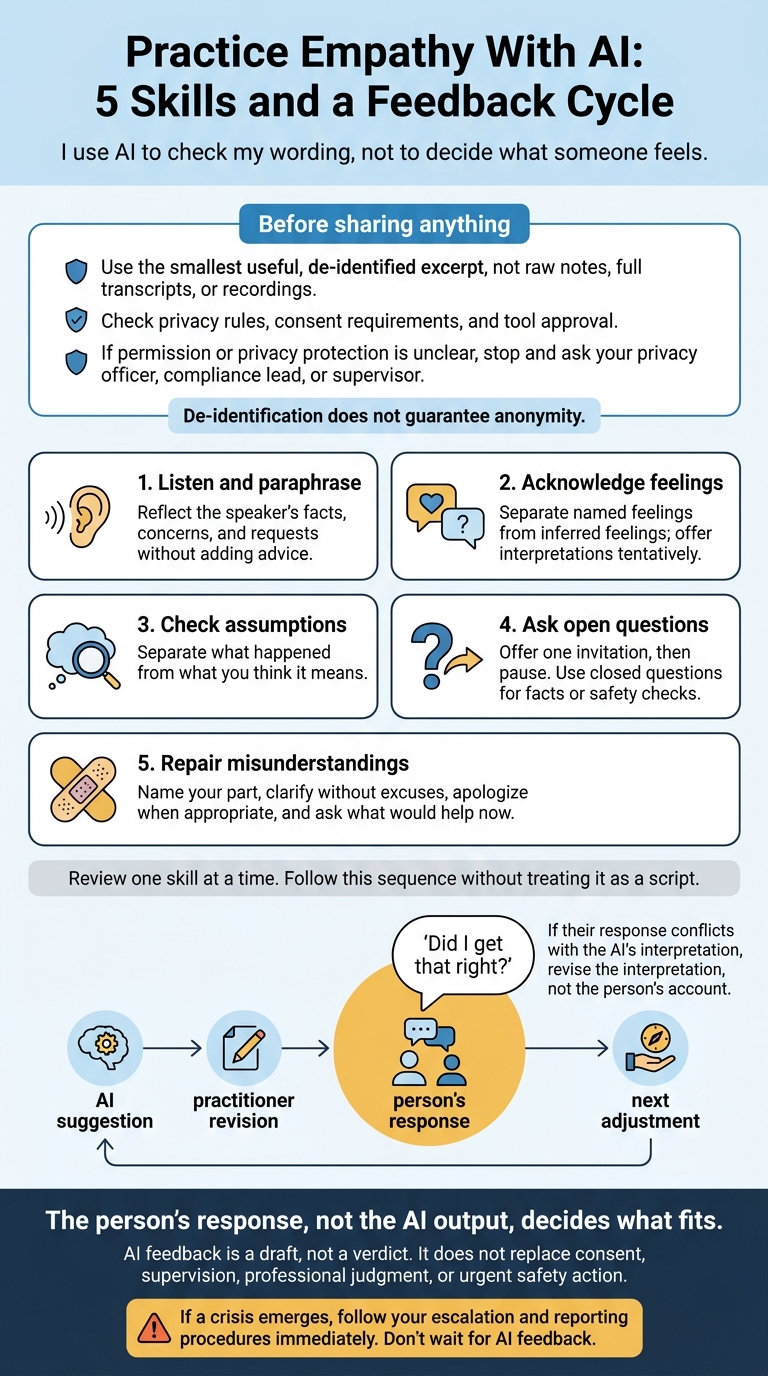
Practice Empathy With AI: 5 Skills and a Feedback Cycle
How AI could unlock human empathy | Jeremy Nguyen | TEDxSwinburne University
Before Sharing a Conversation With AI
Before using AI to practice empathy, share only what’s needed for feedback. Use the smallest useful, de-identified excerpt, not raw notes, full transcripts, or recordings. Removing names isn’t enough. Remove all direct and indirect identifiers. HHS recognizes two HIPAA de-identification methods: Safe Harbor and Expert Determination.[4][5] Then use AI to check one empathy skill at a time.
Check the tool’s terms, not just whether you can access it. Before uploading, check approval, retention, access controls, vendor use, and secondary use. Address consent and disclosure, including how information may be stored or used. If permission or privacy protection is unclear, stop and ask your privacy officer, compliance lead, or supervisor.[1]
Label what you know. Identify speakers as Practitioner or Person, and label each line as direct quote, remembered summary, or paraphrase. Keep observations separate from missing context, such as tone, pauses, body language, language preference, relationship history, and what happened afterward. Ask AI to suggest alternative readings and label interpretations as hypotheses, not conclusions. Request wording feedback only.
Next, test one revision in a real interaction. Check that it fits the person’s language, culture, accessibility needs, and your professional role. Record the wording you used and the person’s full response, including disagreement, silence, or a change of topic.
If a crisis emerges, follow your escalation and reporting procedures immediately. Don’t wait for AI feedback.[6][7]
With these guardrails in place, use the first prompt to check your listening and paraphrasing.
1. Check Your Listening and Paraphrase
Listening Skill
The first empathy check is simple: understand before you respond. Reflective listening means paraphrasing the speaker’s message to check your understanding rather than assuming what they mean. Stick to their facts, concerns, and requests. Treat any meaning you add as tentative.
Copy-Ready Feedback Prompt
Review the conversation below for reflective listening. Compare the speaker’s stated facts, concerns, requests, and any inferred meaning with the practitioner’s paraphrase. For each point, provide supporting quotations from the transcript. Label each conclusion observable, possible, or uncertain. Flag additions, omissions, judgment, premature advice, interruptions, or redirections shown in the text. Do not infer timing, tone, intent, or emotion that the text does not establish. Then offer two neutral reflections that stay close to the speaker’s words and do not give advice. End with one limitation or alternative interpretation the practitioner should check with the speaker.
Observation vs. Interpretation
Use observable when the text directly supports a conclusion, possible for an inference you can check, and uncertain when the text doesn't establish it. Reject any flag that its supporting quote doesn't justify.
Fictional before-and-after example
Speaker: “My housing application was denied, and I don’t understand why. I’m worried I’ll have nowhere to go next month.”
Before - Practitioner: “You need to call the housing office and submit the paperwork again.”
After - Practitioner: “You were told the application was denied, you’re unclear about the reason, and you’re worried about where you’ll live next month.”
The first response skips the speaker’s confusion and housing concerns and jumps straight to advice. The revised response reflects what the speaker said without adding a solution.
Test Your Wording
Try one suggested reflection in your own voice. Then ask, “Did I get that right?” If the person corrects you, adjust your understanding, not their account. Put the speaker’s response ahead of the AI’s interpretation.
The next prompt builds on accurate paraphrasing by checking whether you acknowledged the person’s feelings without guessing.
2. Acknowledge Feelings Without Assuming
After paraphrasing the facts, check your emotion language. Does it leave room for the speaker to correct you?
Acknowledgment Skill
Treat your reading of someone’s emotions as a hypothesis, not a verdict.[9] Acknowledge feelings before offering advice or reassurance, a key part of managing workplace conflicts through emotional intelligence.[10] You don’t have to agree with disputed facts to do this. You can recognize someone’s distress without confirming that another person meant to hurt them.
Copy-Ready Feedback Prompt
Review my response for tentative emotional acknowledgment, treating inferred feelings as hypotheses. First, list feelings the speaker explicitly named. Then list feelings you infer from context, clearly labeling them as uncertain. Flag language that validates the person’s experience, minimizes or dismisses it, pathologizes or labels the person, exaggerates the emotion, relies on clichés, reassures too soon, or gives advice before acknowledgment. Flag any wording that needlessly confirms disputed facts. Suggest two tentative alternatives that name emotion carefully and leave room for the speaker to correct me.
Named vs. Inferred Feelings
Named feelings come from the speaker’s own words. Inferred feelings come from your interpretation. Silence doesn’t prove shame, and a short reply doesn’t prove anger. Reflect named emotions accurately. Offer inferred emotions tentatively, and let the speaker confirm or reject them.[9]
Fictional before-and-after example
Before: “I’m sure your manager didn’t mean anything by it. Just talk to her tomorrow and everything will be fine.”
After: “It sounds like being left out of that meeting felt frustrating and maybe discouraging. I may be reading that wrong - what part of it affected you most?”
Test Your Wording
The revised response doesn’t assume the manager’s intent, but you still need to check its emotion labels. Choose the least assumptive AI suggestion, say it naturally, and pause. Give the speaker room to reject both labels or describe the feeling in their own words. Accept their correction without defending the AI’s interpretation: the person, not the tool, decides whether the acknowledgment fits.
3. Check Assumptions Against What Was Said
Assumption-Checking Skill
After using tentative language about feelings, check whether you’re assigning motives, priorities, or traits that the text doesn’t support.
Separate what happened from what you think it means. A missed call is observable; “avoiding responsibility” is an interpretation. Treat labels such as “unmotivated” or “defensive” as hypotheses, not explanations for a single interaction. This is especially helpful when trying to read personality types in meetings where first impressions can lead to false assumptions.[11][12]
Copy-Ready Feedback Prompt
Review my response for assumptions about the other person’s motives, personality, priorities, or feelings. Quote the relevant wording, separate direct evidence from inference, and identify unsupported speculation. Offer two or three possible explanations without treating them as facts. Rewrite each assumption as a neutral, open-ended question that does not pressure the person. Do not use personality labels to explain a single interaction. Recommend one testable question that invites correction.
Facts vs. Guesses
Fictional example - Thursday’s availability is stated; the client’s priorities and reasons are not.
Client: “I cannot meet Thursday. I will have to see.”
After - Practitioner: “I heard that Thursday may not work, and I am not sure what is making scheduling difficult. Would you like to share what you need to consider? I may be misunderstanding.”
This turns an assumption into a question the person can answer. Instead of deciding what they mean, you leave room for them to explain.
Test Your Wording
If you’ve already shared an interpretation, ask:
“I may have misunderstood - did I get that right, or would you describe it differently?”
Then pause and accept correction without arguing. The person remains the authority on their own experience.[12][13]
Next, ask open questions that invite correction without pressure.
4. Ask Open Questions Without Pressure
Open-Question Skill
After checking your assumptions, ask open questions that leave room for correction. Invite the person to use their own words, then listen. Use closed questions for facts or safety checks.[8][14]
“Did you receive the referral?” checks a fact; “Is anyone in immediate danger?” checks safety.
Direct questions can be appropriate when you need a precise answer.
Copy-Ready Feedback Prompt
Review the questions in this conversation for empathy and pressure. Flag yes/no, leading, stacked, judgmental, blaming/shaming, or questions that push advice. Quote each question and explain how its wording may signal an expected answer, doubt, or pressure. Do not claim to know how the person actually felt. Note when a closed question serves a factual or safety check. For each question needing revision, offer one separate, concise open invitation that preserves choice, invites the person to correct me, and includes an option to decline or continue later.
Wording vs. Assumed Impact
The AI can flag wording that bundles requests or answers for the person. It cannot prove that the person felt pressured. Treat impact as a hypothesis, a core principle in how AI and personality psychology work together to preserve judgment.[15]
Fictional before-and-after example
Before: “Did you skip the appointment because you don’t care about getting help, and what are you going to do about it now?”
After: “If you’re comfortable sharing, what got in the way? It’s also okay to come back to this later.”
Test Your Wording
Offer one invitation, then pause. Accept a brief answer, a topic change, or no response. Check:
“Did that question feel okay, or would you prefer I ask differently?”
Let the person’s answer guide your next response. Don’t rephrase the question to push for more disclosure. If their answer shows a mismatch, or the exchange is still unclear, work on repairing the exchange instead of repeating the question.
5. Repair Misunderstandings and Take Responsibility
Use this when the person corrects you, withdraws, or the exchange still feels off after your last question.
Repair Skill
Even after you’ve listened, acknowledged feelings, checked assumptions, and asked open questions, you may still need to repair the exchange. Pause and name your part in the misunderstanding. Acknowledge the impact, clarify without making excuses, apologize when warranted, and ask what would help now. Minor confusion may need a brief correction. Serious harm needs more than an apology.
Copy-Ready Feedback Prompt
Review this example conversation when the person says I missed something, felt dismissed, or I realize my response landed poorly. Identify where the misunderstanding may have started; separate evidence, inference, and uncertainty. Separate what I said or did, my explicitly stated intent, the impact the person reported, and any inferred impact. Draft two plain, non-defensive repair options: one for minor confusion and one for more serious harm. Include acknowledgment, clarification without excuses, an apology when appropriate, and a question about what would help now. Do not ask the other person to reassure me, forgive me, or resolve the discomfort immediately. Flag when consultation, documentation, safety action, or follow-up beyond an apology may be needed.
Intent vs. Reported Impact
If your question or reflection landed badly, separate what you meant from what the person experienced. Intent explains your aim; reported impact is what the person says it felt like. Neither is an AI inference. Leave out excuses and phrases that ask the person to reassure you.
Fictional before-and-after example
Before: “I was only trying to help, and you know my caseload is overwhelming.”
After: “When I said, ‘We have already discussed this,’ I can see that I may have made your concern sound repetitive or unimportant. My intent was to review the plan, but that does not change how it landed. I’m sorry I responded that way. I want to understand what I missed - what would be most helpful to address now?”
Test Your Wording
Rewrite the draft in your own voice and check each claim against the conversation. Then offer the repair and pause. Give the person room to correct it, reject it, or take time to respond. They decide whether it fits. Follow through on any changes you agree to make.
Confidentiality breaches, discrimination, safety concerns, or repeated boundary violations may call for supervision, documentation, or other safety action, not just an apology.
If the repair still lands poorly, return to the person’s response, not the AI’s wording.
Compare AI Feedback With the Person’s Response
After testing one prompt, compare the AI’s suggestion with the person’s actual response. Follow this cycle: AI suggestion → practitioner revision → person’s response → next adjustment. Use one row for each practice cycle, not to score empathy or prove success.
Fictional example: Prompt 2.
What the AI observed What it inferred What wording it proposed What the practitioner changed What the other person actually said or did What to try next The practitioner said, “You’re frustrated because your supervisor ignored you,” after the person described a difficult meeting. The response may have named the feeling and event too confidently. “It sounds like that meeting left you frustrated - or maybe something else. How did it affect you?” Replaced certainty with tentative language and invited correction. The person said, “Frustrated, yes, but mostly embarrassed,” then described what support would help. Reflect both emotions, ask what support is wanted, and check whether the summary is accurate.
Before deciding what to try next, separate observations from interpretations. Record only observable behavior: a pause is observable; “overwhelmed” is not unless the person says so. Silence, politeness, or immediate agreement does not prove understanding or repair. Ask:
“What, if anything, did I get wrong?”
Let the person decline without pushing for confirmation.
If their response conflicts with the AI’s interpretation, revise the interpretation, not the person’s account. Test one change next time. For instance, pause after a reflection instead of adding advice. That keeps the practice focused on one communication habit.
Keep the table as a short learning record, not a client file. Omit identifying information and unnecessary case details. Use only organization-approved tools and follow applicable privacy policies. De-identification does not guarantee anonymity.[16] Use the person’s correction in the next practice cycle.
Conclusion: Check Understanding With the Person
The five skills work together: listen and paraphrase; acknowledge feelings; check your assumptions against the person’s words; ask open questions that allow correction; and repair misunderstandings by naming the error, taking responsibility, and trying again. Follow this sequence without treating it as a script. Use the same one-at-a-time test from the prompts above.
Choose, rewrite, check, revise, and repeat. Put one AI suggestion into your own words, then ask the person whether it fits. Let their answer guide what you say next. Adjusting your interpretation matters more than sounding polished. Check that revised understanding with the person, too.
Treat AI feedback as a draft, not a fact about someone’s experience. It cannot replace consent, supervision, professional judgment, or direct clarification.[3] The person’s response, not the AI output, decides what fits.
FAQs
Can I practice empathy with fictional conversations?
Yes. Fictional conversations give you a safe place to practice listening, acknowledging feelings, checking assumptions, asking open questions, and clearing up misunderstandings. You can then compare your wording with AI-suggested prompts.
Personos offers suggestions, not facts, with reasoning and examples to help you plan what to say. Use them to adjust your language and test what fits your approach, rather than treating AI feedback as the final word.
How can I spot cultural bias in AI feedback?
Look for AI systems that explain which details about the situation, personality traits, and principles from psychology or sociology shaped their recommendations. Check those factors for culture-based assumptions rather than treating the feedback as fact.
Personos bases its guidance on the Five Factor Model, a framework validated for consistency across cultures. That gives practitioners a basis for reviewing the advice, not a reason to accept it without checking.
How can I track improvement without scoring empathy?
Track progress through observable outcomes, not empathy scores. Use an ActionBoard to turn AI-guided suggestions from prompts or reports into measurable tasks between sessions. Give clients access to their tasks, and track completion and milestones in a coaching dashboard. This records progress through task follow-through and completed checkpoints, while treating empathy-related language as guidance rather than a scored “fact” [1][2].