AI Feedback Insights for Leadership Coaching
AI-driven feedback delivers real-time, personality-aware coaching that identifies leader behaviors, tracks progress, and preserves privacy.
Christian Thomas

AI Feedback Insights for Leadership Coaching
AI feedback systems are transforming leadership coaching by providing real-time, detailed insights into communication, decision-making, and team management. Unlike traditional methods like annual reviews or 360° surveys, these tools continuously analyze data from sources like meeting transcripts and collaboration tools to deliver specific, actionable feedback. For example, instead of vague advice like "improve communication", AI might highlight patterns such as interrupting team members during meetings.
Key Benefits:
- Immediate Feedback: Leaders can address behaviors as they happen, rather than months later.
- Scalability: HR teams can support hundreds of managers with consistent, data-driven coaching.
- Personalization: Advanced tools like Personos tailor feedback to individual personalities and team dynamics.
How It Works:
- Behavioral Insights: AI tools analyze tone, participation, and word choice to suggest improvements.
- Personality-Aware Coaching: Platforms like Personos use detailed personality models to align feedback with individual and team traits.
- Tracking Progress: Dashboards monitor changes over time, helping leaders measure growth.
Privacy and Ethics:
To build trust, organizations must ensure data transparency, obtain consent, and implement safeguards like SOC 2 compliance. AI should complement, not replace, human coaching, creating a balance of data-driven insights and human empathy.
By combining AI tools with human coaching, organizations can improve leadership effectiveness, enhance team collaboration, and reduce turnover rates.
Ignite Startups: How To Use AI for Better Leadership and Feedback with Jared Goralnick | Ep247
Core Features of AI Feedback Systems for Leadership
AI feedback systems designed for leadership stand out because they go beyond simple sentiment analysis. These systems bring together advanced features that directly support better leadership practices and stronger team outcomes.
Real-Time Feedback and Behavioral Insights
The most effective AI feedback tools analyze communication across various channels - like emails, meeting transcripts, performance reviews, and chat platforms - to offer actionable suggestions. Using natural language processing (NLP), these tools pick up on subtleties such as tone, clarity, and word choice that might escape a human reviewer. They also identify patterns in participation, making it easier to highlight areas for improvement.
For example, a system might reveal that a leader dominated a meeting by talking 80% of the time and only asked one open-ended question. This insight could prompt the leader to adopt more inclusive practices. Similarly, the system might flag overly passive language in an email, suggesting a clearer and more direct approach. These insights are delivered in real time, allowing leaders to make adjustments immediately instead of waiting for feedback during a quarterly review.
Taking things a step further, some tools incorporate personality-aware features, offering feedback tailored to the unique dynamics of individual leaders and their teams.
Personality-Aware Coaching Tools
Unlike generic feedback systems, personality-aware platforms take into account the leader's personality traits and how they interact with their team. This personalized approach ensures that the guidance is relevant and actionable.
Take Personos as an example. This platform uses the Five Factor Model, a scientifically backed framework, to assess 30 personality traits on an 80-point scale. It generates detailed profiles for leaders and their teams, offering personality based insights for organizations at three levels:
- Individual: Helps leaders understand their own strengths and areas for growth.
- Relationship: Examines interaction patterns, potential friction points, and communication strategies.
- Group: Analyzes team dynamics and identifies collective blind spots.
For instance, if an extroverted leader works with introverted team members, the system might suggest strategies like giving quieter team members more opportunities to share their thoughts or practicing active listening. This is far more useful than generic advice about "better communication."
The platform also includes an ActionBoard, which turns insights into measurable goals. A coach might assign a task like, "In the next team meeting, invite input from two quieter team members before offering your own perspective." Progress on such tasks can be tracked, ensuring that insights lead to real behavioral changes.
"We reduced team turnover by 45% in six months. Personos helped us understand why certain team dynamics weren't working and gave managers the exact words to fix it." - Sarah Mitchell, MBA, VP of Operations [1]
Alignment with Leadership Competency Models
Another key feature of advanced AI feedback systems is their ability to align feedback with established leadership frameworks. By connecting behavioral data to areas like strategic communication, inclusion, coaching mindset, conflict management, and people development, these tools ensure that feedback is actionable and relevant.
Some platforms even allow organizations to integrate their own values, leadership standards, and role-specific expectations. This customization ensures that AI-generated feedback aligns with the company’s culture. For example, a suggestion to improve "inclusiveness" would be tied to the organization’s specific definition of inclusive leadership, making the advice more practical and easier to implement.
For coaches and learning and development teams, this alignment bridges the gap between AI insights and existing performance goals, making it simpler to incorporate feedback into ongoing development plans.
How to Build an Effective AI Feedback Strategy for Leadership
Personalizing Feedback with Contextual Intelligence
When it comes to feedback, one size does not fit all. The most effective strategies are those that adapt to the leader's unique role, personality, and team environment. This is where contextual intelligence plays a key role.
With contextual intelligence, AI systems consider a leader’s identity, responsibilities, and the dynamics of their team before offering guidance. It takes into account factors like seniority, team size, personality traits, recent employee feedback, and even past coaching notes. For instance, scaling personalized coaching with personality psychology can improve outcomes by 20–30% compared to generic approaches.
A great example of this in action is Personos. This platform integrates personality insights with situational data to provide highly specific guidance. Imagine a coach asking: "How can this leader with low extraversion and high conscientiousness, whose team recognition scores are lagging, develop a habit of recognizing team members during weekly 1:1s?" Personos would generate advice tailored to that exact scenario. Its Dynamic Reports go even further by comparing a leader’s profile with those of their team members, identifying potential friction points and offering communication strategies that strengthen relationships.
Ethics, Privacy, and Fairness in AI Feedback
Using AI to analyze leadership behaviors - like decision-making and team interactions - can feel invasive without the right safeguards. This is a hot topic for U.S. employees, where over 60% express concerns about data privacy in workplaces using AI. However, those concerns drop significantly when companies are upfront about what data is collected and how it’s used.
Here are a few must-haves for U.S.-based organizations implementing AI feedback tools:
- Informed consent: Clearly explain, in plain language, what data is being collected, why, and how long it will be stored.
- Data minimization: Only gather information necessary for coaching. Avoid sensitive data like health records or photos unless absolutely relevant.
- Human oversight for major decisions: AI feedback should never be the sole basis for decisions like promotions or terminations. The EEOC has emphasized the need to audit AI tools for potential bias across protected categories like gender, race, and age.
- Robust security measures: Choose vendors with SOC 2 compliance, encryption (both at rest and in transit), and role-based access controls.
Personos addresses privacy concerns by adopting a privacy-first design. Individual personality scores remain private and are only shared with explicit consent, ensuring leaders feel safe engaging with the coaching process.
With ethical practices in place and human oversight, AI can become a powerful tool for leadership development.
Combining Human Coaching with AI Tools
The real magic happens when AI insights and human coaching work together, creating a seamless feedback loop that drives leadership growth. AI excels at identifying patterns, synthesizing data, and providing timely prompts, while human coaches bring empathy, judgment, and the ability to navigate complex situations.
In a hybrid model, AI and human coaches complement each other at every stage. Before coaching sessions, AI summarizes key themes and potential blind spots, helping coaches prepare. During sessions, the coach leads the discussion, adjusting in real time based on the leader’s responses. Between sessions, AI delivers micro-prompts and actionable tips, encouraging leaders to practice new behaviors in real-world scenarios.
A 2023 McKinsey survey revealed that organizations combining AI tools with human-led processes in HR and talent management saw a 10–20% boost in employee satisfaction and performance metrics. This improvement wasn’t consistently achieved by AI-only or human-only approaches. The secret lies in striking the right balance: AI identifies patterns and suggests next steps, while human coaches decide how best to act on them.
Practical Use Cases: AI Feedback in Leadership Development
AI feedback has found a practical home in leadership development, offering tools that reshape how leaders engage in conversations, track their progress, and enhance team collaboration.
Real-Time Feedback During Leadership Conversations
Leadership conversations - whether 1:1s, team meetings, or performance reviews - are often where trust and clarity are either built or eroded. AI feedback steps in to provide immediate, actionable insights during these critical interactions.
For instance, AI tools can monitor metrics like talk time, sentiment, and the balance between questions and directives in real time. Imagine a performance review where a leader leans too heavily on directive language without offering clear examples. An AI tool might suggest adopting the Situation–Behavior–Impact (SBI) framework to make feedback more constructive and less likely to trigger defensiveness.
Some tools, like Personos, take it up a notch by integrating personality-specific prompts based on the Five Factor Model. During a feedback session, the system might suggest: "This person tends to withdraw under rapid critique. Pause and ask how they’re processing the feedback." Such tailored guidance is difficult to replicate without data-driven insights.
"Personos helps me anticipate when a client is on the edge of shutting down and adjust my approach so we stay connected. That kind of in-the-moment support is priceless." - Carla Mendoza, LCSW, Addiction Recovery Counselor
These real-time interventions not only make conversations more effective but also lay the groundwork for long-term leadership growth through data-driven executive coaching.
Tracking Leadership Progress Over Time
While individual moments of feedback are helpful, tracking patterns over time is what reveals true progress. AI systems can compile data from various interactions - meetings, emails, and check-ins - into comprehensive dashboards that highlight behavioral trends.
For example, metrics like the frequency of coaching questions, sentiment shifts, and follow-through on action items can provide a clear picture of a leader’s development. If a spike in directive communication occurs in a particular month, a coach might ask, "What challenges were your team facing during that time?" The AI identifies the trend, while the coach dives into the context.
Tools like Personos’s ActionBoard make these insights actionable. The ActionBoard translates data into concrete goals, such as "Ask two open-ended questions during each 1:1", and tracks how well these goals are adopted. Sarah Mitchell, VP of Operations, used Personos to address friction within her leadership team. Combining data-driven insights with focused coaching, her team saw a 45% reduction in turnover within six months.
But leadership isn’t just about individual growth - it’s also about fostering stronger teams.
Improving Team Collaboration with AI Insights
AI doesn’t just stop at individual feedback; it also uncovers group dynamics that can influence leadership strategies. Collaboration analytics, for example, can map out communication patterns - who talks to whom, how often, and in what context. Research in organizational network analysis shows that a small group of employees - typically the top 3–5% - often carries 20–35% of collaborative workload, leading to overburdened individuals and underutilized team members.
AI tools can pinpoint these imbalances, enabling leaders to redistribute tasks or encourage new cross-team collaborations. Personos adds depth with its group-level Dynamic Reports, which highlight areas like communication bottlenecks, shared blind spots, and team-wide collaboration styles. For example, if a team includes members who are highly conscientious alongside others who are more open to risk-taking, the leader can balance structured agendas with opportunities for brainstorming, rather than sticking to a one-size-fits-all approach.
Organizations that have embraced AI-driven personality insights report an 88% boost in communication effectiveness and an 83% increase in psychological safety within teams actively using these tools. These improvements underscore how AI can elevate team dynamics while supporting leadership growth.
How to Choose the Right AI Feedback Platform for Leadership Coaching
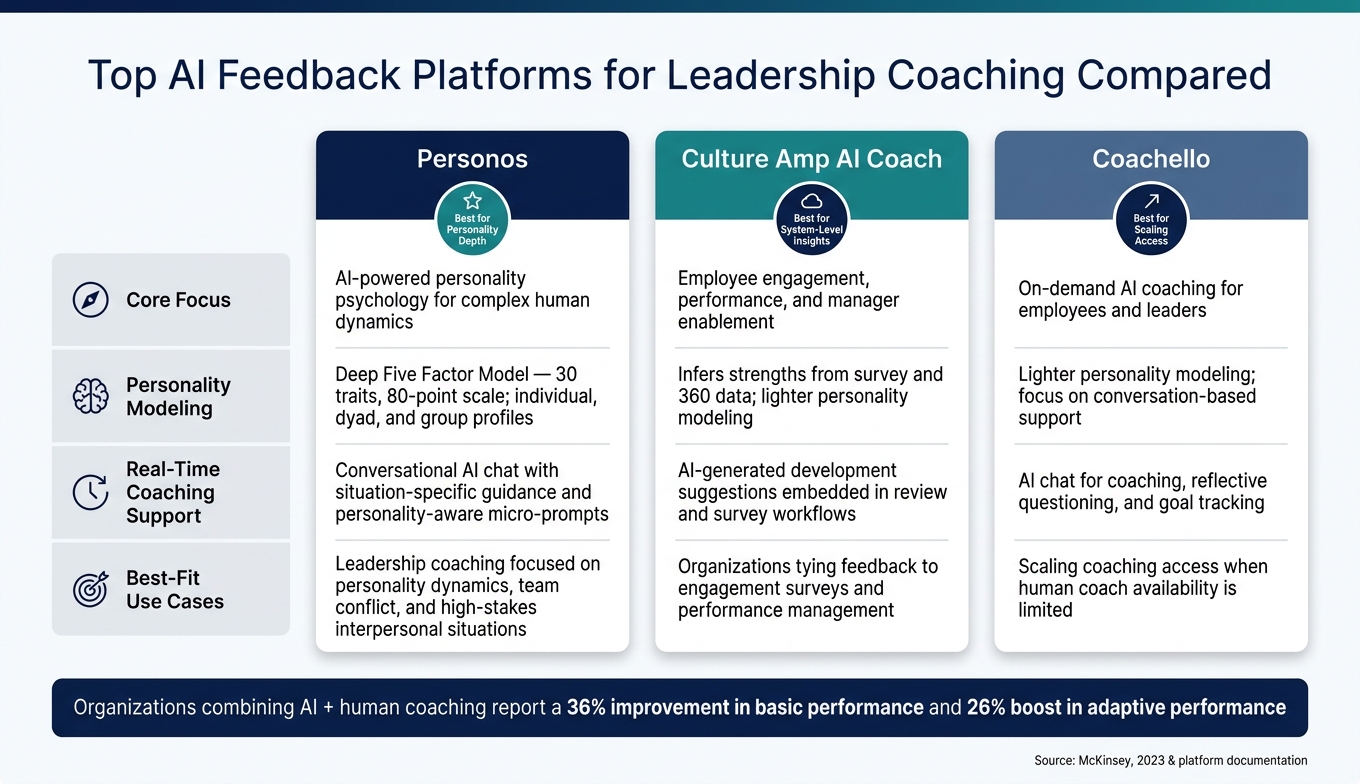
Top AI Feedback Platforms for Leadership Coaching Compared
AI feedback tools vary widely, and choosing one that doesn’t align with your needs can lead to wasted resources and dissatisfaction. The goal is to find a platform that complements your leadership framework - not just one with an impressive list of features.
Key Features to Look For
Start by ensuring the platform aligns with your leadership competency framework. For instance, if your organization prioritizes communication, emotional intelligence, and conflict resolution, the tool should provide insights into those specific areas - not just offer generic scores. Beyond that, certain features set truly useful tools apart.
One of the most critical features is AI coaching and personality psychology. Platforms that use validated personality frameworks offer detailed, actionable coaching insights. Equally important is clear rationale - leaders and coaches need to understand why a recommendation is being made. For example, a suggestion like "this person may disengage under rapid critique - slow down and check in" is far more actionable than a vague prompt like "be more empathetic."
Other essentials include real-time feedback, contextual intelligence (factoring in role, team dynamics, and recent events), and integration with existing tools like HRIS, Slack, or Microsoft Teams. Privacy and security are non-negotiable. For U.S.-based organizations, look for SOC 2 Type II certification, clear data ownership policies, and role-based access controls to ensure sensitive data isn’t misused.
Once you’ve identified your needs, compare how leading platforms meet these criteria.
Comparison of Leading AI Feedback Tools
Here’s a breakdown of how some top platforms address these key features:
| Platform | Core Focus | Personality Modeling | Real-Time Coaching Support | Best-Fit Use Cases |
|---|---|---|---|---|
| Personos | AI-powered personality psychology for complex human dynamics | Deep Five Factor Model (30 traits, 80-point scale); individual, dyad, and group profiles | Conversational AI chat with situation-specific guidance and personality-aware micro-prompts | Leadership coaching focused on personality dynamics, team conflict, and high-stakes interpersonal situations |
| Culture Amp AI Coach | Employee engagement, performance, and manager enablement | Infers strengths from survey and 360 data; lighter personality modeling | AI-generated development suggestions embedded in review and survey workflows | Best for organizations tying feedback to engagement surveys and performance management |
| Coachello | On-demand AI coaching for employees and leaders | Lighter personality modeling; focus on conversation-based support | AI chat for coaching, reflective questioning, and goal tracking | Ideal for scaling coaching access when human coach availability is limited |
Culture Amp excels at providing system-level insights, leveraging data from over 6,500 organizations to benchmark leadership metrics. Coachello is a strong option for organizations looking to expand access to coaching conversations. Personos shines in scenarios that require understanding nuanced interpersonal dynamics, such as how two personalities interact, how team traits create blind spots, or how to tailor coaching to individual wiring. If personality-aware guidance and real-time contextual intelligence are your priorities, Personos offers unparalleled depth.
A Step-by-Step Plan for Rolling Out AI Feedback Systems
Rather than rushing into an organization-wide launch, take a phased approach to minimize risks and build support internally.
- Define outcomes first Identify 3–5 key leadership goals (e.g., psychological safety, manager effectiveness, or reducing regrettable attrition). These goals will help you choose the right vendor and measure the platform’s return on investment.
- Run a structured pilot Select 15–30 leaders across a mix of roles, including first-time managers and mid-level leaders. Have them complete the platform’s assessments and participate in 3–4 AI-supported coaching sessions. Gather feedback on accuracy (“Does this reflect how you see yourself?”) and impact (“What changes did you make?”). Experienced coaches should also evaluate the AI-generated insights for nuance and practicality.
- Configure for your context Customize the platform to reflect your organization’s values, leadership competency model, and role-specific expectations. For example, Personos allows you to layer in these details so that the feedback aligns with your unique culture rather than a generic template. Ensure role-aware settings differentiate between individual contributors and managers.
- Scale with a human overlay AI feedback works best when paired with human guidance. Use the AI for foundational skill-building, real-time prompts, and tracking progress. Reserve human coaches for complex or emotionally sensitive situations. Organizations that combine AI with human coaching report a 36% improvement in basic performance and a 26% boost in adaptive performance, compared to using either approach alone.
Conclusion: Using AI Feedback to Develop Better Leaders
AI feedback, when combined with human coaching, offers a powerful way to generate leadership insights that lead to real improvements. Leaders who use AI to prepare for conversations, monitor behavior over time, and follow through on commitments tend to achieve better outcomes than those who rely only on periodic reviews or gut instincts. According to McKinsey, organizations that integrate AI and analytics into their people-management decisions are 2.6 times more likely to report stronger talent outcomes compared to those that don't.
For AI feedback to be effective, it must go beyond generic metrics and focus on specifics - context, personality, and clear goals. Vague scores don’t inspire meaningful change. But when AI pinpoints patterns, such as identifying who gets interrupted in meetings, how a leader's tone shifts under stress, or potential personality clashes, it provides actionable insights. Tools like AI-driven Five Factor Model assessments, used by platforms like Personos, offer tailored guidance that leaders and coaches can act on, rather than just abstract evaluations.
Ethical considerations play a big role in building trust in AI systems. Clarity about what data is collected, who has access to it, and how it will be used is critical for driving adoption. AI feedback should always be seen as a starting point for discussion, not as an ultimate judgment.
The most successful organizations aren’t focused on having the flashiest tools. Instead, they start with a specific leadership challenge, test AI feedback with a small group, and scale from there. The real transformation happens when leaders take targeted insights from AI and combine them with human-centered coaching. This approach creates a foundation for ongoing leadership development and stronger team dynamics. By blending AI’s precision with human judgment, organizations can unlock continuous growth and better collaboration.
FAQs
What data sources can AI use to coach leaders?
AI taps into workplace interactions to help leaders improve, relying on real-time behavioral data rather than outdated self-reports. It pulls insights from sources like emails, meeting transcripts, chat logs, and feedback patterns. By analyzing factors such as talk-time balance, emotional tone, and response speed, AI identifies key behavioral trends. Tools like Personos take this a step further, combining these insights with individual context and consented data. The result? Dynamic personality profiles that provide practical advice to enhance leadership and foster team development.
How can we ensure AI feedback remains unbiased and fair?
To keep AI feedback unbiased and fair, it's essential to focus on algorithm transparency and conduct regular audits. By reviewing outputs across different demographics, potential disparities can be identified and addressed. It's also important to treat AI-generated insights as hypotheses rather than definitive conclusions, always pairing them with human judgment for a balanced approach.
Platforms such as Personos help build trust by clearly explaining the research-based traits and principles behind their recommendations. This approach avoids the "black-box" issue, ensuring clarity and promoting fairness in AI-driven decisions.
How can leaders use AI feedback without sacrificing privacy?
Maintaining privacy while using AI feedback tools is critical, especially for leaders handling sensitive information. Choosing platforms that prioritize security is a good first step. For instance, Personos ensures conversations remain private, only sharing personality scores when users explicitly authorize it.
Responsible use of AI tools means adhering to key principles:
- Informed consent: Users should know exactly how their data will be used.
- Transparency: Clearly communicate data usage practices.
- Control over data: Provide options to review or delete personal information.
The goal of AI in this context should be to promote self-reflection and personal growth - not to function as a surveillance mechanism.