How AI Enhances Social Worker Awareness of Client Dynamics
How AI analyzes behavior, emotion, and group patterns to help social workers improve client engagement while protecting privacy and ethics.
Rachel Johnson

How AI Enhances Social Worker Awareness of Client Dynamics
AI tools are transforming how social workers understand and support their clients. By analyzing behavior patterns, communication styles, and emotional cues, these technologies help professionals make informed decisions and improve care. Tools like Personos and "Empathy Helper" reduce administrative tasks, provide real-time insights, and even simulate client interactions for training purposes.
Here's what you need to know:
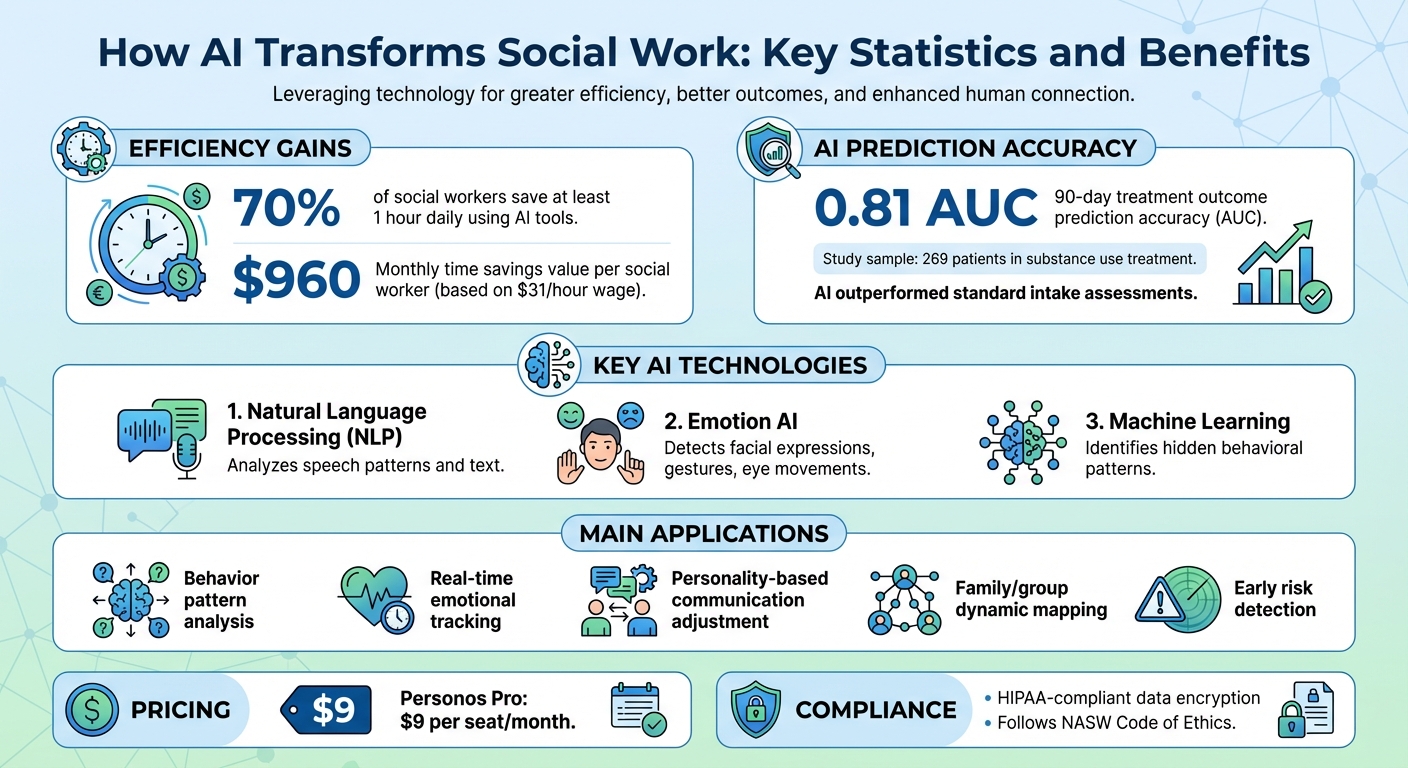
- AI improves efficiency: 70% of social workers save at least one hour daily using AI tools, freeing time for client interactions.
- Behavior analysis: AI uses Natural Language Processing (NLP) and Emotion AI to detect subtle changes in mood, tone, and nonverbal cues.
- Personalized approaches: Personality profiles and emotional insights help tailor communication and interventions.
- Group dynamics: AI identifies patterns in family or group interactions, highlighting conflicts or support systems.
- Ethical use: Compliance with HIPAA and transparency about AI's role are vital to maintain client trust.
AI complements - not replaces - human expertise, allowing social workers to focus on building meaningful connections while ensuring data security and ethical practices.
How AI Tools Transform Social Work: Key Statistics and Benefits
AI Diagnosis Simulator For Social Workers, Therapists, Counselors in Training
How AI Analyzes Client Dynamics
This section explores how AI deciphers client behavior and enhances social work practices.
What Client Dynamics Mean in U.S. Social Work
Client dynamics describe the patterns in how individuals interact, communicate, and express their emotions. In social work, these dynamics are evident in everyday situations - like the tone a parent uses in a family session, a teenager avoiding eye contact, or the specific language a client uses to share their struggles. Recognizing these patterns is crucial for effective work across mental health clinics, child welfare agencies, community programs, and substance use centers throughout the U.S.
These patterns are far from fixed. They evolve based on stress levels, changes in relationships, or external circumstances. For instance, a client might be open and communicative one week but become more reserved the next. For social workers managing 15–30 clients, manually tracking these shifts can quickly become overwhelming.
How AI Tools Analyze Client Behavior
AI leverages advanced technologies to uncover insights that might not be immediately visible in client interactions. Natural Language Processing (NLP) examines speech and text, focusing on word choice, sentence structure, and overall flow. For example, when a client discusses their week during a session or fills out an intake form, NLP can detect subtle language changes that might indicate shifts in mood or an increased risk of harm.
Emotion AI, or affective computing, goes a step further by analyzing nonverbal cues. Using computer vision, this technology can evaluate facial expressions, gestures, and eye movements during video calls or in-person meetings. It can spot subtle indicators, like reduced eye contact, that might signal emotional withdrawal. Machine learning adds another layer, identifying patterns that may escape even the most trained human eye.
A 2023 study published in Neuropsychopharmacology demonstrated AI's potential in this field. Researchers analyzed the social media language of 269 patients undergoing substance use treatment. The AI model predicted 90-day treatment outcomes with greater accuracy than standard intake assessments, achieving a dropout prediction accuracy (AUC) of 0.81 (p < 0.001). This allowed social workers to identify high-risk clients before they discontinued treatment[6].
The practical applications are broad. AI can analyze intake interviews to recommend treatment intensity or format. It can also review session notes to flag issues - like reports of poor sleep - that require immediate attention. Some tools even process unstructured community data to identify emerging social challenges, helping agencies plan targeted interventions[3][4].
Privacy and Compliance Requirements
Integrating AI into social work raises concerns about handling sensitive client data, making compliance with strict federal regulations essential. In the U.S., the Health Insurance Portability and Accountability Act (HIPAA) sets the standard for protecting health information. Any AI tool used in social work must meet HIPAA requirements, ensuring data is encrypted, access is restricted, and usage is logged.
In addition to HIPAA, social workers must navigate state-specific privacy laws and agency guidelines. AI platforms should provide clear data governance features, including details on where client data is stored, who has access to it, and how long it will be retained. These measures help social workers uphold their ethical duty to maintain client confidentiality while using AI insights to improve care.
Using AI in Daily Social Work Tasks
Social workers juggle multiple clients, each with their own unique needs and shifting circumstances. AI tools are stepping in to simplify daily tasks, helping professionals identify patterns and make informed decisions. This frees up time for what matters most - connecting with clients on a deeper level.
Tracking Emotional Patterns Over Time
AI's ability to analyze data is changing how social workers manage cases. Advanced tools can interpret emotions from texts, case notes, and even speech patterns [18-21]. For instance, an AI system might review client reports, session notes, and biometric data to determine which therapies work best for a specific individual. One example showed how a veteran responded positively to cognitive-behavioral therapy and mindfulness exercises, while another benefited more from exposure therapy paired with medication. These insights allow social workers to customize care plans for better results [3].
AI can also send early warnings when it detects signs of isolation or shifts in communication. This kind of proactive support is invaluable, especially when managing large caseloads where keeping track of every small change manually is nearly impossible.
Adjusting Communication Based on Personality Insights
Not every client communicates or processes information the same way, and AI can help social workers adapt their approach. By creating personality profiles, AI tools guide professionals in tailoring communication styles. Similar to sentiment analysis, these profiles offer deeper insights into how clients think and feel, which is particularly useful for children on the autism spectrum. For example, emotion recognition software might detect frustration or anxiety during an activity, prompting the social worker to step in with calming strategies or extra support. Over time, the AI learns and adjusts, making interactions even more effective [3].
When social workers understand a client’s emotional and cognitive preferences, they can ask better questions, select the right interventions, and build stronger relationships.
Analyzing Family and Group Interactions
AI isn’t just useful for one-on-one work; it also sheds light on group and family dynamics. Family interactions, for example, are complex, with individual behaviors often influencing the entire group. AI tools can map these patterns, uncovering areas of conflict, support systems, and communication gaps that might not be obvious. Using Natural Language Processing, AI can analyze conversations during family sessions, identifying who speaks the most, who gets interrupted, and how emotions shift with certain topics. This helps social workers pinpoint power imbalances and identify those who may need extra attention.
In group therapy settings, AI can track how personalities interact over time. For instance, a social worker might notice that certain group members withdraw when specific topics come up, while others thrive in smaller pairings. This information can guide how groups are structured and facilitated, ensuring everyone benefits from the experience.
sbb-itb-f8fc6bf
How Personos Supports Social Workers
Personos uses AI-driven insights combined with personality psychology to create customized reports on individual behaviors, relationships, and group dynamics. By tackling the intricate task of analyzing client behavior, Personos equips social workers with tools to respond quickly and effectively. Here’s a closer look at how it works.
Features That Make a Difference
Personos includes an AI-powered conversational interface that tailors advice based on clients' personality profiles, helping social workers refine their communication strategies. It also provides proactive prompts to identify potential challenges early on. Additionally, the relationship mapping tool offers a visual representation of interactions, highlighting critical dynamics. All interactions are kept confidential, meeting the rigorous standards of social work.
Affordable Pricing for Social Workers
Personos is priced with accessibility in mind. The Pro version costs just $9 per seat per month, making it a budget-friendly option for individual practitioners and smaller agencies alike.
Using AI Responsibly in Social Work
AI has the potential to enhance social work practices, but its integration must be handled with care. Ethical considerations like informed consent, privacy, transparency, and addressing algorithmic bias are crucial to ensure that AI supports, rather than undermines, the values of social work [7][8].
Following the NASW Code of Ethics
Although the National Association of Social Workers (NASW) has yet to release specific guidelines for AI use, the existing NASW Code of Ethics offers a strong framework for ethical practice [8][7]. Social workers are encouraged to use tools like Personos to complement their professional judgment while addressing ethical concerns such as informed consent, privacy, and bias. It's essential to communicate clearly about how AI operates, how data is used, and how it's protected. This level of transparency not only safeguards client trust but also reinforces the principle of client dignity. AI should serve as a resource to enhance understanding - not as a replacement for human decision-making.
Recognizing and Reducing Bias
AI systems often reflect the biases present in their training data [9]. Because historical data can carry social biases and inequities, AI tools built on such data may fail to address - or even worsen - mental health disparities [10]. In some cases, biased models can unintentionally perpetuate systemic inequities [10].
To counteract this, social workers should critically evaluate AI-generated insights within the broader context of each client’s circumstances. For instance, if Personos suggests a particular communication strategy, it’s important to weigh that recommendation against factors like the client’s cultural background, trauma history, or systemic challenges. Collaborating with subject-matter experts during the design and implementation of AI tools can also help identify and mitigate potential blind spots [9]. Ethical practice demands ongoing attention to these issues, ensuring AI supports equitable outcomes.
Tips for Ethical AI Implementation
When used ethically, AI tools like Personos can help social workers provide more effective support. However, these insights should be viewed as starting points, not definitive answers. For example, if Personos flags potential challenges in a client relationship, use that information as a prompt for deeper discussion during sessions.
To integrate AI responsibly, social workers must stay informed about the tools they use - understanding both their advantages and limitations - and adhere to ethical standards [11][8][5]. This includes securing client data, obtaining informed consent with clear explanations of AI's role, and maintaining transparency throughout the process [11][5]. By combining AI insights with professional expertise, social workers can ensure that their practice remains both effective and ethical.
Conclusion
AI tools like Personos are transforming the way social workers understand and interact with their clients. By analyzing behavior patterns, communication styles, and emotional cues, these tools provide actionable insights that help strengthen engagement and improve outcomes [1].
Beyond enhancing client care, AI also makes daily case management more efficient. In fact, research shows that 70% of social workers save at least an hour per day using AI tools [12]. For a social worker earning $31 per hour, that adds up to an estimated $960 in saved time each month [12]. This extra time can be channeled into more meaningful client interactions or even self-care - both of which are crucial in this demanding profession.
However, while AI can deliver efficiency and deeper insights, ethical considerations remain paramount. As Marina Badillo-Diaz highlights in her training sessions for social workers: "We align AI with your values and the NASW Code of Ethics" [2]. This alignment involves maintaining human oversight, securing informed consent, protecting client privacy, and rigorously evaluating AI-generated insights for potential biases and cultural relevance. These safeguards ensure that AI serves as a tool to enhance, not replace, the compassionate and human-centered nature of social work. Ultimately, AI supports professionals without ever substituting their expertise or judgment [2][12].
FAQs
How does AI support ethical practices in social work?
AI tools can be crafted to align with the NASW Code of Ethics, helping social workers uphold professional standards while incorporating technology into their work. Rather than replacing human interaction, these tools aim to strengthen it by offering a clearer understanding of client needs and relationships.
To maintain ethical standards, AI systems can be designed to emphasize transparency, safeguard client confidentiality, and minimize bias in decision-making. When paired with a social worker's expertise, these tools empower professionals to make decisions that are not only well-informed but also compassionate and ethically sound.
How can AI help social workers better understand changes in client behavior?
AI has the potential to assist social workers in recognizing shifts in client behavior by analyzing patterns in communication, emotional signals, and behavioral trends. Tools such as sentiment analysis software or conversational AI can sift through extensive data, identifying changes in mood, tone, or interaction style that might otherwise be overlooked.
Although AI isn’t capable of predicting behavior with complete accuracy, it can highlight possible trends or warning signs. This allows social workers to make better-informed decisions and address client needs more effectively. Incorporating AI into their work can help social workers strengthen their understanding of clients and improve the support they provide.
How does Personos ensure client data stays secure when using AI tools?
Personos puts security and privacy at the forefront, taking comprehensive steps to keep client data safe. They use advanced encryption techniques to protect information both during transmission and while it's stored. This ensures sensitive data stays confidential and secure at all times.
On top of that, Personos strictly follows compliance standards like HIPAA and other U.S. data protection regulations. These measures are designed to uphold trust and accountability. With these protections in place, social workers can confidently use AI tools, knowing client privacy is respected.