AI and Emotional Intelligence in Modern Training Programs
Combining AI tools with human-led sessions to scale, personalize, and measure emotional intelligence training for modern workplaces.
Rachel Johnson

AI and Emotional Intelligence in Modern Training Programs
AI is transforming how organizations approach emotional intelligence (EI) training. By combining AI-driven tools with manual methods, businesses can address both scalability and the need for human connection. Here’s the key takeaway:
- AI platforms like Personos offer scalable, data-based solutions using tools like sentiment analysis and voice recognition. These methods are cost-effective, measurable, and can train large teams efficiently.
- Manual training focuses on human interaction, offering deeper, real-time emotional insights but struggles with scale, consistency, and cost.
For the best results, companies are blending AI's efficiency with the interpersonal depth of human-led sessions. This hybrid approach ensures both widespread access and nuanced emotional growth. The growing market for soft skills training - projected to grow by $207.8 billion (2025-2029) - shows the increasing demand for such solutions.
Emotional Intelligence and AI: Can machines truly understand human feelings?
sbb-itb-f8fc6bf
1. AI-Driven Emotional Intelligence Training (e.g., Personos)
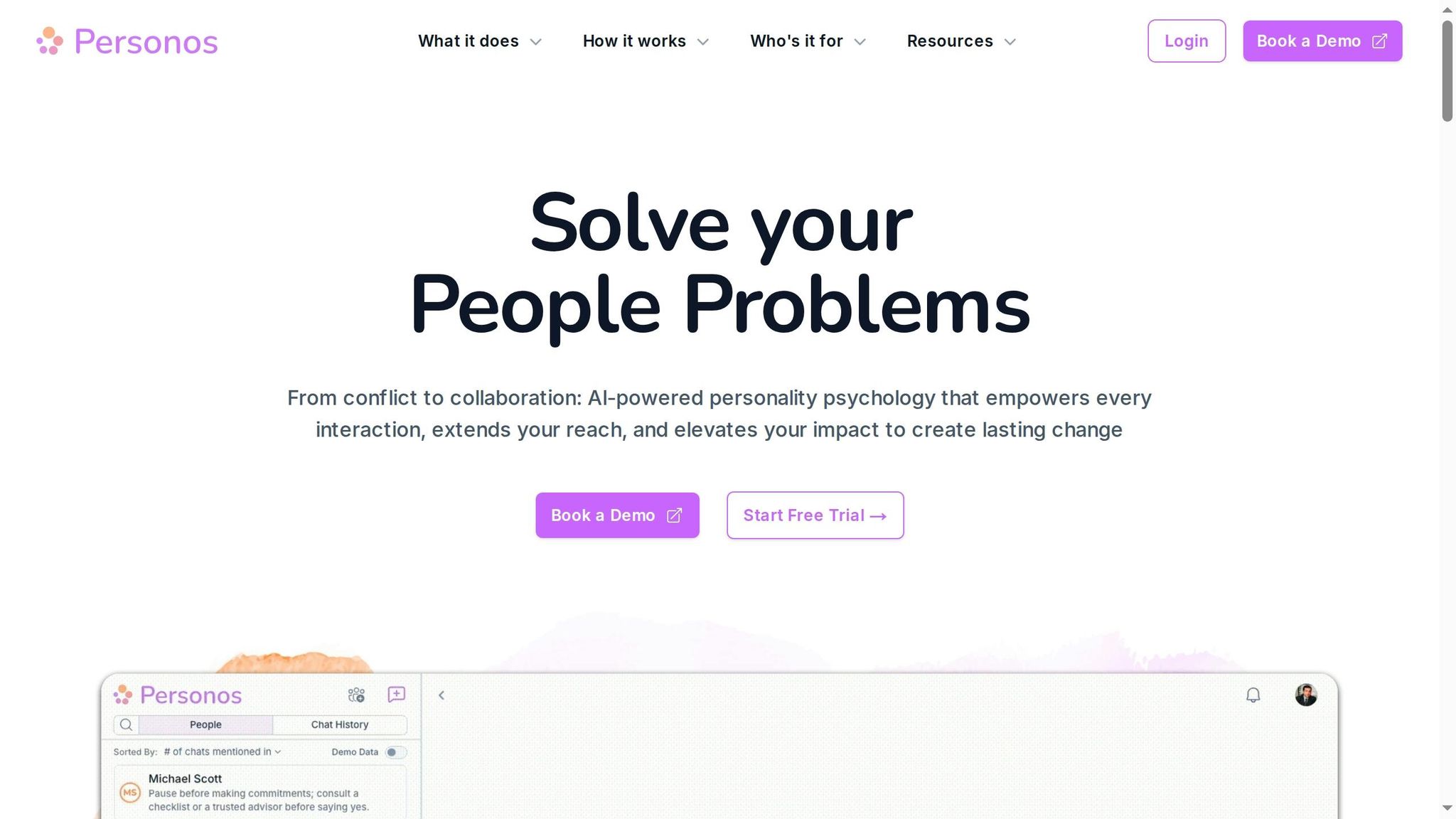
AI-powered platforms are reshaping emotional intelligence (EI) training by offering scalability, personalized experiences, and measurable outcomes. These systems use tools like sentiment analysis, vocal tone recognition, and behavioral data to provide insights that are difficult to achieve through manual methods. For instance, Personos combines personality psychology with conversational AI to deliver real-time coaching for organizations aimed at improving conflict resolution and communication skills.
Scalability
Traditional in-person workshops often face limitations like space constraints and the availability of skilled trainers. AI-driven platforms eliminate these challenges by leveraging cloud-based technology to train thousands of employees simultaneously. A study in Frontiers in Psychology from August 2023 highlighted the effectiveness of online EI training programs, stating:
"an easy and scalable method for building emotional intelligence in a variety of settings" [3].
The demand for such scalable solutions is reflected in the projected growth of the global soft skills training market, which is expected to increase by $207.8 billion between 2025 and 2029, with an annual growth rate of about 34.5% [6]. This scalability ensures organizations can implement EI training across large teams efficiently.
Personalization
Beyond scalability, AI platforms excel at adapting to individual needs. By analyzing communication styles, vocal tones, and written language, these systems create tailored training experiences. For example, in October 2025, a Fortune 500 company utilized AI-driven coaching for mid-level managers. Over three months, the AI provided targeted suggestions based on written communications, leading to a 14% boost in peer trust scores, a 22% improvement in 1:1 meeting feedback, and a 6% decrease in voluntary attrition [7]. Personos takes this further by offering personality-based insights and proactive prompts tailored to specific interpersonal dynamics, enhancing the overall impact.
Measurability
One of AI's standout features is its ability to track and quantify emotional development. In 2023, a University of Arizona study involving 326 participants showed that an online EI training program led to a 5.16-point increase in MSCEIT scores, moving participants from "competent" to "skilled" levels. These gains were maintained even six months after the program [3]. Anne-Laure Augeard, AI Project Manager at ESCP Business School, emphasized how their AI-driven leadership simulations help students:
"navigate complex team dynamics, resolve conflicts, and make decisions under pressure" [8].
This ability to monitor progress through objective metrics ensures that organizations can measure the effectiveness of their training initiatives.
Cost-Effectiveness
AI platforms also offer a more budget-friendly alternative to traditional methods. For instance, Personos Pro is priced at just $9 per user per month. Companies using AI-driven workplace wellbeing tools have reported a 25% reduction in team conflicts and a 19% improvement in feedback quality [7]. The ability to provide continuous, on-demand coaching without the recurring costs of human facilitators makes AI an appealing option for organizations aiming to enhance emotional intelligence across their teams.
2. Manual Emotional Intelligence Training
AI might offer scalability and measurable outcomes, but traditional instructor-led training brings a distinct human touch that's hard to replicate.
Instructor-led emotional intelligence (EI) training thrives on empathy and real-time interpretation of social cues. These methods are excellent for fostering trust and building interpersonal skills, but they come with challenges - especially when organizations need to scale, measure progress, or sustain results.
Scalability
Scaling traditional EI workshops is no easy feat. Limited availability of instructors, logistical hurdles like scheduling, and the need for physical spaces make it tough to implement on a large scale. For example, military organizations or global corporations often struggle to roll out face-to-face training for thousands of participants [3]. The very human element that makes these sessions effective - like empathy and trust-building - also makes them slower to deploy compared to tech-driven solutions [1][2].
Personalization
One of the biggest strengths of instructor-led training is its ability to adapt to individual needs. Trainers can pick up on subtle interpersonal cues that automated systems often miss [1][5]. Take Ruchika Bagga, a Senior Manager at Mankind Pharma, as an example. In 2026, she participated in one-on-one coaching sessions designed to boost her assertiveness and confidence.
This personalized, human-led training enabled her to successfully lead high-level meetings and garnered positive performance feedback from her director [5].
However, this level of customization comes at a cost. It requires significant one-on-one time, making it less practical and more expensive for larger groups [5][3]. And while the results can be transformative, they’re often hard to quantify.
Measurability
Measuring the effectiveness of manual EI training is tricky. Many programs rely on self-reported assessments, which capture how participants feel about their progress but don’t necessarily reflect actual improvements in cognitive-emotional skills [3][10]. Michelle R. Persich Durham from the University of Arizona pointed out:
the interpretation of an intervention's success may depend on the measures used [3].
Self-reports often align well with each other but show weak connections to objective performance-based tests like the MSCEIT [10]. Another issue is the lack of randomized control groups in many workshops, making it hard to determine if improvements are due to the training itself or simply placebo effects [3][11]. Retention is also a challenge - research shows that while 40% of skills are applied immediately, only 25% stick after six months, and just 15% remain after a year [12].
Cost-Effectiveness
The personalized nature of manual training comes with a hefty price tag. Each session involves costs for scheduling, travel, and facilitators, which grow as the group size increases. Meta-analyses of workplace emotional competency training show a moderate effect size of 0.46 [9], proving its effectiveness but at a higher per-person cost compared to automated options. These financial constraints have led many organizations to explore hybrid models that combine the strengths of human-led training with the efficiency of AI [3][9].
All of this points to the need for a balanced approach - one that leverages the precision of AI while retaining the depth and empathy of human interaction.
Pros and Cons
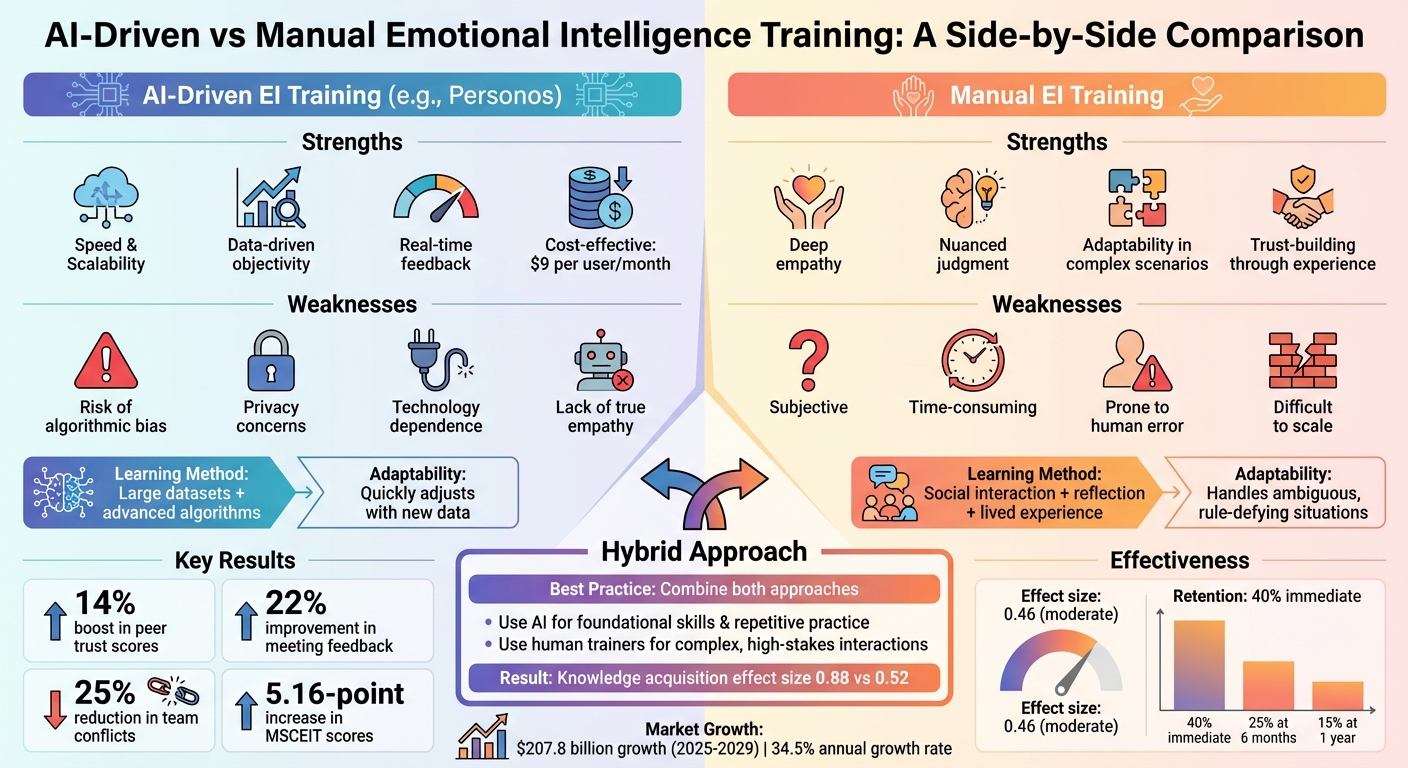
AI-Driven vs Manual Emotional Intelligence Training Comparison
When weighing the choice between AI-driven and manual emotional intelligence (EI) training, it helps to compare their strengths and limitations side by side. Each approach brings unique benefits and challenges that can influence how well they align with your organization's goals. Here's a closer look at how they stack up.
AI-driven platforms, like Personos, shine in areas like speed and scalability. They process vast amounts of data from various scenarios, providing personalized action plans without the need for lengthy assessments. Plus, AI models often outperform human averages in EI assessments, making them a powerful tool for data-driven training [4].
On the flip side, manual training offers something AI can't: genuine empathy and nuanced understanding. Human trainers excel in navigating complex, ambiguous social situations and building trust through experience-based insights. However, manual methods are often subjective and time-intensive, which makes it hard to maintain consistency or scale effectively.
| Feature | AI-Driven EI Training (e.g., Personos) | Manual EI Training |
|---|---|---|
| Strengths | Speed, scalability, data-driven objectivity, and real-time feedback | Deep empathy, nuanced judgment, and adaptability in complex scenarios |
| Weaknesses | Risk of algorithmic bias, privacy concerns, technology dependence, and lack of true empathy | Subjective, time-consuming, prone to human error, and difficult to scale |
| Learning Method | Utilizes large datasets and advanced algorithms | Relies on social interaction, reflection, and lived experience |
| Adaptability | Quickly adjusts algorithms with new data | Handles ambiguous, rule-defying situations with human insight |
Each method's strengths and weaknesses shape its role in modern EI training. AI, while efficient, can only mimic emotional understanding - it doesn't truly empathize. Manual training, though rich in human connection, struggles to scale and maintain consistency. By combining the two, organizations can get the best of both worlds: leveraging AI for initial assessments and ongoing practice while reserving human trainers for nuanced, high-stakes interactions. Together, these approaches can create a more comprehensive and effective EI training program.
Conclusion
Organizations need to tailor their training methods to fit their specific goals and workforce dynamics. For example, companies with large, remote teams can benefit from Personos' scalable and accessible training platform, which eliminates the logistical challenges of organizing in-person sessions. On the other hand, in high-stakes fields like healthcare - where communication failures account for up to 70% of medical errors - a hybrid approach that blends VR simulations with human mentoring proves to be the most effective [6].
Practical case studies and data-driven insights highlight the power of integrated training methods. Research shows that knowledge acquisition improves significantly (effect size 0.88 vs. 0.52) when AI tools combine emotional support with cognitive guidance [13]. Platforms capable of recognizing and responding to learners' emotional states during training consistently outperform those focused only on task completion.
For the best return on investment, organizations can use AI-driven modules for foundational skills and repetitive practice, then bring in human trainers for more complex, nuanced interactions that require empathy. This strategy leverages AI's strengths - like creating a safe environment for failure and tracking progress - while preserving the critical role of human connection in fostering social reinforcement and deeper learning [6]. By combining scalability with empathy, hybrid approaches strike the perfect balance between technology and human touch.
The growing demand for such methods is reflected in market trends. The soft skills training market is expected to grow by $207.8 billion between 2025 and 2029, with an estimated compound annual growth rate of 34.5% [6]. This surge underscores the increasing preference for training solutions that pair technological efficiency with the authenticity and depth of human interaction.
FAQs
How do I choose between AI, human-led, or hybrid EI training?
Choosing the right approach for emotional intelligence (EI) training - AI-driven, human-led, or a hybrid model - depends on what you’re aiming to achieve and how you prioritize efficiency versus personal connection.
AI-driven training stands out for its scalability, consistent delivery, and real-time feedback. It’s particularly useful when you need to reach a large audience or provide standardized learning experiences. On the other hand, human-led training shines in areas requiring empathy and the ability to navigate complex emotional dynamics. It’s better suited for situations where personal interaction and nuanced understanding are key.
A hybrid model blends the strengths of both. AI can provide data-driven insights and structure, while human trainers bring emotional depth and flexibility. This combination works especially well in environments that are diverse or require addressing intricate emotional challenges.
What data does AI EI training analyze, and how is it kept private?
AI emotional intelligence (EI) training involves analyzing various data sources - such as facial expressions, speech patterns, language choices, and even brain activity - to interpret emotional states. Because this data is deeply personal, safeguarding privacy is a top priority. Measures like encryption, anonymization, and secure storage are implemented to protect this sensitive information. Additionally, ethical guidelines and privacy-focused practices are in place to ensure that emotional insights are handled responsibly and not exploited or exposed inappropriately.
How can we prove EI training results beyond self-reports?
To evaluate emotional intelligence (EI) training beyond just self-reports, it's essential to incorporate more objective methods. Tools like ability-based assessments, which use performance tasks, can offer measurable insights. Behavioral observations, such as tracking changes in how individuals interact with others or handle conflicts, provide another layer of validation.
Physiological or neurocognitive measures, like tasks designed to assess emotion recognition, can also help gauge improvements in EI. Pairing these methods with real-world performance data and conducting longitudinal studies creates a well-rounded approach to assessing the impact of EI training over time.