AI-Driven Scenario Planning: Step-by-Step Guide
A practical 5-step guide to AI-driven scenario planning: centralize data, run simulations, evaluate risks, and align teams for faster, bias-reduced decisions.
Christian Thomas

AI-Driven Scenario Planning: Step-by-Step Guide
AI-driven scenario planning uses advanced algorithms to analyze large datasets and generate potential future scenarios. This approach helps businesses prepare for uncertainties more efficiently than traditional methods, which often rely on static tools like spreadsheets. By integrating AI, companies can process diverse factors - such as market trends, weather, and social sentiment - quickly and with greater accuracy.
Key Takeaways:
- Why It Matters: AI reduces forecasting errors (to under 5%) and eliminates human biases.
- Steps to Get Started:
- Build a cross-functional team and set measurable goals.
- Centralize and analyze data from internal and external sources.
- Use AI to identify key uncertainties and simulate scenarios.
- Evaluate outcomes and create tailored action plans.
- Execute strategies, monitor progress, and refine as needed.
Benefits:
- Faster scenario generation (minutes vs. weeks).
- Unified models for better collaboration across teams.
- Dynamic insights into risks and opportunities.
AI-driven planning isn’t just about numbers - it also incorporates tools like Personos to optimize team dynamics and decision-making. This combination of data and human insights ensures businesses stay prepared for shifting conditions.
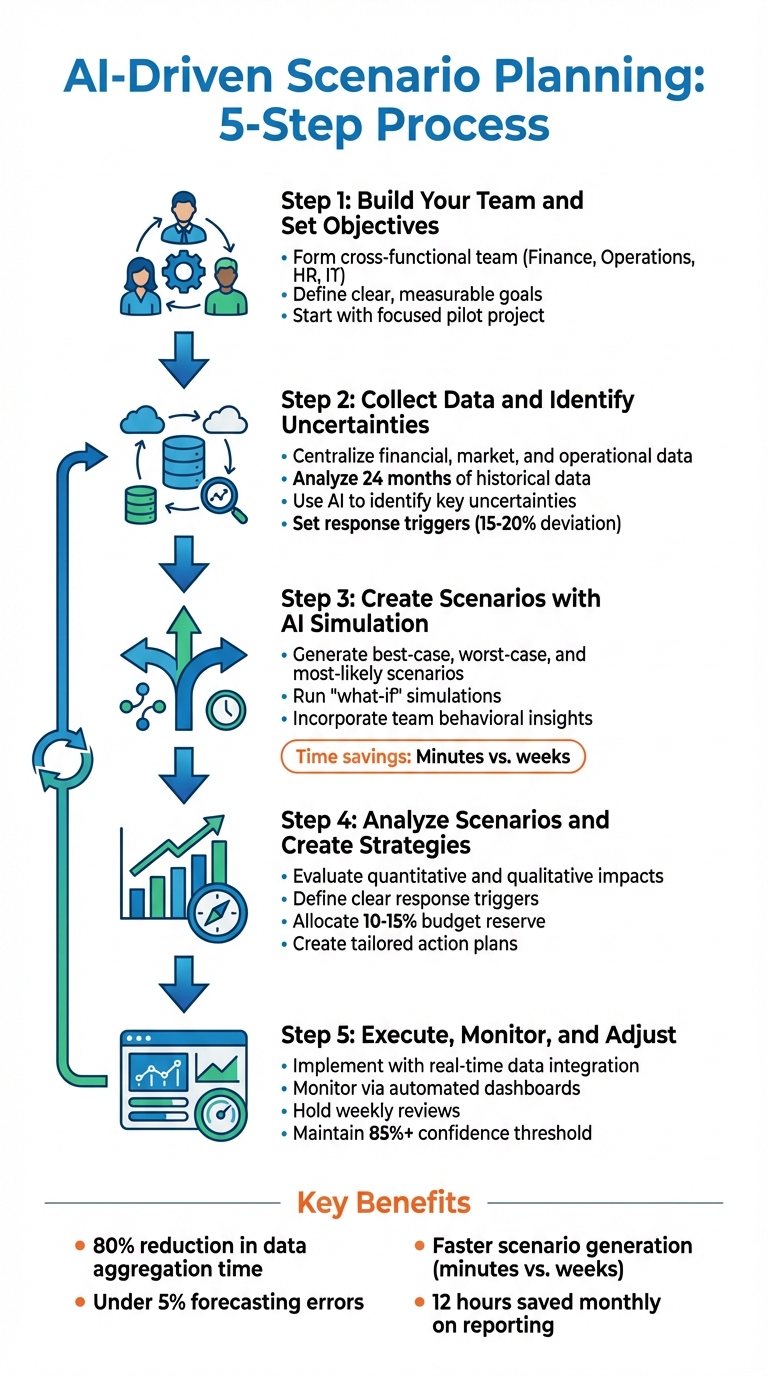
5-Step AI-Driven Scenario Planning Process Guide
Step 1: Build Your Team and Set Objectives
Selecting the Right Team Members
To tackle AI-driven planning effectively, start by forming a cross-functional team that covers every critical aspect of your business. This means bringing together leaders from finance, operations, human resources, and IT - each department contributes a unique perspective that strengthens your approach [8]. A great example of this is fintech firm Pleo, which, in 2025, streamlined its fragmented processes by adopting a unified, cross-departmental AI planning strategy [2].
"Engaging key stakeholders across finance, operations, human resources and IT ensures comprehensive scenario development. Collaboration brings frontline insights and helps align planning with real-world operational needs." - Cherry Bekaert [8]
Your team should include CFOs, executives, and operations experts who can combine strategic vision with practical, day-to-day insights [2][8]. HR professionals bring critical expertise in workforce dynamics, helping to model uncertainties like talent shortages, skill gaps, and employee turnover [8]. To ensure the team operates smoothly under pressure, consider leveraging tools like Personos’ dynamic personality reports. This approach ensures you're not just gathering people with impressive titles but are building teams that work cohesively and effectively.
Once your team is in place, the next step is to establish clear, measurable objectives.
Setting Clear Goals
Define goals that are precise and tied directly to your business priorities. Are you gearing up for a product launch? Mitigating supply chain risks? Or perhaps planning for leadership transitions? For instance, in November 2025, Cherry Bekaert guided a manufacturing firm in creating inflation-sensitive financial models that became the backbone of their scenario planning [8].
Your objectives should focus on specific business outcomes - whether that’s improving the accuracy of quarterly revenue forecasts, reducing uncertainty in labor costs, or developing contingency plans for market disruptions [2][8]. Instead of attempting to model your entire business at once, start small. A focused pilot project, like capacity planning for a single department, not only builds your team’s expertise but also delivers tangible results quickly [2]. Clear objectives also help your team prioritize scenarios - whether it's a best-case growth opportunity, a worst-case disruption, or the most likely path forward [9].
sbb-itb-f8fc6bf
Step 2: Collect Data and Identify Uncertainties
Collecting Relevant Data
The strength of your AI-driven scenario planning depends heavily on the quality of the data you provide. Begin by centralizing three essential data categories: financial records (like revenue, costs, and cash flow), market intelligence (such as competitor pricing and industry growth rates), and operational metrics (including production capacity and supply chain performance) [3][8]. To streamline this, integrate ERP and CRM systems into a unified data hub [2][3].
Analyze 24 months of historical profit and loss data to uncover trends and seasonal patterns [3]. Don’t stop at internal data - incorporate external factors like geopolitical tensions, regulatory updates, and climate risks to ensure a comprehensive view of potential uncertainties [9][1].
Automating your data processes with ETL (Extract, Transform, Load) pipelines is crucial. These pipelines keep datasets updated and consistent, ensuring your AI models work with the most current information rather than outdated snapshots [3]. Additionally, tools like Personos' group analysis reports provide insights into team dynamics, such as communication patterns and performance. This layer of data can help you identify risks, like leadership gaps or team conflicts, before they escalate [9].
Once your data is consolidated, your AI system is ready to uncover critical uncertainties.
Identifying Key Uncertainties
With your curated data in place, AI can now focus on pinpointing the uncertainties that matter most. By processing hundreds of variables, modern AI tools reveal hidden patterns and even highlight low-probability, high-impact events [2][7][10].
"AI plays a critical role in giving you the needed context to build insightful scenario-related models." - Dr. Lance Mortlock, EY Canada Managing Partner [6]
AI goes beyond number crunching - it helps prioritize the uncertainties that deserve your attention. Conversational AI interfaces can guide your team through the data, identifying key drivers and potential outcomes in real time [10]. For example, when modeling workforce scenarios, AI can highlight attrition trends, risks in hiring timelines, or how hybrid work setups might affect productivity [2][10]. You can also set response triggers, such as a 15% shift in cash flow or a 20% change in market conditions, to ensure timely actions [3]. Tools like Personos' conversational interface can surface these uncertainties as they arise, offering insights into risks like team conflicts or leadership transitions [9].
Step 3: Create Scenarios with AI Simulation
Building Possible Scenarios
Once you've defined your data and uncertainties, it's time to put AI to work. By analyzing historical patterns, AI can generate multiple scenarios in just minutes. The aim here isn't about predicting the future but rather exploring a range of possibilities so you can prepare for different outcomes effectively [2].
Start by defining three key scenarios: best-case, which focuses on rapid scaling; worst-case, which identifies vulnerabilities; and most-likely, which reflects current trends [2]. For instance, in 2024/2025, the Copenhagen-based fintech company Pleo leveraged AI-powered planning to streamline their processes, cutting scenario creation time from days to mere minutes [2].
AI also enables quick "what-if" simulations through natural language prompts. You can explore questions like: “What happens to cash flow if our biggest client reduces their contract by 30%?” or “How does a 15% increase in customer acquisition costs impact our runway?” By using predictive analytics, AI helps forecast shifts in variables such as customer behavior or market conditions, offering dynamic insights instead of relying on static assumptions [2]. Adding team behavioral data into the mix further sharpens these projections.
Adding Personality Insights
While scenario simulations help outline potential outcomes, understanding how your team might respond is equally important for crafting effective strategies. Financial projections alone don’t tell the full story - they need to be paired with insights into team dynamics to ensure successful execution.
This is where tools like Personos come into play. Their dynamic personality reports and group analysis features provide a window into how team members may react under pressure. For example, in a worst-case scenario involving budget cuts, some employees may become more cautious, while others might view the challenge as an opportunity to innovate. Knowing these tendencies in advance allows you to tailor communication strategies and assign roles that align with individual strengths.
Personos’ conversational AI can also help identify team dynamics early in the process. In a best-case scenario, such as rapid scaling, the AI can pinpoint individuals suited for leadership roles. Conversely, in a worst-case scenario, it can flag potential areas of conflict and suggest proactive communication strategies to maintain morale and cohesion.
One particularly valuable feature is the proactive communication prompts, which help fine-tune how you present scenarios to stakeholders. By adapting your message to personality profiles - focusing on data and logic for analytical thinkers or emphasizing team impact for relationship-driven leaders - you can boost engagement and ensure everyone is aligned. This way, stakeholders not only understand the potential outcomes but also feel equipped to adapt to them effectively.
Step 4: Analyze Scenarios and Create Strategies
Evaluating Scenario Impact
Once you've created AI-generated scenarios, the next step is to evaluate their potential impact. This involves using both quantitative and qualitative methods to gain a well-rounded understanding. AI excels at processing multiple variables, uncovering subtle relationships that might otherwise go unnoticed [2]. For quantitative analysis, tools like predictive analytics can help you stress-test models and forecast how factors like customer behavior or market trends might change over time [2].
In terms of numbers, focus on financial modeling to estimate revenue, costs, and cash flow for each scenario [8]. Sensitivity analysis is another key step - it allows you to measure how changes in certain variables could affect profitability [8]. Thanks to AI-powered platforms, this type of forecasting, which used to take days, can now be completed in minutes [2].
But numbers alone don’t tell the whole story. Qualitative analysis is just as crucial. It gives you insights into team dynamics and operational readiness, especially under high-pressure situations. For example, tools like Personos' dynamic personality reports and group analysis features can help you understand how your team might respond to different challenges. With this knowledge, you can fine-tune communication strategies to keep morale high and ensure everyone stays aligned [8].
Once you've evaluated the impacts, the next step is to craft action plans tailored to each scenario.
Creating Action Plans
To respond effectively, define clear triggers - measurable signals that indicate which scenario is playing out. For instance, a 15% drop in cash flow might activate a short-term contingency plan, while a 20% change in market conditions could call for medium-term adjustments [3].
| Time Horizon | Key Risk Metrics | Response Triggers |
|---|---|---|
| Short-term (0-6 months) | Cash flow, Working capital | 15% deviation from baseline |
| Medium-term (6-18 months) | Revenue growth, Margins | 20% shift in market conditions |
| Long-term (18+ months) | Market share, Industry position | 25% change in growth trajectory |
Set aside 10%-15% of your budget as a flexible reserve to act quickly when these triggers are activated [3]. Platforms like Personos can streamline the execution of these plans by assigning tasks based on team members’ strengths. For instance, detail-oriented individuals could handle data validation, while those with strong interpersonal skills might focus on stakeholder communication. With built-in collaboration tools, the platform ensures everyone stays on the same page, making it easier to adjust strategies in real time as new information becomes available.
Step 5: Execute, Monitor, and Adjust
Bringing Strategies to Life
Start by implementing your strategies with the help of real-time data integration. Use APIs to connect AI models to essential systems like financial platforms, ERP, and CRM tools [3][5]. This ensures your strategies stay in sync with current conditions. Align AI-driven forecasts with your organization’s KPIs so every step you take supports your key business goals [3].
Collaboration across departments is critical. Teams in finance, sales, and HR should all work from the same AI-powered model [2]. Tools like Personos can simplify this process by assigning tasks based on individual strengths and communication styles. For instance, team members skilled in stakeholder communication can focus on keeping everyone informed, while those with an eye for detail can handle data validation. With real-time insights from these platforms, your team can quickly adapt as new information arises, staying nimble and coordinated during execution.
Once strategies are in motion, the focus shifts to monitoring progress and making adjustments as needed.
Monitoring and Refining Your Approach
After implementation, consistent oversight is key. Set up automated dashboards to track your critical risk metrics and response triggers. AI tools continuously monitor scenarios, flagging potential risks or opportunities [2]. For example, the fintech company Pleo managed to cut data aggregation time by 80% and save 12 hours each month on reporting tasks [2].
Hold weekly reviews to evaluate your AI model’s outputs, refine assumptions, and ensure your scenarios remain relevant [3]. Use technical metrics like Mean Absolute Percentage Error (MAPE) and Root Mean Square Error (RMSE) to measure model accuracy. Focus on scenarios with a confidence level above 85%, and rely on automated validation tools to keep the data feeding your models consistent and reliable [3].
As conditions shift, your scenarios should evolve too. Personos' dynamic personality reports and group analysis features can help you gauge how your team adapts to change, enabling you to fine-tune communication strategies and maintain alignment. Collaboration tools also allow for real-time strategy updates as new data comes in. Remember, AI-driven scenario planning is a continuous process - you don’t have to wait for the next formal planning cycle to make necessary changes [4].
Scenario Planning with AI | Exclusive Lesson
Conclusion
AI-driven scenario planning is transforming how leaders prepare for the unexpected. What once took weeks to analyze can now be done in minutes, empowering teams to evaluate hundreds of interconnected variables and respond to uncertainty in real time [2][4]. This evolution shifts organizations from reacting to crises to thinking strategically, allowing them to spot early warning signs and take action before disruptions grow [9]. The result? Tangible benefits that directly impact organizational performance.
Organizations leveraging AI for planning report cutting data aggregation time by 80% and generating scenarios nearly a week faster [2]. By analyzing complex interdependencies across financial, operational, and market data, AI provides a clearer, more comprehensive view of potential outcomes [2][8]. As Rafael Ramírez, Director of the Oxford-Hyundai Motor Group Foresight Centre, explains:
"The ability to engage with radical uncertainty is becoming increasingly urgent for leaders - and they need tools for doing this rapidly" [4]
To see these benefits, success relies on having clean, centralized data, fostering collaboration across teams, and moving away from infrequent planning cycles to continuous monitoring [3]. By prioritizing scenarios with confidence scores above 85%, setting clear triggers for action, and maintaining strategic financial buffers, organizations can act swiftly and decisively when conditions change [3].
FAQs
How does AI-driven scenario planning improve forecasting accuracy?
AI-powered scenario planning takes forecasting to the next level by analyzing massive datasets, uncovering subtle patterns, and updating models instantly as new information becomes available. With the ability to process thousands of variables at once, predictions are constantly fine-tuned to reflect the most up-to-date data.
This method not only minimizes human error but also accelerates decision-making. The result? Businesses gain reliable insights that allow them to make smart, future-focused choices with greater confidence.
What types of data are essential for successful AI-driven scenario planning?
To make the most of AI-driven scenario planning, you need to feed the model a mix of internal and external data. This data should capture both historical patterns and possible future uncertainties.
Here are some key types of data to include:
- Financial data: Details like past revenue, expenses, cash flow, and profit margins.
- Market insights: Information on industry trends, competitor activities, and shifts in market share.
- Operational metrics: Data such as production volumes, inventory levels, and lead times.
On top of that, adding broader inputs - like forecasts for market changes, advancements in technology, and new regulations - allows the AI to account for external factors that could influence your business. For even more detailed analysis, you might include customer demand signals (like sales forecasts and churn rates), supply chain vulnerabilities, and economic indicators such as GDP growth or inflation rates. This well-rounded approach helps produce actionable insights, giving decision-makers the tools to prepare for various scenarios and make quick, informed decisions that fit the U.S. market landscape.
How do AI simulations help uncover best-case and worst-case scenarios?
AI simulations process massive datasets and run countless what-if scenarios to uncover patterns and trends that might otherwise go unnoticed. By examining these possibilities, they can predict potential outcomes, showcasing both the most promising best-case scenarios and the toughest challenges in worst-case situations.
This method allows businesses to make smarter decisions, anticipate risks, and seize opportunities with more confidence and accuracy.