AI-Driven Approaches in Human Services: A Guide
Learn how AI reduces admin tasks, personalizes client communication, and supports ethical, privacy-focused workflows in human services.
Rachel Johnson

AI-Driven Approaches in Human Services: A Guide
AI is transforming human services by helping professionals spend less time on routine tasks and more time on meaningful client interactions. This guide explains how AI tools can improve communication, streamline workflows, and personalize care while ensuring data privacy and ethical standards.
Key Highlights:
- Time-Saving Tools: AI automates scheduling, documentation, and client intake, reducing administrative burdens.
- Enhanced Communication: Platforms like Personos analyze personality traits, providing tailored communication strategies.
- Personalized Care: AI uses client data to adapt care plans in real-time, improving outcomes.
- Ethical Use: Safeguarding data and maintaining human oversight are critical when implementing AI.
AI isn’t a replacement for human connection - it’s a tool to help you provide better care. By integrating AI thoughtfully, you can improve efficiency and focus on what matters most: supporting your clients.
Artificial Intelligence AI for Human Services
Getting Ready to Use AI in Your Workflow
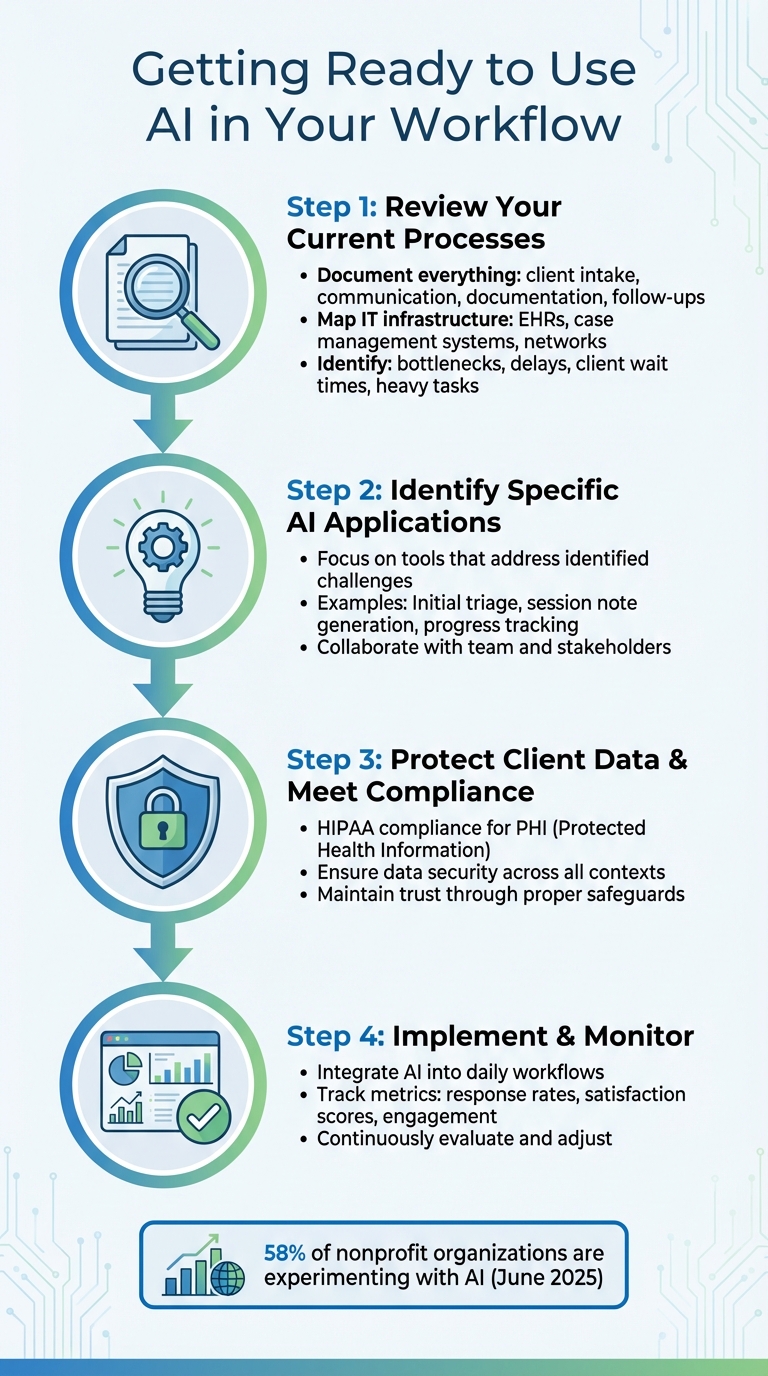
4-Step Guide to Implementing AI in Human Services Workflow
To seamlessly integrate AI into your workflow, start by examining your current processes. Document everything - from how you handle client intake and communication to how you manage documentation and follow-ups. Pinpoint areas where repetitive tasks or bottlenecks slow things down. This groundwork will guide you in choosing the right AI tools to address specific needs.
Review Your Current Processes
Take a close look at your IT infrastructure, such as electronic health records (EHRs), case management systems, and networks, to understand how information flows from the moment a client is onboarded through their ongoing care [1]. This process mapping can help you uncover inefficiencies, redundant steps, and areas where communication falters. Pay attention to where delays happen most often, where client wait times drag, and which tasks weigh heavily on your team. Once you’ve identified these pain points, you’ll have a clearer picture of where AI can step in to simplify and optimize operations.
Identify Specific AI Applications
With your process map in hand, focus on AI tools that can directly address the challenges you’ve identified. For instance, AI might handle initial triage by analyzing client data and suggesting tailored communication approaches based on personality traits. It can also take over time-consuming tasks like generating session notes or tracking client progress over time. Collaborating with your team and other stakeholders is key to ensuring the AI solutions you choose align with real operational needs [1][2].
Protect Client Data and Meet Compliance Requirements
Safeguarding client data is non-negotiable. AI systems that handle protected health information (PHI) must comply with HIPAA’s baseline standards [3]. However, the U.S. takes a fragmented approach to privacy protections, which can complicate AI implementation. These systems often rely on large datasets that cross different contexts and may generate unexpected insights. Ensuring compliance and maintaining trust will be critical as you adopt AI technologies [3].
Using AI to Personalize Client Communication
Once you've streamlined your processes and prepared for AI integration, the next step is to enhance client communication by tailoring it to individual personalities. Effective communication stems from understanding each client on a deeper level. AI tools can analyze communication patterns - such as word choice, sentence style, response timing, and even emoji use - to uncover personality traits and help you adapt your approach [4]. For instance, some clients may prefer concise, straightforward messages, while others might appreciate more detailed explanations.
Apply Personality Insights to Communication
AI tools like Personos can assess personality traits and provide real-time suggestions to refine your communication style. Research involving 36,395 sales representatives revealed that aligning communication strategies with client personalities leads to consistently better results [6]. In human services, this translates to fostering stronger engagement and trust. For example, if AI identifies a client as valuing reliability, you could highlight your follow-through by outlining clear next steps. On the other hand, for clients who show openness to new ideas, presenting creative solutions or alternative approaches might resonate more effectively.
Recent studies indicate that over 70% of consumers have interacted with AI systems, finding them increasingly reliable and supportive, even in sensitive situations [4]. Some platforms can even adjust in real time during live conversations, responding to a client’s emotional state - whether they seem frustrated, curious, or disengaged [4].
Steps for Implementing AI Communication Support
Start by gathering data from previous interactions and intake forms to create a baseline [6]. Before meeting with a client, review AI-generated insights about their preferences. During conversations, observe how they respond, and then use post-session AI analytics to fine-tune your approach [6].
Incorporating these insights into daily routines ensures your team can use them effectively. Regularly evaluate metrics like response rates, satisfaction scores, and engagement levels to measure the impact of personality-based strategies [6]. For example, in April 2025, a legacy video game company implemented psychological AI in customer service. The results? A 30-point boost in Net Promoter Score, improved customer sentiment, and faster ticket resolution times. Clients even reported feeling more "heard" during interactions [5].
Maintain Trauma-Informed and Culturally Responsive Practices
While AI can offer valuable insights, it’s not foolproof. Always validate AI-generated recommendations with direct client feedback, using them as a guide rather than definitive answers. Cultural responsiveness requires balancing AI input with human understanding [8][10]. Similarly, AI should support trauma-informed principles like safety, trust, and collaboration, while preserving the critical human connection [7][9].
"AI alone isn't the magic bullet. It's only powerful when it's paired with data that helps it understand context, tone, and customer intent." - Zendesk report on AI in customer service [5]
AI should enhance your expertise, not replace it. Use it to prepare more thoroughly, respond more efficiently, and gain deeper insights. But always keep the client’s unique experience at the core of your work.
Creating AI-Supported Workflows
Once you've mastered personalized communication strategies, the next step is weaving AI into every part of your workflow. AI can completely transform service delivery by simplifying tasks across the board - from intake to ongoing care - while giving your team more time to focus on what matters most: supporting clients directly.
AI for Intake and Assessment
The intake process often feels like a bottleneck, bogged down by repetitive data entry and manual checks. AI steps in to change that. For example, modern AI systems can analyze referral packets and pull key details into structured fields automatically [11]. One Netsmart provider organization reported slashing referral processing time from 12 minutes to just over two by using AI-powered referral tools integrated with their EHR [11].
AI-powered patient intake agents can also engage with clients through platforms like WhatsApp, SMS, or web portals. These tools gather and verify information before consultations even begin [12]. Using natural language processing, they interpret responses, apply machine learning to ensure accuracy, and seamlessly sync data with your EHR or practice management system [12]. Features like OCR-based identity verification, biometric checks, and real-time insurance validation further streamline the process, flagging potential eligibility issues early to prevent claim denials [12].
AI doesn't just handle logistics - it also enhances risk assessment. By analyzing historical data and inputs from caseworkers, AI models can identify patterns and predict risks, helping teams make timely screening decisions [14]. Language barriers are also less of a challenge, thanks to AI translation tools that improve communication with clients who have limited English proficiency. Meanwhile, chatbots can manage initial screenings and answer common questions, cutting down on wait times [13].
These improvements lay the groundwork for more responsive care plans and better team coordination.
Care Planning and Continued Support
Care plans shouldn’t be static - they need to evolve as clients’ lives change. AI-driven platforms make this possible by continuously updating care plans using data from EHRs, biometric devices, pharmacy or lab results, and even social factors [16]. With real-time data processing, AI can spot emerging risks and suggest adjustments, ensuring care goals stay aligned with a client’s current needs [16].
Clinical decision support systems take this a step further. By integrating data like patient demographics, diagnostic records, treatment history, and even unstructured notes from clinicians, these systems can generate insights about mental health trends and outcomes [15].
This dynamic approach naturally improves team collaboration as well.
Improving Team Collaboration with AI
Strong outcomes depend on strong teamwork, and AI can help bring teams together. With real-time insights and interactive dashboards, AI tools unify team understanding and make collaboration smoother [17]. These tools can create executive summaries, highlight risks, and uncover patterns in case data, allowing professionals to focus on high-impact work and direct client engagement [18][19].
AI also supports consistency across processes by generating interview questions and documentation prompts [18]. Additionally, platforms like Personos use AI to analyze personality traits, helping teams understand how members communicate and work together. This insight improves interdisciplinary planning and reduces friction during team meetings. By combining operational efficiency with better interpersonal understanding, AI strengthens both team dynamics and client care outcomes.
Ethics and Measuring Results
Ethical Guidelines and Accountability
Integrating AI into human services comes with a responsibility to uphold strong ethical standards. As UNESCO emphasizes, "The protection of human rights and dignity is the cornerstone of the Recommendation, based on the advancement of fundamental principles such as transparency and fairness, always remembering the importance of human oversight of AI systems" [20]. This isn't just about following rules - it’s about ensuring the trust of those you serve.
Transparency is key. Clearly explain to clients and staff how data is collected, how decisions are made, and the role AI plays in the process. Collaborate with vendors to obtain detailed documentation on algorithms and data sources, including any biases they may contain [20][21]. For critical decisions, human oversight is non-negotiable. While AI can flag risks or suggest next steps, a human should always make the final call, especially when it impacts someone’s care or safety [21][22].
Protecting privacy is equally important. Client data must be kept secure throughout the AI lifecycle, with clear consent procedures and opt-out options [20][21]. Bias prevention is another critical point - AI trained on flawed data can amplify disparities [20][21]. Regular audits can help identify and address these issues before they cause harm. Documenting the AI's purpose, limitations, data sources, and bias mitigation strategies - and reviewing these regularly - lays the groundwork for ethical and effective AI use [22]. These practices are essential for accurately evaluating AI's impact on service outcomes.
Measuring AI's Effect on Service Delivery
To improve service delivery, focus on measuring outcomes that matter to people, not just technical metrics [24]. For instance, consider client satisfaction, engagement rates, and the completion of care plans. Comparing these metrics before and after AI implementation can provide insights into real improvements.
Staff efficiency is another key area to assess. Track reductions in administrative tasks like paperwork or referral processing times. These operational gains should lead to better client experiences overall. Additionally, keep an eye on fairness and equity by analyzing outcomes across different demographic groups. This helps ensure that AI systems aren’t unintentionally creating disparities [24]. If disparities are identified, act quickly to make adjustments [23][25]. AI tools should work for you, adapting to your needs - not the other way around.
Conclusion: Moving Forward with AI in Human Services
AI is reshaping human services by blending technology with human judgment, empathy, and expertise. As of June 2025, 58% of nonprofit organizations are experimenting with AI, but fewer than 25% have a clear strategy or policy in place [27]. This gap underscores the importance of adopting AI thoughtfully and intentionally. Success lies in crafting a deliberate plan that weaves AI into every aspect of your services.
Think of AI as an assistant that complements your skills. Tools like Personos can help you understand personality dynamics, tailor communication, and handle repetitive tasks - giving you more time to focus on meaningful, human-centric work. As LexisNexis Canada emphasizes, "Human oversight is critical to ensure generative AI benefits legal services in an ethical and responsible manner. With diligent governance, professionals can utilize AI to improve efficiency, insights, and justice while managing risks and upholding ethical standards" [26].
Building trust begins with transparency. Be clear about how data is used, how decisions are made, and how AI is integrated into your processes. Continuous team training is also essential - ensure your team feels confident working with AI and can quickly identify issues like bias. While the social sector is rapidly catching up to the private sector in AI adoption due to budget constraints and staffing shortages [27], rushing the process without preparation can lead to significant risks.
FAQs
How does AI enhance communication in human services?
AI is transforming communication in human services by making interactions more tailored and efficient. With natural language processing, professionals can better understand and address client needs on an individual level. Tasks like scheduling and data entry can also be automated, giving professionals more time to focus on meaningful client connections.
AI also brings tools like real-time translation and sentiment analysis into the mix. These features help overcome language barriers and pick up on emotional cues, making conversations smoother and more empathetic. The result? Stronger, more effective relationships between professionals and their clients.
What ethical factors should be considered when using AI in human services?
When bringing AI into human services, it’s crucial to tackle some important ethical aspects: privacy, data security, transparency, and fairness. AI systems need to be designed to avoid bias, safeguard sensitive client information, and ensure that clients give informed consent before their data is used. Equally important is maintaining human oversight to avoid over-reliance on AI while respecting and preserving client autonomy.
Organizations must also keep up with relevant regulations and establish clear internal policies to ensure AI is applied responsibly and fairly. Focusing on these principles allows human service professionals to build trust and provide solutions that are both ethical and effective.
How does AI create personalized care plans for clients?
AI crafts personalized care plans by examining a wide range of data, including health records, insurance claims, and behavioral trends. This deep dive into individual profiles allows it to identify specific needs and deliver tailored recommendations, resources, and interventions aimed at improving both outcomes and engagement.
With access to real-time insights, AI enables professionals to predict potential challenges and provide timely, proactive solutions. This approach ensures care is not only more precise but also better aligned with each person’s unique circumstances.