How AI Guides Conflict Prevention in Client Talks
Use personality-aware AI to prep, guide tone, and de-escalate client conversations while keeping staff judgment and privacy central.
Nick Blasi

How AI Guides Conflict Prevention in Client Talks
AI can help you lower tension before a client meeting starts, not just react after things go off track. If I boil the article down, the message is simple: use AI to plan your wording, spot likely friction, and stay calm during hard talks, while keeping human judgment in charge.
Here’s the core idea in plain English:
- I use personality signals to shape tone, pace, and wording
- I use case context to find where a talk may get tense
- I use prep notes to draft opening lines, empathy statements, and limit-setting language
- I use live cues to notice shifts like interruptions, silence, or a sharper tone
- I keep privacy and staff judgment at the center of every step
The article also makes a clear split between general AI tools and tools built for helping staff. General AI can suggest softer language. But a personality-based system tied to case history can give more specific direction for that one client relationship.
A few points stand out:
- The workflow has 3 main steps: plan before the meeting, prepare key phrases, and use live guidance during the talk
- Staff should save what works and turn it into team playbooks
- Results should be tracked with simple measures like fewer escalations, fewer complaints, and lower turnover
- Sensitive client details should be masked before entering them into any AI system
Bottom line: I’d treat AI like prep support and in-the-moment backup, not the person leading the conversation.
| Step | What AI Helps With | Why It Matters |
|---|---|---|
| 1. Plan | Read personality types in meetings to match wording and pace to the client | Lowers tension early |
| 2. Prepare | Draft openings, validation, and boundaries | Helps staff stay clear under pressure |
| 3. Support live | Flag tone shifts and suggest de-escalation moves | Helps prevent talks from sliding |
If you want to use AI in client-facing work, this article argues for a simple rule: use it to make staff calmer, clearer, and more prepared.
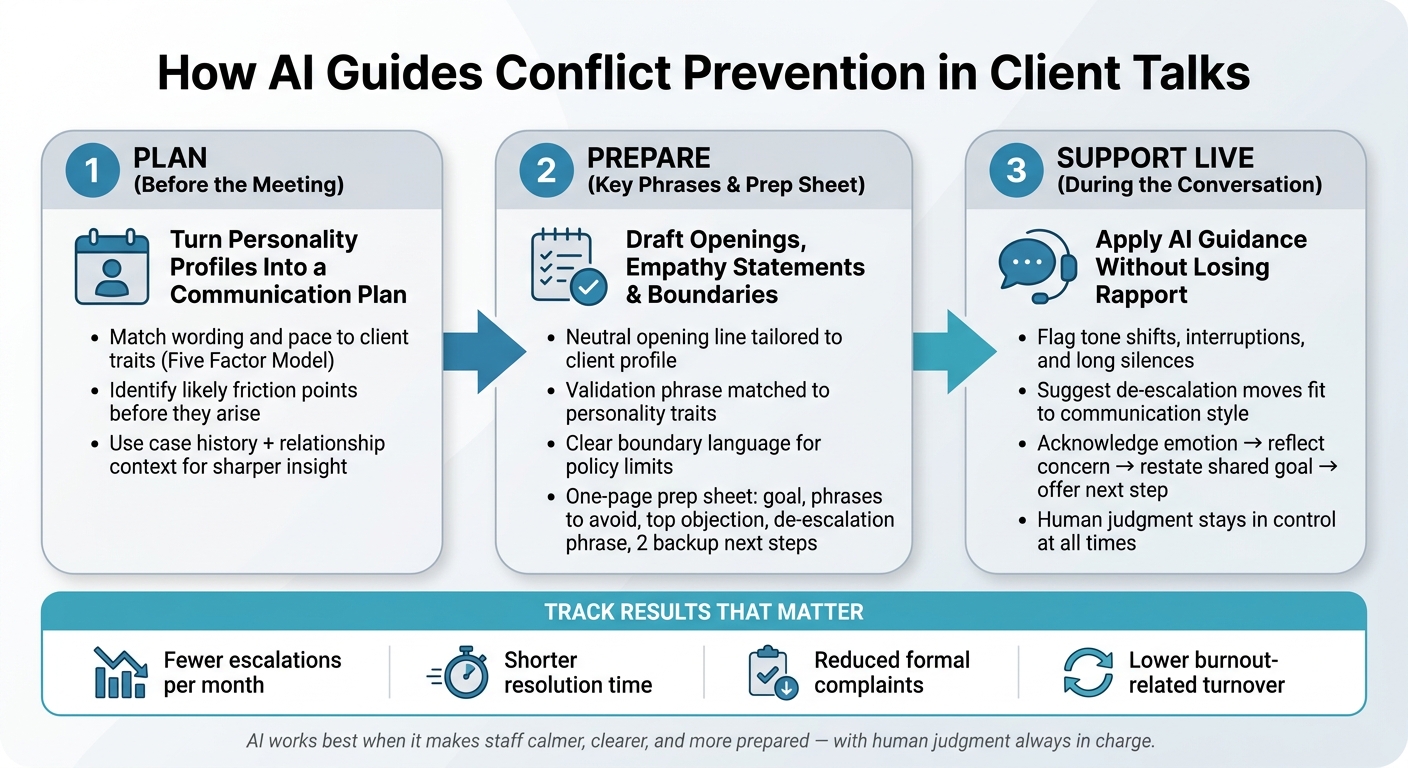
How AI Supports Conflict Prevention in Client Conversations: A 3-Step Workflow
Can AI Help Mediate Human Conflict? - Dr. Wolpe Explains
Step 1: Turn Personality Profiles Into a Communication Plan
Use the profile to shape your wording, pace, level of detail, and the friction points that may come up. That turns personality data into something you can actually use in a conversation.
Match Key Traits to Wording, Pacing, and Likely Triggers
The Five Factor Model adds trait-level detail that helps you spot specific communication risks [1]. For example, a client who is more stress-sensitive may do better with calmer phrasing and a slower pace. A client high in conscientiousness may respond better to clear timelines and structured next steps.
When you combine those trait signals with the client's history, current goals, and past relationship dynamics, the picture gets sharper. You can see where tension is more likely to show up before it does. That makes it easier to choose a calmer, clearer approach from the start.
That gap stands out when you compare personality-aware guidance with general-purpose AI.
How Personos Delivers Relationship-Specific Guidance
Some tools handle this better than generic AI because they connect profile data to the case itself. Personos is built to turn profile data into practical guidance. It uses the full profile, case context, and relationship history to guide response choices.
Before a high-stakes conversation, Dynamic Reports flag likely friction points and suggest phrasing based on the client's trait profile. The platform also explains why it recommends each approach [1].
Personality-Aware Tools vs. General AI: A Side-by-Side Look
General AI tools like ChatGPT can help draft empathy statements or suggest softer phrasing. But they still depend on the prompt you write, not a built-in psychological framework.
| Tool | Personality Model | Primary Use Case | Conflict-Prevention Strength | Limits in Helping-Professional Settings |
|---|---|---|---|---|
| Personos | Five Factor Model (30 traits, 80-point scale) | Helping professionals | Tailored wording and de-escalation cues | Less tailored without a completed personality profile and case context |
| General AI Tools (e.g., ChatGPT) | None | General content generation | Can draft softer wording | Lacks personality context and relationship memory |
For helping professionals, the biggest difference is context integration. Personos carries memory across sessions and brings organizational values, case notes, and relationship dynamics into each response [1][2].
Step 2: Prepare for Difficult Client Talks Before the Meeting
Once you know the client's profile, use AI to turn that information into a simple meeting plan. Even a few focused minutes before a call, home visit, intake, or case review can change the whole tone of the conversation. You walk in with a plan instead of scrambling in the moment.
Summarize the Case and Find the Real Friction Point
Start by giving the AI a short summary of the situation: recent events, service barriers, missed appointments, benefit changes, or safety concerns. The goal is to separate the presenting complaint from the underlying issue [1].
A client who pushes back on a waitlist decision may not be upset only about the waitlist. Something else may be driving the reaction. A personality-aware tool can help flag that likely friction point before the meeting begins. That gives you a much clearer focus for the rest of your prep.
There’s also a simple privacy step worth following. When entering case details into any AI tool, use masked identifiers instead of real names so sensitive data stays protected [1].
Draft Opening Lines, Empathy Statements, and Boundary Language
After you identify the friction point, ask the AI for three specific things:
- a neutral opening line
- a validation phrase matched to the client's personality
- clear boundary language for any policy limits or consequences you need to explain [1]
Different client profiles need different wording and pacing. A generic script can fall flat fast. Use the client's profile to shape the opener, the validation line, and the boundary language so the message lands the way you intend.
This matters even more in hard conversations like eligibility denials, compliance concerns, or resource shortages within an AI social work framework. In those moments, the how often matters more than the what.
Build a One-Page Conversation Prep Sheet
Pull everything into a short prep sheet you can scan in the five minutes before the meeting. Keep it to one page. Include your goal for the conversation, two or three words or phrases to avoid, the most likely objection, a de-escalation phrase you can use right away, and two backup next-step options if the main goal doesn’t land.
Keep the sheet beside you during the conversation. It can help guide your wording in real time, which is a big help when the room gets tense.
The table below shows how each part of that prep connects to what AI does and why it helps:
| Preparation Step | What Staff Do | How AI Helps | Why It Helps |
|---|---|---|---|
| Context Review | Input recent events, barriers, and missed appointments | Connects history, goals, and past dynamics to identify the real friction point | Prevents staff from being blindsided by underlying emotional triggers |
| Scripting | Request opening lines and empathy statements | Generates neutral, personality-matched language and validation phrases | Establishes rapport early and lowers initial client defensiveness |
| Boundary Setting | Define policy limits or consequences to communicate | Drafts firm but respectful language that fits the client's communication style | Maintains professional boundaries without damaging rapport |
| De-escalation Prep | Review known stress patterns and likely objections | Suggests specific phrases and pacing adjustments based on the client's traits | Gives staff a backup plan to stay grounded if tension rises |
| Next Steps | Define 2–3 desired outcomes | Suggests backup options and follow-up tasks if the primary goal isn't met | Ensures the meeting ends with a clear, supported path forward |
Save the sheet so the next conversation starts with the same context.
Step 3: Apply AI Guidance During the Conversation Without Losing Rapport
Your prep sheet is done. Then the meeting begins, and that’s when things get messy in the normal, human way. Conversations don’t stick to a script for long. This is the point where AI stops being a planning aid and starts acting like quiet backup in the background.
Spot the Live Signals That Mean Tension Is Rising
Tension usually doesn’t show up with a warning label. It slips in through small changes: a client starts cutting you off, repeats the same objection in slightly different ways, or shifts into a sharper tone out of nowhere. Even a long silence can mean something is still stuck.
Personality-aware AI tools can flag those shifts as they happen. When Personos notices a tone change or a pattern that hints at friction, it can nudge you to slow down or reflect the client’s last concern before you move ahead. The point is simple: catch the issue early, before a tense moment turns into a full breakdown.
Use De-Escalation Moves That Fit the Client's Communication Style
Clients don’t all react the same way when tension builds. Someone who scores high in Conscientiousness often wants more detail and a slower pace. A client with high Agreeableness may say yes just to keep the peace, so pushing for agreement too soon can hide real resistance.
One simple sequence works in many situations: acknowledge the emotion, reflect the concern, restate the shared goal, then offer a structured next step. The steps stay the same, but the delivery changes. That’s the part that matters. Personality-aware AI can help you judge whether this client needs direct choices, extra reassurance, or more technical detail. That level of detail keeps the response from sounding generic or scripted.
"Treat AI like a junior teammate, not an authority. Give it the right context, then ask it to show its assumptions and reasoning." - Christian Thomas, Co-Founder and CEO, Personos [3]
Set Clear Guardrails for Ethical and Effective AI Use
AI guidance is only as good as the judgment behind it. Staff should feel comfortable ignoring any AI suggestion when their own read of the room, or what they know about the client’s culture, safety situation, or current emotional state, points somewhere else.
As Christian Thomas, Co-Founder and CEO of Personos, puts it: "The safest systems are designed to support human responsibility, not outsource it." [3]
Raw personality scores should remain private. Share only the high-level insights that help the conversation, not the source data behind them. That keeps the exchange centered on the relationship instead of the report.
| AI Cue Type | Example | When to Apply | Misuse Risk |
|---|---|---|---|
| Communication Adjustment | "Client shows high Agreeableness; avoid pushing for a 'yes' too early." | When a client seems to agree just to avoid conflict | Over-simplifying a complex emotional state |
| De-escalation Move | "Slow down the pace and provide more technical detail." | When a high-Conscientiousness client asks repetitive, detailed questions | Sounding robotic or ignoring the client's immediate emotional distress |
| Friction Spotting | "Tone shift detected: reflect the client's last concern before moving on." | When the AI detects a sharper tone or a sudden long pause | Interrupting a natural silence the client needs for reflection |
| Ethical Guardrail | "I am not sure about this specific cultural context." | When the AI gives a generic response to a culturally sensitive issue | Outsourcing cultural competency to a model that lacks local context |
The table above is not something to mentally run through line by line during a meeting. It’s there to help build judgment over time. In practice, that means knowing when AI input can help and when it’s better to set it aside. That’s what keeps the conversation human.
Build a Repeatable Workflow and Track What Improves
Add AI to Playbooks, Supervision, and Follow-Up Steps
When a conversation goes well, don't let that win disappear. Turn it into a pattern your team can use again.
One well-handled conversation helps one person. A repeatable system that improves outcomes across a team is what moves the needle.
Start with your agency's highest-friction situations, like benefit denials and service refusals. For each one, create a simple one-page playbook. Use the same personality profile and case context you used during prep so the guidance stays grounded in the actual situation.
Each playbook should cover:
- Common personality-based friction patterns
- Suggested opening language
- A short list of de-escalation moves
AI can draft the first version. Then staff should edit it based on what happens in practice. That's where the playbook gets sharper.
You can use those same personality signals in supervision too. Personos' Dynamic Reports can produce relationship-specific coaching notes that a supervisor and staff member review together. That turns a weekly check-in from a loose conversation into a structured debrief.
If a piece of guidance is worth using, move it straight into the ActionBoard so it doesn't vanish after the meeting. Over time, steady use can help staff handle hard transitions with more control. The payoff comes from using the workflow the same way, week after week.
Track Results That Matter to Staff and Leadership
Track both client outcomes and staff confidence. Stick with the measures your team already uses so this fits into the work instead of adding more noise.
On the client side, useful signals include steady progress between appointments and faster movement toward case goals. On the staff side, pay attention to whether people feel more confident before difficult conversations. That boost in confidence often shows up before fewer escalations do. If escalations drop after personality-matched guidance, that's a strong sign the workflow is doing its job. Store trend data so supervisors can review change over time.
| Metric | What It Signals | Who Cares Most |
|---|---|---|
| Fewer escalations per month | Conflict prevention is working earlier | Supervisors, program directors |
| Shorter average resolution time | Staff are reaching clarity faster | Case managers, team leads |
| Reduced formal complaints | Client trust and communication quality are improving | Leadership, funders |
| Lower burnout-related turnover | The workflow is easing pressure on frontline staff | HR, supervisors |
| Steady progress between appointments | AI-guided support is helping people keep moving | Case managers, funders |
Conclusion: AI Works Best When It Makes Staff Calmer, Clearer, and More Prepared
The point is simple: AI works best when it lowers staff stress, improves clarity, and supports faster follow-through.
That looks like using personality and case context before a meeting to prepare well. It means reading live signals in the moment to de-escalate. It means keeping human judgment firmly in control. And it means turning what works into a repeatable process the whole team can rely on.
"When AI is built with equity, privacy, and human connection at the center, it becomes a way to amplify mission impact rather than distract from it." - Nick Blasi, Co-Founder & COO, Personos [2]
The best outcome isn't a perfectly handled conversation. It's a staff member who walks into a hard meeting feeling steady, leaves with a clear next step, and has a system that makes the next one a little easier than the last.
FAQs
How do I use AI without losing human judgment?
Use AI as a decision-support tool, not the final decision-maker. Let it guide you, then layer in your own observation, ethics, and judgment before you act.
That matters because context changes everything. A suggestion that looks right on screen can fall flat in an actual conversation. People are messy, situations shift, and tone can make or break the moment. AI can help you think things through, but it shouldn't be the one driving the car.
Choose tools that show their reasoning in a clear way so you can judge whether the suggestion fits. With Personos, treat its wording, de-escalation ideas, and next-step prompts as working theories, not fixed answers. Use them as a starting point, then confirm what holds up in real client conversations.
What client details should be masked before using AI?
Mask names and contact details before you use AI in client conversations, and swap them out with rotating placeholders.
Don’t send real names, email addresses, phone numbers, or other direct contact details. Use stand-in names like “Jane Doe” and “John Smith” instead. Also, keep sensitive personality scores hidden by default unless a client clearly chooses to share them.
How can a team measure whether AI is reducing conflict?
Track both quantitative and qualitative changes over several months. Look at conflict frequency, team engagement, and psychological safety.
That mix matters. Numbers can show whether conflict is happening less often, but they don't tell the whole story. You also need to hear how people feel, how meetings are going, and whether team members feel safe speaking up.
Tools like Personos can help with this. It turns AI guidance into trackable tasks through an ActionBoard, then follows completion rates and communication patterns so you can see progress and share results with stakeholders.