AI Chatbots for Personality Mapping in Teams
AI chatbots map team personalities in real time and turn conversational data into actionable guidance for better communication and role alignment.
Rachel Johnson

AI Chatbots for Personality Mapping in Teams
AI chatbots are transforming how teams understand and improve collaboration. By analyzing personality traits through natural conversations, these tools provide real-time insights into communication styles, decision-making, and stress management. Unlike traditional assessments, which often become outdated, chatbots like Personos continuously gather data and offer actionable advice tailored to team dynamics. This approach helps managers address conflicts, deliver feedback effectively, and align roles for better productivity. With features like ongoing assessments, personalized prompts, and group-level insights, AI-driven personality mapping is becoming an essential tool for modern teams.
Key takeaways:
- Personality mapping identifies individual traits to improve teamwork.
- AI chatbots adapt to team changes and provide real-time guidance.
- Tools like Personos use the Five Factor Model for detailed analysis.
- Managers can use these insights to reduce turnover, resolve conflicts, and improve communication.
Personos, for example, costs $9/month per user and includes a free trial, offering an accessible way to test its benefits for your team.
Understanding Personality Mapping in a Team Context
What Is Personality Mapping?
Personality mapping involves analyzing individual traits - like how people process information, make decisions, handle stress, and interact with others - to get a better understanding of how a team functions as a unit. This approach isn't about categorizing people but about creating a shared framework that helps teams work more effectively.
For example, team conflicts often arise when different work styles clash. Imagine a visionary who thrives on bold ideas working alongside a detail-oriented colleague who prefers caution. These differences can stall progress. Personality mapping helps identify these dynamics and pinpoints areas where important tasks, such as data reviews or brainstorming, might be neglected.
This understanding lays the groundwork for exploring how AI chatbots can actively improve team collaboration.
Why AI Chatbots Work Well for Personality Mapping
Unlike traditional reports that provide static insights, AI chatbots can analyze and apply personality data in real time. Whether it’s assessing individual traits, pair dynamics, or group interactions, these tools adapt as team dynamics shift. They also scale across organizations without requiring a coach for every team, offering managers immediate, actionable feedback instead of waiting for quarterly reviews. For example, a chatbot might suggest specific phrases to help managers deliver sensitive feedback effectively.
"It surfaces blind spots I would have taken months to uncover. It's like having a co-pilot who never misses a detail." - David Kim, PCC, Executive Leadership Coach [1]
By fostering personality-aware communication, AI chatbots help build psychological safety, a critical factor linked to a 10x improvement in team performance [3].
Next, we'll explore the distinction between a chatbot's designed persona and its role in personality mapping.
Chatbot Persona vs. Personality Mapping: What's the Difference?
A chatbot's persona defines how it interacts - whether it adopts the tone of a peer, a coach, or a neutral advisor. This design choice influences how people engage with it. On the other hand, personality mapping focuses on understanding human traits to strengthen relationships within the team. The chatbot acts as a tool, collecting structured data and turning it into actionable guidance to improve collaboration and connection.
"AI has made us more efficient in how we work and communicate, but not smarter about how we connect with people." - Christian Thomas, CEO and Co-Founder, Personos
How AI Chatbots Collect and Analyze Personality Data
AI Chatbots vs. Traditional Personality Assessment Methods
How Chatbots Gather Personality Data
AI chatbots use a mix of methods to gather personality data: structured prompts, conversational check-ins, and situational questions. Structured prompts act like surveys, where team members rate their work styles on a scale, creating a consistent baseline across the group. Conversational check-ins happen regularly, helping uncover traits like conscientiousness or emotional stability over time without overwhelming users with a lengthy one-off test. Situational questions, on the other hand, mimic real workplace challenges to reveal how individuals respond under pressure.
Platforms like Personos combine these approaches for a more refined analysis. For example, they use the Five Factor Model during onboarding, paired with conversational inputs where users share real workplace experiences. Adding personal context (such as goals and role descriptions) alongside organizational details (like company values and team norms) helps the AI refine its understanding over time [2].
Once the data is collected, the AI translates it into measurable personality signals.
How AI Reads Personality Signals
After gathering data, AI analyzes it to uncover actionable personality insights. Word choice matters - frequent use of "I" and "me" can point to self-focus, while collective pronouns suggest a teamwork-oriented mindset. Emotional tone also plays a role; for instance, repeated use of words like "overwhelmed" or "frustrated" might indicate lower emotional stability, while more optimistic language suggests the opposite. Additionally, interaction patterns - such as response length, reply speed, and whether someone asks questions or makes statements - offer clues about traits like conscientiousness and decision-making style.
The AI also detects content themes. For example, a preference for structure ("I need clear steps") aligns with orderliness, while statements like "I prefer to figure things out on my own" suggest independence. These patterns are then mapped to specific traits within a validated framework. Personos, for instance, uses this process to convert raw language data into detailed trait scores and practical advice [2].
"It predicts behavior in a way that still catches me off guard. But taking that and the advice it gives and applying it to my team, I've never seen results like it." - Marcus Lee, JD, Reentry Program Director [1]
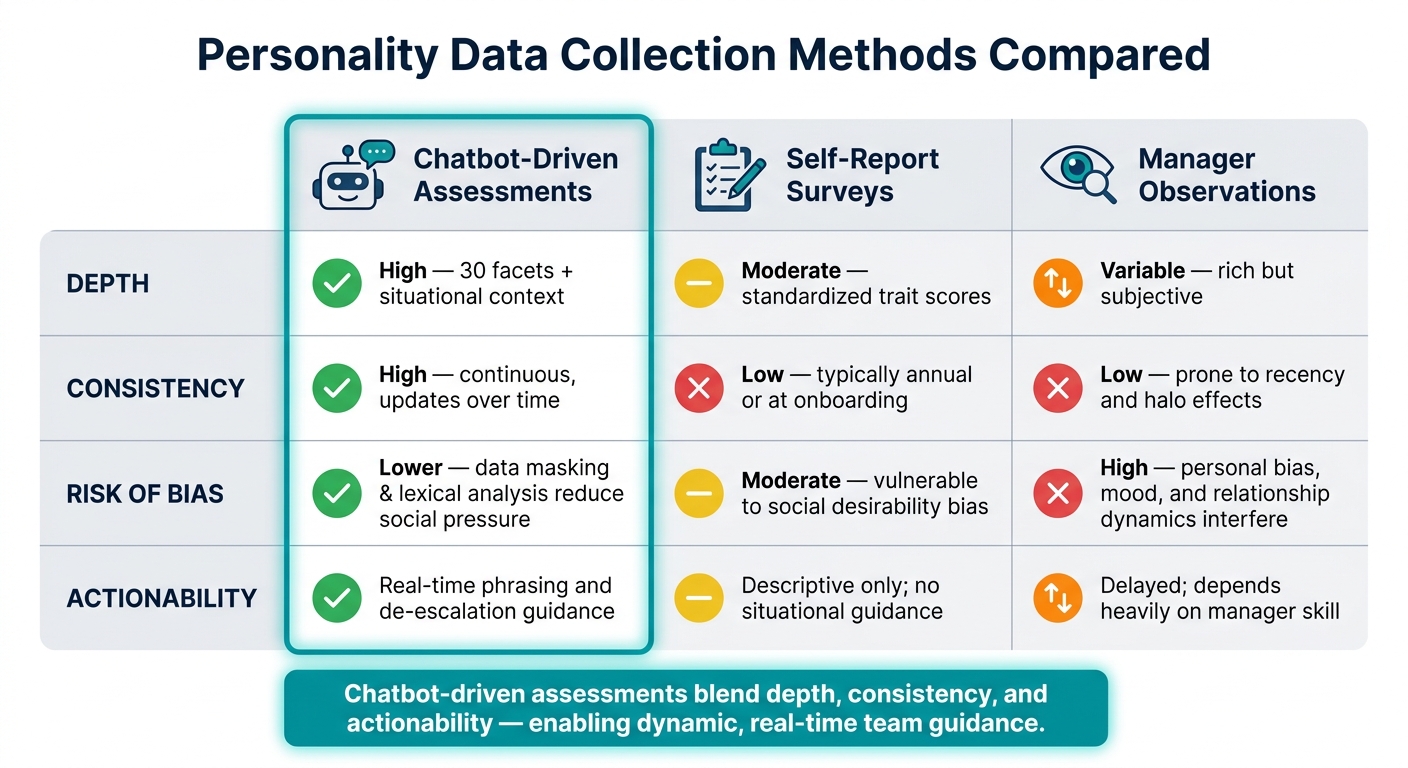
Personality Data Collection Methods Compared
Different methods for collecting personality data have their strengths and weaknesses. Here's a comparison of the three most common approaches:
| Method | Depth | Consistency | Risk of Bias | Actionability |
|---|---|---|---|---|
| Chatbot-driven assessments | High - 30 facets + situational context | High - continuous, updates over time | Lower - data masking and lexical analysis reduce social pressure | Real-time phrasing and de-escalation guidance |
| Self-report surveys | Moderate - standardized trait scores | Low - typically annual or at onboarding | Moderate - vulnerable to social desirability bias | Descriptive only; no situational guidance |
| Manager observations | Variable - rich but subjective | Low - prone to recency and halo effects | High - personal bias, mood, and relationship dynamics all interfere | Delayed; depends heavily on manager skill |
Chatbot-driven assessments stand out because they blend depth, consistency, and actionability. While traditional surveys provide a general snapshot and manager observations offer subjective insights, chatbots continuously learn from ongoing interactions. This allows them to connect the dots and deliver dynamic, real-time guidance. By focusing on real-time personality mapping, chatbots help teams move beyond static assessments, enabling more effective collaboration and growth [2].
How to Set Up AI Chatbots for Personality Mapping in Teams
Choosing a Personality Framework
The framework you choose is crucial - it shapes how you gather data, interpret results, and build trust within your team. One of the most reliable options is the Five Factor Model (FFM), also known as the Big Five. This model evaluates five key traits: Openness, Conscientiousness, Extraversion, Agreeableness, and Emotional Stability. Backed by extensive research in organizational psychology, it provides a robust foundation for understanding personality in the workplace.
FFM works particularly well with AI because it uses language patterns to analyze personality traits. For the most accurate results, look for platforms that assess all 30 facets of the FFM on a continuous scale. This level of detail offers deeper insights. For instance, studies show that Conscientiousness alone correlates with job performance at rates between 0.20 and 0.30 across various roles - a clear sign that granular data can predict workplace behavior effectively.
On the flip side, avoid systems that pigeonhole people into rigid "types" without continuous scoring. These approaches oversimplify complex personalities and lack the scientific rigor needed for meaningful team decisions.
Setting Team Goals and Data Boundaries
Before rolling out any assessments, it’s essential to establish two things: a clear purpose and a data governance plan. Start by identifying your goals. Are you aiming to improve manager feedback, smooth out cross-functional collaboration, or help new hires adapt more quickly? Each objective requires tailored outputs and varying levels of data visibility.
Equally important is defining how data will be handled. Develop a policy that specifies what will be collected (e.g., questionnaire answers, chat data, personality scores), who gets access, and how long the information will be stored. A practical approach might look like this:
- Individuals: Full access to their own profiles.
- Managers: Summaries focused on work-relevant traits.
- Leadership: Anonymized, group-level insights only.
Make sure personality data is shared only with explicit consent. Transparency is key - when employees understand how the system works and know their job security isn’t tied to their results, they’re more likely to engage honestly. This trust directly impacts the quality of the data you collect [1].
Once these foundations are in place, the next step is finding a platform that aligns with these principles.
Using Personos to Get Started
If you’re ready to implement these guidelines, Personos is a platform designed specifically for this purpose. It uses the Five Factor Model to measure all 30 personality facets on an 80-point scale. What sets it apart is its contextual intelligence, which factors in your organization’s values, role expectations, and team norms. This ensures the AI’s insights are tailored to your specific work environment rather than relying on generic templates.
The process is straightforward: team members complete a quick FFM-based assessment during onboarding. From there, Personos generates detailed individual profiles, reports on how team members interact, and overall group insights. Its ActionBoard turns these insights into actionable tasks, bridging the gap between understanding and implementation. With its Configurable Prompts, users receive practical nudges - daily or weekly - making it easy to apply the insights without needing full reassessments.
"We reduced team turnover by 45% in six months. Personos helped us understand why certain team dynamics weren't working and gave managers the exact words to fix it." - Sarah Mitchell, MBA, VP of Operations [1]
Personos is priced at $9/month per seat and includes a 7-day free trial with no credit card required. This makes it easy to test with a small team before rolling it out across your organization [1].
How to Read and Apply Personality Mapping Outputs
Data alone won't improve collaboration - it’s what you do with it that makes the difference.
Reading Outputs at the Individual, Pair, and Group Level
Personality mapping outputs can be viewed through three lenses: individual, pair, and group. These perspectives help turn raw data into meaningful insights:
- At the individual level, you can dive into a person’s 30 FFM facets. This helps you understand their natural tendencies, like how they handle feedback, deal with stress, or approach new ideas.
- At the pair level, AI tools can analyze how two profiles interact - highlighting potential conflicts and suggesting tailored communication strategies to improve understanding.
- At the group level, it’s not just about averaging scores. Instead, consider team norms, shared goals, and collective roles to interpret the data in a way that reflects the group’s unique dynamics [2][3].
This multi-layered approach helps translate observations into actionable strategies.
Actionable Insights vs. Descriptive Insights
Once you’ve broken down the data, the next step is turning it into practical advice. Not all insights are equally useful. Here’s the distinction:
- Descriptive insights explain personality traits. For instance, they might show that someone scores low in Agreeableness.
- Actionable insights, on the other hand, go a step further by offering practical advice. For example, they might suggest specific language to ensure that person feels understood without becoming defensive [2][3].
| Feature | Descriptive Insights | Actionable Insights |
|---|---|---|
| Focus | Understanding and "Why" | Execution and "How" |
| Examples | 30-facet scores, FFM profiles | Language cues, de-escalation phrasing, tasks |
| Team Use | Building empathy and role alignment | Resolving conflict and giving feedback |
| Output Type | Scientific reports and reasoning | Action items and nudge-based prompts |
To make the most of personality mapping, it’s essential to shift from descriptive to actionable insights. Tools like Personos's ActionBoard simplify this process by converting reports into measurable action items or coaching goals. With features like daily or weekly prompts, these insights stay part of your team’s workflow instead of gathering dust in reports.
Keeping Personality Data Current as Teams Change
Insights from personality mapping aren’t static - they need to evolve as your team grows and changes. Profiles should never become rigid labels. As team members step into new roles, take on leadership positions, or join new groups, their behaviors and priorities can shift. Modern AI tools address this with features like Group Memory and Relationship Memory, which track changes in team dynamics, key decisions, and roles over time to keep guidance relevant [2].
It’s smart to reassess personality data after major shifts like new hires, promotions, or leadership changes. Don’t rely solely on annual reviews - these updates should happen as needed. For example, if a team’s composition changes, personality mapping can help identify gaps, such as a lack of creative thinkers in a group that’s heavy on execution [4]. A lighter annual review during planning sessions can also ensure the team’s profile aligns with its future goals [4].
Using Personality Mapping to Improve Team Collaboration
By leveraging personality insights, teams can fine-tune communication and align roles more effectively, creating a smoother and more productive work environment.
Adjusting Communication and Feedback by Personality
Understanding someone's personality profile can change how you deliver feedback. Even when feedback is offered with good intentions, the way it's presented can make or break its impact.
For instance, a person with low Agreeableness might perceive direct criticism as overly harsh, while a highly conscientious teammate may prefer feedback that's structured and grounded in specific examples rather than general observations. AI tools can help bridge these differences by suggesting tailored phrasing based on individual communication styles. For example, a "Campaigner" (enthusiastic and future-focused) might need to temper their optimism when addressing a "Helper" (focused on harmony), while a "Pioneer" might need to frame ideas logically to gain the trust of an "Evaluator."
Before diving into challenging conversations, tools like Relationship Reports can be invaluable. These reports highlight potential areas of friction between two personalities and provide actionable suggestions to prevent conflicts from escalating.
Matching Roles and Spotting Friction Points Early
Personality mapping isn't just about improving conversations - it’s also a smart way to build balanced, effective teams. High-performing teams thrive when different roles and strengths complement each other. When a particular trait or skillset is missing, projects can hit predictable roadblocks.
Here’s how you can align roles with personality traits: assign extroverts to client-facing or outreach roles, pair "Pioneers" (imaginative and idea-driven) with "Doers" (practical and execution-focused) to ensure ideas turn into action, and place detail-oriented individuals in quality assurance or project management roles. If you notice an imbalance - like a team heavy on execution but lacking creative thinkers - you can address it early, before it derails a project.
Tools like Personos make it easier to integrate personality insights into team planning, ensuring smoother collaboration from the start.
How Personos Supports Team Collaboration
Personos is designed to enhance team interaction and productivity. Its Dynamic Reports provide insights at the individual, relationship, and group levels, evolving alongside your team’s changing dynamics. These reports flag potential friction points and offer immediate solutions through a one-click "Discuss in Chat" feature, which provides step-by-step guidance for resolving conflicts. Each recommendation is backed by a "Transparent Reasoning" explanation, so managers can learn the reasoning behind the advice and build their own problem-solving skills over time.
For teams that struggle to act on insights, the ActionBoard turns report findings or chat recommendations into measurable tasks. Weekly team tips or daily nudges, delivered through configurable Prompts, ensure that personality insights stay part of your team’s routine instead of being forgotten in a report.
These tools make personality mapping an ongoing process that evolves with your team, keeping collaboration effective and relationships strong.
Conclusion: What's Next for AI Chatbots in Team Personality Mapping
AI-driven personality mapping is shifting from being an occasional tool to an integral part of how teams operate daily. Gartner forecasts that by 2027, 25% of workers will use AI assistants every day, with many integrated directly into platforms like Slack and Microsoft Teams. This means personality-aware AI won’t feel like an extra step - it’ll be seamlessly embedded into the tools teams already use.
The key to unlocking its potential lies in treating personality insights as an ongoing process rather than a one-off task. Teams that revisit personality profiles after organizational changes, use AI to prepare for challenging conversations, and align insights with specific, short-term goals will see the most impact. Real change comes from consistent, incremental actions, not a single workshop or report.
Ethical considerations will also play a crucial role in how this technology evolves. In the U.S., there’s increasing attention on fairness and transparency when AI is used in workplace decisions. Organizations will need to ensure clear consent, limit access based on roles, and separate developmental applications from high-stakes decisions like promotions or terminations. Platforms that prioritize these safeguards from the outset will build the trust necessary for widespread adoption.
For teams tackling complex interpersonal dynamics, tools like Personos are already leading the way. These platforms combine detailed personality data with conversational AI that takes into account relationship history, organizational context, and the specific situation at hand, offering actionable insights when they’re needed most.
FAQs
How accurate is chatbot-based personality mapping at work?
Chatbots designed for personality mapping can reach an 80% to 85% accuracy rate when compared to human performance on standardized personality tests. However, in more nuanced situations, such as assessing trust-building, this accuracy can dip to around 66%. While adjustments and fine-tuning can improve outcomes, challenges persist - like demographic biases and tendencies to overestimate certain traits, such as extraversion or neuroticism. Experts advise using AI-generated insights as starting points or hypotheses to be validated through real-world interactions and conversations, rather than relying on them as absolute judgments.
What team data is collected, and who can access it?
Personos gathers team data by analyzing 30 personality traits, communication habits, sentiment, meeting involvement, and interaction patterns using emails, transcripts, and feedback. By combining this information with context you provide, it creates detailed, personalized reports.
Your privacy is a top priority: assessment results and personality scores remain confidential unless you decide to share them. The insights are customized for you and are not automatically shared with others.
How do you turn trait scores into day-to-day coaching actions?
Platforms like Personos make trait scores practical by merging personality data with situational context to create customized communication strategies. Key features include one-click task creation, which seamlessly integrates into a Kanban-style ActionBoard for tracking progress, and configurable notifications that deliver role-specific coaching tips directly within your workflow. This approach ensures ongoing, context-aware team development, moving beyond one-size-fits-all advice.