Congress Proposes AI Chatbot Rules: Nonprofit Guide
Compare seven proposed AI chatbot bills and a nonprofit checklist on consent, age verification, data limits, safety tests, and crisis response.
Christian Thomas

Congress Proposes AI Chatbot Rules: Nonprofit Guide
Don’t replace software based on a proposed deadline. I compare seven congressional AI chatbot proposals as of October 13, 2026, and explain what nonprofits should check before buying or renewing tools. The supplied records describe proposals, not enacted laws.
My starting point: <u>separate staff-only tools from chatbots minors use directly</u>. Then ask vendors for written proof of consent controls, data limits, safety testing, and human crisis response.
Quick Comparison
| Proposal | Main focus | What I would ask vendors |
|---|---|---|
| CHATBOT Act, S. 4407 | Family accounts and parental consent | Can you document guardian links and consent withdrawal? |
| Youth AI Privacy Act, S. 4199 | AI disclosures, minors’ data, and engagement features | Can you limit memory, training, ads, and personalization? |
| CHAT Act, H.R. 7218 | Companion-chatbot access and parent alerts | How do age checks, consent, and crisis alerts work? |
| CHAT Act 2.0, S. 5154 | Companion-chatbot safety, design, and data use | What tests support your minor-safety controls? |
| SAFE KIDS Act, S. 4855 | Child-safe defaults, audits, and advertising limits | How do you treat users whose age is unverified? |
| H.R. 8382 | Chatbots in children’s toys and child-care articles | Does your product fall within the proposed ban? |
| H.R. 10719 | Human-like chatbot behavior with minors | Do non-human defaults hold across sessions and role-play? |
I also compare procurement costs, contract terms, and staff-facing tools such as Personos with general-purpose chatbots. A professional-use label is not proof of compliance or suitability for children. Before acting, check the latest official bill text, your organization’s role, and the controls your vendor offers today.
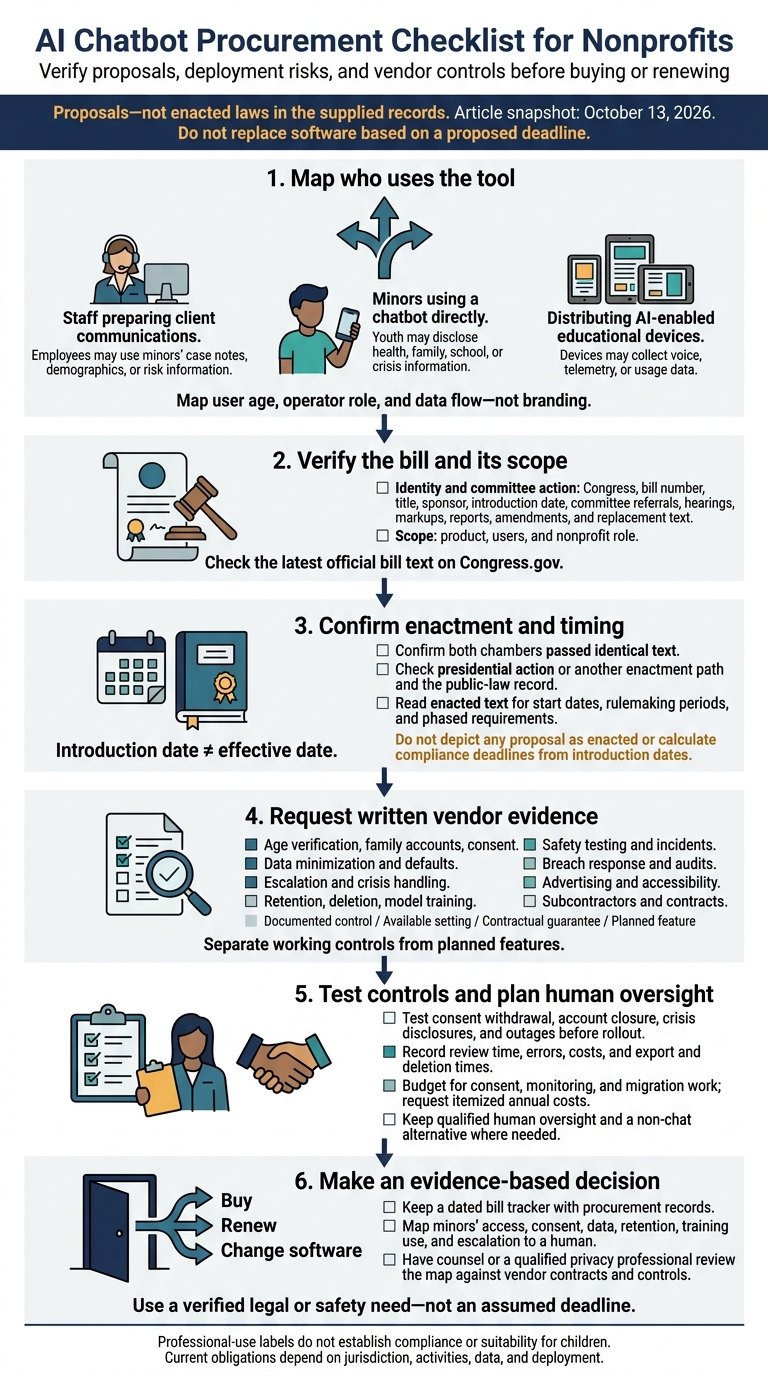
AI Chatbot Procurement Checklist for Nonprofits
1. CHATBOT Act (S. 4407)
Covered Users and Products
S. 4407 applies to AI chatbot providers that know a user is a child or teen. Coverage depends on the chatbot, the user’s age, and what the provider knows. The available text does not establish universal age verification.[7][13] This scope determines when the bill’s family-account and consent requirements apply.
Proposed Safeguards
Before allowing chatbot access for a known child user, providers would need a compliant family account. For known teen users, providers would need to give parental notice and obtain verifiable parental consent before creating an account or profile.[13] Congressional summaries also describe default protections and efforts to block obscene content and suicide assistance.[15]
Legislative Status
S. 4407 in the 119th Congress is the Children’s Health, Advancement, Trust, Boundaries, and Oversight in Technology Act, introduced on April 28, 2026.[7][12] Congress.gov lists its referral to the Senate Committee on Commerce, Science, and Transportation. On August 5, 2026, the committee ordered it reported with a substitute amendment. The introduced text sets an effective date one year after enactment.[7][12][14]
Nonprofit Purchasing Considerations
Ask vendors for proof that they support family accounts, parental verification, consent withdrawal, and exportable consent records. Contracts should spell out who handles consent collection and future rule changes.
Separate staff-only use from access by minors. Practitioner tools such as Personos support staff workflows, but staff-focused features alone do not satisfy S. 4407.[7][13] The next proposal shifts the focus from access controls to privacy and design rules.
2. Youth AI Privacy Act (S. 4199)
Covered Users and Products
S. 4407 focuses on access and consent. S. 4199 addresses disclosure, data use, and product design once a deployer knows a chatbot user is a minor. For nonprofits, the main questions are whether minors can access the chatbot and whether the deployer knows those users are minors.[16][17][19]
Proposed Safeguards
A covered deployer would have to tell minors, in plain, age-appropriate language, that they are not interacting with a human and that the chatbot’s content is AI-generated. This disclosure would appear at the start of every session and repeat at least every 30 minutes. The introduced bill also requires the FTC to issue implementing rules within one year after enactment.[16]
The proposal would restrict how a minor’s personal data can generate, personalize, or otherwise influence chatbot outputs. It would generally limit that use to the current session or a period set by the FTC. Available summaries also describe limits on ads, model training using minors’ data, and engagement or human-like design features. These include rewards, badges, push notifications, unsolicited outputs, and human-like cues.[16][18][21][22] For nonprofits, these rules are most relevant when reviewing data retention, personalization, and engagement features aimed at young users.
Legislative Status
Sen. Edward J. Markey introduced S. 4199 on March 25, 2026. It was referred to the Senate Committee on Commerce, Science, and Transportation. Committee records later reported that the bill was ordered favorably reported with a substitute amendment on August 5, 2026. The available congressional record does not establish enactment.[17][20][23]
Nonprofit Purchasing Considerations
Before buying or renewing software, ask vendors to show how they identify known minor users, display recurring disclosures, limit personalization and session memory, block youth-targeted ads and training on minors’ data, and disable engagement features.
Request written terms covering retention, deletion, access, audit logs, and data sharing. Separate features available today from those still planned. Treat these controls as purchasing criteria for possible future requirements, not proof of compliance with an enacted law.[16][18][21][22]
The next proposal shifts from privacy and design rules to broader access and consent mandates.
3. CHAT Act (H.R. 7218)
H.R. 7218, the Children Harmed by AI Technology Act (the CHAT Act), is a separate bill from S. 5154, the Senate’s CHAT Act 2.0.[8][24][27]
Covered Users and Products
The bill covers companion AI chatbots, not basic search tools, document summarizers, scheduling assistants, or staff-only automation.[8]
For nonprofits reviewing companion chatbots, the key question is whether minors can access the product, not whether it carries an “AI” label. The bill’s narrow scope matters because its requirements center on age verification and parental control.
Proposed Safeguards
Providers would have to request age information. If a user is identified as a minor, the provider would need to link that user’s account to a parent account verified through a commercially available or otherwise reliable method. Verifiable parental consent would be required before access.[8]
Providers would also have to monitor for suicidal ideation, offer appropriate resources, including National Suicide Prevention Lifeline contact information, and immediately notify the parent account holder. They would have to block minors from sexually explicit companion chatbots. Age data would be limited to what is needed for verification, parental consent, or compliance records.[8]
When evaluating software, nonprofits need proof of age checks, parent-account linking, consent collection, alert routing, and record retention. CHAT Act 2.0, discussed next, uses a different compliance model.
Legislative Status
Rep. Michael Lawler introduced H.R. 7218 on January 22, 2026. The bill was referred to the House Committee on Energy and Commerce, and Congress.gov lists it as introduced, not enacted. Its proposed requirements would take effect one year after enactment, not one year after introduction.[8][24][26]
Nonprofit Purchasing Considerations
Ask vendors for proof of parental verification, consent records, minor-account restrictions, and crisis-alert delivery. Check who receives alerts and how staff would respond if notifying a parent could endanger a child.[8][11]
Request documented retention periods for age-verification data, and separate working controls from planned features.[8][11] Nonprofits should ask about these controls now and make them contract requirements if the bill advances.
4. CHAT Act 2.0 (S. 5154)
S. 5154, the Children Harmed by AI Technology Act 2.0 (CHAT Act 2.0), is a separate Senate proposal from H.R. 7218. While H.R. 7218 focuses on parental linking and consent, S. 5154 adds limits on content, design, disclosures, and data use.[5][28]
Covered Users and Products
The proposal covers minors who use companion AI chatbots and the providers of those products. It does not cover all AI tools. Nonprofits should review each product’s intended use, conversational design, user age range, account structure, and vendor classification.[5][25]
Proposed Safeguards
Covered providers would need safeguards against promoting self-harm, suicide, or violence; sexually explicit communication with minors; presenting the chatbot as human or as a licensed medical or mental-health professional; and encouraging emotional dependency, including simulated romance with minors.[25]
Account applicants would provide age-assurance information, including their age and date of birth. Minor users would receive a clear disclosure that the chatbot is not human. For Tier I chatbots, the bill’s highest-risk category, providers would repeat that disclosure at least every 3 hours during a continuing interaction.[25][29]
The proposal also calls for parental controls to monitor and limit use, parent or guardian suicide-notification procedures, and limits on targeted advertising based on conversation content, inferred emotional state, or behavioral profiling. Selling, sharing, or transferring minors’ data to third parties would require verifiable parental consent.[29] This moves the focus beyond consent procedures to product design, changing what nonprofits need vendors to prove.
Legislative Status
As of October 13, 2026, the supplied congressional record lists S. 5154 as introduced. Sen. Jon Husted introduced it with Sen. Andy Kim on July 28, 2026. It was read twice and referred to the Senate Committee on Commerce, Science, and Transportation. Its requirements would take effect 180 days after enactment.[5][28][29]
Nonprofit Purchasing Considerations
For nonprofits, the key issue is vendor proof, not the product label. Ask for written evidence of companion-chatbot classification, age-assurance methods, safety and moderation tests, escalation paths, incident-reporting timelines, human oversight, and subcontractor details.
Also request data-flow diagrams, retention schedules, access and deletion controls, and evidence that age information is kept separate from conversation content. Plan a non-chat alternative for children who cannot complete age assurance.[25][29]
Nonprofits can use these controls to compare vendor readiness before any law takes effect. The next proposal, the SAFE KIDS Act, extends that comparison of consent, privacy, and design safeguards.
5. SAFE KIDS Act (S. 4855)
S. 4855, the Safeguarding AI Features to Ensure Kids’ Informed Digital Safety Act (SAFE KIDS Act), was introduced in the 119th Congress on June 23, 2026, by Sen. John R. Curtis. Sen. Adam Schiff is listed as a cosponsor.[30][31]
Covered Users and Products
The proposal covers providers of certain AI systems, including chatbots available to children in the United States. Unlike the earlier bills’ focus on consent workflows, SAFE KIDS centers on default treatment of users as children, audits, and advertising restrictions.
Under the bill, unverified users would be treated as children for covered restrictions. A nonprofit that purchases the software would not automatically qualify as the covered provider.[30][31]
Proposed Safeguards
Before a covered chatbot could be made available to children, the framework would require child-safety-by-design controls, parental settings, annual independent audits, and documented crisis-response protocols. It would also ban child-targeted ads and product placement, along with selling or sharing children’s personal information.[30][31]
Legislative Status
Congress.gov lists S. 4855 as introduced, not enacted. It records the bill’s referral to the Senate Committee on Commerce, Science, and Transportation on June 23, 2026.[32]
Nonprofit Purchasing Considerations
Ask vendors how they treat unverified users and whether conversations include child-targeted advertising or product placement. Also ask how parents find and use the available controls.
Request documented crisis-response protocols, independent audit summaries, and remediation records. Separate features that work today from those still planned.[30][31]
Next, H.R. 8382 narrows the focus to toys and child-care articles with chatbots.
6. H.R. 8382: Verify the Bill’s Identity and Scope
119th Congress H.R. 8382 is titled To prohibit the manufacture and conveyance of certain products for children that incorporate an artificial intelligence chatbot, and for other purposes. Rep. Blake D. Moore introduced it on April 20, 2026.[6][34] Check the Congress as well as the bill number: H.R. 8382 in the 117th Congress addressed unrelated immigration topics.[35]
Covered Users and Products
Unlike the earlier bills’ consent and design frameworks, H.R. 8382 targets children’s toys and child-care articles that incorporate an AI chatbot. It would prohibit their manufacture for sale, importation, sale, offering for sale, conveyance, or distribution in commerce.[6][33]
For nonprofit buyers, the product’s classification determines whether the bill applies, not simply whether a minor might use its chatbot. Staff-facing software would not automatically fall within these categories.[6][33]
Proposed Safeguards
The bill’s main safeguard is a product prohibition, not a parental-consent or chatbot-design framework. Violations would be treated as violations of Section 19 of the Consumer Product Safety Act.[6][37] That makes product classification the key purchasing question for nonprofits.
Legislative Status
Congress.gov lists H.R. 8382 as introduced, not enacted. It was referred to the House Committee on Energy and Commerce on April 20, 2026. The 180-day implementation period would begin only after enactment.[6][34][37]
Nonprofit Purchasing Considerations
Procurement teams should focus on classification rather than feature checklists. Ask vendors for a written determination that addresses whether the product meets the bill’s definitions of a children’s toy or child-care article, whether it incorporates an AI chatbot, and who controls its sale and distribution.[6][33]
Classify the product before considering replacement solely because it uses AI. Keep the vendor’s determination with the contract, and request exit terms in case the bill later blocks distribution.[6][33]
7. Protecting Kids from Human-Like Chatbots Act (H.R. 10719)
Covered Users and Products
Unlike earlier consent and privacy bills, H.R. 10719 focuses on chatbot behavior, not just access or data use. It shifts attention from age gates and data rules to how chatbots present themselves and frame emotional interactions. The bill covers consumer-facing AI chatbots that developers know, or should know, minors will use. An organization that both builds and distributes a chatbot could face duties in both roles.[36][38][41]
Proposed Safeguards
The proposal would require a separate default mode that does not present the chatbot as a person, starting with a minor’s first interaction. Safeguards would stay active across sessions and could not be bypassed through ordinary prompts or role-play. Restricted behaviors would include claiming human feelings, impersonating licensed professionals, and using guilt or emotional pressure to keep children engaged. In this mode, chatbots would identify themselves as AI at the start, periodically during long conversations, and whenever a child asks.[36][41]
Only parents or guardians could change the setting, with an exception for authorized educators using institution-provisioned accounts for legitimate educational purposes. The bill would direct NIST to work with industry and academic partners on voluntary guidance, testing standards, and examples of compliant behavior. It would also allow enforcement by the FTC and state attorneys general.[36][41]
Legislative Status
H.R. 10719 was introduced on October 1, 2026, and referred to the House Committees on Energy and Commerce and Science, Space, and Technology. It has not been enacted. Its core requirements would take effect one year after enactment.[10][36][39][40]
Nonprofit Purchasing Considerations
Buyers should check whether the chatbot stays non-human-like by default. Request tests showing that safeguards hold up against role-play, persona cues, and adult-like relationship dynamics across sessions. Also request disclosure records and records of permission to change settings reserved for adults. Clarify who handles suspected access by a minor: the proposal contemplates removal within 48 hours of confirmed knowledge or 14 days of reasonable suspicion.[36]
For Personos, separate staff guidance from any client-facing minor chat and confirm whether practitioner review is required.
Comparing Proposed Consent, Privacy, and Design Rules
The tables below separate verified bill provisions from questions nonprofits should ask when buying tools. The goal is to distinguish controls that matter now from those that may become mandatory later. Start with consent, then compare privacy, audits, and product design.
Family Accounts and Parental Consent
Age bands, exceptions, and consent procedures remain partly unverified.
| Issue | S. 4407: verified provision | S. 4199: verified provision | Nonprofit purchasing question |
|---|---|---|---|
| Age categories | Distinguishes children and teens; exact thresholds are not verified.[7][9] | Refers to minors; exact thresholds are not verified.[16] | Can the vendor configure separate age categories? |
| Accounts and consent | Requires a qualifying family account when the covered entity knows the user is a child; the bill’s stated purpose includes verifiable parental consent for teens.[7][9] | Sets design safeguards for entities making AI chatbots available to minors; account and consent procedures are not verified.[16] | Can youth enrollment record and retain the consent method, scope, date, and withdrawal status? |
| Exceptions and timing | Takes effect one year after enactment; exceptions are not verified.[9] | Exceptions and effective date are not verified.[16] | How would urgent access work without a confirmed exemption? |
Next, compare limits on data use and disclosure.
CHAT Act vs. CHAT Act 2.0
Check the bill number, text version, and section before relying on any “CHAT Act” compliance claim.
| Comparison point | H.R. 7218 | S. 5154 |
|---|---|---|
| Chamber and status | House proposal; introduction date and latest action are not verified | Senate proposal; introduction date and latest action are not verified |
| Chatbot definition and covered users | Not verified | Not verified |
| Age assurance, parental involvement, and minor-safety controls | Not verified | Not verified |
| Nonprofit relevance | Check whether staff-operated and client-facing tools fall within the definition. | Check covered-provider duties separately. Do not assume matching coverage based on the title alone. |
The next table moves from access rules to controls for settings, audits, advertising, and data.
Parental Controls, Audits, and Data Limits
S. 4855’s provisions on parental settings, independent audits, advertising, and data need section-level confirmation before they can count as comparison findings. The supplied material does not verify audit frequency, covered data, age thresholds, or exceptions.
| Reported S. 4855 safeguard | Evidence available for comparison | Vendor evidence to request, not a confirmed duty |
|---|---|---|
| Parental settings | Requirements are not verified; S. 4407 takes a different, account-based approach.[9] | Demonstration of permissions and access revocation |
| Independent audits | Requirement, frequency, and independence standard are not verified | Audit scope, assessor independence, and remediation records |
| Child-targeted advertising limits | Specific limits and exceptions are not verified | Advertising configuration for youth-facing deployments |
| Sale or sharing of children’s information | Covered information and exceptions are not verified | Data-flow diagram and contractual restrictions on secondary use |
The last comparison addresses product-based bans and rules for human-like behavior.
Children’s Products and Human-Like Chatbots
Coverage under these bills depends on product type and actor role, not simply whether a chatbot is present. A nonprofit’s role as buyer, distributor, or operator determines which rules may apply. Supplying a tool alone does not establish that the organization is a covered actor.
| Proposal | Verified coverage and remaining gaps | Nonprofit implementation question |
|---|---|---|
| H.R. 8382 | Product scope is not verified here | Is the organization a customer, distributor, or covered provider? |
| H.R. 10719 | Operative sections are not verified here | Can the vendor document which product behaviors and organizational activities trigger coverage? |
| S. 4199 | Sets design safeguards for entities making AI chatbots available to minors.[16] | Can the vendor document who makes the chatbot available: the vendor, nonprofit, or partner institution? |
Nonprofit Software Purchasing: Trade-Offs and Vendor Evidence
Separate the nonprofit’s duties from changes its vendor may make. A proposal may cover a nonprofit that operates a chatbot. Or it may mainly regulate the vendor, which could affect prices, contracts, access, and settings. The supplied records do not confirm enactment or complete legislative status. Treat the unverified effects below as purchasing questions, not legislative findings.
The table translates those bill differences into questions to ask before buying software.
| Proposal | Possible protection if enacted | Potential work and cost | Software-selection question | Unresolved coverage |
|---|---|---|---|---|
| CHATBOT Act, S. 4407 [7][9] | Family accounts; verifiable parental consent for teens | If covered: account setup and consent records; vendor-driven verification fees and access limits | Can the vendor support guardian-linked accounts and revocable consent? | Nonprofit-operated systems, institutional accounts, staff-mediated access, age distinctions |
| Youth AI Privacy Act, S. 4199 [16] | Limits on profiling and model training with minors’ data | If covered: data-use review; vendor-driven training exclusions, contract changes, feature limits | Can minors’ data be excluded from training and profiling disabled? | Definitions, exceptions, covered deployers, case-management and educational uses |
| CHAT Act, H.R. 7218 [8][11][26] | Age verification; minor-user protections | If covered: access procedures; vendor-driven verification fees and support needs | How does the vendor handle verification errors and methods users cannot access? | Companion-chatbot definitions and excluded uses |
| CHAT Act 2.0, S. 5154 | Scope and status unresolved; no bill-specific purchasing estimate yet | Not established | Can the vendor cite the bill text and version? | Definitions, duties, exceptions |
| SAFE KIDS Act, S. 4855 | Scope and status unresolved; no bill-specific purchasing estimate yet | Not established | Are controls available now or only planned? | Covered actors and safeguards |
| H.R. 8382 | Scope and status unresolved; no bill-specific purchasing estimate yet | Not established | Can the vendor identify the Congress, text, and product scope? | Identity and coverage |
| H.R. 10719 | Scope and status unresolved; no bill-specific purchasing estimate yet | Not established | Which behaviors, if any, are covered? | Behaviors, actors, exceptions |
Use these questions to screen vendors. The next section separates current obligations from features that could help prepare for future rules.
Current Duties vs. Preparation for Proposed Rules
Current obligations depend on jurisdiction, activities, data, and deployment, not nonprofit status alone. Stronger controls can reduce risk, but they also add verification, staffing, data, and accessibility burdens. Ask for itemized annual costs. Budget for consent, monitoring, and migration work rather than assuming youth safeguards come with the software.
| Review area | Check current duties | Prepare for possible rules, not a current mandate |
|---|---|---|
| Privacy and consent | Applicable privacy, health, education, and consent requirements | Minor-facing access and consent workflows |
| Safeguarding and access | Safeguarding, accessibility, and employment policies | Restricted defaults, human handoff, accessible verification |
| Records and incidents | Retention, legal holds, breach-notification obligations | Export, deletion, incident logging |
| Contracts and funding | Vendor terms and grant conditions | Feature road maps, change notices, migration pricing |
Vendor Evidence for Workflows Involving Minors
Use this checklist for staff workflows and direct minor use. For each response, identify whether it describes a documented control, an available setting, a contractual guarantee, or a planned feature.
Before rollout, test consent withdrawal, account closure, crisis disclosures, and outages. Record review time, errors, costs, and how long exports and deletions take.
| Evidence to request | Staff use involving minors’ information | Additional checks for direct minor use |
|---|---|---|
| Age verification, family accounts, consent | Staff permissions and approved data uses | Verification accuracy, accessible alternatives, guardian changes, withdrawal records |
| Data minimization and defaults | Necessary fields, encryption, access controls | Restricted defaults, purpose limits, separation of sensitive information |
| Escalation and crisis handling | Staff override and review procedures | Warning signs, human handoff, response targets, emergency limitations |
| Retention, deletion, model training | Schedules, exports, backups, legal holds; treatment of prompts, profiles, files | Account closure, consent withdrawal, training restrictions |
| Safety testing and incidents | Red-team summaries, bias testing, release-change records | Age-appropriate tests, incident logs, remediation |
| Breach response and audits | Notification commitments, assessments, audit rights | Youth-incident responsibility and corrective action |
| Advertising and accessibility | Profiling practices and accessibility documentation | Advertising restrictions, accessible consent and interfaces |
| Subcontractors and contracts | Hosting locations, subprocessors, ownership, confidentiality, insurance, indemnification | Service levels, deletion certification, change notice, termination assistance |
Personos vs. General-Purpose Chatbots
Personos focuses more specifically on helping professionals, according to its vendor descriptions. Its staff-facing workflows may reduce fit problems for nonprofit teams. That focus, however, does not establish compliance, clinical effectiveness, suitability for children, or the ability to respond to crises without human involvement. Keep qualified human oversight.
For nonprofit staff workflows, a purpose-built platform such as Personos is easier to assess against role-specific needs than a general-purpose chatbot. It still requires proof tied to the intended deployment.
| Criterion | Personos | General-purpose chatbot vendors |
|---|---|---|
| Intended users | Helping professionals and nonprofit staff | Broad consumer, business, education, or developer audiences |
| Personality and relationship context | Five Factor Model-based profiles, conversational guidance, relationship-specific insights | Contextual conversation; personality modeling and relationship tools vary |
| Transparency and outputs | Customized Dynamic Reports, Prompts, situation-specific guidance; verify generation, review, and correction methods | Explainability, provenance, admin controls, and review tools vary |
| Action tracking | ActionBoard for client progress and practitioner goals | May require separate systems or integrations |
| Privacy | Require documented data use, retention, deletion, access, training, and subprocessors; vendor descriptions alone are not proof | Review product-specific terms, configuration, training, retention, and subprocessors |
| Age verification | Confirm direct minor-use support and controls; professional focus alone does not establish suitability | Verify age checks, parental consent, minor defaults, and family accounts |
| Contract assurances | Written confidentiality, deletion, incident, audit, training, subcontractor, and feature-change commitments | Equivalent product- and deployment-specific commitments |
Hypothetical Nonprofit AI Uses
Coverage depends on operator role, user age, and data flow, not branding. The examples below show how duties can change when different people use or control the same tool.
Hypothetical deployments - not reported outcomes:
Hypothetical use Users and information Coverage question Vendor evidence Human oversight Staff preparing client communications Employees drafting messages with minors’ case notes, demographics, or risk information Are uploads allowed, is training disabled, and what retention and confidentiality rules apply? Data-processing terms, no-training and deletion controls, access logs, encryption, subprocessors, breach commitments Verify accuracy, minimize data, approve every message, handle safeguarding decisions Minors using a chatbot directly Youth disclosing health, family, school, or crisis information Which proposal covers the product, and what age, consent, monitoring, and advertising rules apply? Age-verification documentation, family accounts, consent records, minor defaults, safety tests, crisis protocols, retention limits, incident history Supervise access, explain limits, review escalations, provide human referrals or emergency intervention Distributing AI-enabled educational devices Children using devices that collect voice, telemetry, or usage data Is the nonprofit a distributor, operator, purchaser, or service provider? Who controls accounts and consent? Which device and cloud providers are involved? Device and software data maps, parental controls, update policies, advertising limits, accessibility, security tests, deletion, warranties, subcontractor terms Set controls, educate families, monitor incidents, maintain a non-AI alternative
Conclusion: Check Bill Status Before Changing Software
Before changing software, verify the bills and treat these measures as proposals, not federal law. If a bill’s identity or scope is unclear, check the official text before assuming a restriction applies.
Use this official-source checklist before making a procurement decision:
- [ ] Identity and committee action: On Congress.gov, confirm the Congress, bill number, title, sponsor, introduction date, committee referrals, hearings, markups, reports, amendments, and replacement text.
- [ ] Scope: Check whether the text covers the product, its users, and the nonprofit’s role.
- [ ] Enactment: Confirm that both chambers passed identical text. Check presidential action or another enactment path, along with the public-law record.
- [ ] Effective dates: Read the enacted text for start dates, rulemaking periods, phased requirements, and any reported 180-day period, including for S. 4855.[42][30]
Keep a dated bill tracker with your procurement records. Before switching software, map minors’ access, consent, data, retention, use of data for training, and escalation to a human. Have counsel or a qualified privacy professional review that map against vendor contracts and controls. Use a verified legal or safety need, rather than an assumed deadline, as the basis for any software change.
FAQs
Could our nonprofit be considered a chatbot provider?
How the rules apply depends on how you deploy AI tools. Using a platform like Personos to guide staff during client interactions in real time generally makes your nonprofit a user, not a chatbot developer or provider [1][2].
If you build, host, or offer your own proprietary chatbot interface to clients or the public, proposed congressional rules may apply. These proposals are not enacted laws. Consult legal counsel about the specific legislative definitions.
How should we handle conflicting parental-consent and confidentiality duties?
Keep conversations private by default. Share only the minimum information needed, and only with explicit consent. Don’t import or disclose child-related information without parental consent. When consent covers specific parties, share only high-level details that help everyone involved, not complete sensitive data.
Personos encrypts conversations and keeps them visible only to the user. It never shows scores to others unless the user explicitly shares them. [1][2]
Which AI safeguards should we prioritize on a limited budget?
Put privacy and protection against data misuse first. Choose providers that don’t train models on your data. Replace names and contact details with placeholders before AI processing [1][2], keep sensitive scores hidden by default, and use strong encryption for stored information [1][3].
Personos offers these protections, plus safeguards against malicious use. That makes it a more secure alternative to tools that expose detailed personality data to leadership or team members [1][4].