How AI Builds Trust in Difficult Relationships
Explains how personality-driven AI gives real-time coaching to help social workers and counselors build trust in high-stakes interactions.
Nick Blasi

How AI Builds Trust in Difficult Relationships
AI is transforming how professionals connect with people in challenging situations. Tools like Personos use personality insights based on the Five-Factor Model to offer real-time communication strategies. This approach helps social workers, counselors, and coaches navigate complex interactions where trust is hard to establish. Instead of relying on generic methods, AI tailors advice to individual personality traits, making conversations more effective and empathetic.
Key takeaways:
- AI platforms like Personos analyze personality traits (Openness, Conscientiousness, Extraversion, Agreeableness, Neuroticism) to guide communication.
- They provide real-time coaching for high-pressure scenarios, such as trauma or addiction counseling.
- Features include personalized reports, prompts, and actionable strategies to improve outcomes.
- Personos ensures privacy and transparency, keeping personality data confidential and explaining the reasoning behind recommendations.
AI isn't replacing human judgment but supports professionals in handling emotionally charged situations with better understanding and precision.
Why Trust is Difficult in Challenging Relationships
Common Barriers in High-Stakes Interactions
Trust is built when one person takes the risk of being vulnerable, expecting the other to act in their best interest [2]. Without this foundation, relationships can stagnate. This becomes even more pronounced in situations where professionals prioritize efficiency, while clients seek a more personal and empathetic approach.
Take, for example, a social worker conducting an intake assessment. To the social worker, it might feel like a routine task - gathering necessary data. But for the individual being assessed, it can feel deeply intrusive, as if their entire life is under scrutiny [3]. This disconnect often leads to tension. Research involving over 80,000 participants across more than 160 studies highlights that people tend to resist impersonal approaches in situations requiring human sensitivity, even when the professional demonstrates clear expertise [3].
Jackson G. Lu, Associate Professor at MIT Sloan, explains this dynamic:
"Just because people perceive an AI technology as more capable than humans does not mean they will adopt it. They also care about personalization. If either one of these conditions is not satisfied, then people exhibit an aversion to AI" [3].
The same logic applies to human interactions. A case manager might excel technically, but if their communication feels impersonal or overly mechanical, trust is unlikely to form. These challenges underscore why traditional, manual methods often struggle to meet the demands of trust-building.
Where Manual Communication Approaches Fall Short
Traditional approaches to trust-building lean on three pillars: benevolence, integrity, and ability [2]. However, many professionals tend to emphasize their ability - showcasing their credentials, expertise, and achievements - believing that competence alone will inspire trust. In high-stakes scenarios like crisis intervention or substance abuse counseling, this assumption often backfires. People are hesitant to trust someone who feels emotionally detached, no matter how skilled they may be [2].
It’s important to recognize that trust and trustworthiness are not the same [2]. A counselor might be reliable, accurate, and well-meaning - qualities that make them technically trustworthy - but if their approach lacks empathy, trust will not develop. Even the most precise methods fall short when they fail to include the emotional signals that foster connection [2]. As Jacovi et al. [2] put it:
"Trust is built when the trustor can anticipate the trustee's behavior to know if it matches its desires."
Without this sense of predictability and alignment, relationships struggle to take root. The gap highlights the importance of personalized and adaptive communication strategies that go beyond technical competence.
How AI Uses Personality Data to Tailor Communication
The Science of AI-Powered Personality Analysis
AI platforms rely on the Five Factor Model (Big Five) to analyze behavior and communication patterns. This model evaluates five key personality traits: Openness, Conscientiousness, Extraversion, Agreeableness, and Neuroticism (OCEAN) [4][6][7]. Instead of rigidly categorizing people, it places each trait on a spectrum. For example, tools like Personos measure 30 traits on an 80-point scale, offering insights into how individuals process information, handle stress, and respond to feedback.
A study of 18 large language models showed that instruction-tuned models, such as GPT-4o, are the most effective at mimicking human personality traits. This makes them particularly useful for crafting personalized guidance [5]. In simulated negotiations, traits like Agreeableness and Extraversion significantly influenced an AI agent's credibility and ability to achieve goals [6]. By mapping these traits in detail, AI can predict which communication strategies will best connect with a person’s unique personality profile. This creates opportunities for dynamic, real-time engagement.
Real-Time Personalization for Resistant Individuals
Armed with detailed personality insights, AI can adapt its communication style on the fly. Traditional personality assessments require professionals to interpret results and develop strategies over days or weeks. AI, however, eliminates this delay by offering real-time coaching during interactions [1].
These systems evaluate both the professional's traits and the client’s personality to tailor advice for specific dynamics. For instance, if a case manager is working with someone high in Neuroticism - who might view interactions as threatening - the AI could recommend slowing the conversation, using calm language, and simplifying the information being shared [7].
This approach tackles a common issue: under stress, professionals often struggle to adapt their communication style effectively. They may become reactive and lose the ability to personalize their responses. Mike Walker, Executive Leadership Coach at Dynamic Decisions Coaching, highlights the benefits of AI in these situations:
"Personos helps clients organize often overwhelming amounts of mental and physical information to make better, creative, more informed decisions that incorporate their values and preferences" [1].
The Different Types of Trust | Why Trust Matters in AI with Bruce Schneier
Personos: An AI Platform Built for Trust-Building
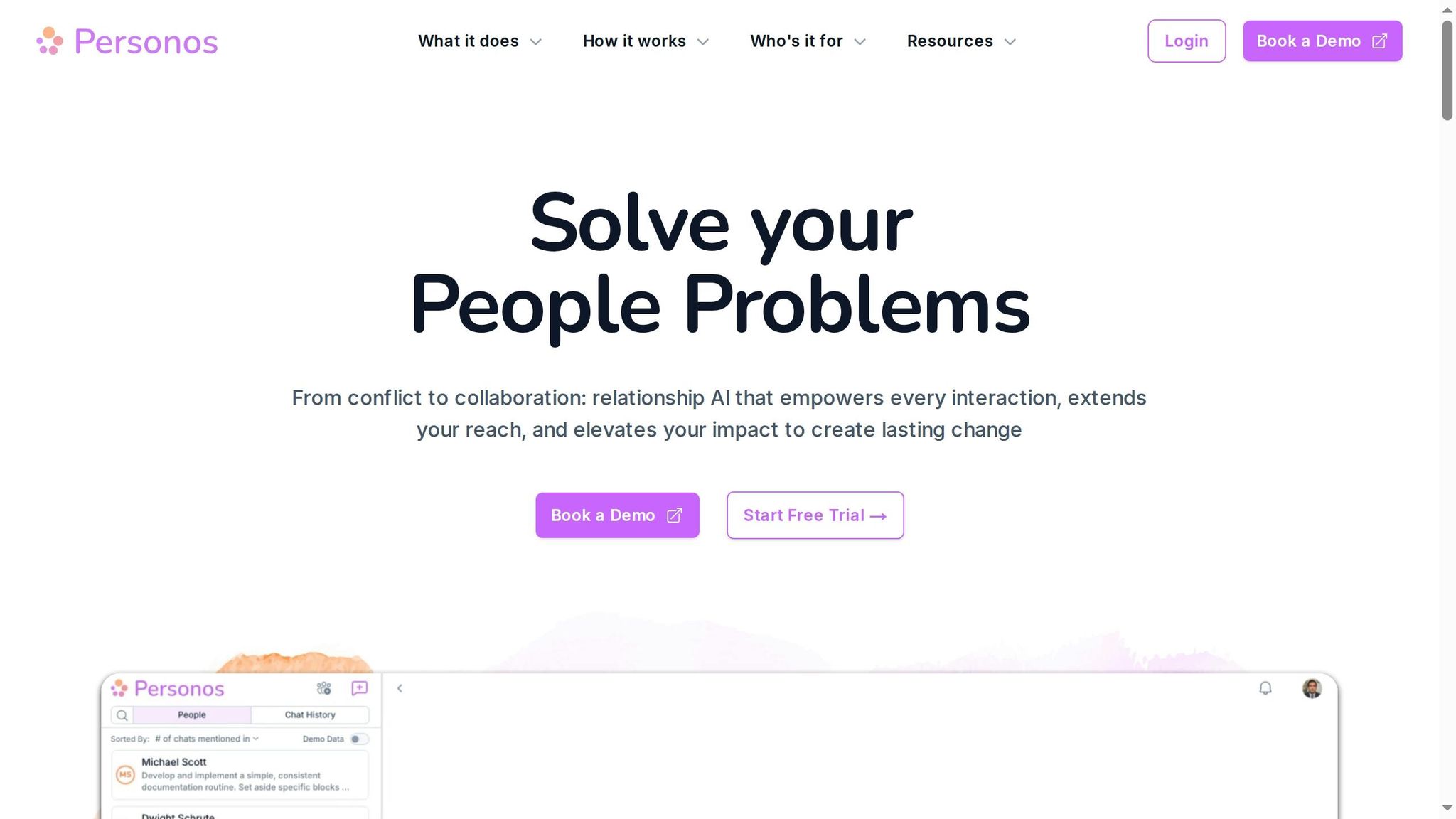
Personos (https://personos.ai) takes a fresh approach to addressing trust-building challenges by leveraging detailed personality data to create actionable communication strategies. Unlike typical AI chatbots, Personos relies on the Five-Factor Model to provide tailored recommendations, helping professionals like social workers, case managers, coaches, and counselors navigate complex human interactions with greater empathy and effectiveness.
Launched in November 2025, Personos represents a shift in AI from focusing solely on efficiency to fostering meaningful connections. CEO Christian Thomas puts it this way:
"AI has made us more efficient in how we work and communicate, but not smarter about how we connect with people. We built Personos to change that, turning personality science into everyday guidance that helps people see and understand one another, rebuild trust, communicate, and solve problems with empathy."
- Christian Thomas, CEO and Co-Founder, Personos [1]
This approach addresses a critical gap. While many AI tools automate tasks, they often lack the depth to provide personality-specific feedback. Personos bridges this gap by making advanced personality insights - once reserved for top executives - available to professionals managing emotionally intense and high-stakes situations. This unique foundation sets Personos apart in the AI landscape.
Key Features of Personos for Building Trust
Personos empowers professionals with four core tools designed to enhance trust and communication:
- Personos Chat: Offers real-time coaching for challenging interactions. For example, a social worker dealing with a resistant client can describe the situation and receive immediate, tailored advice on adjusting their communication style or managing tension effectively. This capability is particularly effective for real-time crisis communication.
- Dynamic Reports: Delivers customized insights for individuals, relationships, and groups, incorporating relevant context like case notes and goals. These reports adapt as situations evolve. For instance, a practitioner working with a trauma survivor might receive strategies tailored to address coping mechanisms and resource readiness.
- Prompts: Provides ongoing support by sending concise, actionable insights at scheduled intervals. A coach might get daily reminders on how to motivate a specific client based on their Conscientiousness and Openness scores, with options to adjust or regenerate the advice as needed.
- ActionBoard: Transforms insights into actionable tasks with a single click, making it easy to track progress. This feature is invaluable for documenting outcomes and demonstrating impact to funders and stakeholders, ensuring that personality insights translate into measurable results.
In November 2025, Steve Huff, PhD, Founder of THRiVE Coaching, incorporated Personos into programs supporting individuals facing terminal illness, trauma, addiction, and housing instability. He emphasized the platform's role in these high-pressure environments:
"Personos isn't just technology, it's a teaching partner. A constant criticism of AI is that it makes us dumber. To the contrary, Personos helps make our members smarter about how they communicate, how to mitigate challenges, and the opportunities available to them for more successful outcomes."
- Steve Huff, PhD, Founder, THRiVE Coaching [1]
Transparent Reasoning and Privacy Protection
For AI tools to truly earn trust, they need to do more than provide accurate recommendations - they must also be clear about how those recommendations are made. Personos addresses this by prioritizing transparency and safeguarding privacy.
The platform explains the reasoning behind its guidance, detailing which personality traits and psychological principles were factored into its recommendations. This not only builds practitioner confidence but also serves as a teaching tool, enhancing users' understanding of personality-driven communication.
Privacy is another cornerstone of Personos. Individual personality scores are kept confidential and are never shared with managers, coaches, or colleagues without explicit consent. This ensures that assessments remain tools for personal growth rather than judgment, avoiding the risk of reducing individuals to simplistic labels.
Mike Walker, Executive Leadership Coach and Founder of Dynamic Decisions Coaching, highlighted how this transparency and privacy support decision-making:
"Personos helps clients organize often overwhelming amounts of mental and physical information to make better, creative, more informed decisions that incorporate their values and preferences, as well as those with whom they are interacting."
- Mike Walker, Executive Leadership Coach and Founder, Dynamic Decisions Coaching [1]
How Personos Compares to Other AI Platforms
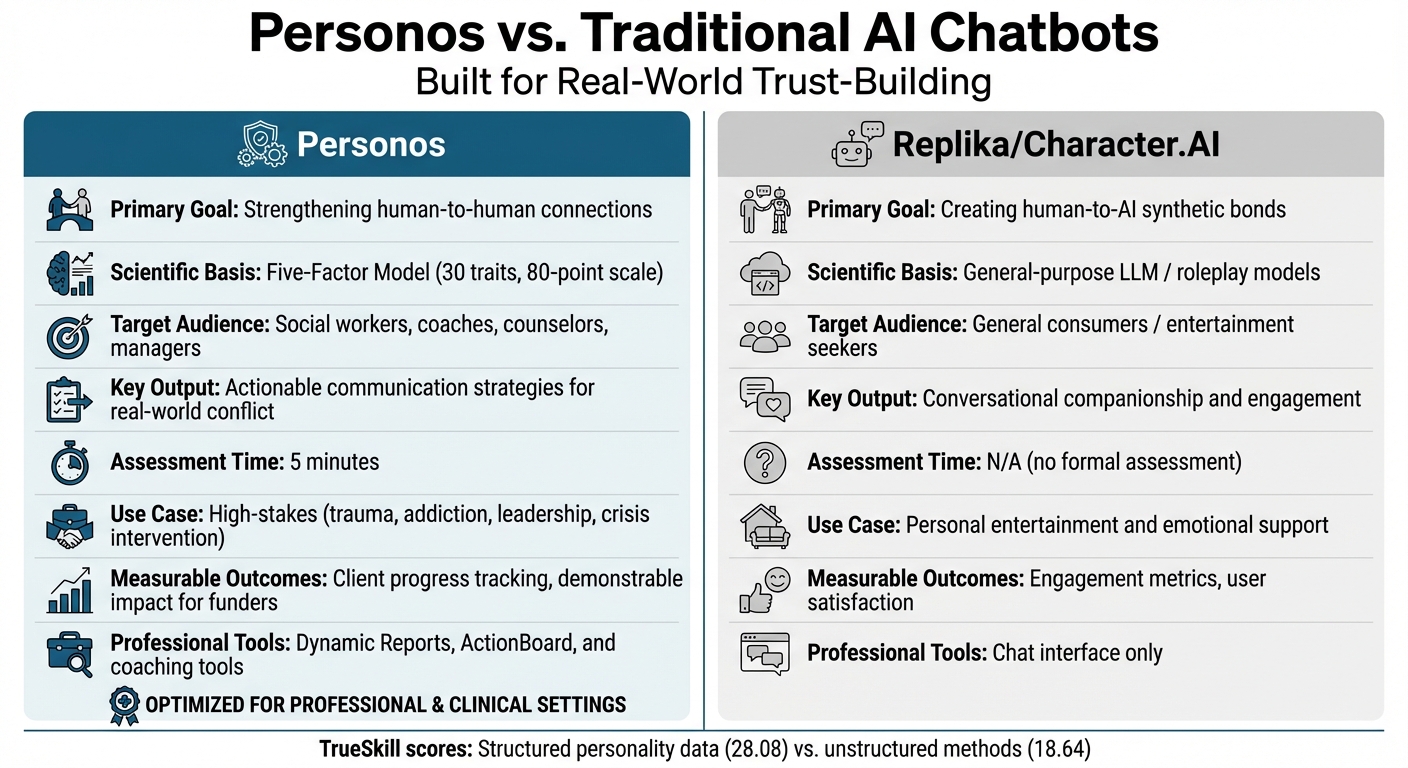
Personos vs Traditional AI Chatbots: Feature Comparison for Trust-Building Professionals
AI platforms aren't all built with the same goals in mind, especially when it comes to trust-building. Platforms like Replika and Character.AI are popular for offering conversational companionship. However, their focus is on creating synthetic bonds between users and the AI itself rather than improving real-life human connections. That’s where Personos stands apart - it’s designed to enhance human-to-human relationships in real-world situations, not just interactions with technology [1].
What truly separates Personos is its scientific approach. Instead of relying on generic conversational context like many chatbots, Personos uses the Five-Factor Model to assess 30 personality traits on an 80-point scale [1]. This method provides grounded, reliable insights, which are essential for professionals handling sensitive or high-pressure scenarios - whether it’s managing a client in crisis, giving constructive feedback to a defensive colleague, or supporting someone through a traumatic experience.
Research backs up the importance of structured personality data. For instance, in strategic reasoning tests, personas built using structured data achieved TrueSkill scores as high as 28.08, while less structured methods scored as low as 18.64. Additionally, heuristic approaches contributed to less than 10% of annotation variance in certain NLP datasets [8]. These findings highlight the reliability of Personos compared to less structured AI systems.
Comparison Table: Personos vs. Competitors
| Feature | Personos | Replika / Character.AI |
|---|---|---|
| Primary Goal | Strengthening human-to-human connections | Creating human-to-AI synthetic bonds |
| Scientific Basis | Five-Factor Model (30 traits, 80-point scale) | General-purpose LLM / roleplay models |
| Target Audience | Social workers, coaches, counselors, managers | General consumers / entertainment seekers |
| Key Output | Actionable communication strategies for real-world conflict | Conversational companionship and engagement |
| Assessment Time | 5 minutes | N/A (no formal assessment) |
| Use Case | High-stakes (trauma, addiction, leadership, crisis intervention) | Personal entertainment and emotional support |
| Measurable Outcomes | Client progress tracking, demonstrable impact for funders | Engagement metrics, user satisfaction |
| Professional Tools | Dynamic Reports, ActionBoard, and coaching tools | Chat interface only |
For professionals working in high-stakes environments, generic conversational AI isn’t enough. Personos offers role-specific customization and insights grounded in science, making it a valuable ally for serving vulnerable populations. As Steve Huff, PhD, aptly put it, Personos acts as a "teaching partner" rather than just another piece of technology [1].
The contrast is clear: science-based, tailored AI tools like Personos are better equipped to foster trust and provide meaningful support in challenging situations.
Results and How to Implement AI Trust-Building
Real-World Results of AI-Driven Trust-Building
AI platforms designed around the Five-Factor Model are turning behavioral science into practical tools that enhance human connections and reduce conflict. What was once exclusive to top executives or elite athletes - deep personality insights - is now accessible to professionals like social workers, counselors, and coaches who handle high-pressure situations every day.
The impact is clear. These tools don't just improve individual interactions; they also tackle broader issues like burnout and cognitive overload. By tailoring communication to individual personality traits, they can make delivering feedback to a defensive colleague or motivating a resistant individual far more effective. As Christian Thomas, CEO and Co-Founder of Personos, explains:
"AI shouldn't just help people be more efficient but help people truly listen and understand each other better to foster connection and create impact."
This shift in communication lays the groundwork for seamlessly integrating tools like Personos into your daily workflow.
5 Steps to Add Personos to Your Workflow
You don’t need to overhaul your current process to start using Personos. The setup is quick, and the platform is ready for immediate application. Here’s how to get started:
- Complete the personality assessment: This quick assessment establishes a foundation for personalized communication. Using the Five-Factor Model, it generates a profile that explains how individuals process information and cope with stress.
- Explore the insights dashboard: The dashboard gives a clear view of potential communication opportunities and areas where conflicts might arise, helping you focus your trust-building efforts where they matter most.
- Leverage real-time coaching tools: Before tough conversations, use features like contextual prompts, adaptive reports, and interactive chat tools to prepare feedback or strategies tailored to the other person’s personality.
- Implement tailored strategies: Adjust your tone, timing, and approach based on personality dynamics - whether you're working with someone facing trauma, addiction, or resistance to change.
- Proactively address friction points: Use the platform to spot and resolve issues before they escalate. As Steve Huff, PhD, Founder of THRiVE Coaching, puts it:
"Personos isn't just technology, it's a teaching partner... Personos helps make our members smarter about how they communicate, how to mitigate challenges, and the opportunities available to them for more successful outcomes."
The goal is to see AI as a supportive partner, not a replacement for human judgment. By keeping control in your hands, you can ensure your communication stays genuine and aligned with your values. Over time, this approach not only enhances your expertise but also builds your confidence in managing even the toughest relationships.
Conclusion
Earning the trust of individuals who are naturally guarded can be a tough hurdle to overcome. Traditional approaches often fall short when navigating the complexities of human behavior. That’s where AI platforms like Personos come into play, offering personality insights tailored for professionals who need precise, actionable guidance.
What sets Personos apart is its focus on strengthening human connections. Using the Five-Factor Model, it delivers real-time coaching that helps professionals adapt their communication style to match the personality traits of the person they’re engaging with. This personalized approach leads to better feedback reception, reduced resistance, and stronger trust - even in challenging scenarios involving trauma, addiction, or housing instability.
Nick Blasi, Co-Founder and COO of Personos, captures the essence of this approach perfectly:
"Personos gives people the confidence to communicate with empathy, not just efficiency. It's about using AI to strengthen the skills that make us human" [1].
Rather than replacing human judgment, Personos enhances it. By organizing vast amounts of information and easing cognitive strain during critical moments, it empowers professionals to make better decisions in real time.
For those managing demanding caseloads, tools like Personos offer a lifeline. They help extend your capacity without compromising the quality of care, alleviate burnout, and provide measurable results to share with funders and stakeholders. With AI-driven insights, professionals can turn potential conflict into meaningful collaboration, ensuring every interaction truly makes a difference.
FAQs
How does AI use personality traits to build trust faster?
AI uses personality traits to fine-tune communication, helping to build trust more effectively. For example, platforms like Personos rely on the Five Factor Model to assess traits like openness and agreeableness. With this analysis, they provide real-time guidance tailored to individual preferences.
This approach minimizes misunderstandings, responds to emotional cues, and ensures interactions feel more relevant. By focusing on these personalized elements, AI creates more genuine and empathetic connections, fostering trust faster than traditional, uniform communication methods.
What data does Personos need, and who can access it?
Personos employs personality insights rooted in the Five Factor Model, evaluating 30 traits on an 80-point scale. This approach captures behavioral tendencies and communication preferences, providing actionable insights for building trust and resolving conflicts effectively.
Access to Personos is limited to qualified professionals, such as social workers, coaches, and counselors. Privacy is a top priority, with strict measures in place to ensure sensitive information is handled securely. The goal is to enhance outcomes without compromising personal data.
How do you use Personos during a real, high-stress conversation?
During intense or high-pressure conversations, Personos offers real-time AI-powered insights to help you navigate the situation with ease. With its conversational AI chat, you can receive personalized advice tailored to the personalities involved and the context of the discussion. Use the actionable prompts it provides to manage emotions, ease tensions, and keep the conversation productive. Plus, the Dynamic Reports feature helps you adjust your communication style on the fly, building trust and creating better results in difficult interactions.