Guide to Adaptive Leadership in Nonprofits
Diagnose whether issues are technical or adaptive, run short learning cycles, protect frontline voices, and build governance for change.
Rachel Johnson

Guide to Adaptive Leadership in Nonprofits
Most nonprofit change efforts fail because people treat a people problem like a process problem. If your team keeps fixing the same issue, the work may not be about better procedures. It may be about changing how staff, boards, and partners think, decide, and work together.
Here’s the short version:
- Use the right diagnosis first. Ask: is this a fixable task problem, or a people-and-values problem?
- Don’t rush to the expert answer. Some issues need learning, not just instructions.
- Watch the system before acting. Look for stuck decisions, avoided topics, power patterns, and stress points.
- Keep pressure steady. Too little, and nothing changes. Too much, and people shut down.
- Give the work to the people closest to it. Frontline voices often see the problem first.
- Use short test cycles. Try small moves, review results, then adjust.
- Build this into board work and team routines. One leader cannot carry change alone, which is why many use AI-powered leadership coaching to scale their impact.
One stat says a lot: 70% of large-scale change programs miss their goals, mostly because leaders miss the behavior and people side of change.
If I were leading a nonprofit through funding swings, burnout, or trust issues, using AI tools for helping professionals to manage the workload, I’d focus on one challenge at a time, run small tests, and measure learning alongside results. That’s the core idea of this guide.
Reimagining Impact: Adaptive Leadership and Strategic Innovation for Nonprofits, Part 1
What adaptive leadership means in a nonprofit context
In a nonprofit, adaptive leadership helps teams deal with problems shaped by competing stakeholder needs, limited resources, and long-term change. Instead of pushing every answer from the top, it moves the work closer to the people living with the challenge every day. In practice, that often means balancing the needs of boards, funders, staff, volunteers, and the community.
Adaptive work shows up when old success patterns no longer fit current conditions and values start to clash. A job title alone doesn't make someone a leader. Leadership is something people do, and anyone can exercise it[1].
Technical problems vs. adaptive challenges
The first step is simple but easy to miss: figure out whether you're dealing with a technical problem or an adaptive challenge before you act. A technical problem has a known fix. Put the right expert on it, and it can be solved. An adaptive challenge is different. People have to change how they think, work, or relate to each other, and no outside expert can do that work for them[1][3]. In nonprofits, these challenges often show up as stalled collaboration, low trust, or pushback on program change.
A useful way to apply this framework is to separate problems you can fix from problems people need to work through:
| Situation | What it is | Leader's role | Good first step |
|---|---|---|---|
| Compliance reporting error | Technical: solvable with existing expertise | Delegate to the right person | Assign staff to correct the data |
| Grant dependence (short-term funding gap) | Technical (short-term): a gap in immediate funding | Secure bridge funding | Apply for emergency grants |
| Mission drift or staff burnout | Adaptive: requires shifts in values and behavior | Hold the space; ask hard questions | Step back and diagnose the system |
| Declining community trust | Adaptive: involves complex stakeholder loyalties | Facilitate collective listening | Hold community listening sessions |
Sometimes a quick fix helps. But when the same problem keeps coming back, that's often a sign you're not dealing with a simple technical issue. You're dealing with something deeper.
That distinction also helps you decide when adaptive leadership fits and when another approach makes more sense.
Adaptive leadership vs. other leadership approaches
Not every nonprofit problem calls for adaptive leadership. Different situations call for different approaches, and good leaders know the difference. The table below shows how each approach works in changing nonprofit settings:
| Leadership approach | Best use case in nonprofits | Strengths | Limits | What the leader focuses on |
|---|---|---|---|---|
| Adaptive | The problem is uncertain; stakeholders disagree; no ready-made solution | Builds long-term resilience; solves problems expertise can't | Slow in true emergencies; can cause discomfort | Helping people face and solve their own challenges |
| Transformational | Need for a new organizational vision | High inspiration; creates momentum | Can paper over deep behavioral issues with temporary excitement | Inspiring belief in a compelling future direction |
| Situational | Individual skill gaps; managing specific tasks or new volunteers | Highly flexible; adjusts to each person's readiness | Focuses on task execution rather than systemic change | Adjusting style to match what each person needs |
| Positional/Traditional | Routine operations; crisis management; compliance | Efficiency, clarity, and quick execution | Fails when solutions are unknown or require genuine buy-in | Providing protection, direction, and order |
Once you can tell which kind of problem is in front of you, the next move gets clearer. You can diagnose the system, manage distress, and spread the work across the people who need to be part of solving it.
Core adaptive leadership principles nonprofit leaders can use daily
Once you know you're dealing with an adaptive challenge, the day-to-day work has to change too. The point is to build habits that stop you from reaching for a fast fix every time pressure shows up.
Diagnose the system before you act
Before you do anything, step back and look at the whole system. Heifetz calls this "getting on the balcony" - seeing the patterns, power structures, and loyalties that shape behavior.
One useful habit is to set aside time each week to watch how decisions actually get made in your organization, not just how people say they get made. Pay attention to the conversations people dodge, who goes quiet in certain meetings, and what the organization seems determined to protect, like long-held routines or assumptions no one has questioned in years.
If the same problem keeps coming back after a fix, that's a strong sign you're not dealing with a technical issue. You're dealing with something adaptive.
Manage distress and keep focus on the real work
Adaptive challenges are uncomfortable. You can't lead through them by making all tension disappear. The job is to keep enough pressure in the system for change to happen without pushing people into shutdown.
That balance matters a lot in behavioral health, social services, and community outreach, where teams are already carrying a heavy emotional load. Say the losses out loud, whether that's routine, status, or even part of someone's sense of self. Then, when the team starts drifting toward easier technical tasks, pull attention back to the harder adaptive question.
Share responsibility and protect frontline voices
Frontline staff are often the first people to notice the gap between stated values and day-to-day practice. If you protect those voices, it becomes much easier to see the challenge for what it is.
A simple way to do that is to use an observe-interpret-intervene cycle. Gather input. Pause before jumping to conclusions. Then act with care. That small pause can stop a team from following the loudest person in the room and lead to responses that match what's happening on the ground.
Shared ownership also means giving the work back in steps people can handle. Tools like Personos can support that process with personality-aware guidance that helps leaders tailor communication, bring quieter voices into the conversation, and build trust.
These habits work best when the organization's systems support them.
Building adaptive capacity across your organization
Individual habits don't stick for long unless the system around them backs them up. That's why adaptive leadership needs to live inside day-to-day operations, not rest on one leader trying to hold everything together.
Governance, learning loops, and planning agility
When leaders learn to spot adaptive challenges, the next move is simple: build systems that can respond fast.
A lot of nonprofit boards still run on annual planning cycles. That can work when things are steady. But it starts to break down when policy shifts in the middle of the year, funders change direction, or community demand jumps with little warning.
Adaptive governance spreads decision-making across roles and levels [4]. Compared with more fixed governance models, it moves faster, brings in more voices, and relies on repeated planning instead of one big annual plan. One practical way to start is with a small rapid-response subcommittee. Give that group one unstable area to watch, like policy change or funding risk, and have it report back on a regular basis [4].
It also helps to plan for uncertainty before it shows up. Map out a few likely scenarios, such as a funding cut, a spike in demand, or a policy reversal, then decide how your team would respond [4]. That kind of prep can keep people grounded when things suddenly change.
After a major project or crisis, set aside 30 to 60 minutes for a short review. Talk through what you expected, what actually happened, and what to change next time. When teams do this often, they learn together and are less likely to repeat the same mistakes.
Partnerships, peer learning, and leader development
No nonprofit builds this kind of capacity on its own. A lot of it comes from outside relationships and shared learning.
Coalitions and shared services can lighten the load and open up more space for strategy. Peer learning circles can do the same. When leaders talk openly about real problems, not polished success stories, practical answers tend to surface faster.
"Organizational resilience starts with adaptive leadership..." - Robena Spangler, Senior Executive, Social Current [2]
For individual leader growth, reflective practice matters. Simulations, role-playing hard conversations, and structured personal reflection help build the self-awareness adaptive leadership calls for [2]. These are not soft add-ons. They're part of the prep work that helps leaders avoid reaching for a technical fix when the problem calls for an adaptive response.
Where tools like Personos fit into capacity building
Digital tools can help when they make it easier for staff to deal with complex people issues without piling on more admin work.
As nonprofits put more into team development, the right tools can extend team capacity without adding workload. Personos uses the Five Factor Model to provide real-time, situation-specific guidance, Dynamic Reports, prompts, and ActionBoard tracking for helping professionals.
The comparison below shows a few practical differences:
| Feature | Generic AI Coaching Tools | Personos |
|---|---|---|
| Personality framework | Basic type-based models or none | Five Factor Model (30 traits, 80-point scale) |
| Context awareness | Generic advice | Incorporates case notes, relationship history, and goals |
| Reports | Static, one-size-fits-all | Dynamic, regenerated as context evolves |
| Progress tracking | Limited or none | ActionBoard with milestone tracking |
A step-by-step roadmap for leading change and innovation in nonprofits
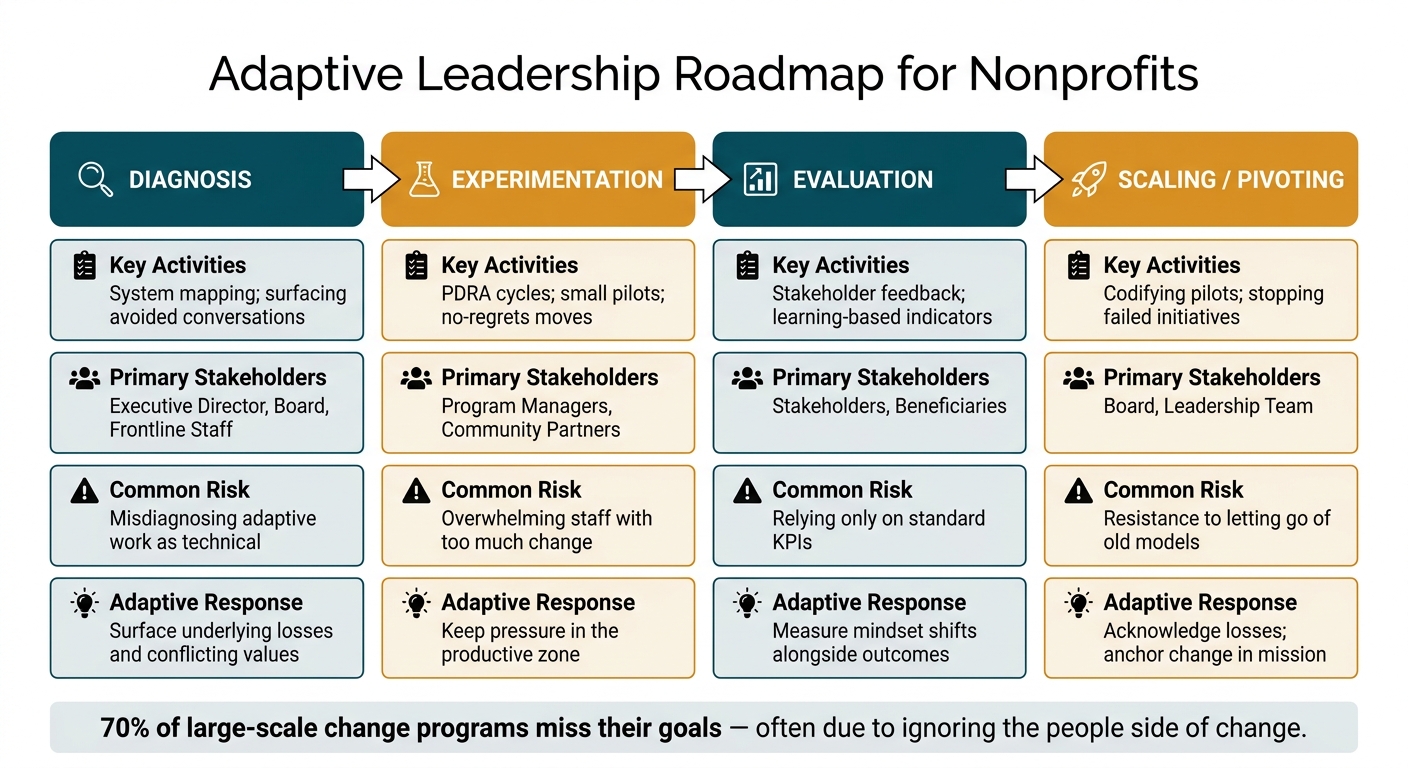
Adaptive Leadership Roadmap for Nonprofits: 4 Stages of Change
Once your organization has the ability to learn and adjust, the next move is simple: take on one change effort at a time.
Assess readiness and pick one adaptive challenge to start
Start by stepping back and looking at the whole system. Where do decisions get stuck? Who has the most sway over those decisions? Which topics keep getting dodged in meetings?
That view usually points to the hardest problems. These are the issues that don't budge with a standard fix, or the places where there's a clear gap between today's reality and the future your organization wants.
Choose just one of those challenges to start with. That narrow focus makes the work easier to handle and helps staff avoid getting pulled in too many directions at once.
Run short learning cycles and small-scale experiments
Once you've picked the challenge, move into small tests fast instead of trying to launch a full solution all at once.
Don't build the entire answer upfront. Run short Plan–Do–Review–Adapt (PDRA) cycles instead. These are brief rounds of testing that help your team learn without tying up scarce time, money, or staff capacity [4].
A good example comes from a mental health nonprofit dealing with shifting Medicaid policies. The organization set up a rapid-response board subcommittee to hold monthly policy briefings and reshape services based on real-time client demand and state funding updates [4]. The setup was simple: a small group, a clear lane of responsibility, and regular review.
Keep the work grounded in no-regrets moves. And watch the pressure level. You want enough tension to push action forward, but not so much that people freeze or burn out.
Conclusion: The key shifts that make adaptive leadership work
Adaptive leadership doesn't depend on a bigger budget or a larger team. It depends on seeing problems differently and sharing the work of solving them. At its core, that means separating technical work from adaptive work before acting, diagnosing the system before jumping to fixes, managing distress on purpose, protecting frontline voices, and building learning systems that get better over time.
Those shifts tend to show up across four stages:
| Stage | Key Activities | Primary Stakeholders | Common Risks | Adaptive Response |
|---|---|---|---|---|
| Diagnosis | System mapping; surfacing avoided conversations | Executive Director, Board, Frontline Staff | Misdiagnosing adaptive work as technical | Surface underlying losses and conflicting values |
| Experimentation | PDRA cycles; small pilots; no-regrets moves | Program Managers, Community Partners | Overwhelming staff with too much change | Keep pressure in the productive zone |
| Evaluation | Stakeholder feedback; learning-based indicators | Stakeholders, Beneficiaries | Relying only on standard KPIs | Measure mindset shifts alongside outcomes |
| Scaling/Pivoting | Codifying pilots; stopping failed initiatives | Board, Leadership Team | Resistance to letting go of old models | Acknowledge losses; anchor change in mission |
Nonprofits keep adaptive change going when they treat learning as part of the job, share responsibility with the people closest to the problem, and put systems in place that make the next round of change easier.
FAQs
How do I know if a problem is adaptive or technical?
Ask whether the problem can be solved with existing know-how and known procedures. If yes, it’s technical.
If fixes keep falling short and the issue touches beliefs, values, identity, or behavior change, it’s adaptive. Common signs include resistance to change, repeated setbacks, or people slipping back into old habits.
What should I do first when my nonprofit faces an adaptive challenge?
First, diagnose the problem to see whether it is technical or calls for people to change how they think and act.
Ask a simple question: does this issue have a known fix, or does it require the organization and its stakeholders to shift beliefs, behaviors, or values?
That difference matters. Problems with a known fix can often be handled with technical answers. But when the challenge asks people to learn, adjust, and do things differently, a technical fix alone won’t do the job. Those situations call for shared learning and behavior change across the group.
How can we use adaptive leadership without burning out staff?
Use leadership that manages pressure and spreads responsibility across the team. Instead of trying to fix every problem on your own, set up the right conditions so staff can help handle hard challenges without burning out.
Also, give the work back to the people, pay close attention to emotional responses, and support a learning culture built on collaboration, experimentation, and open communication. That can ease stress and help people stay engaged.